Monday, May 15, 2023

Bite-Sized Bios Show Up in Search Results!


I've been writing bite-sized bios of ancestors in my family tree and my husband's family tree and posting to multiple websites. Why? Because LOCKSS (lots of copies keeps stuff safe). I don't want these ancestors' names and lives to be forgotten in the future . . . posting brief bios now is part of my plan to keep family history safe for today and tomorrow.

Earlier today, I did an online search for my husband's paternal grandfather, James Edgar Wood (1871-1939), and my bite-sized bios turned up in the first 40 search results. As shown above, this includes both WikiTree profiles and Find a Grave memorial pages!

Not only are bios an excellent way to memorialize ancestors, they also serve as very good cousin bait. Anyone who clicks on these two results will see me as the page manager and be able to send me a note. I've posted bite-sized bios on FamilySearch and other genealogy websites as well.

Little by little, I'm continuing my bite-sized bio project, also memorializing siblings/spouses/in-laws of my ancestors, and making sure to include those who had no descendants. 

Saturday, May 13, 2023

Honoring Moms in Family History


Happy Mother's Day, with much love, to all the Moms 
in our family, past and present! 

To make your own word cloud, try this free word cloud generator. I chose a heart shape and selected four colors, four fonts, and a variety of weights for my list of names from the family tree. 

Wednesday, May 10, 2023

Grandpa Teddy: Born in Ungvar, Hungary

My immigrant grandpa, Theodore "Teddy" Tivador Schwartz was born on May 12, 1887 in what was then the bustling market town of Ungvar, Hungary. Today that town is known as Uzhhorod, Ukraine.

Teddy was the first in his family to leave their hometown and cross the Atlantic to New York City, in 1902. He encouraged his older brother Sam to come through Ellis Island in 1904. The two brothers saved their nickels and brought a younger sister, Mary, to New York soon afterward.

So often, documents list only a country as birthplace. A surprising number of Teddy's documents specifically name his actual hometown, including the passenger manifest for the SS Moltke, his Declaration of Intention to become a naturalized US citizen (left), his NY State affidavit for license to marry, his Social Security application, and his WWI and WWII draft registration cards. Dated from 1902 through 1951, all of these documents show Teddy's birthplace as Ungvar, Hungary.

[Note: The document shown here has the incorrect year for Teddy's travel across the Atlantic. The actual passenger manifest is dated 1902. Always look at the original if possible!]

I knew and loved this Grandpa, who lived with our family after his wife (my Grandma Hermina Farkas Schwartz) died in 1964. Teddy died just before his 78th birthday, on May 12, 1965. You're in my thoughts, dear Grandpa, and I'm doing everything I can to keep your memory alive for the future--including putting your photo and name in a family history coloring book for the youngest descendants.

Friday, May 5, 2023

Prepping for the 1931 Canadian Census Release on June 1


More Census excitement for genealogists! The release of the 1931 Canadian Census is scheduled for June 1, 2023. Embargoed for 92 years, this Census will give us a window into so many demographic changes in Canada between the post-war 1921 Census and the Depression-era 1931 Census. 

Dave Obee, Canadian Census expert

Dave Obee, author of Counting Canada: A Genealogical Guide to the Canadian Census, is prepping for the 1931 release and helping us with posts on his informative website, CanGenealogy.com. For instance, he lists all the Census questions on his site here

Initially, there will be NO index. But Dave shows how to get ready by finding a residential address and district for each ancestor, so we'll be able to browse the Census documents by location when released. 

Of course, if you want to wait for the index, Canada is working with Ancestry and FamilySearch to index by AI technology. This will take months, but we'll eventually be able to search the 1931 Census the same way we can already search earlier Census documents.

Hubby's ancestors, by residence and in context

My husband had three great uncles in Canada (the three Slatter brothers, all military band masters), and I had a great uncle and cousins in Canada during that period. You know I'll be browsing for them by address, based on my notes about addresses found in city directories and their 1921 Census locations.

Once you find your ancestor in Canada, and record all the relevant details from the Census form, don't forget to put the ancestor into social and historical context. If your ancestor is working, that would be in contrast to the growing unemployment problem triggered by the Depression, for example.

I'm looking at the Dominion Bureau of Statistics Publication here (pdf in French or English), which summarizes findings of the 1931 Census and compares results to earlier Censuses. Since most of hubby's Slatter ancestors were in Canada by 1901, I can see context decade by decade and in 1931 specifically.

Above, one table showing the number and percentage of males and females who were single, married, widowed, or divorced as reported in the Canadian Censuses from 1871-1931. The number and percentage of divorced men and women began to rise after 1901, as shown. Also, the number of single individuals dropped as the number of married individuals increased steadily over the years. I'll compare my hubby's ancestors to these statistics for a bit of context.

I'm looking forward to Thursday, June 1st, when the 1931 Canadian Census is made public.

More great tips are on Ken McKinlay's blog as well, with links to resources that will help us prep for the release. Don't miss his take on this exciting Census release.

UPDATE: Since Ancestry indexed this Census very quickly, I haven't yet had to use addresses to locate my ancestors. Plus hints are now showing up on my Ancestry trees!

Wednesday, May 3, 2023

Really Brief Bite-Sized Bios From WikiTree Connect-A-Thon


During the weekend of April 21-24, I was one of 749 people who participated in the WikiTree Connect-A-Thon. The goal was to add as many ancestors as possible to WikiTree's free shared family tree, with a minimum of one source and a bit of biographical content. The camaraderie was wonderful and I enjoyed the opportunity to really concentrate on documenting ancestors during a defined time period. This is part of my plan to share family history across multiple platforms.

An amazing 76,995 ancestors total were added to WikiTree during the weekend. I added 107 ancestors, mostly from the paternal side of my family--especially in-laws of in-laws who were not represented at all on WikiTree but now are there.

Given the limited time I could spend on each profile, the bios were brief, more like a teeny nibble than bite-sized ;). It helps that WikiTree automatically weaves together a few facts into a narrative biography, based on what the user inputs on each profile.

The bio in the image above is representative of what I had time to write during a busy weekend of genealogy: This man was born in ___, son of ___ and ___, WWII military service, occupation, name of wife, number of children with her, death. Plus two specific sources, including one with a link to this ancestor's Find a Grave memorial page. WikiTree shows, at a glance, the names of his parents and his wife and sibling.

In the coming weeks, I'll be revisiting the new profiles to flesh them out with better bios and additional sources/links. And of course I'm continuing my bite-sized family history bio projects with posts on other genealogy websites. 

Tuesday, May 2, 2023

So Many Sites to Memorialize Ancestors


After 25 years of genealogy research, I've learned a lot about my ancestors--and I want to be sure this information isn't lost in the years to come.

For the past few years, I've been writing bite-sized ancestor bios and posting on key genealogy sites. The idea is to share family history more widely, and bios are also possible cousin bait. 

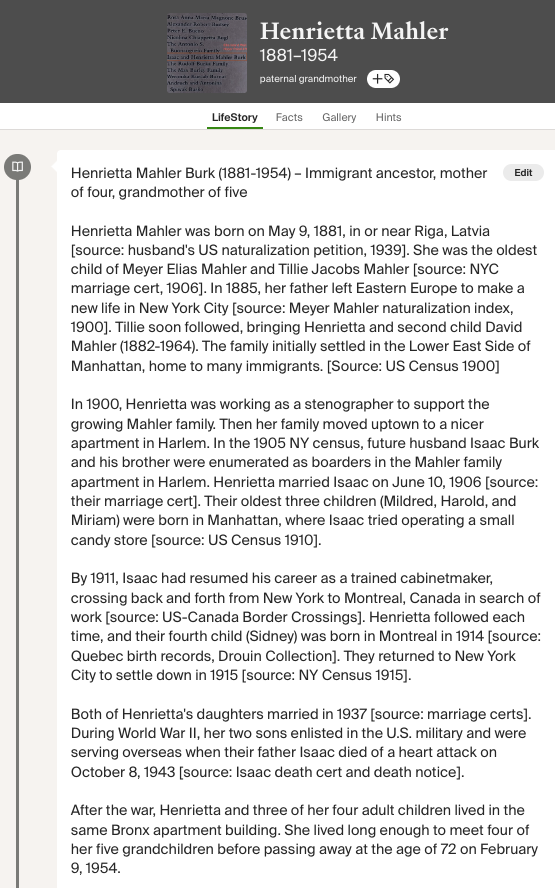
Above, four websites where I've posted the same bio and photo of my paternal grandmother, Henrietta "Yetta" Mahler Burk (1881-1954). 

Clockwise, from top left:

WikiTree is a free collaborative tree site that's growing fast and has the added benefits of sources and (if you wish) DNA connections. I also appreciate the ability to link to profile pages for each parent, each child, each spouse, each sibling. Plus WikiTreers are a friendly bunch!

MyHeritage.com is a subscription site that designates a place on each ancestor profile for a biography. If you want to learn more about how to post a bite-sized bio on MyHeritage, please read my article in the Knowledge Base. Bonus: MyHeritage has many nifty photo tools for enhancing/repairing/colorizing old family photos.

FamilySearch.org came online in 1999 and is the world's largest free collaborative tree site. Grandma Henrietta is well represented with photo, bio, research. A great site, and I'm glad that MyHeritage includes FamilySearch tree results when I research my ancestors.

Find a Grave, now owned by Ancestry, is another free place to post ancestor bios. I especially like that the 226 million+ memorial pages from this site are indexed and appear in search results on Ancestry, Family Search, Fold3, and more. 

Reader Diane asks whether I'm going to use Ancestry's new Storymaker Studio or MyHeritage's DeepStory for telling ancestors' stories. I tried DeepStory, and found it engaging but I do need more experimentation to refine the story and choose the right ancestor photo. It would intrigue the younger generation, but it can't be put on the bookshelf like a photobook, ready at any time for any audience. So far, I haven't yet tried Storymaker Studio but it's on my list to investigate this year.


PLUS: On Ancestry, there is a convenient space under "LifeStory" to type or paste in a full bio! I just did that for Henrietta Mahler Burk, as shown above. Another great way to share family history in narrative form.

Happy 142d birthday, Grandma Yetta, on May 9th. Your name, face, and life story are not forgotten! I'm currently creating a professional photobook about you and Grandpa Isaac, as a keepsake for your grandchildren and great-grandchildren.

Friday, April 28, 2023

Bird-Brain Pets in Family History


Living in a New York City apartment, my parents felt we had no space or time for four-legged pets. But we did have a parakeet, always blue, always a boy! 


Directly above, Maxie, sitting on the shoulder of "Aunt" Lee Wallace, the life partner of my Auntie Dorothy Schwartz.

At top of post, you can see Tyrone, another parakeet pet, sitting on "Sha," the favorite doll of my niece. That niece, now grown up with a family of her own, has two big dogs she dearly loves.

Back in the day, my sisters and I got a kick out of our bird-brain pets, teaching them to speak intelligent phrases like "Stupid birdie." 

"Pets" is the week 18 prompt from Amy Johnson Crow's genealogy challenge, #52Ancestors. 

Thursday, April 27, 2023

Turning the FAN Club into the FANI or FANIL or KFAN Club

Over the 25 years of my genealogy journey, I've learned to investigate friends, associates, and neighbors (FAN Club) of ancestors to try to understand any relationships, familial and otherwise. More than once, I discovered that a "family friend" or neighbor was actually a relative.

What about rechristening the FAN Club as the FANI Club, to explicitly include in-laws? OR call it FANIL Club (for in-law, maybe FANI is not the best acronym). OR KFAN (for Kinfolk)!

Many of my hubby's Larimer ancestors settled in Indiana in the 1800s. A good number intermarried with men and women from the McKibbin family, the Short family, and the Work family. Investigating the in-law situation helped me untangle the cousin connection and recognize naming and marriage patterns in multiple generations.

As a result, I've come to suspect that these families were related in some way across the pond, well before they left for America. Some of the obits hint at that, and some of the old newspaper coverage of family reunions a century ago make that claim. No proof yet, but intriguing to investigate by scrutinizing in-laws.

Currently I'm looking at a family genealogy book (digitized and available for browsing or download via FamilySearch) called: "A family history of Murrays, McKibbins, Smiths, Planks, Neffs, and related families of Elkhart and LaGrange Counties in Indiana." As shown in the excerpted index, these families intermarried with Larimer folks, including some of my hubby's Larimers. 

The detailed index is a huge help, so I can focus on one Larimer at a time. I've already found a couple of fresh leads to follow and confirm through additional research. 

My takeaways: (1) do look at in-laws in the family tree, because some may actually be cousins or descendants of confirmed cousins; and (2) do check for digitized genealogy books in the Family Search collection.

Friday, April 21, 2023

Free Talks at Virtual Genealogical Association Birthday Party - April 22


On Saturday, April 22, the Virtual Genealogical Association is throwing a Zoom birthday party and everyone is invited! 

Here's the schedule and a link to register to see lots of FREE talks about family history.

My live talk about Find a Grave and cousin bait begins about 9:25 am Eastern. 

Speakers, prizes, trivia. Please give it a try...did I mention this special virtual event is free?!

Thursday, April 20, 2023

Bite-Sized Family History: Upgrading to Professional Photobooks

For the past decade, I've been compiling bite-sized family history booklets to share facts, stories, and photos with my relatives. Choosing a specific focus helps me manage each project so it doesn't become overwhelming for me or my readers.

Now I'm in the process of converting my many paper-based family history booklets into professionally-produced photobooks, one at a time. In the past, I had a local copy shop print my bite-sized booklets in color on heavyweight paper, then I put them into a plastic sleeve or a binder for each recipient. But I've noticed the earlier booklets are becoming worn looking, pages getting creased and torn. Some of the thinner booklets have been lost in the shuffle. 

I'm ready to upgrade, little by little. Why pay more for a professional photobook?

  • Professional photobooks are much higher quality, more polished looking. The photos are sharper, the layouts more sophisticated. 
  • Professional photobooks will far outlast my previous paper-based booklets. 
  • Professional photobooks can be customized so photos are larger or smaller, text areas carry more words, headlines are in different colors, etc. The creative possibilities are endless.
  • Professional photobooks impress my readers more than the paper-based booklets. I found this out with my small (6 inch by 6 inch) photobook about ancestors in World War II. Readers responded very enthusiastically!
  • Remember: Watch for discounts and sales. Some photobook sites announce discounts for major holidays...others offer free "extra pages" or other specials. Shop around and see which site meets your needs.
At top, the cover of my latest bite-sized project in progress, a photobook (8 x 11 inches) about my Mom and her twin sister. I first created this in paper booklet form two years ago. Transformed into a photobook, it will be a more durable keepsake that readers can page through again and again for years to come.


Plus I finally know the names of all the people in all the photos so my captions will be more complete! An older cousin reached back into her memory to identify the two "mystery children" in the above photo as part of the FAN club (friends, associates, neighbors), not relatives. We also dated the photo after carefully studying the apparent ages of the kids. 

Redoing my family history into a professional photobook offers an opportunity to correct, add, subtract, and focus. Everyone is identified by full name AND I inserted info from the 1950 US Census, among other changes. The paper-based booklets looked quite good, but these look really great.

Without question, photobooks are much more costly than paper booklets. For me, after 25 years of researching my family tree, it's a worthwhile investment in memorializing ancestors for the long term--but let me stress again that I wait for a sale to order. Actually, I'll first order a single copy to see how the book looks. Then I can either tinker or reorder for all my readers (on sale of course). 

--

Bring Family History Alive in Bite-Sized Projects is one of my genealogy presentations--learn more here.

Saturday, April 15, 2023

Bite-Sized Ancestor Bios: Ideas from #GenChat


Last night and this morning, the #GenChat topic (on Twitter and Mastodon) was "Bite-Sized Ancestor Bios." To stimulate conversation as guest expert, I created a series of questions that participants answered in tweets or toots. Here's a recap--lots of ideas and food for thought! No right or wrong answers. "Everyone deserves to be remembered" as GenChat host Christine says. 

#GenChat Ice-breaker: Have you written any ancestor biographies, bite-sized or not?

Comments: Most folks have written at least a few ancestor bios. A bite-sized bio, no matter how brief, is more informative than no bio at all. One person said this was a good way to document both genealogy research and family lore (more about "lore" later). Several have been blogging ancestor bios for some time. Someone self-published the detailed bio of an ancestor after years of research. A few pointed to their growing number of bios on WikiTree profiles. 

One participant started with bullet points to get the ball rolling. Sometimes bios can be time-consuming if cross-reference related ancestors, research, etc. Preparing to write a bio, someone noted sources, research plans, timeline. What do you need to know before writing?

There was discussion about how short or long a bite-sized bio might be. Depends on the space available, what you know about an ancestor, the attention span of your audience, how much you want to include or need to include to help others understand that ancestor. 

Q1: What are the pros and cons of bite-sized bios?

Pros: the ability to commemorate an ancestor, preserve something of that person's life, humanize that person. Quick to research/write, quick for audience to absorb without getting overwhelmed. Interesting ancestor anecdote might spark interest among family members. Main facts at least summarize ancestor's life, putting in highlights and context adds dimension. Especially for ancestors without descendants and those who died quite young, a way to keep their memories alive. 

Cons: Difficult to choose what to include/exclude. Room for stories? Or just a teaser to capture interest, build excitement? If it's too brief, is it just a story about one episode in ancestor's life? Only include unproven "family lore" if room for explanation/proof, to avoid having anyone copy unproven info and perpetuate it. (My thought: label it clearly as "family story" or "family legend" so it will be remembered even if not proven, because adds color and personality--mention if any facts contradict or might maybe possibly tend to confirm but not actually prove.) If large family tree, might have a lot of bios to write, so prioritize (see later question). 

Q2: What to include, what to exclude in bite-sized bios?

Starting points to consider including: basic facts (birth, marriage, death); family situation/relationships; occupation; one or more notable highlights (good or bad). Also: migration, religion, military, cause of death.

Consider excluding: full names/data about living people, to protect privacy; info that could be hurtful or otherwise cause problems for living people; disclosing something consequential family doesn't know in an ancestor's bio. Keep info in your files for future if not include now.

Q3: When you know a little about an ancestor, how do you create a bite-sized bio? When you know a lot about an ancestor?

Comments: Harder to write when we know a lot because must decide on focus, such as occupation or an award/honor or whether ancestor was known/close to relatives still alive. What makes that ancestor "newsworthy" for the audience? What do we most want our audience to know? General outline might include: birth, parents, spouse/kids if any, residence, interesting fact, date of death (maybe cause). Focus on a theme if possible, breaking down into bite-sized chunks.

When we know a little: "Elevator pitch," set a goal for a small number of sentences. Mention in bio what you don't know, creates a bit of drama. Choose specific focus to do a deeper dive: occupation (specifically that person or in general type of occ that person had), immigration, schooling (or lack).

If on WikiTree, try the automatic bio generator here. It uses factual data entered by user (birth date, death date, etc) woven into narrative form, bite-sized bio that can be enhanced at later date if you want.

Q4: How can you share bite-sized bios with family and more widely?

Comments: Profiles on WikiTree and other genealogy platforms; in blog posts; in a book or letter or handout; at reunion; in family Facebook group; on family chat thread; on a family or surname or genealogy website; email to relatives; submit to selected libraries/archives/genealogy societies; post as "memory" to FamilySearch; on family calendar, one ancestor per month; posting on social media with visual to attract interest (or ask for help identifying more faces); send in cards on relatives' birthdays; during video calls, audio calls; as captions for photos; on Find a Grave, Fold3, other sites that are searchable; on ornaments, maps, more.

Q5: How do you set priorities for bite-sized ancestor biography projects?

Comments: Create a list (or spreadsheet) of ancestors you want to write about, some with bite-sized bios and some with longer bios. Or prioritize direct ancestors, followed by siblings/spouses of direct ancestors, first cousins of direct ancestors, etc. Or pick one generation to start. Or a single family to profile. Or write about ancestors you never met. Or be spontaneous, depending on which ancestor or line "calls" to you. Try to write regularly, maybe one bio a week or whatever fits your schedule.

Want to participate or follow along during #GenChat on Twitter or Mastodon?

Schedule is 2d and 4th Friday of every month on Twitter, then Saturday morning on Mastodon. For more, see the GenChat website.

#GenChat on Twitter: @_genchat

#GenChat on Mastodon: @genchat@lor.sh

Tuesday, April 11, 2023

How My Immigrant Grandparents Signed Their Names


Some of my immigrant grandparents had lovely, flowing handwriting when signing their names...others wrote more haltingly.

Maternal grandparents

At top, the 1911 signature of my Hungarian-born maternal grandfather, Theodore Schwartz (1887-1965), on his US naturalization cert. He arrived at Ellis Island, alone, at the age of 14. In New York, Teddy initially worked as a runner for steamship lines. I'm sure he put his name to many documents then and later as owner of a small dairy store in the Bronx, NY. His formal education stopped early, but he had an ear and affinity for languages. He also regularly wrote to his son and daughter serving in the military during World War II.

Above, the 1911 signature of my Hungarian-born maternal grandmother, Hermina Farkas (1886-1964). She was 24 years old when she signed this marriage license to wed Theodore Schwartz. Another flowing, cursive signature. She signed lots of paperwork during her life, helping her husband Teddy run their dairy store. She was, for a year or two, secretary of the Farkas Family Tree (formed by herself and her siblings) and signed the monthly meeting minutes. 

Paternal grandparents


Here's the signature of my paternal grandpa, Isaac Burk (1882-1943), on his World War II draft registration card. Born in Lithuania, Isaac came to North America at the age of 21. He was a self-employed carpenter and cabinetmaker. Isaac's signature looked halting, but was recognizable. On his 1906 marriage certificate (see below), he was transitioning to a more "Americanized" version of his name. The signature reads "Isaak Berk" but the official name on the document was "Isaac Burk" on this and all subsequent documents.


My paternal grandma, Henrietta Mahler (1881-1954) was born in Latvia and arrived in New York before she was 10 years old. She and Isaac Burk married in 1906, and it's clear that her signature was less halting than his, as shown on this marriage license. Henrietta (nicknamed Yetta in the family) wrote letters and sent packages to Isaac's cousins in Manchester, England, during and after World War II. How do I know? The cousins wrote back--and one of my relatives saved those notes, time capsules of the era and of family history. 

Sunday, April 9, 2023

Happy Easter 1914, from Aunt Nellie and Aunt Ada


In 1914, my husband's 9-year-old uncle, Wallis Wood, received two penny postal greeting cards for Easter. He lived in Cleveland, Ohio, and was the recipient of postcards for every holiday!

Above, a postcard from his father's older sister, Rachel Ellen Wood Kirby, who lived in Chicago. She signed "Aunt Nellie."

Below, a postcard from his mother's older sister, Adelaide Mary Ann Slatter Baker, who lived in Toledo. She signed "Aunt Ada."


Wishing you and your family a lovely Easter holiday!

Saturday, April 8, 2023

Relatives by Heart, Not by Paperwork


Thanks to an exchange of messages with another genealogy researcher, I was reminded that even when relationships are unofficial, they can be super-important to our ancestors.

In this case, the researcher was interested in one of hubby's ancestors (Lynn), who had a foster daughter (no full names, for privacy reasons). 

Lynn's obit mentioned the foster daughter, indicating a close emotional link. In fact, when the foster daughter's husband died, his obit named Lynn as grandmother of his child. 

So far as we know, there was no official government documentation of this foster relationship. They were relatives by heart, not by paperwork.

To honor this special bond, the researcher is connecting all of these folks on his family tree, with an explanation. 

Sources? He cites the obits as his sources. 

A lovely tribute.

Sunday, April 2, 2023

A is for Asenath: Wife, Mother, Pioneer, Baker, Library Founder


This week's #52Ancestors prompt from Amy Johnson Crow is "begins with a vowel." Great--a chance to write about one of the favorite female ancestors in my husband's family tree: Asenath Cornwell Larimer (1808-1897). At top, Asenath's home in Santa Monica, California, where she spent her last years after quite an adventurous life.

Canada to Ohio to Indiana

Asenath and her siblings were born in Canada, according to multiple Census records over multiple years. How she wound up in Ohio, I don't know. But on August 14, 1832, in Fairfield county, Ohio, she married hubby's great-great-great uncle James Larimer (1806-1847). They had 6 children together (sadly, one died in infancy). Within a year, they moved to Elkhart county, Indiana as pioneer farmers, clearing heavily wooded land to raise crops.

After James was accidentally thrown from a horse and died early in 1847, Asenath was left the family farm in Indiana and still had five children under the age of 10 to raise. Her brothers and in-laws helped out, but it was a struggle.

Gold Rush journey

Within a few years, she made a bold but emotionally difficult decision: Sell the farm, leave the children in care of family and friends, and use the money to accompany her brother John Cornwell, a jewelry merchant, on a journey to the Gold Rush in California. Starting in March, 1852, they took two steamboats en route to joining a wagon train at Lexington, Missouri. 

During the long, arduous trip west, Asenath wrote in a journal from March 1852-March 1853 about the daily thoughts and events of that period. Although her oldest son tried to dissuade her from leaving for California, she wrote in her journal about her strong faith: "...looking forward to the dangers and trails of the way, I feel very gloomy, but in the Lord put I my trust." She missed her children very much, yet she was hopeful of establishing herself in a new place where she could earn a living and the family would be reunited in the future.

By mid-May of 1852, her wagon train joined a "constant crowd of wagons" headed west. She wrote: "Colera [sic] and small pox both among these trains. 30 fresh graves have been counted on that road." Several more of her traveling companions sickened, passed away, and were buried, even as babies were born. 

California had been a state for less than two years--and Asenath writes of passing out of the United States, then entering the States again during the journey. By September of 1852, six months after leaving Indiana, she and her brother John reached Volcano (east of Sacramento). They went 8 miles further to Clinton, where they chose a lot and set up a tent. Her brother prospected for gold while Asenath earned a bit of cash washing, patching, and baking. 

After a while, when her brother did not strike gold, she moved to San Francisco and reinvented herself based on her skill in baking. 

John, for his part, traveled back to his family in Athens, Ohio and reopened his jewelry store. He also kept a Gold Rush journal. The store he reopened prospered for more than a century, finally closing its doors in 2019.

Putting down roots in California

Meanwhile, Asenath opened a bakery in San Francisco in the early 1860s. Soon, one of her married sons moved west and she lived with him and his family, continuing her bakery business. 

Later, she moved south to Santa Monica in Los Angeles County, Calif., where she was a force in establishing the first public library. Her granddaughter Elfie Asenath Mosse (1867-1939) was the first librarian in 1890. The quote above talks about Asenath's early involvement in the Santa Monica community and library.

Asenath never remarried. At the age of nearly 89, she passed away in 1897 and was buried in Woodlawn Cemetery in Santa Monica. I'm in the process of putting her bite-sized bio in multiple places, including here, WikiTree, and Find a Grave.

Remembering Asenath

Thanks to her journal and her civic involvement, Asenath has been mentioned in a number of sources that are digitized and searchable online. I hadn't seen her home before, which is in the Santa Monica Image Archives (image is at top of post). But clearly, Asenath is going to be remembered inside and outside the family, because her name and her life are referenced in a variety of places (not just on my blog and family trees).

Friday, March 31, 2023

World Backup Day - Keep Your Genealogy Data Safe!


Today is World Backup Day. So many options...the cloud, one or more external hard drives, flash drives, but please keep a backup off-site just in case. Ideally, use more than one backup method!

Also be sure your surge protector(s) are in good working order. I recently upgraded from a decade-old surge protector to a newer unit that offers better protection and has room for a variety of power adapters and plugs. 

Keep your genealogy research, family photo scans, and other data safe for today, tomorrow, and beyond. 

Monday, March 27, 2023

Adopting Orphan WikiTree Profiles


In the interest of LOCKSS (lots of copies keep stuff safe), I've put family trees on multiple platforms (Ancestry, MyHeritage, FindMyPast). Others are working on family trees on Family Search, so I only touch up profiles there and check that cousins who are very much alive are not yet shown as "deceased." Right now I'm waiting for FamilySearch to change the status of a 99-year-old cousin from "deceased" to "alive." Hey, I spoke with him a week ago and he's definitely alive! UPDATE: Only a few days after requesting this change, my cousin was officially declared "living."

Focusing on WikiTree

Currently, I'm adding and enriching ancestor profiles on WikiTree. Rather than upload a GEDCOM, I'm entering one ancestor profile at a time. The collaborative WikiTree tree is more than just names and dates--sources are required, and often contributors link to actual sources. By creating profiles one by one, I can review the sources I've already gathered and conduct fresh research to fill any gaps and sketch a bite-sized bio for each ancestor. 

Early this year I finally connected hubby's ancestors to people already profiled on WikiTree. Now I'm discovering even more of his McClure ancestors and in-laws on WikiTree. At top, the formerly orphaned WikiTree profile of Louisa Austin McClure (1837-1924), the wife of hubby's great-granduncle Theodore Wilson McClure (1835-1927). 

I immediately adopted her profile and began filling it out. Below, my work in progress, with a bite-sized bio and more sources. I still have more children to add, and more orphaned profiles to adopt...but this is a good start. (You know I married my husband for his ancestors!)


My first ancestral connection to someone profiled on WikiTree was through a cousin-in-law on my Farkas side. That profile had originally been created in 2011, and I adopted it this month. Fewer orphans means more recent research and enriched bite-sized bios. 

Connect-a-Thon Coming 

I'll be participating in WikiTree's Connect-a-Thon during April, concentrating on adding more profiles of my ancestors and their in-laws. See you there?!

Tuesday, March 21, 2023

Small Family History Book Brings Wartime Activities to Life


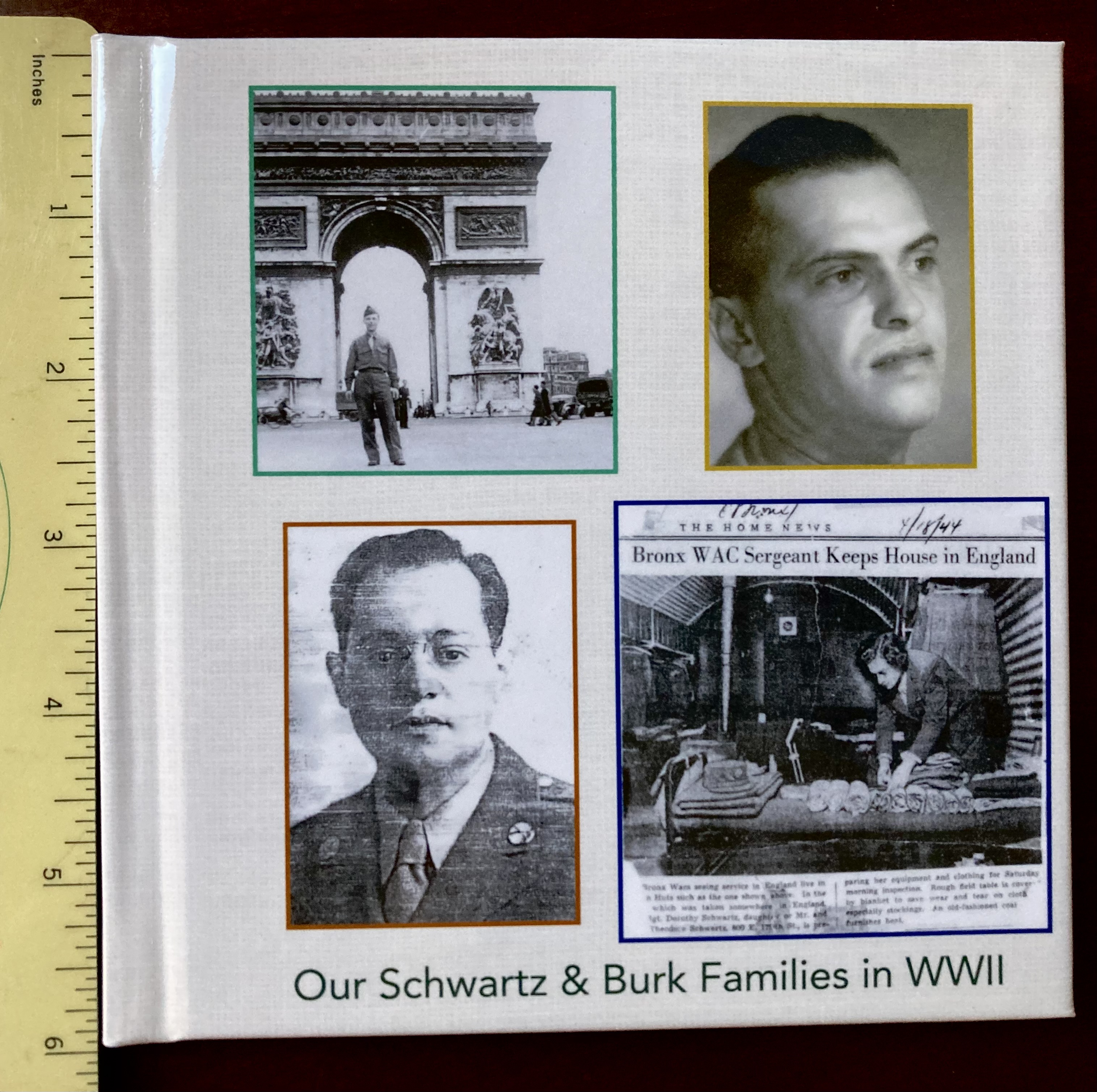
Early this month, a young relative asked about our family in World War II. In response, I created a small (six inch by six inch) photobook focused mainly on the military service of my Dad, my two uncles, and my aunt. Bite-sized family history projects like this don't take a lot of time to prepare and don't overwhelm the audience with details--using images to bring ancestors and stories to life.

The cover (see above) shows the four focus ancestors, with a colorful border around each image. Even a small touch of color is important because the next generation has complained that "black and white is boring." The text is dark green, and the background is light tan, avoiding the dreaded black-and-white that makes eyes roll among my younger audience.


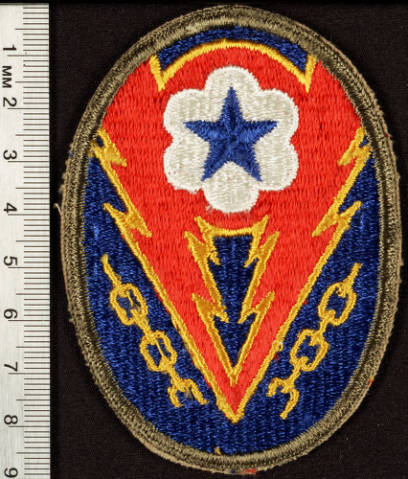
On the back cover, I repeated the two most colorful images from the inside pages. Top left, the unit shoulder patch from Dad's US Army unit. He was in the 3163d US Signal Service Company, and everything on that patch has significance, from the thunderbolts forming a V for victory to the blue star in a white background, which stands for the Army Service Forces, and the broken chains, freeing Europe from the Axis. I explained the significance inside the book.

Lower right on the back cover is the shoulder patch for the 9th US Air Force, to which my aunt's WAC unit was attached. This particular image is from that WAC's unit history, researched and written by my aunt, Sgt. Schwartz.

Inside, I also included a few sentences (with photos) about the military service of Dad and Mom's first cousins, noting that Mom was in the New York City Air Warden Service. 

This attractive bite-sized book has a hard cover and looks professional, with flashes of color throughout. Now the next generation will know that our Schwartz and Burk ancestors were active during World War II in the US Army, US Army Air Force, US Marines, US Navy, US WACs, and on the home front as well.

Sunday, March 19, 2023

LOCKSS via Find a Grave


After I join my ancestors, I don't want my family history to be forgotten or lost. That's why I've been sharing far and wide, knowing that LOCKSS - lots of copies keep stuff safe.

In addition to documenting my family tree and hubby's family tree on multiple websites, I've made Find a Grave a big part of my LOCKSS plan. Membership in Find a Grave is free: register, create a member profile (you can list surnames you're researching, great cousin bait!), and get started. 

Create memorials, link relatives, add bios

I'm steadily going through my trees and checking for Find a Grave memorials. I add a page for ancestors who have none, when I know where those people were buried (or cremated or memorialized on a cenotaph, like hubby's cousin here). Little by little, I'm also adding bite-sized bios, as shown on hubby's cousin's page.

If a memorial already exists, I link the memorial pages of ancestors who were related to each other. That way the memorial will show an ancestor's parents/spouse/children/sibling(s) as family context--and clues for other researchers. This also gives me a push to conduct a bit of research if I'm missing a date or a relationship.

Nearly all the memorial managers I've dealt with have approved my edits quickly and completely. The wonderful manager whose bio I show here holds a few ancestral memorials from my tree. He's posted all suggested edits within a day or two, and also made one transfer at my request. He is the ideal manager IMHO. I've heard so so many complaints about managers who won't transfer memorials, won't make edits, but rarely have I had a bad experience and I'm not easily deterred from my mission of LOCKSS.

Once or twice I had to explain my edits to a memorial manager by showing documentation. For instance, when there was no headstone, I proved someone's name was wrong in the cemetery's index and the manager changed the page. This doesn't happen often, but I can understand a manager striving for accuracy might want to know "how I know."

On the other hand, I disagreed with an edit suggested by a researcher trying to be helpful. The edit suggested adding "Jr" to the ancestor's name because his father was "Sr." Um, the younger guy had a different middle name than his dad AND never in his life did he use the "Jr" suffix (lots of documentation on this guy). We had a polite exchange of messages when I rejected the proposed "Jr" change, explaining my reasoning and thanking the researcher for other edits I did approve.

Find a Grave index is widely available

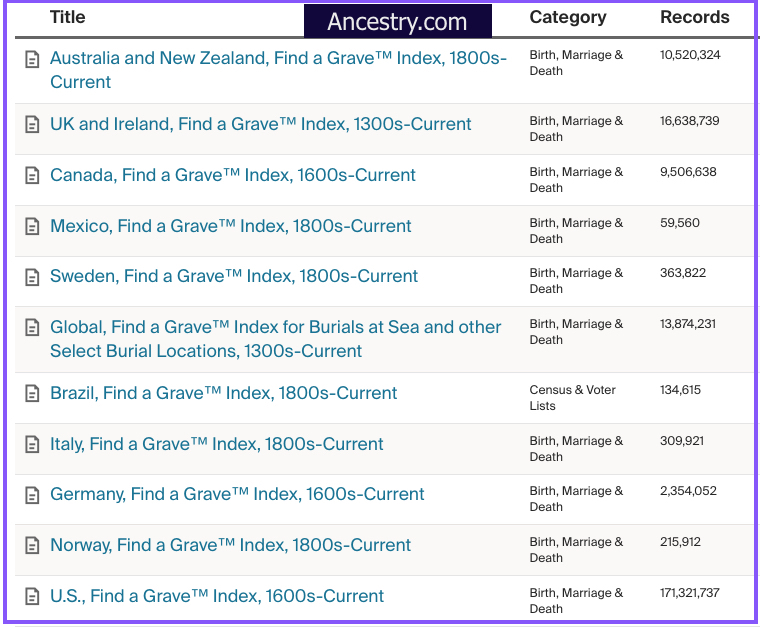
Now back to LOCKSS. At top is a screen shot of the Ancestry catalog entry for Find a Grave. This, this, is a big reason why I invest so much time in Find a Grave. 

See how many millions upon millions of Find a Grave memorials are indexed and searchable on Ancestry?

Anyone researching an ancestor of mine via Ancestry is highly likely to see a link to the Find a Grave memorial page. They'll fill out their tree, and may even connect with me to share info (remember my Find a Grave profile shows surnames researched). My ancestors on multiple Ancestry trees--LOCKSS.

FamilySearch also makes the Find a Grave index available on its free website. Millions of people use FamilySearch--meaning any of them could potentially notice the Find a Grave memorial I created OR a link to a relative on Find a Grave. Quite a powerful incentive to add my ancestors to Find a Grave and improve existing memorial pages!

Is Find a Grave perfect? Of course not, and there are any number of legitimate concerns. But the many pluses make it an important part of my plan for LOCKSS, which is why I'm an active member.

"Membership" is Amy Johnson Crow's genealogy prompt for week 12 of #52Ancestors. 

Thursday, March 16, 2023

Book Review: Essential Guide to Researching Your Kentucky Family History


If you're researching ancestors in the Bluegrass State, you'll find lots of practical information in the brand-new book Essential Guide to Researching Your Kentucky Family History. 

Published by the Kentucky Genealogical Society, available on Amazon here, this 144-page book is filled with expert research advice, useful historical maps, insider's tips, and much more. Disclaimer: I'm a member of the KGS and received a free copy to review, but the opinions expressed here are entirely my own.

Organization of chapters

Not for beginners only, the Essential Guide is divided into six sections, leading readers through the background of the state, genealogical methodology, and specific resources and techniques for genealogy research in Kentucky:
  • Understanding Kentucky History (forming counties, pioneer family paths, Jackson Purchase, common causes of death in 19th century)
  • Basics of Family Research (getting started, pedigree charts, tips for research, remotely researching in Kentucky, strategies for working with clues)
  • Finding Genealogical Sources (Census, tax lists, land grants, obits, military records)
  • Genealogy Techniques and Tricks (maps, vital records, female ancestors, marriages for formerly enslaved persons, timelines, courthouse disaster plan, published ancestor research)
  • Sharing Your Research (catch relatives' attention, tips and suggestions for family storytellers)
  • Reference (county formation dates/county seats, cousin formula)
Insider's knowledge

The book spotlights resources and approaches not necessarily familiar to researchers outside of the state--but known to the insiders at the Kentucky Genealogy Society. 

For instance, the chapter titled "Is Your Kentucky Ancestor in the Log Cabin?" explains how to access and search, for free, issues of a weekly newspaper published in the Harrison County area from 1896 to 1960. Often ancestors' activities were mentioned in the paper--a terrific place to check if your family's roots extended to that region of Kentucky.

I'm partial to maps, so I particularly like the chapter about the use and source of topographical maps, historical county maps, and cadastral maps (which indicate land ownership). 

Another super-valuable chapter digs into techniques for researching Kentucky land grants, following the four-step patent process and specifics of where to locate land documentation.

In short, anyone who has Kentucky ancestors will want to read and refer to this detailed yet succinct guide again and again. 

Tuesday, March 14, 2023

Word Cloud of Hubby's Irish Ancestors


For St. Patrick's Day, I created a lucky four-leaf clover of surnames and places from my husband's Irish ancestry. The free site I used is WordArt.com

As always, I sent "Erin Go Bragh" greeting cards to the grandkids. This year I included a four-question quiz about a few of the Irish ancestors I've been telling them about for years.

  1. Who was the first Brice in our family to be born in America, and where in Ireland did his parents come from?
  2. What happened to our ancestor Robert Larimer after he set sail from Northern Ireland bound for America in the 1740s?
  3. Where in Ireland were Larimer in-laws Thomas McKibbin and Jane Irvine McKibbin born before moving to Turkeytrot, Pennsylvania?
  4. Which Scots-Irish ancestors, born in Donegal, paid for passage to sail to Philadelphia and then walked to Virginia to buy farm land?
Answers:

  1. Brice Smith was the Brice in our family to be born in America, in Pennsylvania in 1756. His parents, William and Jean Smith, were from Limerick. Brice and his wife Eleanor Kenny Smith were hubby's 4th great-grandparents. There is also a Brice in my husband's generation.
  2. Robert Larimer boarded a ship about 1740 to sail across the Atlantic in search of a new life, age 21. Unfortunately, he was shipwrecked and forced to serve as an indentured servant to work off the cost of his rescue. After years of hard work, Robert ran away, married Mary Gallagher, and farmed in Pennsylvania. Later, the couple and their family moved to Rush Creek, Ohio. Robert and Mary were hubby's 5th great-grandparents.
  3. Thomas McKibbin was born in County Down, Ireland, and married his wife Jane Irvine in Ireland before traveling to Pennsylvania about 1812. Later, Thomas and Jane moved west to pioneer in Indiana, where both are buried. Thomas and Jane were in-laws of hubby's Larimer family.
  4. Halbert McClure and his wife, Agnes, were both born in Donegal, although the McClure family is originally from Scotland. Halbert, his wife, their children, and some of Halbert’s brothers sailed to Philadelphia and then walked together to Virginia in the 1700s. Their descendants became farmers in Ohio and then in Indiana. Halbert and Agnes were 5th great-grandparents of my husband.
"Lucky" is the 52 Ancestors theme for this week, from Amy Johnson Crow. 

Saturday, March 11, 2023

Bite-Sized Family History from World War II

It seems my relatives like to learn about family history in small doses. Not for them a big data dump about dozens of ancestors or multiple generations. Keep it focused, keep it simple, they'll pay attention for at least a little while.

This week, I created a bite-sized photo book with snippets of what some ancestors did during World War II--in the military and on the home front. (Photo of photobook will be posted soon!)

Many served in the armed forces. I selected four to profile in some detail: my Dad (US Army), his brother (US Army Air Corps), my aunt (WAC), and my uncle (US Army). Lots of photos and bits of documents brought their stories alive.

I also briefly touched on the military service of Dad's and Mom's first cousins, including one in the US Navy and one in the US Marines Corps. Another of Dad's cousins served in the New York Guard. Nearly every branch of the armed forces was represented in the family tree, and mentioned in the bite-sized book!

Supporting the war on the home front

Beyond the military, our Farkas family had its very own Rosie the Riveter. My great aunt Freda, younger sister of my Grandma Minnie, worked long hours in the Grumman aircraft factory on Long Island. 

Other women in the family tree were supporting the war effort on the home front, as well. My Mom and her twin, plus two cousins, joined the American Woman's Voluntary Services, volunteering for a range of activities including selling war bonds. 

My maternal grandma's Farkas Family Tree association often held war-bond sales during monthly meetings, raising a couple thousand dollars at a clip. Mom was also involved with New York City's civilian Air Warden Service during 1943, checking that curtains were closed for blackouts in case of overnight enemy bombing raids. 

Does your family tree include any Rosie the Riveters? Women's History Month is a great time to show pride in these ancestors by telling their stories in a bite-sized family history project.

Wednesday, March 8, 2023

International Women's Day: Honoring the Women in My Family Tree


Today is International Women's Day!

To honor the women in my family tree, let me present:

  • Daisy Schwartz Burk, my Mom
  • Hermina Farkas Schwartz, my maternal Grandma
  • Leni Kunstler Farkas, my maternal great-grandmother
  • Henrietta Mahler Burk, my paternal Grandma
  • Rachel Shuham Jacobs, my paternal great-great-grandmother
  • Tillie Jacobs Mahler, my paternal great-grandmother
Thinking of them with affection and appreciation today, March 8, 2023.

Monday, March 6, 2023

Translating Facts and Artifacts into Family History


Last week, one of my younger relatives asked about the World War II service of our ancestors. Little did he know that he would get answers, lots of answers!

For this young man and other descendants, I'm preparing a little photo book with snapshots, documents, and stories of our ancestors who served. The focus is on my immediate family: Dorothy Schwartz (maternal aunt, a WAC), Fred Shaw (maternal uncle, US Army), Harold Burk (Dad, US Army), Sidney Burk (paternal uncle, US Army Air Corps). Plus a paragraph about my Mom doing her part at home (see below). After all, it is Women's History Month, so Mom and her twin should both be included!

Facts into stories

Dad's honorable discharge documentation recorded the facts of what he did overseas, but no details or explanation (see at top). I had other documentation, from Fold3 and other sources, as well as from family files. I wanted to translate the facts into readable snippets about his role in WWII.

Doing an online search for his 3163d Signal Corps unit, I stumbled on an oral history from someone who served at the same time in the same unit! After reading a summary of the background provided by Alan B. Conlin Jr. in 2013, I was able to write a few lively sentences about the unit's vital wartime role, exactly where they were stationed, and when. 

This fleshed out the facts of Dad's wartime service into a brief story of how the Signal Corps installed and managed communications such as radio and teletype, extremely vital for transmitting troop orders and bombing instructions in the European Theater. 

Artifacts into stories


Meanwhile, my wonderful husband was intrigued by the wartime shoulder patch my father had saved all his life. After a bit of online searching, hubby discovered a detailed explanation of the symbolism on the Pritzker Military Museum website. Someone had donated the unit patch and the museum summarized what each element means, as you can see here

In the book I'm preparing, the photo of the patch will be accompanied by a rephrased version of what the patch represents. For sure I wouldn't have recognized that the twin thunderbolts represent V for Victory. Now descendants will know that part of the artifact's story, along with a clear photo of Dad's own patch (being passed down to heirs).

On the home front

Not to leave out my Mom, Daisy Schwartz, I included this image of her Air Warden service in 1943. She didn't serve in the armed forces, but she did work as deputy communications director for the New York City units. 

My book will include a brief description of the function of an air warden, so the document is "translated" into a story of my Mom doing something meaningful to support the war effort on the home front.


With younger folks in mind, these bits of research helped me turn bare facts into actual stories to capture my audience's attention and bring family history alive. 

"Translation" is this week's #52Ancestors theme from Amy Johnson Crow.

Friday, March 3, 2023

Book Review: "Generation By Generation"


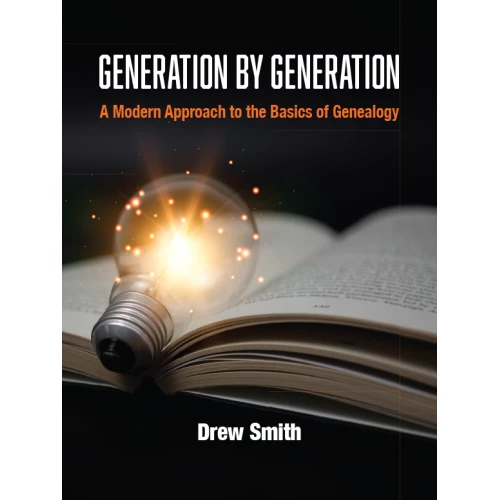
Know any newcomers to genealogy? I encourage you to point them toward a new book designed specifically for people just starting their journey into family history: Generation By Generation, a Modern Approach to the Basics of Genealogy by Drew Smith, from Genealogical.com. Disclosure: Although I received a free copy from the publisher, the opinions in this book review are entirely my own.

Drew is well known as co-host of the Genealogy Guys podcast, founder of the Genealogy Squad Facebook group, and a frequent speaker on genealogy topics. One of his innovations is to organize the research chapters according to how we actually trace a family tree--starting with ourselves and going back in time, one generation at a time:

  • Generations after 1950 in the US
  • Generations from 1880 to 1950 in the US
  • Generations from 1850 to 1880 in the US
  • Generations from 1776 to 1850 in the US
  • Generations in British America before 1776

He also assumes that today's genealogy newbies will be relying on technology, both for research and for documenting family history. Chapter 4 is all about getting organized, with software, bookmarks, etc. Chapter 7 focuses on the four major online genealogy platforms (FamilySearch, Ancestry, MyHeritage, FindMyPast). Truly a modern approach! 

At 170 pages, this large-format book is well-illustrated and highly readable, making the genealogy process more accessible to newcomers. In short, I highly recommend Generation By Generation.

Note: In the introduction, Drew reminds readers to share family history so it can live on, a philosophy dear to my heart. Drew, if you ever write a second edition, my suggestion is to add a brief chapter with a few ideas about how newbies can do that, so ancestors will not be forgotten in the years to come. 

Wednesday, March 1, 2023

Back Up Your Genealogy and More


The first of every month is backup day. 

Don't take any chances with your genealogy! Having lost a few folders of family photos to some computer glitch years ago, I'm careful to back up both automatically and manually.

I have three external hard drives, as you can see, with one specifically for all those wonderful family and family history photos. That drive is where I put my manual backups--meaning that when I create something new or update something, I copy and paste it on that hard drive. All of my genealogy presentations are also backed up on the photo hard drive.

The other two hard drives store daily and weekly backup drives, running automatically in the background. (I schedule my backups at a time when I'm not active on the computer so I can leave it running and step away while the automatic systems do the backups.)

For extra safety, I put genealogy presentations on flash drives in case something doesn't work properly as I'm speaking, and I need to make a switch quickly. Plus I have two cloud backups running every day.

My family trees are on multiple sites, as well as on my RootsMagic8 software. 

Lots of copies keep stuff safe. LOCKSS! Please backup regularly. Your descendants will thank you. 

Thursday, February 23, 2023

Family History as Ancestors Lived It

Famed Presidential scholar/author Doris Kearns Goodwin makes an important point about writing history, which also applies to family history. 

Dr. Goodwin recommends writing history from the perspective of what someone knew at the time, not what we know today as we look back on the past and see events and their consequences.

What did they know, when did they know it?

As an example, in her research for writing about President Franklin D. Roosevelt and First Lady Eleanor Roosevelt, Dr. Goodwin carefully studied their diaries and letters, to get a sense of their thoughts and emotions at particular points in time, particularly over the course of World War II.

Her goal was to write so "the reader could feel what it was like to be Franklin and Eleanor at that time, which means that if they made mistakes, you could at least understand why they did. If they did something admirable, you could feel it with them."

In terms of family history, our ancestors had no way of knowing what would happen when they decided to leave their home country, or get married, or join the military, or change jobs. Today, we can be Monday morning quarterbacks, applauding some ancestors' moves while questioning others. But what could they have known at the time they faced that decision and at each step of the way afterward?

Tell the story as the ancestor lived it

What was it like for my aunt Dorothy Schwartz (1919-2001), a daughter of Hungarian immigrants, to decide to join the WACs in WWII, and eventually make a dangerous trip overseas to serve in war zones? I have some idea about her day-to-day story as it unfolded, thanks to news articles, letters home, family meeting minutes, and the recollections of a friend she made on board the RMS Aquitania when going to war. The NY Times and other publications covered the voyage to Europe because Dorothy and her WAC unit was the first sent overseas in WWII.

As background, Dorothy worked for a few years after high school before attending Hunter College in New York City, her home town. She was ardently pro-democracy during college--her quotes on the subject were included in local news coverage of the time. Dorothy didn't have a clue how World War II would turn out, but she was determined to do her part when she applied for the Women's Army Auxiliary Corps. She didn't even know whether she would be chosen to serve, because 35 women applied for each open position. Once she was chosen, her life took a very different direction than if she had stayed in New York and finished college. Remember, she was only in her early 20s.

Dorothy's letters home during training and after deployment showed her learning to be part of a WAC team, gaining an appreciation for the immense tasks ahead, and developing into a squadron leader. They also revealed her pride in the professionalism she and her WAC colleagues displayed, despite being underestimated by many men in the military and in everyday life. This was a theme that came up over and over again--countering misperceptions through hard work and super-professionalism.

Ancestor's story in context

Decisions like Dorothy's aren't easy, and they change not just the individual's life, but the entire family's situation. Dorothy left her aging parents and her beloved twin sister to become a WAC. She never dreamed she would be away from home for nearly 3 years, nor did she imagine serving alongside Allied bombing squadrons. 

Her letters reveal she felt intense pressure to perform perfectly because thousands of lives depended on her accuracy in recording and transcribing bombing orders. When Dorothy finally came home, she had a huge sense of accomplishment in helping to win the war and fresh confidence in her own capabilities.

We know how these decisions turned out, but our ancestors had to live each day without any idea of the eventual outcome. If we tell as much of the story as we can learn, tell it as it unfolded from the ancestor's perspective, we can help our relatives and future generations appreciate the true drama and suspense of family history. 

Wednesday, February 22, 2023

Happy Twin Birthday


Happy twin birthday to Sis and me, shown here in winter bonnets, all snuggly settled into our deluxe baby buggy. 

We were clearly ready for a bit of a joy-ride around our corner of the Bronx, New York. This is one of my fave photos from our early childhood!

Saturday, February 18, 2023

My Family Tree Word Cloud


Here are the main names on my family tree, including many of those who married into my maternal and paternal lines. Fun to see them in a tree shape! 

Thanks to the free online word cloud generator here, which includes a tree shape and the option to customize colors, sizes, and fonts, not just names.