Tuesday, May 19, 2026

Today's Photos of 20th Century Big Apple Homes and Buildings


I like to see where my ancestors lived in New York City back in the day, and what their homes and neighborhoods look like today.

I've used the New York City tax photos from 1939-1941 to see older views of these buildings. Often I use Google to see the map locations and today's "street views" but now I have a different tool I can use.

Above, a search I conducted on NYCityMap (click here to get started yourself) for my great-grandma Tillie Jacobs Mahler's address in the 1950 US Census. She was in her 90s and living in an apartment with her grown daughter Dora Mahler, who had a chronic heart condition. (Dora was incorrectly listed as "Dorothy" in the 1950 Census.)

At top right you can see I typed in the street address "1933 Marmion Avenue, Bronx." Up popped the correct address and zip code. When I clicked on the address, the map appeared, highlighting this apartment building in a gold rectangle.

Also the column at right of map gave me details such as how many floors (5) and how many residential units (16). The construction year was noted (1921) and an option for "street view" (see arrow on image at top). 


Clicking to view the building as it looks today, I saw the apartment building appears very much like it did when Great-Grandma and Great-Aunt Dora lived there. This was a walk-up, no elevator. How Tillie and Dora got up all those stairs, considering their health challenges, I can't imagine.

For comparison, here is the Google Street View version of 1933 Marmion Avenue in the Bronx. Photo taken same month as the other photo, by the way.

Of course, if your New York City ancestor's residence or business has already been torn down, this website won't be of any help. My Dad (Tillie's grandson, Dora's nephew) lived in an apartment at 77 East 109th street in Manhattan as a boy and that address no longer exists, which is why I can't view any building details or photos. He also lived in an apartment at 7 East 105th Street in Manhattan, which was redeveloped in 1921 as some kind of public facility building--no longer a residential building. 

Thinking of Dora and Tillie with affection as the anniversaries of their deaths approach. Dora died in June of 1950 at age 55, and Tillie died in June of 1952 at age ... 99 or 100 (maybe).

Saturday, May 16, 2026

Odds and Ends from Recent Genealogy Research


I've found some odd/interesting things as well as some notable "ends" in my recent family history research.

In the past few weeks, I've been surprised to learn these oddities and discoveries, sometimes from documents and sometimes from old newspapers:

  • Alabama was once the quickie divorce capital of America! Based in New York City, Violet Schwartz Winton, the sister-in-law of my 1c2r, was divorced in 1958 in Alabama, of all places. Why? Only a 24-hour residency was needed for a "quickie divorce" in Alabama. Lots of famous people divorced in Alabama (millionaires, movie and TV stars, etc.). Much faster than going to Reno, Nevada.
  • The 1880 US Census asks about a very broad range of illnesses and disabilities. Usually I see notations like blind or mute, but in the case of Elizabeth McCann Caldwell, wife of hubby's 1c3r, the enumerator wrote "paralyzed on right side." Elizabeth was pregnant then, and gave birth to her last child a few months later. This enumerator was very detail-oriented: she noted illnesses such as sick headache, tumor on neck, white swelling, dropsy, rheumatism, and "old age" [for anyone over 70 years old].
  • Hubby's 3c1r was involved with public radio. Josephine Helen Hanford and her future husband, Raymond J. Stanley, fell in love while working at public radio station WHA in Madison during the 1930s, after both graduated from nearby University of Wisconsin. When the couple married in 1941, station co-workers attended the wedding. In 1956, Helen received a Pioneer award for writing for the station's classroom radio broadcasts.
Also a few discoveries about endings:

  • Grim Reaper was the headline on the column listing deaths in 1915 in the Star Press of Muncie, Indiana. 
  • A number of Midwestern and Southeastern US ancestors in my tree and hubby's tree died of typhoid fever, unfortunately. Outbreaks were apparently not uncommon, often due to contaminated water. My hubby's 1c3r in Missouri died of typhoid in 1911. "Typhoid may claim family" read a headline about a neighboring family stricken with typhoid weeks after this cousin died.
  • "Falls Dead Sawing Wood" was the 1908 headline of a brief death notice for a farmer who died suddenly of heart disease and was found hours later still with a saw in his hand. Not a relative but a sad end.

Tuesday, May 12, 2026

Sold in Teddy's Dairy Store: Butter, Eggs and -- Beer?!

On the anniversary of my paternal Grandpa Teddy's death in May, 1965, I've been redoing my newspaper research and learned something new, thanks to additional newspapers now in databases and fully searchable.

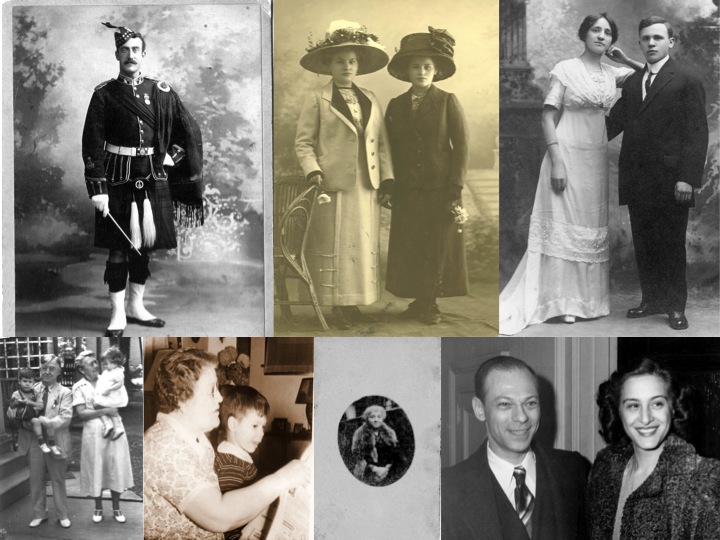
Background: Theodore "Teddy" Schwartz was born in Ungvar, Hungary on May 21, 1887. He came to New York City in March of 1901, married my Grandma Hermina "Minnie" Farkas in 1911. The portrait above shows him around the time of his marriage. Just as the US was entering World War I, Teddy started up a dairy store in the South Bronx, New York. With a small son and expecting more children in the future, this family-owned store would provide more stable income than his previous occupation as insurance and steamship agent.

Teddy's Dairy was a small, one-store operation, always in the Bronx, selling basics like butter, eggs, and pantry items. Also soda pop, candy, pickles, and assorted household supplies. He sold his store once or twice and opened in a new location each time, moving further north toward the more "suburban" areas of the Bronx.  

In 1933, as Prohibition was just about coming to a close, Grandpa Teddy received a retail license to sell beer and wine in his dairy store at 679 Fox Street in the South Bronx. How do I know? I found the public notice of his license published in the New York Evening Journal newspaper, page 19, on July 19, 1933. Prohibition wasn't quite over but apparently stores and restaurants could sell some alcoholic beverages with the proper permits.

Grandpa later sold that store and opened another at 640 East 180th Street in the Bronx, further uptown from the earlier store. In July of 1948, he was issued a permit to sell beer at retail, not to be consumed on the premises. This public notice was published in the New York Post Home News, considered the "hometown newspaper" of the Bronx. 

Since Teddy's Dairy was open all day, and six days a week, I think selling beer was a good way to bring in customers later in the day and into the evening. Sometimes Teddy didn't close the shop until well after dinner (I know from reading the family tree minutes) but those beer sales would have been profitable.

Thinking of Grandpa Teddy Schwartz with great affection. And grateful for the newspapers newly added to databases!

Sunday, May 10, 2026

Book Review: The First 24 Hours of the American Revolution

April, 1775 was a pivotal time for Patriots in the American Colonies, who were seeking more freedom from Great Britain. No spoiler alert needed: You know how this story ends.

Jack Darrell Crowder chronicles The First 24 Hours of the American Revolution in this 2018 book, 129 pages from Genealogical.com. It's packed with history, personal drama, military maneuvers, and peeks over the shoulders of American and British participants.

Not only does Crowder set the stage with background on why and how local militias formed in the colonies, he also provides maps, portraits, illustrations, and little-known but interesting details about the sparks that touched off a revolution. 

The engaging narrative unfolds in the present tense, providing a "you are there" feeling about history that continues to reverberate today as we celebrate America 250 in 2026. Crowder uses the voices of people on both sides of the conflict to describe what happened hour by hour, based on research in letters, historical archives, and other sources.

The book includes a section showing how the British described the Battle of Lexington and Concord. Crowder calls this "propaganda" and the spin is that British troops were fatigued but fought mightily during an "unfortunate affair" that was caused by the "ruthless and imprudence of a few people who began firing on the troops at Lexington." (p. 108)

The author also devotes nearly 4 pages to listing the names (and a biographical sentence or two) of those who were killed during those first 24 hours. 

Good bibliography, good index, fascinating insights into a series of battles that led to the American Revolution and ultimately, independence from the Crown. This book is most definitely worth reading!

Note: I received a complimentary copy from the publisher in exchange for an honest review, and the opinions in this post are entirely my own.

Thursday, May 7, 2026

Wartime Letters Going to a New Home, Part 2


I'm nearly finished curating my family history materials and finding safe new homes for artifacts that don't have a close, direct connection to my family. This is Part 2 of the saga of letters and cards written by a family in England to my family in the Bronx, New York, during World War II. (Part 1 is here.)

Last year, I decided the correspondence should either go to descendants of the letter-writers in England or be offered to a museum. Part 1 tells the story up to the point that the English family's descendants had been found by the Imperial War Museum in England, which was considering whether to accept the letters for study and archiving.

All descendants agree, now what?

My family and the letter-writers' descendants agreed whole-heartedly that the letters should go to the museum. We were excited at the prospect of the handwritten notes being professionally preserved and made available to researchers and possibly museum visitors.

Before the museum's management could make a decision about accepting the letters for their collection, they had one more question: What value would I put on the correspondence?

Valuing personal correspondence

Because the museum would be importing the letters from the United States to the United Kingdom, the value of the items must be declared.

I've had no experience with valuing items, so I looked at similar correspondence on eBay. Single letters from that period ranged in price from $10 to $50 or more--for a multi-page handwritten letter, sometimes with, sometimes without an envelope.

But as the museum pointed out to me, we know the background of both the letter-writers and the recipients, which adds to the value of the correspondence. Plus the letters themselves are in very, very good condition! 

Therefore, I suggested to the museum that we value the set of letters at $400.

Did the museum accept the letters?

Yes! The curator is happy, the families are happy. Just think: My ancestors and their ancestors will be in the collection and database of the American Air Museum at the Imperial War Museum at Duxford. We all couldn't be prouder.

Now the museum is making arrangements for express shipping these letters from New England to England. By the time you read this, I will have signed all the documentation and arranged for getting the letters to their new home across the pond.

What about your ancestors?

What I did with these letters is the equivalent of contacting the prestigious Smithsonian here in the United States--a really big stretch. Fifteen years ago when I began looking for new homes for family-history artifacts, I actually did email the Smithsonian about two items. I got no reply, for good reason: those artifacts were not truly rare enough to belong in the Smithsonian. I never made that rookie mistake again.

Back then, I didn't yet know how to analyze the artifact, research possible repositories, and match the artifact to the most appropriate one. I quickly learned how repositories manage their acquisition of donated materials and was able to adapt and format my offers accordingly. I have now placed literally hundreds of artifacts in the collections of dozens of repositories across the United States (most physically, some digitally). 

No dumpster, no recycling bin, no flea market, but safe places for items ranging from theater programs and old photographs to a leather war bond wallet and various historic newspapers.

In this particular case, the Imperial War Museum was actually the most appropriate match for the wartime correspondence from England. I aimed high and made a strong case, resulting in the letters being accepted by the museum. A happy ending indeed. 

PS: When I began curating my collection, it took a few non-responses and refusals to teach me how to successfully donate a family-history artifact to a repository. Be patient if you decide to donate something, and if you get a "no," ask where else you might try to donate. For more, see my book, Planning a Future for Your Family's Past.

Tuesday, May 5, 2026

Wartime Letters Going to a New Home, Part 1

Early this year, I wrote about wanting to donate a series of letters written to my grandparents and my mother by a family in England. 

The correspondence began when a widow walking her dog met my aunt Dorothy, a WAC serving in England during World War II. They struck up a conversation and this lovely widow began writing to Dorothy's parents (my grandparents) and to Dorothy's twin sister (my Mom). 

Keep or find a new home outside the family?

Because the letters have no particular ancestral significance, I saw an opportunity to curate my holdings by finding the letters a safe new home outside the family. Sis agreed with my plan to let the letters go. Always check with your family first!

Here's the process I followed (and you might follow) for finding a good new home for items that aren't absolutely vital to the family's history. Part 1 of 2.

Process for finding artifacts a new home

With my sister's agreement, I attempted to find any living descendants of the letter writers by looking at online family trees. My goal was to tell them the story of the correspondence, express my family's appreciation for their ancestors' kindness, and offer them the letters. (Note: there's more to this story in Part 2, no help needed now!)

I had no response from the owners of two online family trees with that family. Next, I found a more distant cousin with an online tree and contacted him. After months of trying to reach out to closer cousins, he got no response either.

We agreed it was best if these wartime letters go to an institution, to be preserved for the future. And we both had the same thought about an appropriate repository.

Match the artifact to the repository

To find the right repository, I first classified the letters: 

  • World War II period descriptions of the home front in England
  • Original letters and cards, including envelopes with stamps and postmarks
  • Written in England on thin wartime stationery
  • Mailed to individuals in America
  • Evidence of examination by wartime censors (see image above)
  • Written after meeting my aunt, a WAC serving in England
  • Ongoing contact from 1943-1945

The perfect place for these letters, we believed, was the Imperial War Museum in England. It is dedicated to documenting the "human experience of war and conflict and the impact it has had on people’s lives." The letters from England were a contemporary window into the everyday life of a family close to military bases where UK and US servicepeople were training or stationed in World War II. 

The correspondence revealed how this family coped with wartime shortages, detailed who was joining the military, who was at school, and how they felt about the war. These folks opened their home to my aunt the WAC and their hearts to my aunt's family.

What will the repository accept?

I checked the Imperial War Museum's guidelines about offering to donate an item. After noting their collecting priorities, I wrote an email to explain the letters and their significance in light of the museum's mission. I provided a bit of background about the letters being provoked by a meeting with my aunt the WAC, serving alongside the 9th Air Force in England (and later France and Belgium). All institutions want to know provenance, so this was part of my explanation.

I had already scanned all the letters and envelopes, and had ready a summary of the dates and who's who of the writers and the recipients. To support my request to donate artifacts, I attached a scan of one of the letters--including a tiny head shot of the letter writer! I hoped to attract the attention of the curator with this sample of handwritten letters from the heart. 

Helping shape a proposal

After nearly a month, I was delighted to hear from the curator of the American Air Museum, a part of the Imperial War Museum. She was interested in the family letters and especially intrigued that my aunt was the historian of her WAC detachment connected with US Air Force (the focus of this division of the Imperial War Museum). 

She quickly created an entry for my aunt on their museum website, drawing on a bite-sized bio I wrote for my aunt on Find a Grave. And after checking my aunt's history of the WAC unit, she began adding other WACs to the museum's database.

Next, the curator asked me for additional background to help her write a proposal that the museum's directors would read as they considered whether to accept the letters. I submitted a contextual summary of the letter writers' family situation, the recipients' family situation, my aunt's WAC career. Also I said I had no more letters beyond 1945, so it appeared unlikely that the connection continued after my aunt finally returned from Europe to her parents' Bronx apartment.

One more bit of due diligence

The museum's directors met and determined that before they made a decision about the letters, they wanted one more bit of due diligence: to check for any other descendants in England. They were able to locate two living descendants that I was not aware of--and those descendants quickly agreed that the letters written by their ancestors should most definitely have a new home in the museum.

Thanks to the museum, the descendants and I are now in touch with each other. We've shared more about the later lives of the correspondents. We are all excited that after 80-plus years, our families are connected again through the letters written during World War II.

To be continued: Did the museum say "yes" to accepting the letters for their collection? What happens next?

More in Part 2, here!

PS: I learned how to donate artifacts by trial and error. If I can do it, so can you! 
Friday, May 1, 2026

Future Heirloom: My Hubby's Military Memorabilia


The framer did an incredible job with this custom, archival shadow box displaying my wonderful husband's wonderful US Army memorabilia. It was a worthwhile investment in preserving these items for the future, including an archival envelope on the back. His discharge papers and his many stories about peacetime Army life will be put into that envelope for posterity.

In the center is a b/w photo of hubby as he looked on his way to lunch in camp one day. The framer took my high-resolution scan of the original photo and had it printed on cotton to preserve the smallest details and prevent yellowing over the years.

The chronology of his military service as a personnel clerk begins to the left of the photo, with a stint in the First Cavalry (notice the horse on the patch) and below that patch, the combat engineer unit badge, combat engineer brass, and his US Army brass. 

Going clockwise, above the photo is my husband's 32d Infantry badge, 7th Division patch, and infantry brass. This last item was purchased from eBay because the original was cruddy-looking.

To the right of the photo is his US Army Japan patch, 8th Army patch, Sgt's stripes, and good conduct medal.

Below the photo, hubby's dog tag showing name, serial number, blood type, and religion (obscured for privacy here).

We put a brass name plaque on the bottom edge of the frame (blocked for privacy here) to permanently identify who this is. Descendants are actually excited about this future heirloom! And it is neat and attractive, putting these important items on display rather than leaving them in a box or drawer.