Showing posts with label Genealogical.com. Show all posts

Monday, April 13, 2026

Book Review: Women Patriots in the American Revolution

 
Jack Darrell Crowder wrote Women Patriots in the American Revolution (Genealogical.com, 2018) to honor "the colonial women who were the secret weapons that the Americans had in the effort. They were the weapons the British could not control or defeat." As a former teacher, Crowder has devoted many years to studying the American Revolution and this is only one of several books he's written to examine various aspects of that pivotal period. 

This highly readable book shines a light on both well-known and little-known stories of women who exhibited courage and compassion during the fight for freedom. For a full alphabetical listing of the women featured in the book, including which the state where each woman lived, see Genealogical's post here.

The first half of Crowder's book is devoted to "Women Patriots," such as Margaret Cochran Corbin (1751-1800). Born in Pennsylvania, she married John Corbin a few years before the revolution. Her husband decided to join the fight against the British, and she became a camp follower--until he was killed in battle while firing a cannon at Fort Washington. Margaret, who had been at his side, took over his position and fired away, despite being shot and wounded. She was taken prisoner,  paroled, and hospitalized. Margaret later became part of a regiment that tended wounded soldiers at West Point. There she met and married a man who was recuperating and after he died, she successfully applied for a pension--highly unusual for a woman at that time and place. Years later, Margaret was memorialized with a monument at West Point.

The second half of the book is devoted to "Heroic Women of the Battle of Lexington and Concord," such as Elizabeth Page Stark (1737-1814). Known as Molly, she was well versed in the use of a gun when she married Major General John Stark. As the Battle of Concord and Lexington got underway, John took off so quickly that he left some gear behind. Molly realized what he needed, saddled up, and caught up with him many miles away to hand over the equipment. When John was about to go into the battle at Copp's Hill, Molly went on horseback into the surrounding area to rouse more Patriots for the fight.

While Molly and Margaret have been remembered by history, many of the women in Crowder's book are far less well known. I appreciate that each entry goes beyond names and dates, providing narratives and sometimes quotes from correspondence and historical publications to illuminate the stories of these women. In addition to a detailed bibliography and listing of sources, the index covers the women and the men in their lives. 

Some entries are fairly skeletal. Mrs. Whitall (no given name) was seated at her spinning wheel inside a fort during battle. Rather than fleeing in fear when a British cannon ball landed nearby, she simply moved to the basement and kept up her spinning. Compared with the activities of most other patriots in the book, Mrs. no-first-name Whitall and her spinning wheel don't really leap off the page.

Other entries have a great deal of color and depth. Emily Geiger was just 16 when she volunteered to carry a message from General Greene to General Sumter in 1781. A Tory woman and her daughter were asked to search Emily when she was detained by British scouts, but found nothing incriminating. The daughter recollected years later that the prisoner seemed to be "a sweet young girl about my own age, looking as innocent as a pigeon." In reality, the teenager had memorized the message and swallowed the paper. She was let go and went on to deliver the message verbally.

I'm sure the author is correct when he writes: "For every act of courage reported in this book there are hundreds of courageous acts that will never be known." This book is a worthwhile read for the many fascinating stories of women in Colonial America who played a role in the fight for freedom.

In this year of America 250, I appreciate books such as this for different perspectives on the revolutionary war period in US history.

Note: I received a complimentary copy of this book from Genealogical.com in exchange for an honest review. The opinions in this review are entirely my own and not affected by any outside influences.

Wednesday, November 13, 2024

Book Review: Storytelling for Genealogists

Since my emphasis these days is on writing family history for the sake of future generations, I was drawn to this concise and affordable new book by Doug Tattershall, Storytelling for Genealogists.

Tattershall packs a lot of ideas and info into nine chapters plus a humdinger of a worksheet, and an index. The table of contents includes:

  1. Why Family Story? - "We work hard to discover our family tree," writes the author. "But what we really want to know is our family story." So true. Names and dates don't illuminate ancestors' lives. That's why this book is so helpful.
  2. How to Tell a Good Story - Engage readers. Then plot a course and find a theme to keep readers interested.
  3. The Stuff - Put meat on the bones by researching and interpreting history, biography, and "affective history."
  4. Puzzle Pieces - We have facts, but we may also have fiction. How to put the puzzle pieces together in the right way and in the wider context.
  5. The Value of Things - Going beyond words to tell the story with images, heirlooms, places, and more.
  6. Format - Text, audio, and/or video? Considerations as you choose a format to tell your ancestor's story.
  7. True and Good - "You've done fact-finding. Now it's time to spin a tale," the author says, and he goes on to explain how to make the story interesting without getting bogged down.
  8. Before You Write - Tattershall recommends outlining first to establish how to organize and present your story, with examples. Yes, outlining really works.
  9. Conclusion - "Your family history is a story worth telling, and therefore a story worth telling well." 

Although I would have preferred a little more elaboration on the key points in this slender book, I appreciate and agree with Tattershall's emphasis on telling an engaging story, well beyond names and dates with sources. 

In particular, I recommend his Family Story Worksheet, shown on p. 81. The worksheet serves as a quick-start guide to completing the components needed to spin a tale that will interest the next generation and beyond. 

Storytelling for Genealogists is an excellent, practical, readable book for anyone who wants to bring family history alive through storytelling.

Please note: The Genealogical Publishing Company sent me a free review copy of this book, and it has previously provided free review copies of other books. My reviews always reflect my honest opinions, without regard to any outside influence.

Thursday, September 12, 2024

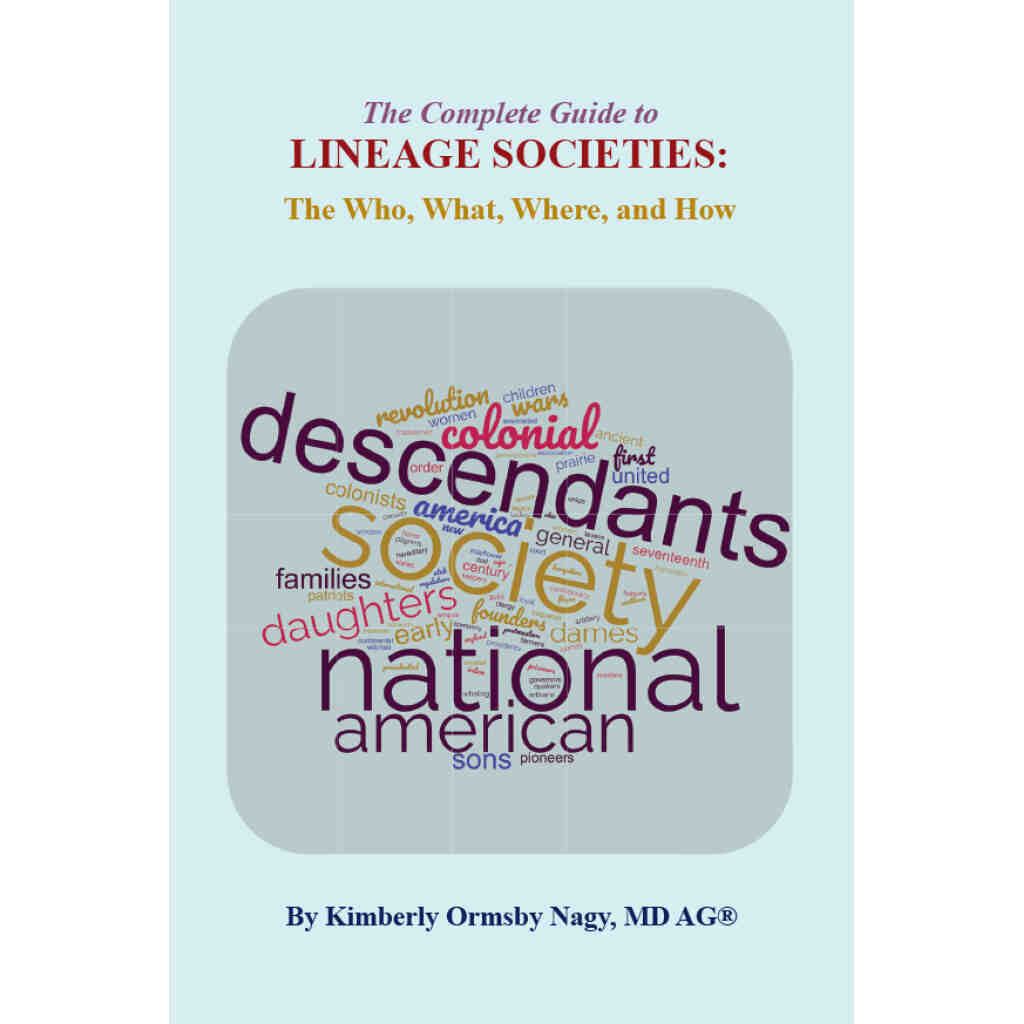
Book Review: The Complete Guide to Lineage Societies

The Complete Guide to Lineage Societies is a unique new book written by Dr. Kimberly Ormsby Nagy, an accredited genealogist who knows a great deal about lineage societies: She's a member of more than three dozen, and has been a Registrar for several societies. 

Now Dr. Nagy has written a concise and informative handbook about lineage societies, explaining what such societies offer, describing how membership works, exploring eligibility, and moving through the application process, step by step.

Considering that my husband's ancestral background could qualify him for several lineage societies, I was interested in this book and appreciated the author's ability to clearly capture the key points of who, what, where, and how in only 80 pages.

The table of contents for this new book is:

Chapter 1: What is a lineage society? The author explains the premise, which is to recognize and honor a specific group of people, such as early settlers in certain regions, those who fought in particular wars, descendants of royalty, and so on. 
Chapter 2: What does a lineage society do? In addition to honoring a certain group of ancestors, a lineage society's mission may focus on historic preservation, a charitable cause, education, or patriotism.
Chapter 3: How to locate a lineage society - A variety of suggestions for how to find and connect with a lineage society, online or on social media and beyond.
Chapter 4: Eligibility - This chapter looks at the two main elements of eligibility: lineage and service.
Chapter 5: Beginning the application process - What to expect when approaching a society about applying for membership.
Chapter 6: Documenting your lineage - One of the two main elements of eligibility is proven lineage from a qualifying ancestor. The author outlines acceptable types of lineage proof (not online family trees!) and provides helpful tips for finding and documenting descent from that key ancestor.
Chapter 7: Documenting your ancestor's qualifying service - The type of "service" is determined by each lineage society; some are based on military service, some on civil activities, some on occupations, etc. This chapter points readers in the direction of sources for service documentation. 
Chapter 8: Completing the application - Illustrated with pages from actual applications, this chapter guides readers through the process of putting specific info on the application for submission to the society.
Chapter 9: What next? Waiting for a response, and what comes after acceptance: going to meetings, reading publications, getting involved.
Chapter 10: Special considerations - A potpourri of possibilities, such as understanding whether collateral descent qualifies and lineage societies for children.
Appendix: Selected listing of lineage societies, some that are well known (General Society of Mayflower Descendants) and some not as well known (Hereditary Order of the Red Dragon), with web contacts.
Selected Bibliography: Books for lineage-related research and sources for researching the "service" of a qualifying ancestor. 

I recommend Dr. Nagy's book as a practical introduction to the world of lineage societies and a roadmap to moving through the entire process, from figuring out what society to join to gathering/documenting lineage and service proof and then working on the application. For readers with intermediate and advanced genealogy research skills, the resources named are likely to be mostly familiar--but curated with an eye toward what lineage societies require for an application to be approved.

Please note: The Genealogical Publishing Company sent me a free review copy of this book, and it has previously provided free review copies of other books. My reviews always reflect my honest opinions, without regard to any outside influence.

Thursday, August 1, 2024

Book Review: The Complete Guide to FamilyTreeDNA by Roberta Estes


Roberta Estes is the ideal author to explain the practical ins and outs of how to use the powerful tests and tools at FamilyTreeDNA. She's one of the gurus of genetic genealogy and a long-time blogger at DNAeXplained, so she has the scientific background and the writing skill to explain DNA testing and application in a step-by-step way, with examples that help make a very complex topic much more understandable.

As shown above, I've marked many pages to review and reread as I work my way through Roberta's comprehensive new book, The Complete Guide to FamilyTreeDNA, chapter by chapter. 

The brief table of contents is: 

  1. Types of Testing: Y-DNA, Mitochondrial DNA, Autosomal, X-DNA
  2. Setting Yourself Up for Success (how to get started on the FamilyTreeDNA website and provide enough detail to get the most out of testing)
  3. Y-DNA, Your Father's Story (Y-DNA in great detail, types of tests, matches, and more)
  4. Mitochondrial DNA, Your Mother's Story ("not X-DNA," mutations and haplogroups and so much more)
  5. Autosomal DNA, the Family Finder Test (features, matching, chromosome browser and on and on)
  6. X Chromosome, Unique Inheritance Path (a very clear explanation of the X chromosome inheritance path with fan charts and other illustrations)
  7. Ethnicity, MyOrigins (understanding the site's ethnicity estimates and painting population segments on your chromosomes, how to dig deeper)
  8. Advanced Matching (to avoid being overwhelmed by matches, learn to filter match results)
  9. Finding, Joining, and Utilizing Projects (explanation of DNA projects, how to join and get the most out of a project)
  10. Third Party Tools (Genetic Affairs and, yes, DNA Painter)
  11. Creating Your Step-by-Step Roadmap (specific recommendations for what to do when you decide to test and what to do with your results)
Even with Roberta holding my hand page after page, I can see that this process requires close concentration and a measure of time--no quick fixes. Get your spreadsheets ready and prepare for a super deep dive into the tiny details, learning about DYS markers, HVR1, parental phasing, and triangulation, and a lot more. 

The many TIP boxes scattered through the book highlight specific ideas and issues to be aware of. Also, I appreciate the convenient, concise glossary (pp. 231-247). Some terminology is very familiar to me, some is less familiar, so I like the ability to flip to the back of the book and look something up. 

However, I really wish this book had an index. Because endogamy is one of the big challenges I face in applying DNA to my own genealogical research, I would have turned to the index to see what Roberta says about endogamy in various chapters. Fortunately, she wrote about endogamy in a blog post here. So do try searching Roberta's blog as a companion to her book.

By the way, the illustrations in the printed book are NOT in color (because, I imagine, that would raise the price to astronomical levels). If you want to be a power user of FamilyTreeDNA, consider buying the digital version because those illustrations are in color--just like the screens you'll be viewing when you're on FamilyTreeDNA.

Full disclosure: I received a free review copy of the printed book from Genealogical.com but the views expressed in this post are entirely my own. 

Sunday, January 7, 2024

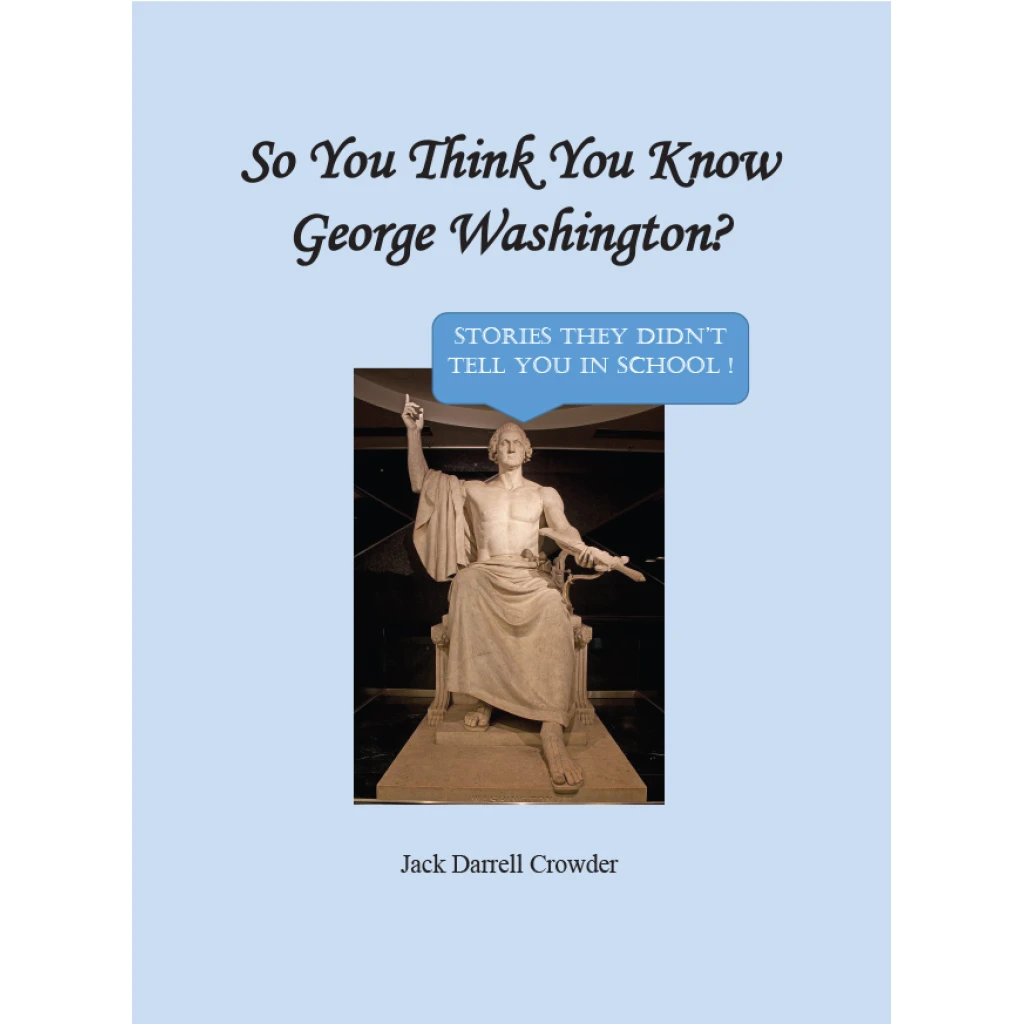
Book Review: "So You Think You Know George Washington?"


Because my birthday is February 22d, I'm of course interested in George Washington, who was born on that day. Actually, according to the Julian calendar used at the time, Washington was born on February 11th. When the Gregorian calendar was adopted in the American colonies in 1752, his birthday was adjusted to be February 22d. 

That's one of the factoids in the new book by Jack Darrell Crowder, So You Think You Know George Washington? Stories They Didn't Tell You in School! Crowder is a retired teacher and the author of other books about US history, including Victory or Death: Military Decisions That Changed the Course of American Revolution and Women Patriots in the American Revolution.

This new book does not have a traditional biographical narrative. Each chapter is a collection of sections about different aspects of Washington's life. Readers can dip in and out of any chapter, or any page, and read fascinating snippets about Washington's life and legend. 

Chapters are organized according to "The Man" (his early life, his humor, his romances, his religion, his occupations, and so on), "The General" (his military career, views of his military success, close calls, and more), and "The President" (dealing with the national debt, being chosen as president, choosing honorific titles for the President and Lady Washington, inauguration, end of second term, death). Since his presidency is so well known, and is the subject of numerous books, the last is the shortest section. Instead, Crowder devotes more space to dispelling myths about Washington's earlier life and his military career.

The author poses intriguing questions, and answers them, in a very readable way, such as:

  • How did Washington feel about slavery? (pp. 111-2, he never spoke out against it but later decided it was morally wrong)
  • Did he always favor independence for America? (pp. 135-6, he didn't start out in favor)
  • Did he kneel in prayer? (p. 87, he didn't like to kneel, but Martha Washington did kneel during prayer)

I particularly liked chapter 3, George Washington, Body and Soul, which opens with a section titled "Physical Appearance of Washington." In my mind's eye, he has powdered white hair, as he looked during his presidency. But actually the author describes him as having reddish brown hair, and being more than a bit of a dandy about wearing fine clothes.

Chapter 12 was also quite interesting, because it traces Washington's military career from 1752 to 1757, a period when he was involved in the French and Indian War, became "a hero...well, sort of" in 1755, and what he learned that would help him win the American Revolution.

Most of the illustrations look good, with the exception of some pixelated images. The author includes a lengthy bibliography for those who want to dig deeper. But I do wish the book had been more carefully proofread to avoid distracting typos. Finally, the list price of $45 seems a bit pricey.  

I tend to prefer traditional biographies rather than "stories they didn't tell you in school," but if you or your family want to learn more about George Washington as a man, a general, and a president, this book will fit the bill. 

Disclosure:  I received a free review copy from Genealogical.com, but I want to stress that the opinions in this book review are entirely my own.
Friday, March 3, 2023

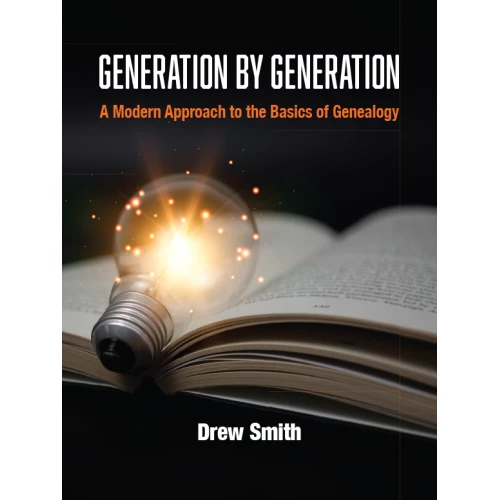
Book Review: "Generation By Generation"


Know any newcomers to genealogy? I encourage you to point them toward a new book designed specifically for people just starting their journey into family history: Generation By Generation, a Modern Approach to the Basics of Genealogy by Drew Smith, from Genealogical.com. Disclosure: Although I received a free copy from the publisher, the opinions in this book review are entirely my own.

Drew is well known as co-host of the Genealogy Guys podcast, founder of the Genealogy Squad Facebook group, and a frequent speaker on genealogy topics. One of his innovations is to organize the research chapters according to how we actually trace a family tree--starting with ourselves and going back in time, one generation at a time:

  • Generations after 1950 in the US
  • Generations from 1880 to 1950 in the US
  • Generations from 1850 to 1880 in the US
  • Generations from 1776 to 1850 in the US
  • Generations in British America before 1776

He also assumes that today's genealogy newbies will be relying on technology, both for research and for documenting family history. Chapter 4 is all about getting organized, with software, bookmarks, etc. Chapter 7 focuses on the four major online genealogy platforms (FamilySearch, Ancestry, MyHeritage, FindMyPast). Truly a modern approach! 

At 170 pages, this large-format book is well-illustrated and highly readable, making the genealogy process more accessible to newcomers. In short, I highly recommend Generation By Generation.

Note: In the introduction, Drew reminds readers to share family history so it can live on, a philosophy dear to my heart. Drew, if you ever write a second edition, my suggestion is to add a brief chapter with a few ideas about how newbies can do that, so ancestors will not be forgotten in the years to come.