Wednesday, April 22, 2026

Find a Grave Forums and GenEvents

At the bottom of every page, Find a Grave has quick links to various pages such as help and, as shown above, forums.

Although I've never participated in forum discussion groups, I was interested to see the blue banner on the forum page. When I clicked "Support Delays," I found this message, dated March 3, 2026:

Due to higher than normal volume we are running behind on processing email, edits, and merges and apologize for the delay. We appreciate your patience as we work through all the email, edits, and merges that have been sent in. You can learn more about these topics in the links below, provided for easy reference.

The actual forums, organized according to topic, have thousands of posts, as shown in this screen grab below. Any Find a Grave user can register and participate in these discussions by asking questions, answering questions, offering comments.


More: Look again at the screen capture at top of this post. To the right of the word "Browse" is "GenEvents." When I clicked that link, I discovered a calendar of genealogy events, as shown here: 


I usually look for genealogy events at ConferenceKeeper. Now that I've noticed these Find a Grave extras, which are free, I'll keep peeking from time to time. 

Sunday, April 19, 2026

Happy Anniversary to John and Sophie


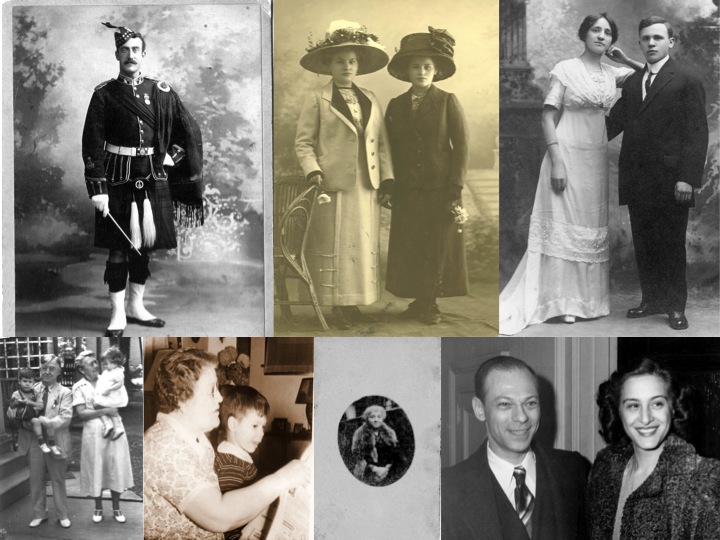
My husband's grandmother had a trio of brothers who rose to prominence as military bandmasters in Canada. Born into dire poverty in London, England, they prospered by joining the military early, with one ultimately settling in Toronto, one in Vancouver, and one in London, Ontario.

The most famous brother was John Daniel Slatter (1864-1954), who married Sophie Marie Elizabeth Le Gallais (1861-1943) on April 21, 1887 at Christ Church Cathedral in Montreal, Canada. They had three children together before John applied for and was appointed to the position that would make his name.

John became the second bandmaster of the 48th Highlanders Band in Toronto, Canada. He led the band for an astonishing 50 years as they toured the world for months and fueled the fad for kiltie bands. 

Here is the story of his appointment, from the Daily Mail and Empire newspaper of Toronto, published 25 January 1896, with my comments in brackets:

The Band Committee of the 48th Highlanders, composed of Major Cosby, Capt. Robertson, and Lt. Hamilton, have selected a successor to Bandmaster Griffin [founding bandmaster]. From a large number of applicants Mr. John Slatter, at present residing in Detroit, has been appointed as bandmaster, and will be here on the first of February [1896] to take charge. Mr. Slatter was highly recommended, and after a careful examination he was given the appointment.

Mr. Slatter, who is between 30 and 35 years of age [actually almost 32], is, in appearance, somewhat like the stalwart sgt-major of the Highlanders. He has served in the 7th Royal Fusiliers' and 1st Life Guards' bands, where he made a reputation as a soloist and instrumentalist, besides being considered a [musical] writer of merit. He has a thorough knowledge of military band music, and has been in the orchestra of the Grand Opera house here, and for a time a member of [John Philip] Sousa's band.

John and Sophie had four more children after Slatter took up his post in Toronto, although one baby sadly died in infancy. The couple enjoyed 55 years of marriage before Sophie's death during World War II. 

John continued to lead the 48th Highlanders Band until 1946. He received honors galore and maintained his devotion to military music throughout his life. 

Happy 139th anniversary to John and Sophie.

Wednesday, April 15, 2026

Unexpected: "Unlikely to Become An Efficient Soldier"


You just never know what handwritten notes you'll find on a document unless you put your eyeballs on the actual image, in addition to reading the transcription or index.

Case in point: In researching James, a New York-born man on my husband's side of the tree, I discovered that he volunteered for the Canadian Overseas Expeditionary Force in October, 1915, for World War I service.

At the time, James was a clerk living in Saskatoon, married with four children. The youngest child was just 2 years old!

Still, he volunteered, signed his attestation paper, and was pronounced physically fit by the physician who examined him.

Yet the handwritten note says he was "discharged Nov 1915, unlikely to become an efficient soldier."

Why? Because, depending on which birth year I believe, James was either 43 or 44 years old.

I'm not revealing his full name, but I am wondering what his wife thought about the idea of her husband, approaching middle age and with a growing family to support, volunteering for the military to get sent overseas. 

Was this unexpected and unwelcome news?! I've never seen a notation like this--quite unexpected.

"Unexpected" is this week's genealogy prompt for Amy Johnson Crow's 52 Ancestors in 52 Weeks series.

Monday, April 13, 2026

Book Review: Women Patriots in the American Revolution

 
Jack Darrell Crowder wrote Women Patriots in the American Revolution (Genealogical.com, 2018) to honor "the colonial women who were the secret weapons that the Americans had in the effort. They were the weapons the British could not control or defeat." As a former teacher, Crowder has devoted many years to studying the American Revolution and this is only one of several books he's written to examine various aspects of that pivotal period. 

This highly readable book shines a light on both well-known and little-known stories of women who exhibited courage and compassion during the fight for freedom. For a full alphabetical listing of the women featured in the book, including which the state where each woman lived, see Genealogical's post here.

The first half of Crowder's book is devoted to "Women Patriots," such as Margaret Cochran Corbin (1751-1800). Born in Pennsylvania, she married John Corbin a few years before the revolution. Her husband decided to join the fight against the British, and she became a camp follower--until he was killed in battle while firing a cannon at Fort Washington. Margaret, who had been at his side, took over his position and fired away, despite being shot and wounded. She was taken prisoner,  paroled, and hospitalized. Margaret later became part of a regiment that tended wounded soldiers at West Point. There she met and married a man who was recuperating and after he died, she successfully applied for a pension--highly unusual for a woman at that time and place. Years later, Margaret was memorialized with a monument at West Point.

The second half of the book is devoted to "Heroic Women of the Battle of Lexington and Concord," such as Elizabeth Page Stark (1737-1814). Known as Molly, she was well versed in the use of a gun when she married Major General John Stark. As the Battle of Concord and Lexington got underway, John took off so quickly that he left some gear behind. Molly realized what he needed, saddled up, and caught up with him many miles away to hand over the equipment. When John was about to go into the battle at Copp's Hill, Molly went on horseback into the surrounding area to rouse more Patriots for the fight.

While Molly and Margaret have been remembered by history, many of the women in Crowder's book are far less well known. I appreciate that each entry goes beyond names and dates, providing narratives and sometimes quotes from correspondence and historical publications to illuminate the stories of these women. In addition to a detailed bibliography and listing of sources, the index covers the women and the men in their lives. 

Some entries are fairly skeletal. Mrs. Whitall (no given name) was seated at her spinning wheel inside a fort during battle. Rather than fleeing in fear when a British cannon ball landed nearby, she simply moved to the basement and kept up her spinning. Compared with the activities of most other patriots in the book, Mrs. no-first-name Whitall and her spinning wheel don't really leap off the page.

Other entries have a great deal of color and depth. Emily Geiger was just 16 when she volunteered to carry a message from General Greene to General Sumter in 1781. A Tory woman and her daughter were asked to search Emily when she was detained by British scouts, but found nothing incriminating. The daughter recollected years later that the prisoner seemed to be "a sweet young girl about my own age, looking as innocent as a pigeon." In reality, the teenager had memorized the message and swallowed the paper. She was let go and went on to deliver the message verbally.

I'm sure the author is correct when he writes: "For every act of courage reported in this book there are hundreds of courageous acts that will never be known." This book is a worthwhile read for the many fascinating stories of women in Colonial America who played a role in the fight for freedom.

In this year of America 250, I appreciate books such as this for different perspectives on the revolutionary war period in US history.

Note: I received a complimentary copy of this book from Genealogical.com in exchange for an honest review. The opinions in this review are entirely my own and not affected by any outside influences.
Friday, April 10, 2026

This is WikiTree Connect-a-Thon Weekend

From Friday morning till breakfast time on Monday, I'm going to be busy adding dozens of ancestors to the free worldwide collaborative tree at WikiTree.

Hundreds of volunteers will be participating in teams, adding some friendly competition to an intense weekend of ancestor documentation. 

As shown in the table at top, previous "thons" have connected tens of thousands of new ancestor profiles to the worldwide tree, listing sources as well.

Once again I'll be part of Team L'Chaim, adding Jewish ancestors from every corner of my family tree (you know how I love in-laws and in-laws of in-laws). Also I plan to document non-Jewish ancestors from my husband's family (in-laws and well beyond). 

A few cousins have connected with me via ancestor profiles on WikiTree, so I'm looking forward to adding even more ancestors throughout this weekend. UPDATE: I added 73 ancestor profiles!

FINAL number of all profiles added over the weekend by all teams: 75,651.

Wednesday, April 8, 2026

Checking Out Newspaper Finder

 
Thomas MacEntee recently wrote about Newspaper Finder, a new website to help find newspapers in any of 32 databases. These include databases that are freely available (such as Chronicling America) and those behind a paywall (such as Oldnews.com, newspapers.com, etc.).

The founders of Newspaper Finder were frustrated with the process of locating newspapers for genealogy research because of the many different databases available. Now, instead of going database by database, users simply search by place/date range and Newspaper Finder shows all the newspapers available, organized by source. Here is a closeup of the databases covered by the search:


As noted on the search page, you can filter out certain databases (maybe you don't want to see results from fee-based databases, indicated by $). Maybe you want to exclude databases that are clearly outside the geographical area. You can also use the date range to narrow the search to avoid having too many results.

Example of a search and mapped result is at top. Here, I searched all databases for newspapers from Upper Sandusky, Ohio, between 1850 and 1980. My husband's grandma Floyda Steiner was from this area and I wanted to see more news items about her. 

Up popped a map of Ohio with pins for various cities in that area. By clicking on the Upper Sandusky pin, I could see the names of the newspapers, the dates, and which database has each. Also I looked at other pins nearby, such as Bucyrus, because I know newspapers sometimes had overlapping coverage.

If only I could click to go directly to each newspaper in the list...but at least now I know where to look. 

As reader Doris notes, we can click on the name of the newspaper and immediately go see it in the database where it is held! I tried it and it works well.

Easy and useful! Give it a try. 

Sunday, April 5, 2026

Easter Greetings Sent to Cleveland in 1914

Eight-year-old Wallis "Wally" W. Wood received pretty Easter postcards from two aunts in April of 1914. He lived in Cleveland, Ohio with his parents and three brothers, who ranged in age from 4 to 10 years old.

At right, the postcard sent by Aunt Nellie Wood Kirby from Chicago. Pretty flowers and a green countryside. Nellie was a sister of Wally's father.

Below, the postcard sent from Toledo, Ohio by Aunt Adelaide "Ada" Slatter Baker. Ada was a sister of Wally's mother. This postcard features a rooster standing atop a decorated Easter egg.

The families sent colorful penny postcards to the children for every occasion, from birthdays to Easter to Christmas. 

Happy Easter!


Wednesday, April 1, 2026

Full-Text Search Yields Unpublished Genealogy from 1959


Brick wall revisited: My husband's McClure line traces back to Halbert McClure (hubby's 5th great-grandpa) of Donegal, who with his family sailed across the Atlantic before 1740 and bought land to settle in Virginia . . . then his sons began fanning out south and west. I wanted to learn more about descendants from hubby's 3d great-grandparents, John McClure and Ann McFall McClure.

Using FamilySearch's full-text search, I searched for McClure as surname, McFall as key word, and Virginia as place. Just a few results from the top, I was able to find a big volume of typewritten (unpublished) genealogy from 1959, filled with helpful family history clues for this McClure line. The book's title is Pond-Adams Family and Allied Families.

I would probably not have found this book without full-text search, because the McClure section is buried deep inside the book, and the title doesn't even hint at any connection with my husband's McClure family tree. 

The careful researchers who compiled this genealogy are Rachel Adams Cloud Pond (a DAR Regent) and Chaplain Clifton Ray Pond (a member of SAR). They checked Census records, land records, family Bibles, and lots of other sources, specifically noting what they found and where (and what they didn't find). The authors also included family stories with comments about what could be confirmed.

For ease of understanding the various branches of this sprawling family tree, the authors separated the book into sections by surname. They thoughtfully included a detailed bibliography and multiple indexes for each surname section (one for the direct line, and one for in-law names, an interesting way to index). 

Above, one of several pages with info about the John McClure family. I knew that John McClure (1780-1834) had two wives, and Ann McFall was the first. This page transcribes and organizes birth, marriage, and death notes from the family Bible of John's second wife, Martha McClanahan McClure (1792-1876). I pasted the citation directly on the downloaded pages so I can retrace my steps in the future.

Several sources (such as this one) indicate John McClure and his first wife, Ann McFall (1780-1812) were married on April 8, 1801. I put my eyeballs on the handwritten notation from the time and confirmed the year as 1801. Happy 225th anniversary to these ancestors!

However, the Bible of John's second wife, Martha, lists that marriage as taking place on April 12, 1800. She began writing in this Bible during the 1860s, so I suspect she wasn't certain of the actual date of her husband's first marriage that many decades in the past. 

Family history from family Bibles are good clues, not necessarily facts. Still, sometimes Bible info is all I have for little babies who sadly died within a few days or weeks of birth, at a time/place when no registration took place. I'm chipping away at the McClure brick wall, one name at a time, and thankful for full-text search!

Lessons learned:

  1. Periodically redo searches, especially when new search technologies become available. I've been slowly repeating searches on the main surnames in my tree and my husband's tree and digging deeper into the full-text results from FamilySearch. It's going well!
  2. Don't judge a genealogy book by its cover. Check content (table of contents, index, and beyond) to see the various family names included. 
  3. Double-check Bible genealogy. Martha seems to be incorrect about the exact date of her husband's first marriage. I'll do my best to check other dates, knowing that some late 1700s/early 1800s records are scarce. 
Brick wall revisited is an April genealogy prompt from Amy Johnson Crow's series of 52 Ancestors in 52 Weeks.