Showing posts with label Kaplan. Show all posts

Saturday, April 25, 2026

Making a Living from a Manhattan Newspaper Stand in 1918


My uncle's future mother- and father-in-law ran a Manhattan newspaper stand during the second decade of the 1900s. In the 1910 US Census, Lena Kaplan Katz (1879-1963) gave her occupation as "newspaper keeper." In his 1918 draft registration card, her husband Litman Leon Katz (1881-1944) said he was self-employed, running a news stand at 53 East 30th Street. That address was just a few steps from a busy commercial district of New York City, half a mile south of Grand Central Terminal.   


As shown in the New York Public Library photo above, news stands also sold magazines, candy, gum, and other convenience items. News stands were everywhere--on city streets, near or in subway stations, inside hotels, at bus and railroad terminals. This was because the Big Apple was awash with morning, afternoon, evening, and weekly newspapers, many published in English and some in the various languages of those who lived and worked in the city. Papers were the definitive source of local, national, and international news in those days before radio and television.

I checked newspapers for, well, news about news stands during World War I, and discovered that distribution hit a snag in early February of 1918. The dealers who supplied papers to 5,000 local carriers ("newsies") went on strike in a dispute over money. At top, you can see a special box printed on the front page of the New York Tribune (Sunday, Feb 3, 1918), explaining the newspapers' position.

According to a New York Times report on Monday, Feb 4, thousands of people in New York City (and suburbs) had been desperate to get a Sunday paper on the previous day. They besieged news stands, publishing plants, hotels, and other locations where papers were ordinarily sold. The police had to restore order in a few instances, as demand surged well beyond supply. Publishers eventually used taxicabs to ferry any extra copies to outlying distribution sites.

I imagine that Lena and Litman sold out quickly that Sunday and then tried to obtain more newspapers. They definitely weathered the strike (since Litman's 1918 draft registration was dated that fall and he was still running the stand). By 1920, with World War I over, the couple converted their newspaper stand into a fruit stand and soon parlayed that into a grocery store. Later still, they ran a small restaurant, quite a different living from the modest newspaper stand they originally ran.

"Working for a Living" is this week's #52Ancestors prompt from Amy Johnson Crow.

Friday, June 24, 2022

Never Give Up! My Great Aunt Nellie Breakthrough

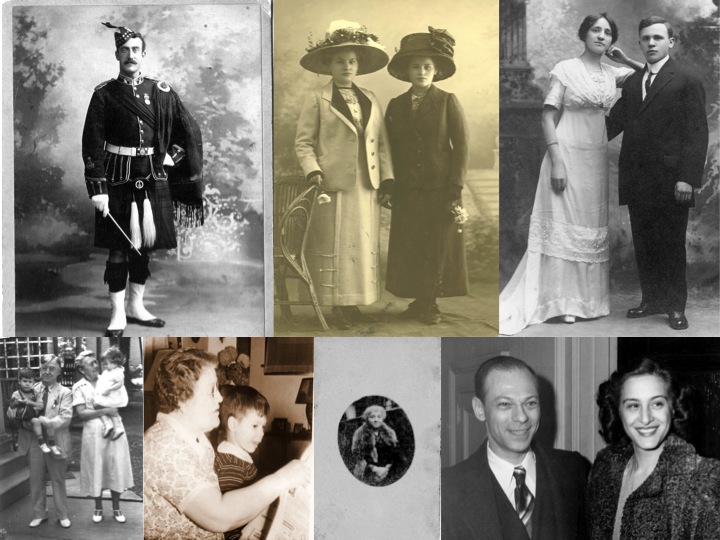
Photo of three Burk and Block ancestors

My heart holds a special place for ancestors who had no descendants. I try to research and memorialize them so their names and lives aren't forgotten.

This is the case with my paternal great aunt Nellie Block, born in Gargzdai, Lithuania (?-1950). She was the oldest sister of my grandfather Isaac Burk (1882-1943). It wasn't until I connected with second cousins a few years ago that I could even put a name to the face I found in my parents' wedding album and elsewhere. 

Cousins said they remember great aunt Nellie as kind and attentive, someone who enjoyed family gatherings. In the photo above, she is the elegantly-attired lady in lace, standing between a younger brother on one side and a younger sister on the other.  

Single or widowed?

For a long time, I thought Nellie was a maiden aunt. More than a decade of research had only turned up a Census where she was recorded as S (single). In fact, she wasn't coming up in my repeated searches of US Census documents from 1920, 1930, and 1940, even when I searched on multiple sites (because each indexes the Census in its own way).

A couple of years ago, I was able to obtain Nellie's death certificate. The informant was her brother, who said Nellie was widowed. That was news.

In April of this year, I found Nellie enumerated in the 1950 US Census, where she was shown as...widowed! Two sources said she was widowed. Hmm.

Curiously, Nellie Block's 1950 US Census entry and her death cert both refer to her surname as Block, with no married name ever mentioned. Even in the 1930s, when an English cousin invited Nellie to a wedding, she addressed the invite to "Nellie Block." 

But searching for years, I found no indication of any marriage. 

My secret weapon

Just the other day, one of my cousins asked about Nellie. We compare notes about brick walls from time to time, and he remembered Nellie as one of mine.

Because of his gentle nudge, I redid my search for Nellie. Lo and behold, up came a record transcription for a 1916 marriage to Samuel Kaplan in Manhattan, NY, in April of 1916, along with the cert number. There are a LOT of Nellie Block marriages in search results, but now I have a secret weapon to dig deeper into Big Apple records.

Since early this year, the New York City Municipal Archives has offered FREE access to digitized vital records from roughly the late 19th century to the Depression era. You should first try to find the cert number, borough, and year, otherwise you'll be browsing till the cows come home.

Because the actual digitized records are free to view, I had nothing to lose by searching for the Block-Kaplan marriage cert. I input the details and up came a pdf. I wanted to view the cert with my own eyes, not rely on the transcribed info.

My Nellie?

Reading the cert, I saw Nellie listed as single, 30 years old, born in Russia, her first marriage. Samuel Kaplan was 38, widowed, a jeweler born in Russia, son of Isaac Kaplan and Sarah Freedman, being married for the second time. 

I never heard of Samuel Kaplan, but it only took a moment to determine this was my Nellie's marriage cert. First, the mother's name was very close to what she said on other documents. Second, the father's name was a family surname I know. 

The clincher was the place where the ceremony took place: 7 East 105th Street in Manhattan. That's the apartment building where Nellie's sister-in-law lived. My Nellie!

Next step

I've just sent $18 to the NYC Municipal Archives to obtain the three documents related to Nellie's wedding: the marriage license application, affidavit executed by bride and groom, and actual marriage license original. You can learn more about how this works via the FAQs here.

Although I may have to wait a few weeks, I'll get lots more info on Nellie and her husband, especially from the affidavit. I hope to trace the life of Samuel Kaplan, who seems to have died before the 1950 US Census was taken.

So never give up! New records become available all the time and database indexing improves all the time. In this case, the bonus secret weapon of free NYC vital records helped me across the finish line for this breakthrough, confirming that my great aunt Nellie Block had, indeed, been married.
Thursday, February 20, 2020

Philip Markell's Path to Prosperity

Naturalization index of Philip L. Markell
One of my favorite in-law families is the Markell family. My paternal great-aunt Mary Mahler (1896-1979) married Joseph A. Markell (1895-1975) in 1921. Mary was one of the match-maker aunts who set up the date on which Dad met Mom. No wonder I'm really interested in these in-laws!

Through research, I learned that great-uncle Joe's father, Barney (Benjamin) Markell, and three of his brothers left Vilna, now in Lithuania, to come to America before 1905.

Philip L. Markell (1880-1955), the eldest brother, followed a non-linear career path from newly-arrived immigrant to achieve solid economic status fairly quickly. What I particularly appreciate is that he was able to adapt to the times, over and over throughout his life.

Philip Arrives, Enlists, Is Sent to the Philippines and Back

Philip Markell landed in Boston on December 20, 1894, part of a wave of Eastern European Jews fleeing to America. He was nearly 15 years old.

From Eastman Museum collection
At age 19, he enlisted in the U.S. Army for a three-year period of service beginning in January, 1899. The enlistment shows his occupation as "florist."

In 1900, he was enumerated as part of the 9th Infantry in the Philippine Islands, during the Philippine–American War.

Having served his three years in the army, he was discharged "at sea on Kilpatrick" in January, 1902. Above, an early photo of the U.S. Army Transport Kilpatrick, which entered service in 1875 and was retired in 1914, a dozen years after Philip sailed back from his Army service.

Salesman, Merchant, Manager, and Moving Pictures

In 1910, Philip was enumerated in a Jersey City (NJ) boarding house as a salesman of sewing machines. As shown at top, he was naturalized in 1911. In 1912, when he married Etta Kaplan (1890-1967), Philip told Boston authorities he was a "merchant."

When Philip filled out his WWI draft registration card in 1918, he and his wife Etta were living in Dorchester, just outside Boston, and he said his occupation was "manager in a baking plant."

By 1920, Philip was telling the U.S. Census that he was a "commercial traveler" (meaning salesman).

By 1923, however, Philip had switched careers. He was manager of the Roxbury Theatre in Roxbury, MA, where he remained well into the 1930s.

In the 1930 Census, his occupation was "manager, moving pictures," referring to his position at the Roxbury Theatre. But possibly there was more!

From Theaters to Sales

According to a news story, Philip and his brother Barney Markell were partners in owning the Atlas Theater in Adams, MA, a large opera house that very likely showed movies at that point. The Markell brothers sold it in 1935. (The theater burned down in 1937, by the way.)

A 1931 news story showed a Philip Markell as part of a group incorporating the Franklin Theater corporation in Springfield, MA. There was a Franklin Theatre operating there in the late 1930s, but I didn't find any documentation that Philip was actively involved at any point.

By 1933 and for years after that, Philip was again listed as a "salesman" in the Boston city directory. On his WWII draft registration card in 1942, he was listed as a salesman, age 60.

Moving pictures were quite the thing in the 1920s and 1930s, and Philip was in the right place at the right time. Although I don't know why he left the business, I do know he was quite adept at adjusting his careers to the changing times--from florist to soldier to salesman to merchant to manager to moving pictures to salesman.

This is the prompt for week 8 of Amy Johnson Crow's #52Ancestors series for 2020.