Sunday, January 7, 2024

Book Review: "So You Think You Know George Washington?"


Because my birthday is February 22d, I'm of course interested in George Washington, who was born on that day. Actually, according to the Julian calendar used at the time, Washington was born on February 11th. When the Gregorian calendar was adopted in the American colonies in 1752, his birthday was adjusted to be February 22d. 

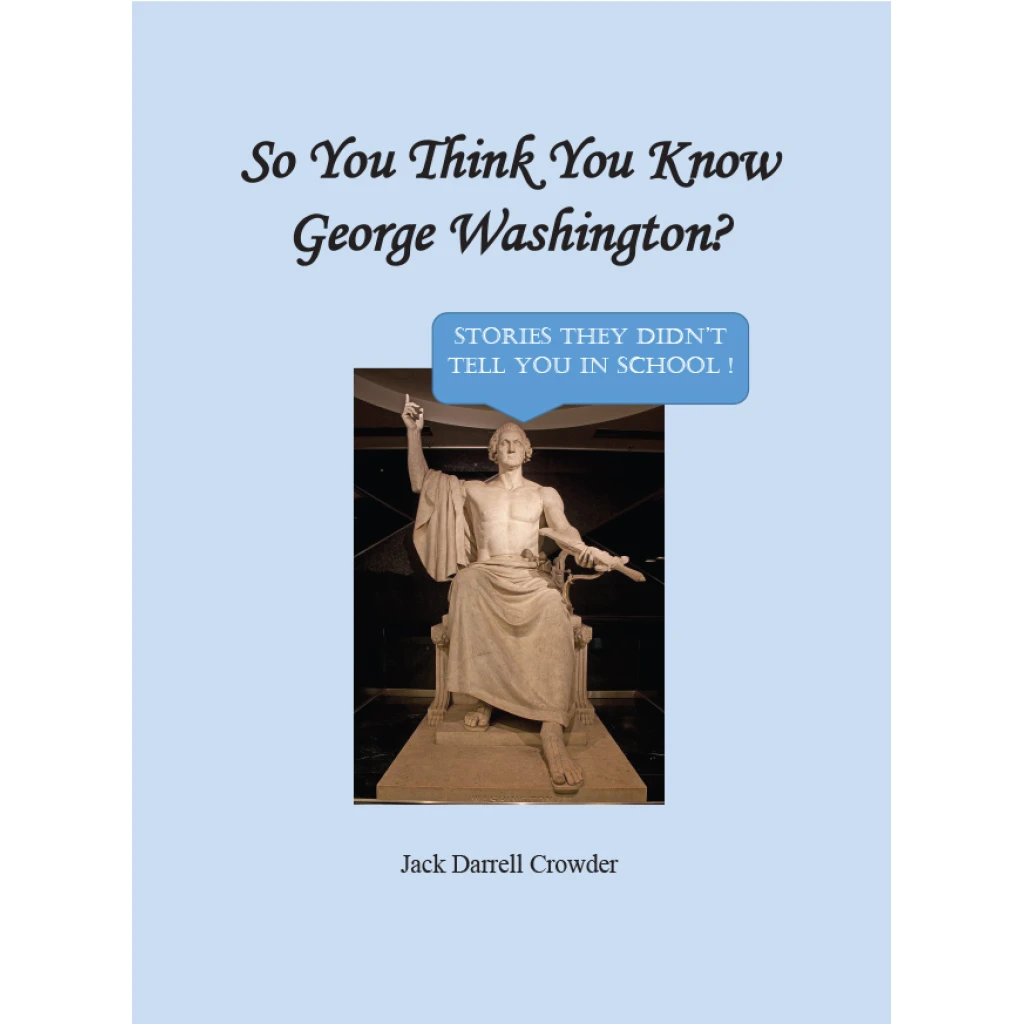
That's one of the factoids in the new book by Jack Darrell Crowder, So You Think You Know George Washington? Stories They Didn't Tell You in School! Crowder is a retired teacher and the author of other books about US history, including Victory or Death: Military Decisions That Changed the Course of American Revolution and Women Patriots in the American Revolution.

This new book does not have a traditional biographical narrative. Each chapter is a collection of sections about different aspects of Washington's life. Readers can dip in and out of any chapter, or any page, and read fascinating snippets about Washington's life and legend. 

Chapters are organized according to "The Man" (his early life, his humor, his romances, his religion, his occupations, and so on), "The General" (his military career, views of his military success, close calls, and more), and "The President" (dealing with the national debt, being chosen as president, choosing honorific titles for the President and Lady Washington, inauguration, end of second term, death). Since his presidency is so well known, and is the subject of numerous books, the last is the shortest section. Instead, Crowder devotes more space to dispelling myths about Washington's earlier life and his military career.

The author poses intriguing questions, and answers them, in a very readable way, such as:

  • How did Washington feel about slavery? (pp. 111-2, he never spoke out against it but later decided it was morally wrong)
  • Did he always favor independence for America? (pp. 135-6, he didn't start out in favor)
  • Did he kneel in prayer? (p. 87, he didn't like to kneel, but Martha Washington did kneel during prayer)

I particularly liked chapter 3, George Washington, Body and Soul, which opens with a section titled "Physical Appearance of Washington." In my mind's eye, he has powdered white hair, as he looked during his presidency. But actually the author describes him as having reddish brown hair, and being more than a bit of a dandy about wearing fine clothes.

Chapter 12 was also quite interesting, because it traces Washington's military career from 1752 to 1757, a period when he was involved in the French and Indian War, became "a hero...well, sort of" in 1755, and what he learned that would help him win the American Revolution.

Most of the illustrations look good, with the exception of some pixelated images. The author includes a lengthy bibliography for those who want to dig deeper. But I do wish the book had been more carefully proofread to avoid distracting typos. Finally, the list price of $45 seems a bit pricey.  

I tend to prefer traditional biographies rather than "stories they didn't tell you in school," but if you or your family want to learn more about George Washington as a man, a general, and a president, this book will fit the bill. 

Disclosure:  I received a free review copy from Genealogical.com, but I want to stress that the opinions in this book review are entirely my own.

Thursday, January 4, 2024

Book Review: "Valiant Women"


If any of your female ancestors served during World War II as one of the 350,000 WAAC/WACs, WAVES, SPARS, MCWRs, or WASPs in uniform, I heartily recommend reading Valiant Women by Lena Andrews.

Andrews has written a very engaging, informative history of "the extraordinary American servicewomen who helped win World War II," who resumed their civilian lives with a sense of satisfaction but little or no public acknowledgement of their indispensable roles in the military. As the author notes, women in uniform were part of the "Greatest Generation" yet their WWII roles are often overlooked.

Rocky road to women's service

The book's main focus is the sometimes rocky road to establishing US military women's programs, recruiting women with the right skills, and putting them in the right places to support the US war effort. The US Army was the first of the armed forces to create a women's service, going all out to attract the best and most skilled women--which it did, with thousands and thousands applying to enlist. On the other hand, Andrews shows how the leaders of the US Marines were much less enthusiastic about a women's program, although they ultimately went along with the idea. 

The story behind each service's approach to women in the military is fascinating. The author has a knack for putting a lot into a few words and holding the reader's interest throughout. And she does a superb job of sketching historical and military context without slowing down the story, which gets pretty lively.  

Quotes add personality

The personal memories and experiences of female veterans, based on author interviews, bring to life the social and bureaucratic obstacles they had to overcome in order to serve their country. From the historical record and from their own words quoted in the book, it's clear that women in uniform strove to do their very best at any and every assignment, from pilots and stenographers and mail sorters to translators and chemists and map-makers. Andrews deftly captures the essence of their experiences, both the ups and the downs, whether the women served stateside or overseas.

My aunt, WAC Sgt. Dorothy Schwartz, was an expert stenographer, one of the top in her unit. I can see echoes and confirmations of her experiences in Valiant Women. In the book, a WAVE thinks back to her wartime assignment, creating oceanographic maps for the US military. "I confess I was terrified at all of the complications," she admits, knowing how essential the charts were to Allied commanders. My aunt felt similarly as she transcribed orders for bomber crews: many lives were at stake, so her transcriptions had to be accurate as well as speedy. It was a huge responsibility, and what she did made a difference every day. 

Honoring Capt. Stratton

The final section in Valiant Women examines how women's WWII service led the way for women to become part of the regular armed forces and military reserves in the post-war era. Andrews ends with the commissioning of the US Coast Guard Cutter named for a veteran, Captain Dorothy Stratton, who headed women's Coast Guard services in WWII. Capt. Stratton gave the program its name, SPARS, drawing on the Coast Guard's slogan, "Semper Paratus--Always Ready." 

Highly recommended: Valiant Women by Lena Andrews.

Wednesday, January 3, 2024

Two Birth Years in Family Lore for Minnie


What if family lore indicates two different dates for an ancestor's birth year? These two notes were handwritten by hubby's grandfather, Brice Larimer McClure. One of his sisters-in-law was Minnie Estella Steiner Halbedel, who died on this day in 1947, as shown in the note above (see blue line). Brice recorded Minnie's birth year as 1867 in that note.


Here's a second note, written at a different time by this same man, with Minnie's birth year recorded as 1868

So which year is correct? 

AI Record Finder says birth was in 1868

I asked MyHeritage's new AI Record Finder to locate church records for Minnie, providing her full name and birth place to get the process started. In response, I received several family tree records (from MyHeritage and FamilySearch), but no church records. 

Then I asked: "Show me birth info to prove Minnie's birth in 1868." The AI's response: "The records confirm that Minnie Estella Halbedel (née Steiner) was born on May 1, 1868, in Ohio. Her parents are listed as Edward George Steiner and Elizabeth Jane Steiner (born Rinehart). These details substantiate her birth date and place for your genealogical inquiry." 

Well, no. All that was shown were family trees asserting Minnie's birth year was 1868. No proof as such. Since no official birth records are available for the time and place of Minnie's birth, and church records from that time/place are scarce, how could I resolve the conflicting dates in family lore?

My research: census records, obit, death cert, gravestone

I looked at what Census data, obits, and the death cert said about Minnie's age at different points in her life, and also looked at her gravestone. I found out:

  1870 US Census - Minnie was 3 years old (implied birth year 1867)

  1880 US Census - Minnie was 13 years old (1867)

  1910 US Census - Minnie was 42 years old (Census was taken weeks before Minnie's May birthday) (1867)

  1920 US Census - Minnie was 52 years old (Census was taken weeks before Minnie's May birthday) (1867)

   1930 US Census - Minnie was 63 (Census was taken weeks before Minnie's May birthday) (1866)

   1940 US Census - Minnie was 73 (Census was taken weeks before Minnie's May birthday) (1866)

    Obituaries: Two obits noted Minnie's age as 79 when she passed away (implied birth year 1868)

    Death cert: Informant was Minnie's youngest sister, Floyda, who gave the birthday as May 1, 1868. The cert showed Minnie's age at death as 78 years, 8 months, 2 days (calculation agrees with birth year of 1868).

    Gravestone: Birth year is shown as 1867. Not the same as the death cert!

1867 or 1868?

Ordinarily, I would put more weight on what a sibling says on a death cert than on what a Census says. The informant, a sister, should know her sister's birth year. She said on the cert that it was 1868. Yet the gravestone shows the birth year as 1867, so one of the sisters or more of them believed that was the correct year.

Contemporaneous Census records of 1870-1920 point to a birth year of 1867. I put considerable weight on earlier records like these since parents are likely to know when their children were born and what their ages are.

A bit murkier: IMHO both the 1930 and 1940 US Census enumeration answers were probably meant to suggest a birth year of 1867, with the assumption that Minnie's age was "approximately 63" in 1930 and "approximately 73" in 1940. In other words, even though Minnie's birthday was a few weeks later than the date of the Census, her age was recorded as though she had already celebrated her birthday. That's what I think, anyway.

My conclusion: Minnie was almost certainly born in 1867. The detailed note about family lore most likely had the correct birth year, 1867; the briefer note about sibling birth years was most likely incorrect in asserting 1868.

Given the scant info available to MyHeritage's AI Record Finder, I understand why it told me the birth year was 1868. Yet the AI seemed so certain! Not me. I thought it was worth digging deeper. Then again, these are my husband's ancestors.

"Family lore" is the first #52Ancestors genealogy challenge of 2024 from Amy Johnson Crow. 

Monday, January 1, 2024

Soaring into the New Year with Good Luck


To start the new year in 1910, a Wood cousin received this penny postcard featuring good luck symbols and a couple of youngsters flying high in a new-fangled flying machine LOL. 

May your 2024 start with much good luck!

Saturday, December 30, 2023

Happy New Year 2024 with a 1909 Greeting

In 1909, a Wood cousin in Toledo, Ohio sent this colorful penny postal greeting to his four-year-old first cousin in Cleveland, Ohio. 

Usually the postcards sent to this little boy were written by other children. This New Year's greeting was written by an 18-year-old cousin who had flowing cursive handwriting. Tracking him through the 1910 US Census, I learned he soon had a job in a local drug store.

May you enjoy all the luck of a bouquet of four-leaf clovers in 2024 and have a healthy new year! 

Friday, December 29, 2023

Big Focus on LOCKSS Online

Back in 2018, which was the 20th year of my genealogy journey, I began using RootsMagic. First, I really wanted to be able to sync with Ancestry and have my family trees handy on my own computer. Second, I wanted Mac software, with a roster of robust features that wasn't too complicated to learn. RM7 worked well for me for several years.

When I upgraded to RootsMagic 8, I liked the colorful new interface, but the software didn't always sync properly. I admit I didn't want to invest a lot of time trying to learn the bells and whistles, because to my mind, that took precious time away from my research and documentation. Plus this software is only on my computer, and my heirs are very unlikely to be excited about learning specialized software just to access the family tree. 

Dear readers, I recognize that some folks are very much into genealogy software. They know all the ins and outs and they appreciate the convenience. I just didn't have the ooomph to make it up the learning curve. Turns out, genealogy software just isn't my thing. 

Lots of copies keep stuff safe

As I enter the 26th year of my genealogy journey, I am more determined than ever that my family history will live on, for relatives and for researchers interested in my ancestors. Booklets and photo books are great for my immediate family, but I'm thinking longer-term.

That's why I've been expanding my trees on Ancestry, MyHeritage, and WikiTree, as well as posting bite-sized ancestor bios on those sites plus FamilySearch, Find a Grave, Fold3, and elsewhere. Of course, I continue to tell family stories and explore genealogy questions on this blog, which is in its 16th year. 

I'm putting my faith in LOCKSS--lots of copies, spread across many online genealogy sites, should keep stuff safe for the future, in 2024 and well beyond.

Tuesday, December 26, 2023

Two Weddings in 1937 for the Burk Family


On the morning of December 26, 1937, my aunt Miriam Burk (1911-1987) married millinery salesman David Bourstein (1907-1982) in New York City. They're the handsome young couple in the photo above, flanked by her father Isaac Burk (1882-1943) and Henrietta Mahler Burk (1881-1954).

The Depression was still underway, but when Dave proposed (he told his son years later), he showed Miriam his bankbook as proof that he could support her when they were married. 

Earlier in 1937, Miriam's older sister Mildred Burk (1907-1993) had married hairdresser Charles Lang (1906-1968), who went on to open his own beauty salon in the Bronx after World War II. 

Miriam and Dave were married at a relative's apartment, surrounded by both families. My father Harold was there, an aspiring travel agent at age 28, along with his brother Sidney, the "baby" of the Burk family at age 23. The day was mild for late December, with no snow on the ground, according to Extreme Weather Watch

The Boursteins shared 44 years of marriage before Dave died at the age of 74. Miriam outlived her husband by five years. The Langs were married for 31 years before Charlie died at the age of 62, outlived by Millie, who died at age 86.

Remembering my aunts and uncles on this anniversary of the Bourstein wedding.

Monday, December 25, 2023

Christmas Greetings Via Penny Post Cards in Ohio


Here is one of the colorful penny postal greetings sent to my husband's uncle in Cleveland, Ohio, every Christmas from 1907 to 1914. 

I was surprised to learn, from Smithsonian Magazine, about the history of Christmas penny postcards--all because someone wanted to streamline his holiday correspondence. 

Wishing you and all those dear to you a very merry Christmas.

Sunday, December 24, 2023

Heirloom Wreath and Snowflake for Christmas Eve

This delightful wreath is made up of handprints from my grandkids, traced and cut from felt and then glued onto a cardboard ring. The names/dates were written on the cardboard backing.

Another favorite holiday decoration is this grandchild recreation of a snowflake. 

We hang these handcrafted heirlooms on our front door every holiday season. The colors have faded a bit, but the memories are bright and merry.

May you have a peaceful and joyous holiday!

Saturday, December 23, 2023

Keeping Our Own Memories Alive for Today and Tomorrow


The final genealogy prompt in Amy Johnson Crow's #52Ancestors challenge for 2023 is "me, myself, and I."

Since 2007, I've created photo books featuring photos from my hubby's and my activities and adventures, big vacations, and family reunions. Above, a small sample of these books. Inside, the photos are arranged chronologically from January to December, and captions explain what's happening in each photo. Every so often, I pull a book off the shelf, leaf through, and relive those memories, happy that the photos are conveniently available.

At least once in each book, I caption a group photo with full names. Why? Although we all know who everyone is today, future generations may not recognize some people. How I wish I had inherited more photos with full names and dates! I'm learning from that experience by captioning as completely as I can.

Books or albums are a great way to get family photos off our phones and into print so others can see them too, IMHO. 

In the far future when my hubby and I join our ancestors, we hope these photo books will be enjoyed by those who come after us. Meanwhile, I'm currently working on the 2023 retrospective photo book of our "adventures."

Thank you to Amy Johnson Crow for the gift of #52Ancestor genealogy prompts throughout 2023, and now a new set of prompts for 2024.

Sunday, December 17, 2023

Keep Those Cousin Connections Alive!


As 2023 winds down, I've been updating my cousin connections. I don't want to lose track of these relatives in the coming years! How I wish I had inherited something like this. My Mom's handwritten 1960ish address book was as close as I got to such a listing, except she didn't explain any relationships.

I maintain a digital document so I can sort alphabetically if I'm looking for a particular set of cousins or if I want to search the entire document for specific words/dates. My notes column lists the exact relationship and any other pertinent details. Don't forget maiden names, nicknames.

My Sis now has a copy of the updated version so she's aware of our cousin connections on both sides of the family tree. We've met many of these cousins in person, but others we've only "met" via email or phone. 

As a new year's resolution, please do yourself and your family a favor and create or update a listing of cousin connections. To make it easy, go ahead and borrow or adapt my format, which is also in my popular genealogy book, Planning a Future for Your Family's Past.

"Cousins" is Amy Johnson Crow's genealogy prompt for week 51 of her #52Ancestors challenge for 2023. 

Tuesday, December 12, 2023

Looking Ahead to 2024 Genealogy Priorities


Well, 2024 is nearly here! It will be my 26th year of genealogy obsession, I'm happy to say. Also, 2024 will be my 16th year of genealogy blogging.

In the coming year, my priorities will be:
  • Create a family history photo book about my husband's paternal grandparents. This is likely to be the longest and most detailed of my photo books, because I have a lot to share (research, photos, stories) about James Edgar Wood and Mary Slatter Wood, and their siblings. I'll blog as I work on it.
  • Continue writing and posting bite-sized bios of ancestors. Some bios I've already written form the basis of content in my photo books...and vice versa. Over time, I'm posting brief ancestor bios on WikiTree, Find a Grave, Fold3, FamilySearch, MyHeritage, and more.
  • Switch old photos from archival sleeves to safe, convenient photo albums, a project that fell to the back burner in 2023. I love working on old photos when there's a big snow storm outside. So if January in New England turns out to be snowy, my photo project (including captioning) will gain momentum.
  • Continue redoing research on focus ancestors, as new info becomes available and as I try different sites. In 2023, I learned how my husband's maternal grandparents met, by researching the social columns in newspapers that only recently were digitized. More of that in 2024. Also, I love learning more about in-law ancestors. Sometimes researching them gives me a clue about a direct ancestor OR gives me context for understanding family dynamics of the past.
  • Slim down and reorganize surname file folders. I'm slowly pawing through my surname file folders, consolidating/digitizing research notes, tossing unneeded paper (like printed-out census pages). This is another wonderful snowy-day activity that usually sends me down a rabbit hole as I follow up on something I forgot about or didn't understand the first time I saw it.
  • Genealogy programs, education, connections. I'm still making presentations, still taking webinars, and will be attending some local genealogy meetings in 2024. Most important to me, I'm keeping alive the cousin connections I've made in my years of researching family history. 
  • Saving family history in institutions. I still have a few items from family history that I'll be donating to institutions in 2024. More about that in upcoming posts. 
Dear readers, I wish you a new year of peace and a tree full of genealogy fun!

Sunday, December 10, 2023

Looking Back at 2023 Genealogy Results

As 2023 begins to fade into the history books, a look back at what I thought my priorities in genealogy would be this past year--and what they really turned out to be.

My planned genealogy priorities for 2023

One year ago, I set five priorities for my genealogy activities in 2023: (1) continue writing/posting bite-sized ancestor bios, (2) resume my photo album project, (3) redo research about ancestors of particular interest, (4) continue my genealogy presentations, and (5) further my genealogy education. Oh, and I wanted to clean out the unneeded scribbled notes in my surname files.

My actual genealogy priorities in 2023

Family-history photo books (a variation on bite-sized ancestor bios) turned out to be my absolutely top priority this past year, something that wasn't on my list at all. Why? Because in February, relatives asked questions about what our ancestors did during World War II. I wanted to provide answers that could be saved and reviewed again and again.


In response to the questions, I created my first-ever family-history photo book about ancestors in WWII. It was only 6 inches by 6 inches, with colorful front and back covers (see image above, from back cover) and 20 pages of info about my Dad (US Army), my uncles (US Army), my aunt (WAC), and my parents' cousins who served in the war (in the US Army, US Army Air Corps, US Marines, US Navy, and National Guard units). 

This tiny book was a big hit with the next generation! So I went "all in" on family-history photo books during the year, creating one about my maternal grandparents, one about my paternal grandparents, and one about my Mom and her twin sister. All were well received. Just last month, I completed a photo book about my husband's maternal grandparents, and last week I reordered copies for other relatives after previewing and editing one copy. In all, a very worthwhile priority that will continue into 2024.

In addition, I wrote many bite-sized bios of ancestors to post on WikiTree, Fold3, Find a Grave, and other sites, as I originally planned for 2023, and will continue into 2024. 

I began cleaning out handwritten notes from my surname files, saving the info as comments on my trees or otherwise consolidating for less paper clutter. This is something I usually do on the fly while looking for other info in those files. 

What slipped to 2024

When those photo books jumped onto the front burner, other priorities had to wait. Now on the back burner is my photo album project, which will show up on the "to do" list for 2024 (more on that in another blog post). 

Also slipping to 2024 was some (not all) of my in-depth research on particular focus ancestors, particularly those from Eastern Europe. I'm pursuing a couple of leads and may yet have an interesting breakthrough before the end of 2023. 

Genealogy presentations and education

I gave more than a dozen virtual presentations live in 2023, and already have dates lined up for 2024. Continuing my own genealogy education, I watched dozens of excellent webinars (both live and recorded) from a variety of sources: Legacy Family Tree Webinars, Virtual Genealogy Association, WikiTree Symposium, Allen County Public Library Genealogy Center, Center for Jewish History, Jewish Genealogy Society of CT, Kentucky Genealogical Society, and other genealogy groups around the country. I really appreciate the opportunity to learn from experts.

Tip: Always download the handouts when available! Maybe I can't use all of the info or instructions right away, but I might want to consult the handout in the future. I have one digital file where I store handouts and conference syllabi from the past decade. Thank you to the many speakers who put so much detail into their handouts! 

Wednesday, December 6, 2023

Previewing and Editing Family History Books


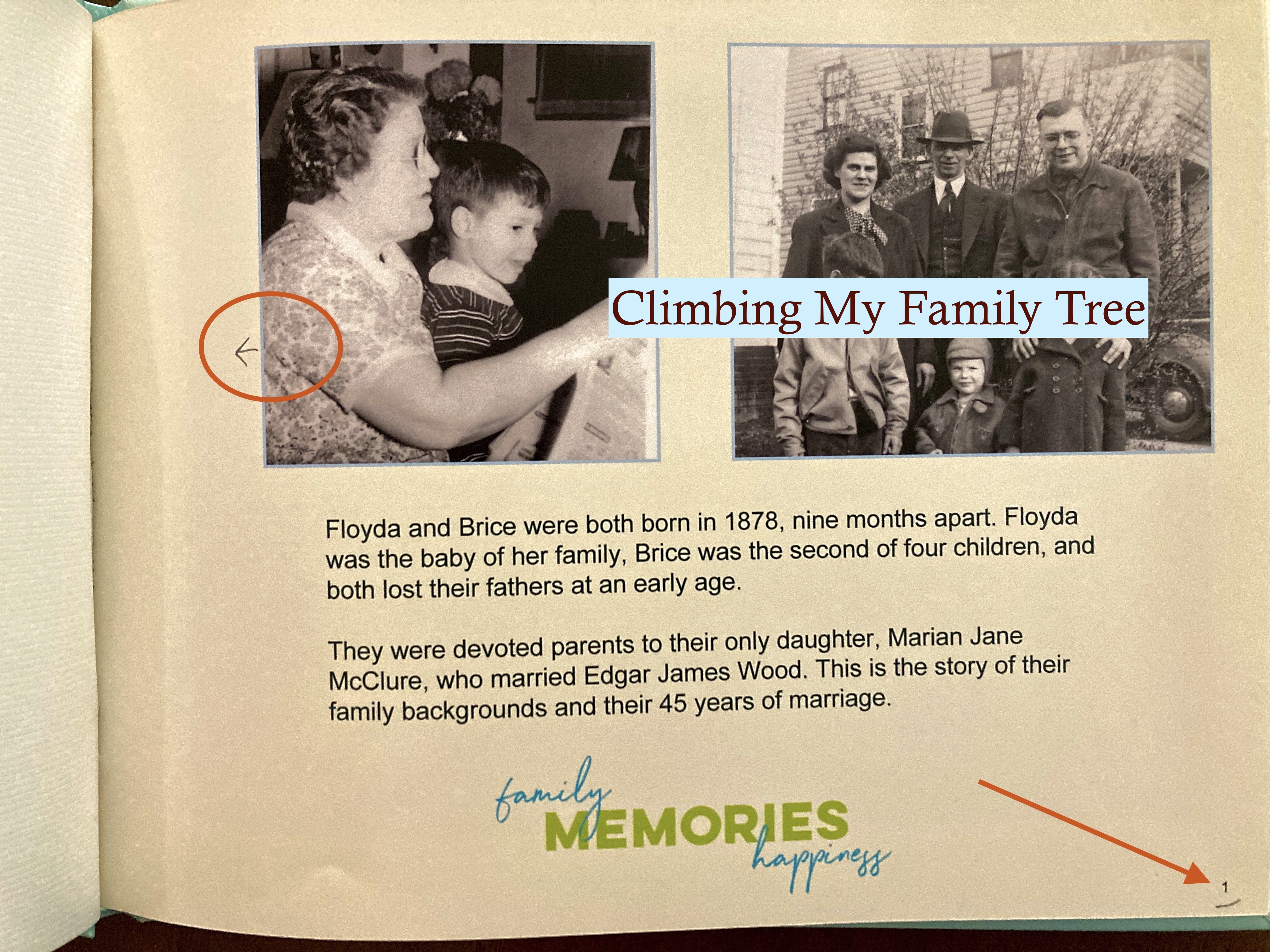
Last month, I ordered one family history photo book so I could preview it before ordering multiple copies for relatives on my husband's side of the family. The main subjects are Floyda Mabel Steiner (1878-1946) and Brice Larimer McClure (1878-1970).

I've spent much of 2023 creating such professional photo books so I can memorialize ancestors for the sake of descendants who want to read the "story" rather than just looking at a family tree or a couple of photos. The books include a tree and many old photos, but also quotes from the ancestors and memories from descendants.

Preview copy for my edits and recipients' comments

The preview allowed me to see what the cover and pages look like, in print, as a final check. Sure enough, I noticed little things to improve AND little things to add.

In addition, I showed recipients the preview book and they took time to look at each page, offering comments about what they like and don't like (feedback I appreciated). My audience has repeatedly told me that "black and white is boring" so every page has some color, such as a color title at top and a colorful border around each photo, and some pages have a small saying. Also, I colorized two old photos and noted that they were colorized to avoid misleading future generations.

Pencil edits on preview copy

At top, the title page. In real life, it's NOT this yellow looking. I made a pencil note to move the left-hand photo further left to balance out the page. Also, I made a tiny pencil note under the page number, so I could quickly spot which pages had changes. 

After reading and rereading the timeline in the book, I discovered I'd inadvertently omitted two key deaths in the lives of these ancestors. In pencil, I reminded myself to add one death in 1880 and one in 1887--both are described in the narrative, but not included in the timeline until my revision.

Reorder with changes

Now I've reordered multiple copies with these and other edits, ready to give as holiday gifts to relatives who are actually excited about learning more. This is not my final family history photo book--I have one more to go, about my husband's paternal grandparents, Wood and Slatter. I'm currently gathering old photos for that project, which I'll begin in January. 

Monday, December 4, 2023

Remembering the 1919 Birth of Twins


On this day in 1919, my mother, Daisy Schwartz Burk (d. 1981), and her twin sister, Dorothy Helen Schwartz (d. 2001), were born in New York City, to parents Hermina Farkas Schwartz and Theodore Schwartz

This snapshot was taken during their first year...and unlike most photos, the twins were carefully identified (much later, not at the time). Mom, who was 5 minutes younger than her twin, is at left. 

Checking the New York Times archives, I learned that December 4, 1919 was clear and cold, with temperatures below freezing all through the day. Truly a winter day!

Remembering Daisy and Dorothy with much love, on this 104th anniversary of their birth. 

Friday, December 1, 2023

"If You're Not in The Photo, You Weren't There"


On vacation or at family gatherings, my wonderful Sis strongly encourages friends and relatives to be visible in at least one photo. She reminds them: "If you're not in the photo, you weren't there." Translation: You'll remember you were there, but others won't know you were there unless you're in the photo. 

Who was there, who wasn't there?

Also true in family history. Years from now, who will know you were at that birthday party or holiday dinner or reunion if you don't appear in any photos from the event? Uh, people might remember you being there even if you're not in a photo, but it's a picture is worth 1000 words, right?

More than once, I've speculated about why an ancestor was not in a photo...sick or at work or out of town or estranged or actually behind the camera? Sometimes I can confirm my speculation, but often I just have to wonder. There's no one left to ask.

Photographer, step into the picture!

My late father-in-law, Edgar James Wood (1903-1986) was a lifelong shutterbug, and thanks to him, we inherited a rich cache of photos and slides--usually with captions or some kind of identification. 

In most cases, Ed was taking the photos of family and friends. But he also made sure to appear in at least one photo when on vacation. At top, a photo of Ed and his wife, Marian McClure Wood (1909-1983), on one of their cruises to Europe. This photo, pasted into one of his albums, was accompanied by a caption detailing the name of the ship, the special event, and the date. 

I'm sure Ed and Marian smiled when they looked back at this photo and the wonderful memories of that vacation. As the family historian, I smiled too--and preserved it for the future so future generations can see them at dinner.

What to keep, what to toss

My hubby and I took time to sort through Ed's vast collection of personal photos and slides after he passed away. We retained and digitized his photos of people and places/buildings important to family history. 

Even when we couldn't immediately identify the faces, we held onto photos of people because in time, we hoped to learn more (and sometimes we later identified who was who). Happily, his collection included photos showing Ed at different points in his life--as a boy, a musician, a husband, a new father, a retiree.  

In the end, we tossed the many, many images of famous landmarks and city skylines after determining there was no real genealogical value. (See my book Planning a Future for Your Family's Past for more about curating and keeping ancestral photos and slides safe for the future.)

So please, if you're the usual family photographer, remember to step into a photo or video during each event. Be part of your own family history! And as reminder, be sure to back up your digitized photos and genealogy research regularly. 

Monday, November 27, 2023

V Is For Veteran


Although Veterans Day has come and gone, I'm still submitting edits or making edits on Find a Grave to designate the veterans in my family tree. It's a way of honoring my ancestors who served in the military, memorialized on a site that is free, searchable, and accessible worldwide. 


At top, the edit screen for my cousin Harry Pitler's Find a Grave memorial, which I created and maintain. To edit, I moved the veteran designation to indicate Harry was a veteran. Once I clicked "save changes," the memorial showed a tiny V next to his name, as in the screen capture directly above.

For memorials I don't manage, I submit edits. Below, the "suggest edits" screen for my cousin Michael Marks. I moved the designation marker to indicate that Michael was a veteran and clicked "save suggestions." This edit will be sent to the person who maintains Michael's memorial on Find a Grave. Since Michael's gravestone lists his military service, I'm sure the veteran designation will be quickly approved and visible on his memorial page. UPDATE: Less than 24 hours later, this and all other "veteran" designation edits I submitted were approved!


When you have a few minutes, why don't you take a look at the Find a Grave memorials for your ancestors who served in the military. If they are not designated as veterans, you can submit edits to add the V for Veteran on their memorials, as another way to honor their service to country. 

Thursday, November 23, 2023

Aunt Lee and the 1950 Macy's Thanksgiving Parade


The 24th annual Macy's Thanksgiving Parade was held 73 years ago, on November 23, 1950. My honorary Aunt Lee Wallace (1903-1989) directed the whole shebang as the head of Macy's special events and public relations. She had so many creative ideas and was brilliant at getting publicity for the department store.

So many famous folks and so many impressive floats and performances made this a special parade for spectators of all ages who lined the route in Manhattan. According to the 1950 news advertisement on the fandom page for the parade, Jimmy Durante led off, with Bert Parks greeting Santa in person. Boris Karloff rode on a pirate ship float.

Cowboy star Hopalong Cassidy (played by William Boyd) rode his white horse, Topper, in the parade--you can see them in this home-movie clip from Dusty Old Thing and in this clip from the Footage Farm. For more images of this big parade, including a spaceman float my aunt mentioned in a 1952 interview, see this photographic retrospective

My honorary aunt, partner of my mom's twin sister, planned every detail of the parade, from start to finish. Thinking of Aunt Lee and remembering her with love on this Thanksgiving Day, 2023. 

Wednesday, November 22, 2023

Have a Happy Thanksgiving


This colorful penny postal greeting was sent from a Wood cousin in Toledo, Ohio, to his cousin in Cleveland, Ohio in November of 1910. The message was a reminder that the cousins were gathering for a big meal on the day after Thanksgiving, so save room for more holiday feasting. 

May you and your family enjoy a happy and healthy Thanksgiving! 

Friday, November 17, 2023

Previewing a Family History Project


Finally, after more than two months of on-and-off work on my latest family history project, I pressed the "buy" button for a single copy. This is a professional photo book telling the story of my husband's maternal grandparents, Floyda Mabel Steiner (1878-1948) and Brice Larimer McClure (1878-1970). 

Of course, I previewed the book many times on my screen, zooming in on every page to read carefully and look at how the images are positioned. I made countless changes during the project and had my husband preview the book at least 5 times in the last few days. So many small adjustments might even introduce tiny errors or omissions, right? Not to mention typos, missing words, inconsistent dates or spellings, and other mistakes that can creep in and get overlooked at the finish line. Also, the color of the background on each page might appear slightly different on the screen compared with how it appears in print. 

That's why I'm ordering a single copy at first. I want to be sure the book looks as it should, as I envisioned it. If I like the first copy, I can reorder multiple copies for relatives. If not, I'll make any necessary corrections and then buy multiple copies. The first copy will stay in my collection, with any changes noted by hand. This is only my personal approach, of course, and it might not work for you, but it's working out well for me.

Above, a sample page from this book, showing an ancestor's marriage cert and a handwritten listing of Floyda and her siblings. The story begins with Floyda's grandparents, briefly telling the highlights and low points of their lives. In the sample, Floyda's father was embroiled in legal trouble when his brother was arrested for burglarizing a storehouse. (Spoiler alert: Floyda's father wasn't actually a culprit but his brother was convicted and went to jail--story here.)

On the sample page, you can see a yellow exclamation point on the handwritten note illustration. This is an indication that the image might not print well, another reason to order a single copy before committing to multiple copies. Usually, I've found that even with the yellow warning exclamation, images tend to print well if I've prepared them carefully, including adjusting contrast. Only very low-resolution images will look terrible, in my experience, but who needs surprises? 

Given how many hours I put into this kind of project, and how enthusiastic I am about sharing ancestral stories/photos with future generations, I'm willing to invest in a single book to do a preview in print, hold the book in my hands, and check carefully before investing more heavily in multiple copies. I've done this in the past, and made tiny corrections that improved later books. I want one copy in my own collection anyway, even if there are a few notes or changes here and there. 

PS I only buy with a discount code or coupon! 

Tuesday, November 14, 2023

Free WikiTree Symposium Talks Still Available

If you missed some of the informative WikiTree Symposium talks earlier this month, the handouts for presenters named above are going to remain available, so download handouts here. I especially liked Thomas MacEntee's tech talks, and his handouts are very good.

For an indepth look at ways of safeguarding your genealogy collection, please consider picking up a copy of my book, Planning a Future for Your Family's Past, available from Amazon in Kindle and paperback formats. Thank you!

Sunday, November 12, 2023

Still Seeking Ancestors Missing from the 1950 US Census

Did you locate all the US ancestors you were hoping to find in the 1950 Census?

Immediately after the release of records last year, many of us rushed to find people who were enumerated on April 1, 1950. Still, I have yet to find a couple of dozen ancestors, so I'm going to redo my Census searches again on multiple sites, focusing on this one point in time.

At top, I'll use the Ancestry hints to see what that site has already found for ancestors in my family trees. To be thorough, I won't just rely on hints--I'll also specifically search the database "1950 United States Federal Census" with creative surname spelling.

On MyHeritage, I'll search for missing ancestors in the database titled "1950 United States Federal Census." Why? Because MyHeritage and Ancestry indexed this Census differently, I have a better chance of finding "missing" ancestors if I try both sites. 

Of course, Family Search is always free to search, with the 1950 US Census available here

I've also been using other sources, including phone directories, newspaper mentions, and vital records, to locate these ancestors and their families in the mid-20th century. But I would like to have the Census records so I can compare with previous Census answers about age, citizenship, occupation, and so on.

With a focused search, I expect to cut the number of ancestors "missing" from this Census to only a handful! 

Friday, November 10, 2023

What Happened on the Eve of Mary Slatter's Wedding

Mary Slatter (1869-1925), my husband's only immigrant grandparent, was born in Whitechapel, London, England, on this day 154 years ago. She had a traumatic childhood, in and out of workhouses with some of her siblings while their mother was in asylums and father was out of the picture.

After their mother died in a notorious asylum after years of confinement due to "melancholia," Mary's older sister Adelaide and then Mary sailed from England to join their father across the pond, all making a fresh start in Ohio.

Most likely through her sister Adelaide, Mary met Toledo-born carpenter James Edgar Wood (1871-1939).

Mary and James were married on September 21, 1898 at the newly opened St. Paul’s Episcopal Church in Toledo, Ohio. When I did an online search to learn what was going on in the city at that time, I was shocked to see this article in a California newspaper. 

The night before Mary's marriage, a giant grain elevator in East Toledo exploded in flames, with at least 16 dead and many more injured. The explosion was loud enough to be heard all over the city, according to this news report. 

The event was so horrific, with tremendous loss of life and property, that similar news reports appeared in other papers around the country for weeks afterward.

I'm sure the entire city of Toledo was still reeling from the aftermath of this deadly fire when James and Mary were married the next day at the church, which had opened its doors the previous year. See postcard view, below

Both bride and groom had family in the area, so I imagine relatives were in attendance at the ceremony. 


The couple soon moved to Cleveland, where James built dozens of homes in the early 1900s. They had four sons together, including my husband's father, Edgar James Wood (1903-1986). 

Sadly, Mary died of chronic heart disease in 1925, at the age of 55, much mourned by her family. Today I'm remembering this beloved ancestor of my husband on her birthday, November 10th.

Monday, November 6, 2023

The WWII Veteran Who Enlisted at Age 45

Looking at my hubby's family tree, I noticed something unusual about one World War II enlistment: my husband's 2c1r, Fred A. Rinehart (1897-1986), enlisted in October of 1942 and wasn't discharged until mid-1946 (see image at right).

This is the first time that I've researched anyone in the 20th century who joined the US Army at age 45, and served until he was nearly 49 years old.

Digging deeper, I located Fred's obit in the Sacramento Bee in January, 1986. Mystery solved.

Fred was a US Army Chaplain during World War II. He didn't become a minister until after he was married. (His brother Hugh S. Rinehart also became a minister, by the way.)

From painter to minister

Fred's WWI draft registration card shows him working for a body company in Cleveland, Ohio, supporting his parents. In the 1920 US Census, his occupation was "painter." He was supporting both his wife Lucille and his mother-in-law, Dora. His occupation changed after that Census.

In the 1930 US Census, his occupation was "pastor, village church" in Moorefield, Ohio. Also in the household were his wife and his 10-year-old daughter. In the 1938 city directory for Cincinnati, Ohio, Fred was listed as pastor of two Methodist Episcopal churches. 

In the 1940 US Census, he and his wife and 20-year-old daughter were living in Cincinnati, and his occupation was "minister." Fred's 1942 WWII draft card showed him living in Ohio, working for the Methodist Conference in Cincinnati. 

In the 1950 US Census, Fred and his wife and his daughter plus two granddaughters were living in California, where his occupation was "minister." City directories for various places in California show Fred as a clergyman from the 1950s through the 1970s. By 1981, his occupation in the city directory was listed as "retired."

Reverend Rinehart, Army chaplain

Fred's name appears in a detailed history of the 80th General Hospital unit in the Philippines. He served as a chaplain there from March to May of 1945, when the hospital was involved in evacuation activities and dealing with an overload of patients. I'm still hoping to learn more about his service before and after his time in the Philippines. 

In January 1986, Fred was laid to rest in Fairmont Memorial Park, Fairfield, Solano County, California. His obit mentions not only his decades of ministry but also his membership as a Mason and in the Order of the Eastern Star. He was survived by his wife, daughter, two granddaughters, and five great-grandchildren. In all, he served 48 years as a minister, including nearly 4 years as an Army chaplain.

It's my honor to write about Fred's dedication to service in peace and in war, keeping his memory alive for the future as Veterans Day approaches.

This week's #52Ancestors genealogy prompt, by Amy Johnson Crow, is war and peace.

Thursday, November 2, 2023

Downsizing a Figure Skating Program from 2008

Fifteen years ago, I attended a fundraiser figure-skating program in Danbury, Connecticut. Yesterday, in a downsizing mood, I happened across the full-color program. Dozens of local skaters performed alongside well-known ice-skating stars like Ashley Wagner and Jeremy Abbott. Good memories, lots of money raised for a good cause. 

The program is still in mint condition...I even saved the ticket stub!

I decided to try to donate these items to a repository that collects materials related to the city of Danbury. It's important to not only identify potential institutions but also to ask permission to donate.


With a quick search. I discovered that the Danbury Museum is actively collecting materials such as these. I submitted an inquiry along with photos of the program/ticket. 

Within a day, I received an email from the collections manager, who wrote: "I’m very pleased to say yes to adding this to our collection. I don’t think we have anything from this event and very little of this era in general, so this is a definite yes."

I will be signing a certificate of gift conveying ownership of the program and ticket stub to the museum, and will be delivering everything in person.

The museum will gain fresh materials for its collection, and I will feel good that these items have a safe new home, not in the rubbish or recycle bin.

Do you have items nobody in your family wants, so you want to find them a new home? Learn how to proceed by viewing my free talk "Keep Your Family's History Safe for the Future!" during the WikiTree Symposium this week, starting on Friday, Nov. 3, at 5 pm Eastern. For more about the speakers and free presentations, see the full listing here. I'm looking forward to a weekend of genealogy education and fun!

Wednesday, November 1, 2023

Back Up Your Family History!


The first day of every month--more often, preferably--is a great time to back up all of your family history files. Thomas MacEntee has great advice about the importance of a 3-2-1 Backup Plan

As someone who lost dozens of digitized photos a few years ago when an external drive malfunctioned, I'm careful to back up frequently in multiple ways.

I have 3 external hard drives (different types, with one dedicated to photos), plus a cloud system that automatically backs up daily, plus individual flash drives for current projects (such as genealogy presentations). Also I put very important projects on my laptop as well, for easy/instant access if my desktop Mac has a hiccup.

Don't lose any of your family history. Today's the day to get into a routine and back up everything!

Tuesday, October 31, 2023

Colorful Penny Postcard from Halloween Past

This penny postcard for Halloween was mailed from Chicago, Illinois to Cleveland, Ohio on Oct. 28, 1913, from a doting aunt to a 6-year-old nephew.

The greeting asked whether the boy was practicing his violin or had decided to stop taking lessons. (Spoiler alert: he quit!)

In the early 1900s, hubby's Wood family throughout the Midwest stayed in touch via this type of penny postcard, colorful and convenient, not to mention affordable. Thankfully, 110 years later, the colors remain bright and the handwritten message is still legible today.

For more about the history of the postcard, and the craze for penny postal greetings, see this page.

Monday, October 30, 2023

Spirited Halloween Crafts, Future Family History


Three generations of my family (ages 4 and up) enjoyed a morning of spirited Halloween crafts last week. 

Not only did we have a fun time, we created memories that will be part of family history in the future, with photos as conversation starters. Maybe we'll look back on this craft day as the, uh, ghost of Halloween past!


Of course these spirited beauties will be represented in the family photo calendar for 2024.

Happy Halloween, and may you have treats, no tricks. 

Top: ghost, deep-sea fish, panda. Bottom: sad princess, watermelon, watermelon with sparkly rainbow. 

"Spirits" is the 52 Ancestors prompt for week 44, from Amy Johnson Crow. 

Thursday, October 26, 2023

Do You Participate? One, Two, Three

Local genealogy groups don't just need good leadership...they also need active member participation to thrive. 

IMHO, here are one, two, three ways to participate even if you don't want to serve as an officer or chair a committee:

  • Show up. Gen clubs and societies take care and spend money to plan programs that will be meaningful for members. Seems obvious, but a great way to show support as a member is to attend meetings (virtually or in person). As a bonus, ask the speaker a question and/or tell the program chair what you think of the presentation. If it's a virtual program, read and try to participate in the chat--often I get good ideas or make connections based on chat comments. 
  • Offer input. Most societies survey members about topics or speakers they're interested in, genealogical origins they're researching, and so on. They really want to hear from us. If we don't provide input and feedback, societies can't plan programs and/or library purchases that will be of benefit to members. One local club recently asked for input about genealogy books we're buying to donate to the library where we meet. Several people responded, and soon the library will be expanding its genealogy section with the club's donated books. Good for the club, good for the community.
  • Submit content. Most societies have a newsletter or social media presence--and they generally welcome content from members. Consider submitting a sentence or two about a local gen resource or an upcoming conference, or a paragraph or two about a conference you attended or a genealogical book review. Or pipe up during a meeting when asked to comment on something new. Sharing benefits everyone and adds value to membership.

Please consider participating so local clubs and societies stay strong and vibrant.

Sunday, October 22, 2023

Happy 112th Anniversary to Minnie and Teddy


On this day in 1911, my immigrant maternal grandparents got married on the Lower East Side of Manhattan. Hermina "Minnie" Farkas (1886-1964) and Theodore "Teddy" Schwartz (1887-1965) were born in different towns in Hungary, and both arrived at Ellis Island in 1901 when they were just teenagers. The path to their wedding wasn't smooth, since Minnie's parents weren't crazy about Teddy at first. But over time, she won them over. 

That's the lede, and I didn't bury it. In fact, I put it front and center on the cover of my colorful family history photo book, to get readers intrigued by previewing the lives of these ancestors. This is my approach, which fits with my goal of making family history accessible and maybe even fascinating for younger audiences. Your approach might be different, of course, depending on your audience and your goals.

Inside the book, I wrote that my grandparents were married for 52 years, working side by side for much of that time in Teddy's Dairy grocery store in the Bronx, New York. I put in pictures of big family get-togethers (captioned) and mentioned their charitable works. Also, I traced their parents' histories, from birthplaces to marriage to burial places, and summarized what happened to their siblings. Finally, I talked just a bit about their descendants (my readers) and included some contemporary photos. My readers will, I hope, open the book in the decades to come and smile at what will by then be quote old family photos unquote ;)

No matter how you tell your family's story, I think it helps to cater to the interests and preferences of your audience--today and tomorrow. 

Wednesday, October 18, 2023

Occupation as a Theme in Family History

Home built by James E. Wood on Lancelot Ave, Cleveland Hts, Ohio
Home built by James E. Wood on
Lancelot Ave., Cleveland Hts, Ohio

In my husband's family tree, multiple generations of people had the same occupation. Another recurring pattern was younger generations choosing vastly different occupations than the generations who came before. The theme of occupation can be a really good hook for sharing bite-sized family history stories, no matter what your ancestors did for a living.

Slatter: Military men

My husband's three great uncles in the Slatter family were military bandmasters, and their sons also joined the military. I've written a few bite-sized family history bios of these men, and found lots of rich research, in particular, about Captain John Daniel Slatter (1864-1954) and Bandmaster Henry Arthur Slatter (1866-1942). But even without the extra details about how Capt. Slatter popularized the kiltie band, I can organize stories around the multiple generations of Slatters who served their country in wartime and in peacetime. 

Younger relatives in our family were quite interested in the dramatic backstory of how the three Slatter brothers got their military training, starting in their preteen years. They were also fascinated by artifacts such as this WWI handkerchief, passed down in the family for more than a century. The theme of military career has been a hook for me to tell quick stories on Memorial Day and Veterans Day, not just in bite-sized bios, photo books, and on websites.

Wood: Carpenters for generations, then none

My husband's grandfather, James Edgar Wood (1871-1939) plus James's brothers and father and earlier generations going back many generations were--as the name Wood implies--carpenters. Earlier Wood ancestors were shipbuilders and general carpenters, later Wood ancestors applied carpentry to build railroad carriages, homes, and other things. 

The family still has several photos of homes built by grandfather Wood in Cleveland and Cleveland Heights, Ohio, during the first three decades of the 1900s. At top, the photo shows a home Wood built on Lancelot Ave, Cleveland Heights, as it looks today--more than a century after it was constructed. The grandchildren were impressed that their ancestor built a home so sturdy that it looks very good even after so many decades.

Then I tell the youngsters that our Wood line no longer has any carpenters. After James, the next generation went into professional careers such as stockbroker, insurance, and company management. That abrupt shift got their attention, sparking conversation about the older careers and the newer careers. 

Lower: Attendance officer and breadwinner

There were women teachers in several branches of my husband's family tree during the first decades of the 1900s, but usually they stopped teaching soon after marriage. Hubby's grand aunt, Lola McClure Lower (1877-1948), wasn't a teacher, though she worked in schools when she became the breadwinner of her family after her husband, a civil engineer, was confined to bed.

Lola built a career as a truant officer in Wabash, Indiana, and became well-respected in the field, giving presentations to regional conferences. How she found time to volunteer for the Red Cross for 25 years, I'll never know. Telling her story is an opportunity to hear what younger relatives think about her choice of occupation! Plus an opportunity to discuss societal and economic changes during the 20th century as more women entered the workforce.

IMHO, any occupation, in any time period, can be an engaging theme for sharing family history stories. Just don't bury the lede

Monday, October 16, 2023

Family History as News: Don't Bury the Lede


When I write family history stories and create family history photo books, I put the important stuff close to the beginning. Why? It's an old but still relevant journalism adage: don't bury the lede.  

In other words, don't wait to reveal key information until later in the story...unless there is a really compelling reason to build up to it slowly.

Will our audience pay attention?

For family historians, simply getting the attention of our audience can be a challenge. Encouraging them to keep reading or listening to a story about ancestors is often a challenge as well. Every family history incident has some drama or mystery or fascinating element--it's up to us to shape the narrative and keep the audience engaged.

If we bury the lede, we make the audience wait for the payoff to the story. Um, maybe they won't stick around until the second paragraph or second page to find out what happened to that ancestor.

But if we give them a strong hint or outright reveal the most exciting or important details near the start, our audience will know right away why this story is worth their time. I hope they'll be intrigued enough to continue to find out who, what, when, where, and why. Especially why! 

It's news to them!

For example, when I blogged about my grandpa Isaac last week, my first paragraph didn't hide what was going to happen--it led with the sad fact of his death while visiting relatives. Then I told the story leading up to his unexpected death. No need for suspense, 80 years after the fact, IMHO. 

Family history isn't exactly news coverage but I feel these stories are, in fact, news to our younger relatives. Maybe they've heard the story before, but not with the new discovery I just made. Or maybe they've never heard about what other people did or said about the story and how it rippled through the family in the past. There's always a way to make genealogy fresh and interesting.

That's why, as the family historian conveying ancestral news to the next generation and beyond, I believe it's up to me to put the lede up front. 

Wednesday, October 11, 2023

How Floyda Won Her Divorce Plus Alimony and Court Costs


In my current family-history photo book, I'm telling the story of my husband's maternal grandparents, Floyda Mabel Steiner McClure (1878-1948) and Brice Larimer McClure (1878-1970). One page is devoted to Floyda's first marriage, to an affluent local farmer in Upper Sandusky, Ohio, in 1898. Three years later, Floyda left him and filed for divorce--very unusual for a woman in her early 20s in small-town Ohio, circa 1901.

Which court house?

A few years ago, I called two county court houses in the area to see which might have the divorce files. Turns out Floyda filed in the closest court to her hometown, much to my surprise. Other ancestors I've researched filed for divorce in a neighboring county or even another state. Not Floyda. I imagine her mother and sisters stood by her as she prepared to confront her husband in the court room. 

It cost me only $3 and postage to obtain photocopies of all the divorce documentation by snail mail. Here's what I learned, all of which I'm sharing in my photo book.

Floyda's side

Floyda alleged that her husband was verbally abusive (calling her a "damn hen" and jeering that she was low-bred, among other taunts and curses I won't repeat here). She said he was also physically abusive (scratching her face, kicking her, threatening to do more). 

Her husband's side

Her husband's attorney responded to the petition with just a few handwritten lines to the court. The lawyer wrote "that the facts stated therein are not sufficient to constitute a course of action." Note that the lawyer didn't dispute Floyda's version, just said the allegations weren't enough to lead to divorce. Hmmmm.

No-show leads to divorce

Floyda's husband failed to respond in person to the court summons and the judge therefore ruled entirely in Floyda's favor, granting the divorce and all she requested in her petition. 

At top is the accounting of how much Floyda won: $215 in alimony and full payment of her divorce costs (in all, worth $8,400 in today's money). 

The court also ruled she could return to her husband's home and retrieve her own belongings. Floyda now legally resumed using her maiden name. I found her mentioned in newspaper social items as "Miss Floyda Steiner" once again. 

Only recently did I figure out how Miss Steiner met Mister McClure. That story is also in the current photo book!