Thursday, August 18, 2022

In Memory of Harold D. Burk, World War II Vet and Travel Agent


My Dad, Harold David Burk, was born on September 29, 1909, and died on August 18, 1978, sadly just weeks before his 69th birthday. In loving memory of Dad's life, I'm posting his bite-sized bio here (in addition to posts on Find a Grave, Fold3, Ancestry, and other sites). 

Harry was born in New York City, the second child of Lithuanian-born immigrant Isaac Burk (1882-1943) and Latvian-born immigrant Henrietta
Mahler
Burk (1881-1954) [source: NYC birth cert].

Growing up, his ambition was to be a travel agent. He spent years learning the travel industry from the ground up in Manhattan, waiting for his big break to become a full-fledged agent.

During World War II, Harry interrupted his career to enlist in the U.S. Army on March 7, 1942 and was discharged on October 4, 1945 [source: Dept. of Veterans Affairs BIRLS death file]. His younger brother Sidney B. Burk (1914-1995) also enlisted and served during WWII. In this photo from the war years, Harry is at left and Sidney at right.

Because Harry had good typing skills, he served as a personnel clerk, Technician 5th grade, in the 3163d Signal Service Company of the U.S. Army Signal Corps. His official designation was Administrative NCO 502 [source: DD-214 discharge papers]. His unit served in Central Europe and Rhineland, maintaining communication lines in support of Allied military efforts [source: DD-214]. Toward the end of the war, Harry and his unit were stationed near Paris, in April 1945.

After his honorable discharge, Harry returned home and married Daisy Schwartz (1919-1981) on November 24, 1946, in New York City [source: NYC marriage cert]. They settled in the Bronx, New York, and raised three children. He founded a successful travel agency, Burk Travel Service, working with his brother in their lobby office at the luxurious Manhattan hotel, the Savoy Plaza [source: business documents].

Harry reluctantly retired after the hotel was torn down in 1965 to make way for construction of the General Motors Building. He died of a heart attack on August 18, 1978 in the Bronx, New York, and is buried in Mount Hebron Cemetery in Flushing, NY [source: NYC death cert].

Remembering Dad and missing him today.

Tuesday, August 16, 2022

Free Ancestor Memorial Pages on Fold3


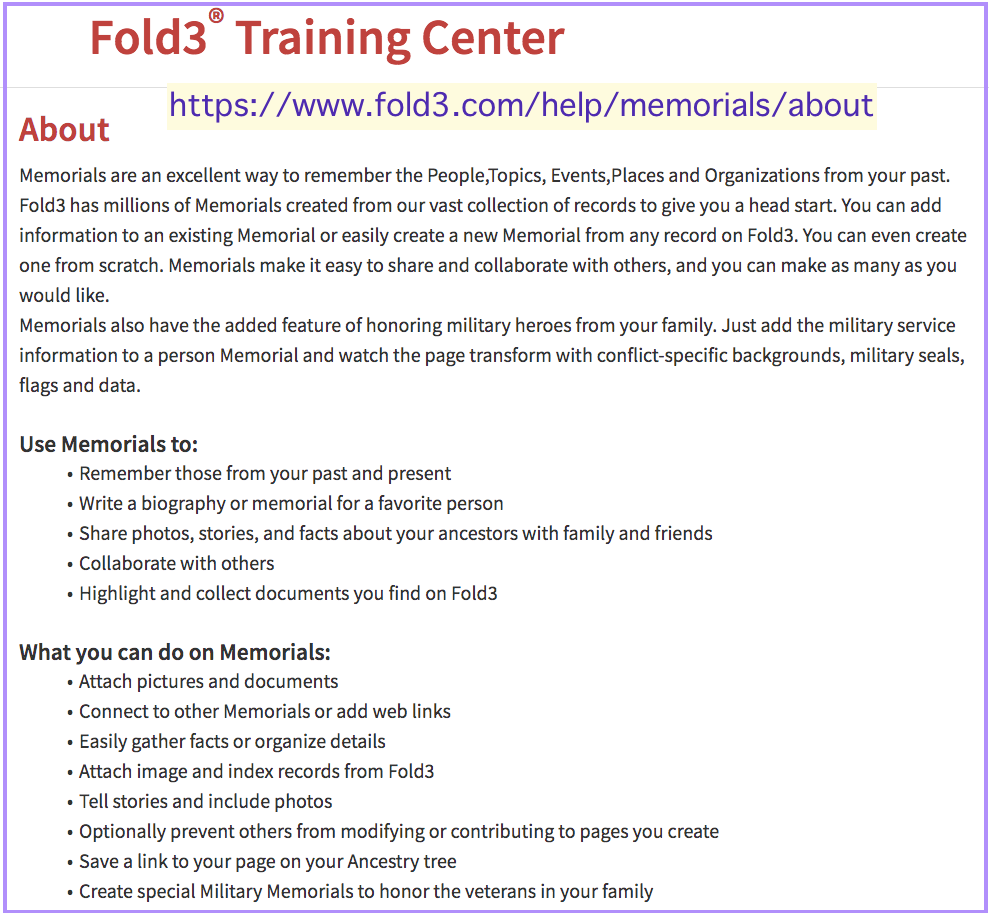
I'm in the process of setting up or beefing up memorial pages on Fold3.com (owned by Ancestry) for ancestors who were military veterans. Memorial pages can be created for non-veterans--even for special events or organizations--but because Fold3 is heavily focused on military records, I'm prioritizing memorials for ancestors who had military service.

At top is a photo showing thumbnails of the 12 memorial pages I've created for vets in my family tree and my husband's family tree. Some were from the US, some from England, some from Canada. Some served in the US Civil War, some in World War I, some in World War II. But now all are searchable and findable on Fold3!

You don't have to be a Fold3 subscriber--just register for a free account. This will allow you to set up memorials, add bite-sized bios, and upload photos. 

But remember, you won't be able to conduct extensive research unless you subscribe, with the exception of using more than 200 free Fold3 databases.


Fold3 may have already given you a head start by creating a memorial page with your ancestor's name and, possibly, some details about his or her service. I discovered a few of my ancestors already had a memorial page with bare-bones about military service. Then I added a bite-sized bio, photos, etc. 

To start, register for a free account and then go to the "training center" page where you can learn more about memorials. From Stories Behind the Stars, here's a brief video that shows, step by step, how to create a new memorial. 

Just another way to keep our ancestors alive by sharing info on multiple sites.

This is my post for Amy Johnson Crow's #52Ancestors challenge, following this week's theme of service.

Wednesday, August 10, 2022

Hidden in Plain Sight

Indexes and transcriptions don't tell the complete story of what's contained in a document. 

The actual document scan often includes interesting details that put a different light on an ancestor's life--hidden in plain sight, available only by looking at the image!

Draft registration reveals unusual occupation

In researching Charles Train Caldwell (1877-1929), my husband's 2c2r, I took a look at the scan of his WWI draft registration card. I can't remember ever seeing one typed before, which caught my eye.

What also caught my eye was the occupation: "prisoner."

Plus this man's signature, which looks as though he can barely write. All of these small clues helped me get a better sense of his life--and motivated me to dig deeper for more information.

Charles had married in 1901 and was the father of two sons. By 1910, he and his wife had divorced. When and why he wound up in prison by the time he was registered for military service in 1918, I don't yet know.

Civil war registration reveals physical condition


Charles's father was Sanford Caldwell (1843-1922). His US Civil War militia registration is on the last line of the above excerpt from an Indiana ledger book.

He's 19 years old, a farmer by occupation, and in the remarks column is a notation about his health: "diseased lungs, ex."

In other words, Sanford was exempt from service because of some sort of problem with his lungs. 

This detail was hidden in plain sight, visible only if I looked at the document rather than simply accepting the basic facts from the transcription.

Sanford's lung problem didn't prevent him from farming, marrying, having children, and living until the age of 79, by the way.

Always look at the original document if the image is available! 

Sunday, August 7, 2022

Mother-Daughter Autograph Books

On this Sentimental Sunday, I'm looking at autograph books from family history.

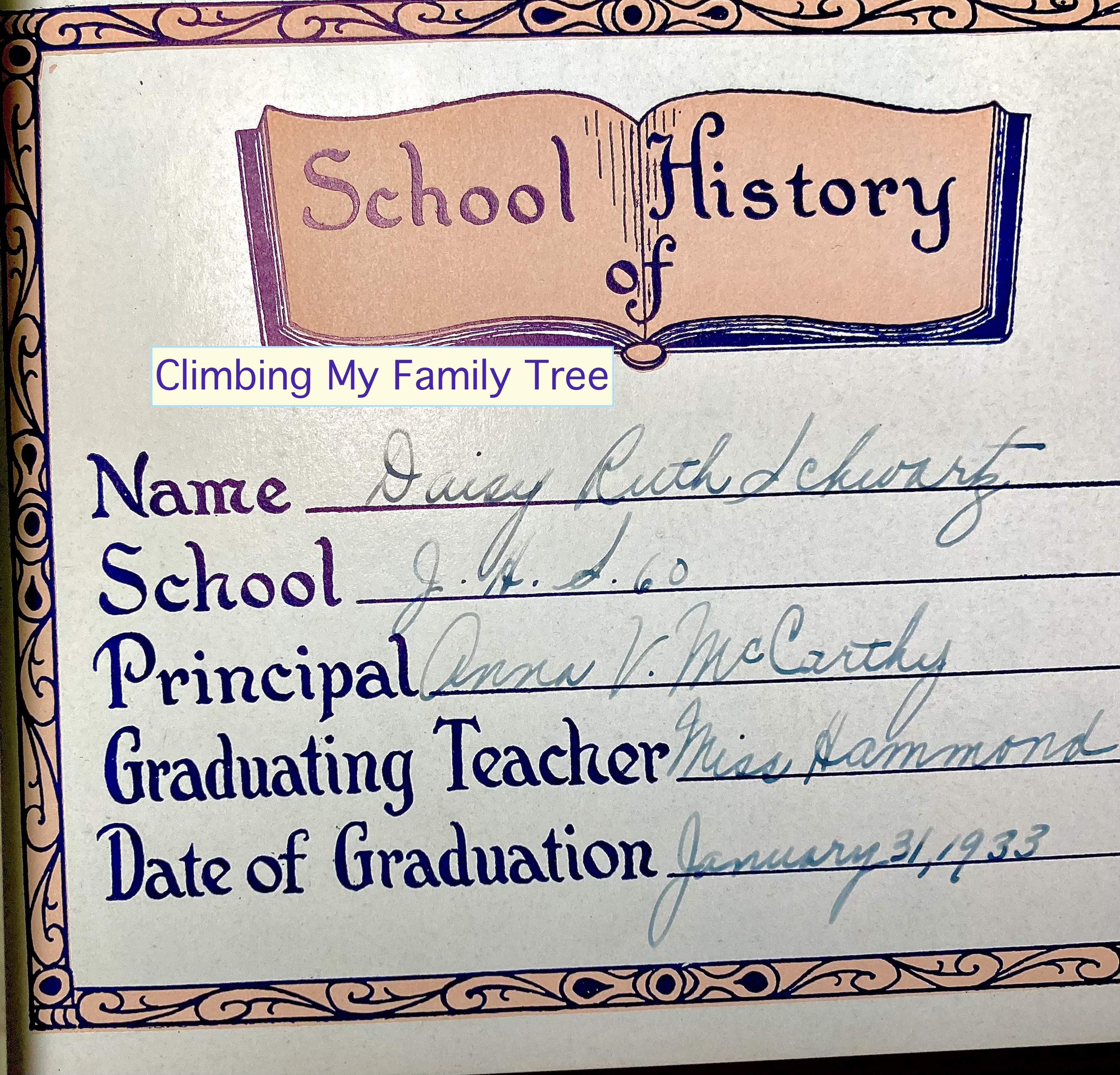
Nearly 90 years ago, my mother (Daisy Ruth Schwartz, 1919-1981) graduated from junior high school (which was then grades 7, 8, and 9). 

She was 13 years old and moving up to high school for grades 10, 11, and 12.

Mom kept her graduation autograph book in great shape! 

As shown above, she wrote her name, the school number (J.H.S. 60 in the Bronx, New York), the principal's name (Anna V. McCarthy), her graduating teacher (Miss Hammond), and the date of graduation (January 31, 1933). 

A January graduation was the norm then. Mom graduated from high school three years later, in January of 1936.

At right, a page from Mom's autograph book, with a cute rhyme that was still in use decades later. "There are all kinds of ships, wooden ships, and steel ships, but the best ship is friendship." Signed, "your sister grad-u-8, Anna Kratzer." I've been able to find many of these classmates in Mom's high school yearbook, as well.

Although I attended school decades after Mom, my autograph book from grade 6 graduation also included signatures and inscriptions from classmates, some sentimental and some funny. I attended PS 103 in the northern Bronx, NY.

At left, one of my best friends included an affectionate notation based on 2+2=4. This same "equation" appears at least three times in my autograph book!

Another inscription used more than once in my autograph book is..."For dirty people only." Turn the page, and the inscription continues: "Use soap! Happy graduation from ...." (no LOL or emoticons of course)

Best of all, these handwritten messages from the 20th century are well preserved in an archival box and will live on through the 21st century. If future generations can still read basic cursive handwriting, they'll be able to decipher the messages!

This is my post for the September 2022 School Days "Genealogy Blog Party."

Monday, August 1, 2022

Back Up Your Cousin Connections Too


The first of every month is backup day--to be sure my genealogy documents, notes, digitized photos, and everything are kept safe in more than one place. LOCKSS: Lots of copies keep stuff safe.

In addition to automated backups to the cloud every day, I have multiple hard drives with backups, just in case. What about backing up my cousin contacts? For that I created a simple cousin connections document.

As shown in the sample at top, my connections format has three columns: (1) name/relationship, maiden name and/or nickname, (2) all contact info, including social media; and (3) notes, such as clarifying who the person is and when I last was in touch. 

This week, after I spoke with one of my cousins, I jotted a note that we had a conversation, and wrote down the update month/day/year.

For my hubby's cousin connection form, I added the email of a cousin I'm now corresponding with about mutual ancestors. Also noted the update month/day/year.

Both forms are now freshly printed and tucked into my address book as well as in a surname file or two. These forms will refresh my memory and will be useful to the next generation after I join my ancestors in the far future.

And both forms are digitally backed up to my hard drives and in the cloud!

-- Tips from my popular genealogy book, Planning a Future for Your Family's Past, available in ebook and soft cover from Amazon USAmazon UK and Amazon Canada.   Also available in soft cover from the AmericanAncestors.org bookstore and the Newberry Library bookstore!

Thank you to Tamie Dehler, who reported on my book with a glowing review in the July 30th issue of the Tribune-Star, Terre Haute, IN. 

Thursday, July 28, 2022

Did Your Ancestor Buy a Tombstone from Sears?


Wednesday night, I learned that the venerable Sears, Roebuck catalog actually marketed tombstones a century or more in the past!

This fascinating factoid came out during a book club meeting hosted by the Virtual Genealogical Association. 

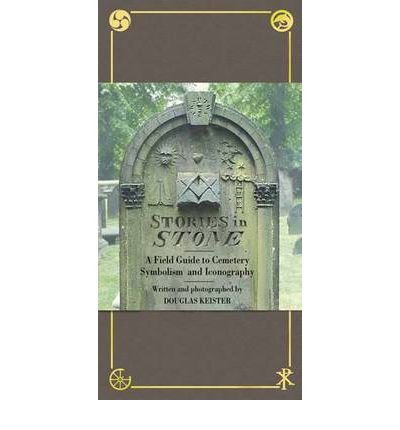
We were discussing Stories in Stone by Douglas Keister, a terrific book about gravestone architecture, symbolism, and acronyms.

Then the Sears catalog was mentioned. I can envision ancestors in small, rural towns ordering a wide range of merchandise by mail. But I had no idea tombstones were also for sale in the catalog. 

Especially in tiny communities where few skilled craftspeople were available to create stones, this must have been a good alternative.

Doing a quick online search, I discovered an entire Sears catalog devoted to products  called Memorial Art in Granite and Marble, better known to consumers as tombstones. 

The 1906 catalog, available for free to view or download from Internet Archive, includes more than 200 pages of illustrations and explanations. The catalog page at top shows a stone priced at $57.40 (and upward), which today would be more than $1,800. 

Prices varied, depending on size, type of stone, and whether ordered with or without engraving. Want a bench or a fence? Also available in this specialized catalog.

I don't know for sure whether any ancestors purchased tombstones from Sears, but it's an intriguing possibility I hadn't considered before. Did you think any of your ancestors bought a stone from Sears?

Monday, July 25, 2022

1950 US Census Update at 115 Day Mark

The 1950 US Census was released 115 days ago, on April 1, 2022. You can browse or search for free on several sites. Indexing has been in the works since the first moment the Census was made available to the public. Here's an update on where things stand.

Family Search and Ancestry

Family Search and Ancestry teamed up to work on the index for this Census. Family Search's thousands of volunteers are making tremendous progress on reviewing and improving the index. You can browse any state while indexing continues.


Above, the map showing completed states and states still being reviewed. There's still time to participate and get this project over the finish line more quickly! Soon full search functionality should be ready at Family Search, for free.


Meanwhile, Ancestry's automated indexing system worked well enough that you may be able to find ancestors using the early draft index. Give it a try on Ancestry, for free. I've had excellent luck locating ancestors in 1950 using the Ancestry early index.

MyHeritage


MyHeritage also has the 1950 US Census searchable for free, using this access page. Not every state has been indexed, but work continues and soon all states will be indexed and searchable. Again, I've had good luck with indexed states, so do give it a try for free.

NARA


The original US National Archives (NARA) website remains available for researching in the 1950 US Census, ideally by enumeration district and surname or full name of head of household. It's entirely free, forever.

The NARA index has been slightly improved since April 1st, thanks to corrections submitted by members of the public, but it remains a "work in progress." 

I was able to find a cousin and her husband by searching for him (head of household) in ED 1-1025 in Washington, D.C, as shown here. The NARA site returned the exact page as the top result. Without entering the enumeration district, however, there were too many results to explore.

Top Tip

If you've looked for some ancestors who should have been in this Census, but haven't yet found them, try this: Join the Facebook group called 1950 US Census for Genealogy. The wonderful members have a lot of experience with Census searches! First browse the latest posts (usually queries followed by suggestions and answers). Then post if you have a specific question about how to search or what might be missing. Check back regularly to see what's happening!

Friday, July 22, 2022

Where Was Maud Born? Research Hints Help!

Three of my husband's great uncles in the SLATTER family, born into poverty in Whitechapel, grew up to become well-known military bandmasters in Canada. 

I've been tracing their descendants as I write bite-sized family-history bios to share with relatives and post to my online family trees.

Albert William Slatter & family

Currently, I'm deep-diving into the children and grandchildren of Albert William Slatter (1862-1935), married to Eleanor M. Wilkinson (1865-1950). 

After earning a pension with the British military, Albert moved to Ontario, Canada and became bandmaster of the 7th London Fusiliers. (A digitized copy of this regiment's history, 1899-1914, mentioning Bandmaster Slatter, is here.)

Albert and Eleanor's oldest child was Maud Victoria Slatter, born June 21, 1887. She was my hubby's 1c1r, born 135 years ago.

Early in her life, she was listed as Victoria Maud Slatter on official documents. Later, she was listed as Maud Victoria or just Maud.

England or Egypt?

On a few historical records (such as the 1911 Canada Census and a 1932 border-crossing card from Canada to Buffalo, New York), Maud's birthplace is shown as England.

But more documents (including the 1950 US Census and multiple border crossing documents between Canada and New York) indicate her birthplace as Egypt, sometimes specifically Cairo.

Egypt was plausible as Maud's birthplace, given that her father's British military pension record included a period of 23 months in Egypt. But I wanted confirmation.

Research hints on Family Search 

To investigate further, I went to Family Search, where Maud was already part of the collaborative family tree. There were two research hints from a database called British Armed Forces and Overseas Vital Records. I've never seen this database before!

Clicking on both hints, I was happy to see they confirm Maud Victoria Slatter's birth in Cairo, Egypt, as shown in the index image at top. Both index sources are now attached to the collaborative tree and will be shown as sources in my other online trees. 

Thursday, July 21, 2022

Fave Genealogy Channels on YouTube

YouTube is a really fun, informative resource for genealogy education, news, and opinion! 

Five of my favorite channels for genealogy, in no particular order, are:

  • Family History Fanatics - Updated weekly or more often, lots of hands-on demonstrations and insightful examination of topical issues.
  • Amy Johnson Crow - Updated weekly, focusing on practical techniques, research resources, and contemporary concerns.
  • Allen County Public Library Genealogy - Regular updates with engaging 45- to 60- minute videos about a broad range of topics.
  • BYU Family History Library - Meaty genealogy content for all levels, including how-to for genealogy technology.
  • Genealogy TV- Updated weekly, with a wide variety of useful genealogy content plus lively expert interviews.

    Five more go-to YouTube channels: Family SearchAncestryMyHeritageFind My Past, and WikiTree

    There are more genealogy-related channels on YouTube, but these are among my very favorites because of the solid content. Whether you choose to subscribe or just watch a couple of videos to gain knowledge about a particular aspect of genealogy, do take a peek at these channels.

    If chat is available, try scrolling through . . . often there will be interesting Q&A or additional comments.

    Tuesday, July 19, 2022

    Searching for Fun Facts and Finding Jumbo


    This week's #52Ancestors genealogy prompt from Amy Johnson Crow is "fun facts."

    Looking for a fun new tidbit about my late father-in-law, Edgar James Wood (1903-1986), I did a quick online search with his full name in quotes and the name of his alma mater, Tufts. Ed remembered his years at Tufts with obvious affection when reminiscing many decades later. Now I wondered what a fresh search might uncover.

    The 1925 Jumbo Book

    Up popped a digital copy of The 1925 Jumbo Book, Tuft's yearbook. 

    I actually have Ed's bound yearbook safely stored in an archival box, ready for the next generation and beyond.

    But the digitized version is a valuable find because Tufts has made this downloadable by anyone, anywhere, any time. 

    It's been scanned by professionals and it's easily searchable for names and activities. 

    The digitized version can be read and annotated over and over again, saving the printed copy from wear and tear.

    For instance, here's the page devoted to the roster of Zeta Psi fraternity. I clipped it digitally from the downloaded yearbook.

    Then I highlighted Ed's name at the bottom.

    Never would I write in the original! Yet the digitized version is incredibly convenient for my family history projects.

    Why Jumbo?

    Why was the yearbook called the Jumbo Book? The story, according to Tufts:

    Master showman P.T. Barnum was a Tufts trustee and benefactor. In the 1880s, his circus toured with a huge elephant named Jumbo, standing nearly 12 feet tall and weighing six tons. 

    Jumbo died in 1885, and a few years later, Barnum donated the elephant's hide to Tufts. He intended it to be the centerpiece of a Barnum natural history museum to be built on campus. 

    Over time, Jumbo became a kind of good luck charm. He has served as mascot for the Tufts sports teams, as well as lending his name to the yearbook and other campus publications. He's even gone high tech: JumboSearch is the Tufts library's search system. 

    Jumbo fun--one reason I enjoy the #52Ancestors challenge!

    Saturday, July 16, 2022

    I Did a Double-Take When I Saw This Date!


    I do a lot of horizontal genealogy research, adding siblings, their spouses, and their in-laws to my family tree. More than once, I've discovered some of these folks are actually distant cousins of my ancestors!

    This man's relationship to me is not very close: sibling of husband of sister-in-law of 1c1r.

    Still, by looking closely at Ray Klein and his siblings, I'm seeking to determine whether and how their mother might be related to my maternal Waldman cousins from Hungary. 

    I did a double-take when this database info turned up. Anybody think this is an actual birth date?? 

    Um, no. 

    Automated indexing and extracts don't always get the details right. That's why I aim to look at original documents myself. 

    Wednesday, July 13, 2022

    Pandemic Pastime Becomes Family Craft

    What began as a weekly craft activity  during the pandemic lockdown has become a surprisingly popular family craft. 

    Pandemic rock painting parties

    In the spring of 2020, Sis invited me and two friends to her place every Saturday to paint rocks. We sat socially distant and wore masks to stay safe. Our artist friend helped by sketching outlines and making suggestions about color, shading, and proportion.

    Early efforts were, um, rudimentary. As we got better at painting something recognizable, we decided to share our art with neighbors. During walks around our neighborhood, we left rocks on fences, benches, and windowsills. A few are still in place, nearly two years after first placement.

    Soon we began painting rocks for particular family members: A vase of flowers for a green thumb gal, a trout for a guy who loves fishing, a saxophone for a musician, a silly face for a wee one, a sun-rise for an early bird.

    Sis and I became known at the local post office for mailing small boxes of rocks near and far.

    Let's paint 

    In 2021, we were visited by relatives with a two-year-old. This cute twig really wanted to paint rocks with us! He held the paint brush, dipped carefully in colors he liked, and decorated a couple of rocks, with his Mom's help. Easy, fast, and fun. 

    After that visit, the twig began collecting rocks during walks in his home town, asking to paint them. Sis mailed out supplies and our joy of rock painting spread to that family.

    Let's rock

    This year, when the now three-year-old twig visited, he brought rocks he had decorated especially for us. At top, a sparkly rainbow rock he placed in my front yard. 

    Of course, we held a painting party in this twig's honor. At right, two rocks he painted in bright colors to accompany our garden bunny.

    By now, every member of the family has taken a turn trying rock painting, good sports that they are. 

    And that's how our pandemic painting parties turned into a family craft. Family history in the making!

    Sunday, July 10, 2022

    Stories in Stone - VGA Book Club Pick


    The Virtual Genealogical Association has so much to offer, for only $20 per year. The name says it all: All virtual, all the time, including informative webinars (live and on-demand), special interest groups and hangouts, even a book club.

    This month, you don't have to be a member of the Virtual Genealogical Association to join the fun with the book club pick, Stories in Stone by Douglas Keister. 

    The subtitle previews what's inside: A field guide to cemetery symbolism and iconography. From architecture to gravestone symbols and beyond, this compact but comprehensive book is indispensable for genealogy folks. 

    Full-color photos illustrate so many of the key points, with clear explanations. In addition to an extensive index, this handy book includes pages and pages of acronyms deciphered, a big help when trying to understand organizational initials and symbols on gravestones.  

    No wonder I have this book at hand for ready reference and to accompany me on any cemetery field trips.

    Now VGA is hosting a contest in connection with the July book club. Mark your calendar: The book club meets virtually on Tuesday, July 26th, at 8 pm Eastern. See you there!

    Friday, July 8, 2022

    Seventeen Wood Children Born in Three States


    As I continue to draft bite-sized bios of my husband's great-grandparents, Mary Amanda Demarest (1831-1897), husband Thomas Haskell Wood (1809-1890), and their children, I'm examining what was going on in their lives. This helps me put each ancestor into the context of the time, place, and ongoing family situation. Even if I write only a sentence or two for the wee ones, it keeps their memory alive for the future.

    Bride from New York, groom from Massachusetts

    Thomas Haskell Wood was born in Massachusetts and his bride Mary Amanda Demarest was born in New York, yet they married in Iberville Parish, Louisiana, in 1845. 

    The Wood family was based in the whaling community of New Bedford, many working in the industry. There's some evidence that Thomas signed onto a whaling ship in New Bedford years earlier. He may have arranged to bring Mary to Louisiana by ship for an elopement, but we have no proof.

    Their 17 children were born in three states from 1846 to 1875. At left, the names and dates of their five girls and twelve boys. Mary was 15 when her first child arrived, and nearly 45 by the time the last child arrived. 

    Three born in Louisiana, 1846-1850

    Jane "Jennie," Thomas, and John--the first three children--all were born in Iberville Parish, Louisiana.

    Only Jane survived to adulthood, unfortunately. Thomas drowned at age 12, and John died at age 8.

    Why the family left Louisiana, no one has any idea. Thomas Haskell Wood was a carpenter and much later, a coach builder, so he could go wherever work was available. But they must have had a good reason to pack up and move 900 miles away.

    Six born in Virginia, 1851-1861

    Once the family settled in a part of Virginia that is today in West Virginia, six more children were born: Lucy, William, Alfred, Francis, Lavatia, and Joseph. 

    Sadly, not all lived long lives. Lucy died at age 18. Diphtheria claimed Lavatia just after her 5th birthday and Joseph just before his 2d birthday. William died of typhoid at age 39, leaving a wife and children. Alfred also died at age 39, leaving a widow but no children. 

    Francis grew up and followed his father into carpentry, forming a business with some of his brothers. He and his wife had four children--and their descendants are in some of the old Wood family photos.

    Eight born in Ohio, 1862-1875

    The move to Ohio, about 300 miles away, could very well have been precipitated by the US Civil War, which broke out in April of 1861. Both parents were from the North, so maybe they wanted to leave the South to settle in the Union state of Ohio, or simply wanted to be far from the fighting. 

    Another reason might have been opportunities for steady work on Ohio railroad projects, as indicated by occupation of "RR carpenter" and "coach builder" in two US Censuses taken after the family got to Ohio. 

    In Toledo, Ohio, the last eight of the Wood children were born between 1862 and 1875: Charles, Rachel "Nellie," George, Marion, Mary "Mollie," James, Robert, and Leander. During this period, one of the children born in Louisiana and two of the children born in Virginia died in Toledo. 

    Of those born in Ohio, neither George nor Leander lived more than a few months, sad to say. The other six children all grew up and married. The men went into carpentry or commercial painting, sometimes in partnership with each other. Photos of some of these ancestors are in our hands and in the hands of cousins.

    My husband's grandfather was home builder James Edgar Wood (1871-1939), the tenth of twelve sons who became the father of four sons himself. 

    Wednesday, July 6, 2022

    Fleeing War on the SS Nyassa


    My maternal grandfather Theodore Schwartz (1887-1965) was the first of his family to come to America from Ungvar, their Hungarian hometown. He then helped his brother Sam and sister Mary to come to America. 

    Unfortunately, many of their siblings were killed in the Holocaust, including the oldest sister, Rezi Schwartz Winkler (1881-1944). 

    Happily, in recent weeks, I've discovered that some of Rezi's descendants escaped Europe during and after World War II. As it turned out, in-law connections proved pivotal.

    Fleeing the war

    Rezi's daughter Leni Louise Winkler Price (1909-1997), her husband Eugene Preisz (Price) (1906-1979), and their daughter Edith came to America on the SS Nyassa, which left Lisbon on April 15, 1941. This trip was made possible because blocks of tickets were purchased by HIAS, the Jewish relief group working to get people out of harm's way.  

    The Prices had their passports issued in Marseilles, France, in January of 1941. Waiting for safe transport from Europe, they had lived in Belgium for a time and then made their way to Lisbon, somehow, for their voyage. 

    Fleeing on the very same ship were the parents and grandparents of Bettie Lennett Denny, whose blog post vividly brings to life this agonizing ordeal, truly a flight for life.

    Nearest relative in America

    According to the SS Nyassa's passenger list, Leni and Eugene were going to join Eugene's older brother David Price (1893-1985), who was already established with his family in Brooklyn, New York. 

    After the war, Eugene Price (now also living in Brooklyn) was the US contact noted on the 1948 passenger list for his brother-in-law Albert Winkler. I wrote about Albert recently in this blog post. Albert and Leni were my first cousins, once removed. 

    Thankfully, I've connected with a couple of cousins in my extended Winkler and Price families, thanks to public family trees and ancestor memorials on Find a Grave.

    This week's #52Ancestors challenge by Amy Johnson Crow is "extended family." 

    Sunday, July 3, 2022

    Independence Day Postcard from 115 Years Ago


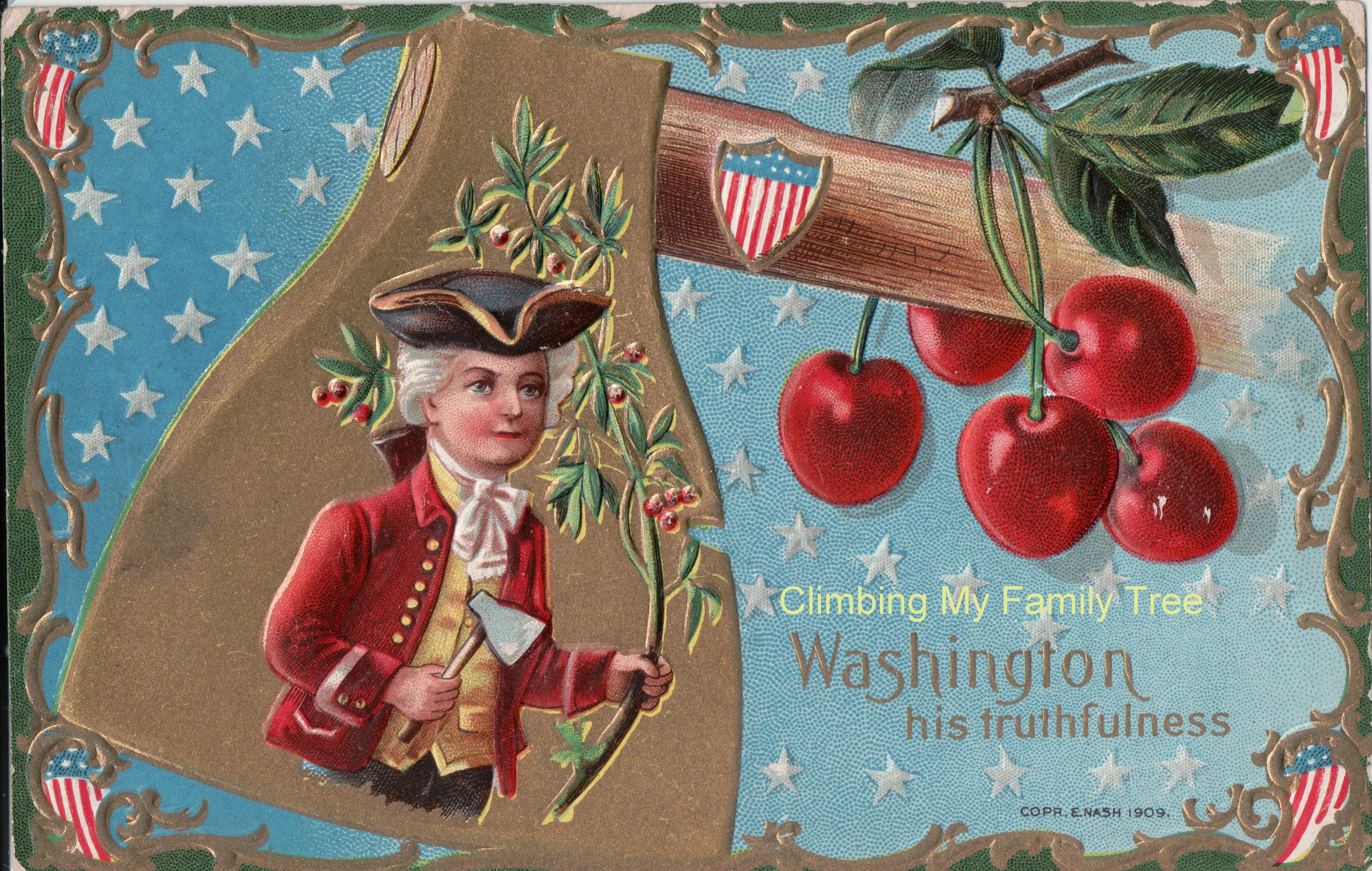
    For Independence Day 115 years ago, my hubby's uncle Wallis W. Wood (1905-1957) in Cleveland, Ohio received this colorful penny postcard in the mail. 

    I just love these vintage postcards, still in the family more than a century later.

    The sender was Rachel "Nellie" Wood Kirby (1864-1954), an attentive aunt living in Chicago, Illinois. 

    Nellie and other members of the Wood family rarely missed an opportunity to send penny postcards to younger relatives. 

    One year, Nellie even sent her nephew a postcard for George Washington's birthday on February 22, which was celebrated as a federal holiday beginning in 1879. 

    Today, of course, George Washington shares his official holiday with Abraham Lincoln, both celebrated on Presidents' Day. 

    Happy Independence Day!

    Saturday, July 2, 2022

    Your Family Tree: One and Done or LOCKSS?


    As genealogy folks, we're used to looking back toward the past. But to keep family history safe for the long term so descendants and researchers won't need to reinvent the wheel, we should look ahead to the future. 

    Think LOCKSS:

    Lots

    of

    Copies

    Keep

    Stuff

    Safe

    Will one family tree be enough? Here are some of the steps I've taken to perpetuate my family history by sharing trees (and more) in different places:

    • Posting my family tree on multiple sites (Ancestry, MyHeritage, FamilySearch, WikiTree, FindMyPast). These serve as cousin bait too! 
    • Posting bite-sized ancestor bios on these and other sites (Fold3, FindaGrave). 
    • Sharing family history with relatives now (via booklets, videos, heirloom photos, my blog, and more).
    • Sharing ancestor photos with relatives now (sometimes with a story, sometimes on a shared family tree, sometimes here on my blog).
    • Sharing family stories now (on my blog and during family gatherings, plus in conversation, as "memories" on family tree sites, and more).
    • Sharing ancestor bios with repositories where I've donated artifacts or materials. This keeps ancestors alive in their collections!

    LOCKSS. Keep your family history safe for the future. Maybe "one and done" isn't enough?

    --

    For more ideas, please see my book (print and ebook), Planning a Future for Your Family's Past, on Amazon (US, UK, Canada, beyond) and at the American Ancestors book store. If you're a Kindle Unlimited member, you can read the ebook for free! 

    Thursday, June 30, 2022

    Posting Bite-Sized Bios For Canada Day


    In honor of Canada Day on July 1, I'm focusing on my husband's great uncles who rose from grinding poverty in London's notorious Whitechapel district to become career military men and renowned bandmasters in Canada. 

    Currently, I'm widening my reach to post brief bios of each man on multiple sites. This week, I'm adding bios of Albert William Slatter and Henry Arthur Slatter to WikiTree, Fold3, and MyHeritage. 

    All three of my husband's Slatter great uncles served Canada with distinction. I want to help keep their memories alive for future generations, not just within the family but far beyond.

    Monday, June 27, 2022

    My 2022 Genealogy Paper Chase

    Here we are, halfway through 2022, and already it's been quite a year for family history! 

    Thanks to the big Census releases, my genealogy paper chase has been extremely productive in the first half of this year. 

    In fact, I'm making good progress on all my projects and plans:

    • Find ancestors and the FAN club in the 1950 US Census (results: yay, lots and lots of info and really interesting clues).
    • Look for hubby's ancestors in the 1921 Census of England (results: found some, will look for a couple more).
    • Write and post bite-sized bios for aunts, uncles, and great-grandparents on genealogy websites (results: some completed, a few in draft stage)
    • Reorganize family photos into archival albums (results: hundreds of 20th century snapshots reorganized, but oldest photos and negatives still to be reorganized--a big project to accomplished in small chunks). 
    • Follow up on genealogy clues from Burk/Birk branch of my father's side and Schwartz/Winkler/Preisz branch of my mother's side (results: yay, made new cousin connections!).
    • Continue making presentations on genealogy topics (results: talks scheduled July through autumn of this year).

    Next steps

    One top priority is to write more bite-sized bios, with the goal of keeping these ancestors' names alive for future generations. Currently, I'm finalizing details for bios of my hubby's great-grandparents and my great-grandparents (actually just posted hubby's great-grandpa's bio). Even when I know very little about these people, I can still write about milestones in their lives (BMD), number of children and/or siblings, where/when they lived, and the social/historical context of of their lifetimes.

    Another priority for the second half of 2022 is reorganizing older photos, captioning, and maybe even writing brief narratives about a few of the series photos. I did this with one of my late dad-in-law's albums chronicling the summer of 1917, when his father drove the family from Cleveland to Chicago in a new 1917 Ford. 

    I'll also be testing additional archival photo storage possibilities during the summer, to see which are best suited to the small and odd-shaped old photos and negatives inherited from my late dad-in-law. As I wrote in my book, Planning a Future for Your Family's Past, life by the inch is a cinch--life by the yard is hard. I'm stretching out my photo reorganization and taking small steps to keep this project from becoming overwhelming. Digitizing these photos is only part of the process. It's just as important to keep the originals safe for decades to come.

    Paper chase in my future

    I'm still busy following the paper trail to trace more of my Eastern European ancestors. DNA has less helpful than I'd hoped. Yet there are documents and family tree clues about a few branches that came to America, some around the time of World War I and some after World War II.

    In recent months, I found a couple of distant cousins I never knew about. Together, we're pooling information and coordinating research to try to connect with more descendants while documenting those who came before. 

    The second half of 2022 promises to be as productive as the first half! And of course I'll be blogging about challenges, breakthroughs, techniques, issues, and more. More than 13 years of genealogy blogging, with more to come.

    Friday, June 24, 2022

    Never Give Up! My Great Aunt Nellie Breakthrough

    Photo of three Burk and Block ancestors

    My heart holds a special place for ancestors who had no descendants. I try to research and memorialize them so their names and lives aren't forgotten.

    This is the case with my paternal great aunt Nellie Block, born in Gargzdai, Lithuania (?-1950). She was the oldest sister of my grandfather Isaac Burk (1882-1943). It wasn't until I connected with second cousins a few years ago that I could even put a name to the face I found in my parents' wedding album and elsewhere. 

    Cousins said they remember great aunt Nellie as kind and attentive, someone who enjoyed family gatherings. In the photo above, she is the elegantly-attired lady in lace, standing between a younger brother on one side and a younger sister on the other.  

    Single or widowed?

    For a long time, I thought Nellie was a maiden aunt. More than a decade of research had only turned up a Census where she was recorded as S (single). In fact, she wasn't coming up in my repeated searches of US Census documents from 1920, 1930, and 1940, even when I searched on multiple sites (because each indexes the Census in its own way).

    A couple of years ago, I was able to obtain Nellie's death certificate. The informant was her brother, who said Nellie was widowed. That was news.

    In April of this year, I found Nellie enumerated in the 1950 US Census, where she was shown as...widowed! Two sources said she was widowed. Hmm.

    Curiously, Nellie Block's 1950 US Census entry and her death cert both refer to her surname as Block, with no married name ever mentioned. Even in the 1930s, when an English cousin invited Nellie to a wedding, she addressed the invite to "Nellie Block." 

    But searching for years, I found no indication of any marriage. 

    My secret weapon

    Just the other day, one of my cousins asked about Nellie. We compare notes about brick walls from time to time, and he remembered Nellie as one of mine.

    Because of his gentle nudge, I redid my search for Nellie. Lo and behold, up came a record transcription for a 1916 marriage to Samuel Kaplan in Manhattan, NY, in April of 1916, along with the cert number. There are a LOT of Nellie Block marriages in search results, but now I have a secret weapon to dig deeper into Big Apple records.

    Since early this year, the New York City Municipal Archives has offered FREE access to digitized vital records from roughly the late 19th century to the Depression era. You should first try to find the cert number, borough, and year, otherwise you'll be browsing till the cows come home.

    Because the actual digitized records are free to view, I had nothing to lose by searching for the Block-Kaplan marriage cert. I input the details and up came a pdf. I wanted to view the cert with my own eyes, not rely on the transcribed info.

    My Nellie?

    Reading the cert, I saw Nellie listed as single, 30 years old, born in Russia, her first marriage. Samuel Kaplan was 38, widowed, a jeweler born in Russia, son of Isaac Kaplan and Sarah Freedman, being married for the second time. 

    I never heard of Samuel Kaplan, but it only took a moment to determine this was my Nellie's marriage cert. First, the mother's name was very close to what she said on other documents. Second, the father's name was a family surname I know. 

    The clincher was the place where the ceremony took place: 7 East 105th Street in Manhattan. That's the apartment building where Nellie's sister-in-law lived. My Nellie!

    Next step

    I've just sent $18 to the NYC Municipal Archives to obtain the three documents related to Nellie's wedding: the marriage license application, affidavit executed by bride and groom, and actual marriage license original. You can learn more about how this works via the FAQs here.

    Although I may have to wait a few weeks, I'll get lots more info on Nellie and her husband, especially from the affidavit. I hope to trace the life of Samuel Kaplan, who seems to have died before the 1950 US Census was taken.

    So never give up! New records become available all the time and database indexing improves all the time. In this case, the bonus secret weapon of free NYC vital records helped me across the finish line for this breakthrough, confirming that my great aunt Nellie Block had, indeed, been married.

    Wednesday, June 22, 2022

    Genealogy Blogs: Read, Comment, Repeat!

    Recently, blogger Mish Holman posted a poll on Twitter, asking "Do you think people actually read your #Genealogy blog posts?

    The final results from 83 participants: 

    • YES - 50.6%
    • NO   - 32.5%
    • THEY SAY THEY DO, BUT THEY LIE - 16.9%

    I answered yes, people actually do read my blog. How do I know? Because some folks leave comments...and some get in touch via my "contact me" gadget on the blog's home page. Plus site statistics show me the number of views per post and page, another indicator that people are stopping by. 

    Why I 💜 blogs 

    Personally, I love reading genealogy blogs! Many bloggers post about new developments in the genealogy community...the latest database improvements by big genealogy sites...tricks and tips for technology...using specific resource sites/repositories. I learn a lot from these bloggers, and I leave a comment of thanks now and then. 

    Blog entries about personal family history adventures are also fun and informative. Posts about creatively sharing genealogy with the next generation...finding ancestors in the most unexpected places...connecting with a long-lost cousin, all can teach me something. Again, I comment every so often to let the blogger know I've stopped by.

    Finding genealogy blogs

    One good place to find interesting blogs is at the GeneaBloggers site. You can also see bloggers in action on the Generations Cafe Facebook page where Amy Johnson Crow posts weekly blog prompts. Then there's the Genealogy Blog Party, which has a different theme every month. That's just for starters. 

    A few bloggers list their picks for "best of the week" blog posts with links for easy access. To name just two: Linda Stufflebean posts her weekly roundup on Fridays on her blog, and Randy Seaver posts his weekly roundup on his blog

    Of course, there's not enough time in the day to read every blog or every post, let alone comment every time. Just dip in and out, and have fun.

    Saturday, June 18, 2022

    Finding Dads and Grandfathers in 1950 US Census


    Happy Father's Day! Researching in the 1950 US Census, I enjoyed finding fathers and grandfathers in my direct line and my husband's direct line.

    • My maternal grandfather Teddy Schwartz was living in the Bronx, New York, with my grandma Minnie Farkas Schwartz (given name written incorrectly). The Census correctly shows that Grandpa Teddy ran a small grocery store, working 70 hours per week. My paternal grandpa Isaac Burk was no longer alive.
    • My Dad (Harold Burk) and Mom (Daisy Schwartz Burk) were enumerated a few miles away in the Bronx, in their first Census as a married couple. Dad was a travel agent in his own agency, as shown in the Census.
    • Hubby's maternal grandfather  Brice L. Wood, by then widowed, was living in Upper Sandusky, Ohio. He was retired ("ot" stands for "other" because he's not working and not looking for work). My husband's paternal grandfather James Edgar Wood was no longer alive.
    • Hubby's Dad (Edgar J. Wood) and Mom (Marian McClure Wood) were at home in Cleveland Heights, Ohio. Ed worked as a claims adjustor for a casualty insurance company, as shown on the questionnaire.

    Now I'm remembering these fathers and grandfathers with love on Father's Day 2022. 

    Friday, June 17, 2022

    One Signature Changed My View of an Immigrant Ancestor


    A single signature on a document I purchased this week has changed my view of the immigrant experience of one of my Schwartz ancestors. 

    My grandpa Theodore Schwartz was from a large family in Ungvar, Hungary, a region that later was in Czechoslovakia and is now in Ukraine. 

    Some documents from this region are available for free from JewishGen.org and Family Search.org, while others documents are available (some free, some at a fee) from the Sub-Carpathia Genealogy website

    Grandpa's sister married a Winkler 

    A quick recap: Last week, I bought a document from the Sub-Carpathia site that showed me the correct birth year of a 1c1r, Albert Bela "Voytech" Winkler (1912-1993). He was the son of Grandpa's oldest sister Rezi Schwartz and her husband, Moritz Winkler. Very sorry to say, Rezi was killed in the Holocaust--I found her son Albert's Yad Vashem testimony about her death, which led me to do more research. 

    Following up on Albert, the birth document I purchased last week gave me sufficient clues to research his refugee status during World War II, find the passenger list showing his arrival, and locate his US naturalization papers. 

    Connecting Winkler to Price

    When Albert Winkler sailed into New York City in 1948, the passenger list showed a contact in New York City: Price, 182 E. 19th Street, in Brooklyn, New York (see excerpt here). New names I don't know.

    Using the 1950 US Census, I discovered who was living at that Brooklyn address. It was Eugene Price, born in Czechoslovakia, and his wife Louise, also born in Czechoslovakia, with their 18-year-old daughter Edith Price, born in Belgium. 

    Next, I opened my wallet and paid for another document from Sub-Carpathia, based on what I could see in a transcribed excerpt. The document was about the marriage of Leni Winklerova and Eugene Preisz in August of 1929. I suspected Louise Price's maiden name might be Leni Winkler, and her husband Eugene Price had been Eugene Preisz.

    One document with so much significance

    Once I received the document, I found the parents' names and the dates match what I already know. This proves the link between the Winkler and Price families, with Leni married to Eugene. 

    The document is significant for two more reasons. One, I've found yet another branch of my family tree that survived the Holocaust, emotional in itself. Two, the document revealed a surprise witness to the marriage, a name I never expected to see.

    As shown at the top, one of the two witnesses on the marriage document was Samuel Schwartz of New York in "Amerika." Maybe this was my grandpa's brother Samuel Schwartz (1883-1954), who left Hungary in 1904 to come to New York City? 

    I compared the signature from the 1929 marriage document with Samuel Schwartz's signature on his own marriage document from 1909. They are nearly identical! My great uncle Samuel was at the wedding in Ungvar in 1929.

    Changing my view 

    Up till now, I envisioned all of my Schwartz ancestors making a one-way, one-time trip to America, seeking better economic opportunity. This was not a "birds of passage" family, with men leaving home to make money and sailing back to the homeland periodically. My Schwartz ancestors who left Ungvar settled permanently in America, became US citizens, and raised families.

    My Grandpa (Theodore Schwartz, 1887-1965) ran a small grocery store in the Bronx, New York. There was little money to spare; everyone in the household worked hard to send two of the three children to college. Based on family documents and cousin recollections, it's highly unlikely Grandpa ever returned to his birthplace. He never again saw his parents or the siblings who stayed behind. His immigrant experience was a one-time trip, one-way to America.

    Then I think about Grandpa's older brother, Samuel Schwartz. He also ran a small grocery store in Queens, New York, also put a son through college, became a citizen. Samuel definitely was not a bird of passage.

    Yet his signature proves that he did, indeed, visit his hometown of Ungvar. (I've also found his passenger list for the return voyage.)

    As a result, I now realize his immigration experience was different from that of my Grandpa. Before this, I never dreamed any Schwartz immigrant ancestors would be able to return to Ungvar after they left. Clearly, Samuel would have seen his mother, siblings, and nieces/nephews at this family wedding in 1929. A joyous reunion, I'm sure.

    I'm continuing to trace the Price/Preisz family and also to try to match photo dates to these new documents! More soon.

    Monday, June 13, 2022

    1950 US Census: 9V Income Code

    Did you have an ancestor or friend/associate/neighbor (FAN club) of an ancestor who was chosen to answer the sample questions on the 1950 US Census? I've been paying attention to the income questions, in particular, as I put my ancestors into context.

    Above $10k? 

    According to the 1950 US Census Enumerator's Training Manual, if someone reported income above $10,000, the answer would be listed as $10,000+ on the population schedule--regardless of how much higher their actual income might have been.

    Income answers from the 1950 US Census were coded for data entry and analysis, as were a few other questions (such as birthplaces and occupations).

    Decoding the code

    As you can see from the code circled in image at top, the income listed was $10,000+. and the code was 9V.

    Huh? Turns out, 9V is the code for more than $10,000, as I read on the History Hub page about decoding 1950 US Census answers for Column 31.

    In this case, I'm willing to bet that the actual income was far above $10k. Why? Because this is the 1950 US Census entry for Jack Cohn, VP of the film giant Columbia Pictures. One of Jack's nieces married a first cousin of my father. Of course I'm looking at the answers given by these and other in-laws in the 1950 US Census 😉

    Saturday, June 11, 2022

    1950 US Census Offers Sad Clue to John's Life


    My late father-in-law, Edgar James Wood (1903-1986) was the oldest of four boys born to James Edgar Wood (1871-1939) and Mary Slatter Wood (1869-1925). After Ed came Wally, John, and Ted. I have family stories and research about Wally and Ted, but not much about John Arthur Wood (1908-1980).

    Who remembers Uncle John?

    My husband remembers his Uncle Wally and Uncle Ted coming to holiday dinners, but not Uncle John. Yet there was definitely contact over the years, because John and his wife Marguerite were mentioned several times in my father-in-law's diaries (written 1958-1986). 

    Still, I had little to go on when trying to research this man. Then last year, my sister-in-law mentioned John might have been married twice. Her memory led me to confirming that he did have a first wife

    John was just 20 in 1928 when he married Elsie Harder, who was 23. According to the news account of their wedding, John was working for Grasselli Chemical Company, which was soon merged into the chemical giant E.I. du Pont. (John remained with du Pont for his entire professional life.)

    Through WWII draft card info and city directories, I can trace John Wood and his first wife, Elsie, up to 1945, when they're living together in Hammond, Indiana. 

    New info from 1950

    Now the 1950 US Census has given me a new clue about John and Elsie's married life. As shown in the image at top, Elsie was enumerated as a patient in Longcliff Logansport State Mental Hospital in Logansport, Indiana. This was unexpected and sad.

    Of course medical records are sealed, so I don't know exactly why Elsie was in the hospital. When she passed away in 1960, her death cert said she was divorced and died of a cerebral hemorrhage, having had cerebral arteriosclerosis for some years. I wonder whether her health problems were part of the reason she and John divorced?

    In April of 1951, John married Marguerite Goodin (1918-1988). She's in the 1950 US Census, enumerated as divorced, and working as a telephone operator in East Chicago, Indiana. When John had heart problems and died in 1980, Marguerite was the one who kept my father-in-law informed, according to the diaries. 

    Where was John Wood in 1950?

    One possibility is in Cleveland, Ohio, the city of his birth, living in a two-family home. It's not easy to tell one "John Wood" from another when the Census enumerator only notes that this John Wood is separated (probably correct), born in Ohio (correct), and is 43 years old (close enough). No occupation, no industry. Not a strong possibility, but maybe.

    A better possibility is in East Chicago, Indiana (the same city where his soon-to-be second wife was living). This man was enumerated as "John Woods," a roomer, married (correct), 44 years old (about right), born in Ohio (correct), with occupation "engineer, planning and schedule, chemical lab" (close).  

    I've put both of these Census records on John's family-tree profile until I can sort them out. 

    Wednesday, June 8, 2022

    1950 US Census: Indexed by Computers, Reviewed by People


    Released on April 1, the 1950 US Census is available to browse and search for free on Ancestry and Family Search (among other sites, including the US National Archives). For more about this mid-century American Census, see the informative Family Search page here. Also take a peek at the Family Search YouTube Channel playlist of 1950 Census videos.

    Indexed by computers, reviewed by people

    Family Search describes the 1950 Census as "indexed by computers, reviewed by people." 

    Ancestry used artificial intelligence to create an "early index," already available on that site. Still, computers invariably make mistakes, which is where the "reviewed by people" part comes in. 

    Ancestry turned the index over to Family Search, which has recruited thousands of volunteers to review the names, checking that the digital index actually reflects what the handwritten name says on the Census page.

    Volunteers are also reviewing households to see whether all people in that household have been grouped properly by the AI indexing system, and be sure the main details are correct.  

    Progress! See the webinar on June 10

    By the end of June, every name in the 1950 US Census index on Family Search will have been reviewed by human eyes! That's a real plus for finding our ancestors through a name search, rather than the browsing method of looking at one page at a time.

    For the latest from Family Search, you can watch a webinar update on Friday, June 10, at 4 pm Mountain Time. 

    Here's the link--and you don't need to be a Facebook member to watch! 

    Tuesday, June 7, 2022

    Fixing a Mistaken Assumption by Buying a Record


    Albert Winkler was my first cousin, once removed, the nephew of my maternal grandfather, Theodore Schwartz. His mother, Rezi Schwartz Winkler (1881-1944) was my grandpa's oldest sister.

    I know Albert's name because he submitted Yad Vashem testimony about the Holocaust killings of his mother and other close relatives. But I knew almost nothing else about him, other than he died in May of 1993. 

    Don't assume anything!

    Without any proof, I made the assumption that Albert was born in the early 1900s, given that his parents Rezi and Moritz Winkler were married in 1898 and their children began arriving in 1899. At this point, the youngest child I'd found was Lili Winkler, who was born on March 20, 1912

    Traditional sources didn't help me much in my research for Albert. Then I took a look at summaries of birth records available for purchase from the specialized site Sub-Carpathia Genealogy

    Doing a record search on this site for "Winkler" birth records from Ungvar (now Uzhhorod, Ukraine), I found TWO Winkler children born in March, 1912. 

    Father of both: Mor Winkler. Mother's maiden name of both: Schwartz. One baby Winkler was named Lili, the other baby Winkler was named Bela. A Winkler cousin confirmed that Bela was almost certainly Albert.

    Paying to fix my mistake

    Of course I quickly clicked to buy the records for Bela Winkler. Within an hour I had proof that he was born on March 20, 1912, the same day as his twin sister, Lili Winkler! (Twins run in the Schwartz family, by the way. Bela and Lili had twin first cousins, my Mom and her twin sister.)

    As soon as I plugged in this birth date for Albert Bela Winkler (using Ancestry, MyHeritage, and FamilySearch), I had multiple results.

    Never, in a million years, would I have been able to find out so much without paying for this unique record to get Bela's original name and exact birth date. Why? Because Bela had yet another name!

    Bela, Albert, Voytech

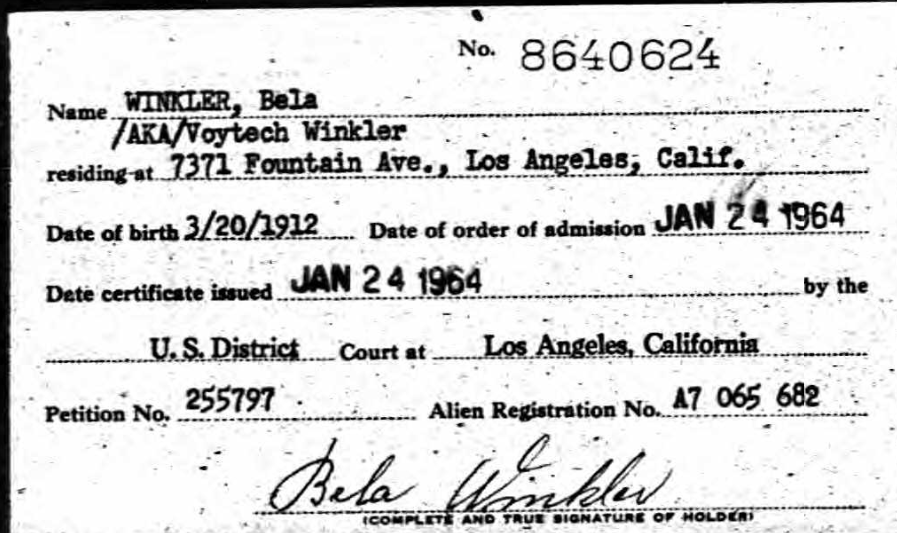
    As shown at the top of this post, Albert entered the United States under the name of Voytech Winkler. Not a name I've ever seen before. It only turned up once I searched for Bela Winkler with the exact birth date and residence city.

    This single index card, for Albert's naturalization, gave me a wealth of information. I tracked down the passenger list, his naturalization petition, and his naturalization papers. I learned that Albert married in 1962, and his Hungarian-born wife was naturalized around the same time as Albert. There's more to discover, but already I have many more facts than I had before.

    UPDATE: "Voytech" on the passenger list was phonetic...I found "Wojtek Winkler" (born in Uzhhorod) on a list of Vilna Refugees in 1940, "Polish Jewish Refugees" who had been helped out of Krakow. Now to investigate further! 

    All because I invested in a unique genealogical record to fix my mistaken assumption. Now my trees show Albert Bela Winkler, 1912-1993.

    --

    "Mistake" is this week's #52Ancestors prompt from Amy Johnson Crow.