Sunday, May 18, 2025

Crossing the Northern Border at Age One

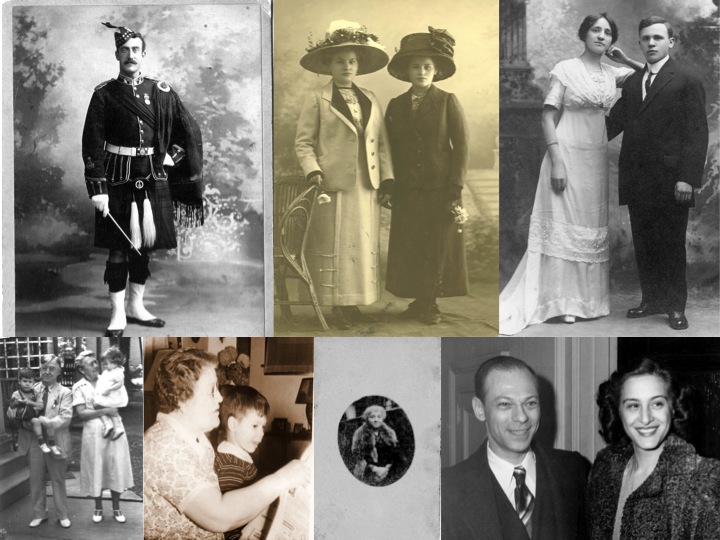
This week is the 114th anniversary of the birth of my paternal aunt Miriam Burk (1911-1987). 

In this New York City photo, Miriam is the babe in the arms of her mother, Henrietta Mahler Burk. To the left, in the fashionable hair bow, is older sister Mildred Burk. The tyke at lower right is my own Dad, Harold Burk.

Not shown in the photo is Henrietta's husband, my paternal grandfather Isaac Burk, who was then in Montreal, where he often worked as a cabinetmaker and carpenter. He went alone and sometimes the family followed, then returned to New York City where Henrietta's family lived.

The day in 1911 when Miriam was born was sunny and warm. The New York Times headlines that day were about Mexico reorganizing itself politically, possible mayoral candidates, foreign banks doing business in New York, and Mrs. Taft returning from New York to Washington after falling ill. One small front-page item quoted a City College professor as saying that life "must have come from other worlds," with germs brought to Earth on the energy of light rushing through the universe. I kid you not.

In 1912, at the age of one, Miriam crossed the border from the United States to Canada, traveling with her mother Henrietta and two siblings, to be reunited with Isaac in Montreal. While living in Montreal, Henrietta gave birth to their fourth child, Sidney Burk. 

In 1915, when Sidney was one year old, Henrietta brought him, Miriam, Mildred, and Harold back across the border to New York City for good. Isaac soon returned to the Big Apple and that's where they planted permanent roots.

Happy birthday to Aunt Miriam, who was a gracious and glamorous aunt.

Wednesday, May 14, 2025

If I Could Do It Over: Oral History

A few years before my late father-in-law Edgar J. Wood passed away in 1986, my husband sat down with him on two occasions, to ask questions about the past. He had a microphone set up on the coffee table and a cassette ready to tape his father's oral history. 

This was a first-ever attempt to ask the last of the older generation about family history and his personal history. Great idea, and I'm grateful my husband did this.

Because hubby has a journalism background, he was prepared with lots and lots of questions for Ed, and held a pad and pen to take notes. (Me, looking back now with hindsight: Pages of questions, taking notes--maybe too direct, maybe a little overwhelming for the interviewee.)

Of course, my husband did many things right: He tested his recording device just before the interviewee began. He smiled and looked interested even when the story seemed old. He asked for the time to interview and made sure the place was quiet and free from interruptions. He got his father's agreement to do the interviews. And afterward, he transcribed the recordings to share with family.

Set the stage for a solid oral history

If we could go back in time and redo this opportunity to capture oral history from Ed, I would:

  1. Ask open-ended questions that encourage freewheeling answers. "How did you and Mom meet?" encourages the interviewee to tell a story. This should be a conversation, NOT an interrogation. Interviewers can guide the conversation but not force it or make the interviewee feel cornered. The beginning of an interview sets the tone. My late father-in-law was nervous and not comfortable for the first half an hour, I could hear from the recording, but then he got into story-telling mode and recounted some fascinating tales!
  2. Allow time for thinking and remembering. It takes time to retrieve memories from decades in the past. When there are pauses in the conversation, take a deep breath and be patient. Don't push the interviewee, don't rush into the next question. 
  3. Allow for natural follow-up. Reporters might have to get through a list of questions, but not family historians. Listening to answers, reflecting on what the interviewee says, will naturally lead to gentle follow-up comments and questions. Being overeager is a trap. After Ed got more comfortable, he was able to recall more vividly some high and low points of his life, and he did share some of his stronger feelings.
  4. Try not to interrupt. There are stories that folks just love to tell, over and over. But those stories may lead down a fresh path if we listen with interest and respect...and wait for the right opportunity to pose a natural follow-up comment or question. While my husband was listening to a well-worn story, suddenly his father remembered a key new detail! Some of these memories may be positive, some painful, so I think it's best to let the interview unfold without rigid structure, but with an occasional subtle, supportive comment and open, accepting body language.
  5. Interview for fairly short periods, with flexibility. Ed sat for two interviews, each an hour long. Now I think that was too long per interview. I would aim for half an hour and see how things go and continue if the interviewee would like to keep going (depending on age and health, etc). I would also encourage the interviewee to jot down stories he or she would enjoy telling in an interview. This should be a positive experience, not a chore. 
Questions and issues

Back in the day, nobody could envision how much genealogy research would or could eventually reveal about the past. So my late father-in-law had no way to know that eventually we would uncover some irregularities in his stories. Not just timing mismatches, but deliberate obfuscations. Looking back, we now know Ed left out certain details and deflected some questions to avoid disclosing difficult facts or feelings.

Even if we had known about these issues at the time of the interview, I believe it would have been a bad idea to challenge the interviewee's version, what that person wanted to remember/convey. 

If I could go back in time and help my husband redo those oral history interviews, I would recommend that he listen with his heart to what the interviewee was saying and the reason for telling the story that way. Maybe I would suggest rephrasing a particularly direct or sensitive question or give a gentle followup question, nothing confrontational. I wouldn't want the interviewee to get upset or to stop talking.

As the family historian who is lucky enough to have oral history content like Ed's interviews, I can always provide context if and when I retell parts of the story for the benefit of future generations. 

If something was too sensitive to disclose at this time (and that was NOT the case with Ed), I would simply leave a note in my files and let the next generation decide what and when to disclose.

What do you think? 

Sunday, May 11, 2025

Honoring Three Generations of Moms


My beloved Mom (Daisy Schwartz Burk, 1919-1981, shown above) was born in New York City, the daughter of a Hungarian-born immigrant, Henrietta "Minnie" Schwartz Farkas (1886-1964, shown below) and the granddaughter of a Hungarian-born immigrant, Lena Kunstler Farkas (1865-1938, at bottom). 

My great-grandma Lena arrived in New York City 125 years ago to join her husband who had crossed the Atlantic first to make a fresh start for his family. My grandma Minnie sailed, as a teenager, with three other siblings, to be reunited with her parents in the Big Apple 124 years ago. She had hopes and dreams for her new life!


If not for these three mothers, I wouldn't be here. So on Mother's Day, I'm honoring the memory of these special moms in my family tree, with love. 

Friday, May 9, 2025

When Was That Volunteer Last Active on Find A Grave?


Something new at Find a Grave: Now when you look at a user's profile, you can see approximately when that person was last active on the site.

Before I submit an edit to a Find a Grave memorial, or try to contact that memorial's manager, I can check how long it's been since that user has been active. 

Here are the activity levels I've seen so far:

  • Over a year ago. My interpretation of this activity level is I doubt I'll hear from the user if I ask a question or submit an edit.
  • In the past year. Maybe I'll hear back, maybe not, but there's some hope.
  • Last month. Active not very long ago, so I'll probably get a response to an inquiry or edit.
  • This month. An active user! Better chance I'll get a response.

I like this new activity indicator and will aim to keep mine at "This month" if I can!

Wednesday, May 7, 2025

One Generation Back for $27 Plus an Eight Week Wait


Researching the Yurko family, an in-law line on my hubby's family tree, I wanted to discover the names of the parents of Joseph John Yurko (1873-1954), born on this day 152 years ago.

Believe the death cert?

According to Joseph's death cert, his father was John Yurko and his mother's name was unknown. Indeed, in Joseph's generation and later generations, the names of Joseph Yurko and John Yurko appear more than once. Clearly these were beloved family names.

However, the informant on the death cert was John's youngest daughter, Mary L. Yurko (1916-2001), I doubted her ability to remember her grandparents' names. Why? Mary was born 17 years after her own parents left their homeland to come to America. She was 37 when her father died. Although she may have heard her Yurko grandparents' names as she grew up, Mary probably never met those relatives, and I imagine the stress of her father's death impeded her ability to recall the names clearly. 

I didn't feel confident that Mary's memory was correct...which led me to shift my research in another direction. Where would I find Joseph saying the names of his parents?

Social Security application = first-hand info

Joseph applied for a Social Security card in 1937. The application form asks for birth place/place, current residential address, names of parents, and employer, among other details. This is first-hand info supplied by the applicant. 

In the past, I've had great success getting a generation back when I paid to receive a copy of the SS-5 (Social Security) application for other ancestors. IMHO, the information is valuable enough to invest in obtaining it for certain ancestors of interest.

As shown in image at top of this blog post, we can order either the SS-5, which costs $27 at the moment, or a Numident, which is an extract of the info on the application. ALWAYS spend the extra buck or two for the SS-5 because we should see with our own eyes what the applicant wrote on the form! Forget the Numident 👎

Eight weeks later, info arrives

Late in February, I made a Freedom of Information Act request for Joseph John Yurko's SS-5. I had to supply information to help the government ascertain that it was giving me the correct person's form. And of course I had to pay. Note that there are restrictions on such requests, such as how long the person has been dead. In my case, because Joseph was born in 1873 and died in 1954, there were no impediments to obtaining his SS-5.

After eight weeks, I received an email containing the image shown above. Just looking at the form, I think Joseph verbally gave the info and was shown where to sign his name. The info confirms what I believed were his date of birth and birth place, also showing that he worked for the WPA (as shown in the 1940 US Census), and confirming his long-time home address, a house in Cleveland that has since been torn down.

I was delighted to see the names of Joseph's parents. His father was NOT John but was Andrew Yurko. And now I also know his mother's full name for the first time. Joseph and his wife presumably named their older daughter Anna, after Joseph's mother. For me, all these details were worth the investment of $27.

By the way, Joseph and his wife Mary Gavalek (1879-1943) were married in 1896 in their hometown of Hazlin, according to his naturalization papers. Joseph and Mary had no sons named Andrew that I've found (still looking in their hometown) and no grandsons named Andrew either. Hmm. 

Paying for a record

I decided to pay for this record because it provided info that was furnished by the applicant, even though he didn't actually write anything but his signature. Having exhausted other avenues of research, I felt it would be worth my while to see this document and all the details on it. 

Not every ancestor in my ever-expanding family tree is worth an investment of $27, but I decided that the SS-5 was the only way I would learn about this ancestor's parents and be confident that the info was accurate because it came from the man himself. Plus I would see the actual image, not an extract or transcript, which is of great value.

Sunday, May 4, 2025

In Ten Minutes, Learn How to Tune Up Your Cousin Bait!

When the Virtual Genealogical Association held its seventh birthday party a week ago, I presented a ten minute talk about how to connect with cousins via cousin bait. You can watch my talk for free and learn how to search for user-uploaded images and stories, see who uploaded these things (maybe your cousins?!), and make your own cousin bait more appealing to folks who are researching the same ancestors. 

For more free genealogy talks, see the VGA website here. Lots of excellent speakers and topics!


Thursday, May 1, 2025

Back Up Your Family History!


Back up day! Back up your digital items in the cloud as well as using another method such as an external hard drive and/or a flash drive (or all three!). It's important to keep our genealogy info safe for today and tomorrow.

Also, consider periodically downloading a gedcom (family tree document in standardized format) from Ancestry and MyHeritage so you can keep those trees in your digital possession too, just in case. I have trees on both of these sites so I download a gedcom from each from time to time. Here's how I do it.

Ancestry download

At top of this blog post is a picture of the "tree settings" section of my Wood family tree, showing "tree info" that includes tree name and description on the left.

The button for downloading a gedcom is at lower right of this page (see blue arrow in image). I clicked the button "download your GEDCOM file" and very quickly the file appeared on my desktop (in your case, wherever downloads are supposed to go, since your destination may be different). 

The download will have a .ged file extension at end of the file name. I renamed the file to reflect the Wood tree but left the .ged extension. 

Wash, rinse, repeat for all trees. I have a few trees on Ancestry, including a speculative private tree, and want to download each as an occasional backup.

MyHeritage export


On MyHeritage, I go to the dropdown "family tree" menu at top of page, select "manage family trees," and then see options like "download original GEDCOM" and "export to GEDCOM." This is the image above.

Since I originally began with a gedcom upload from my software, I don't want to download the original now. I do want to export the current family tree to a gedcom now! 

Once I request the export, MyHeritage asks whether I want personal photos and photo album in the download. Yes, I do! See image at right where I checked those boxes for my export.

MyHeritage sends me an email when the export is ready, with a link to click to retrieve the gedcom. I change the name to describe which tree, but leave the .ged ending. Wash, rinse, repeat for each tree if more than one.

WikiTree download

Yes, it is possible to download a gedcom from WikiTree. You can read about the process (and any privacy concerns) here

Backing up isn't complicated, and it gives me peace of mind.

Saturday, April 26, 2025

Olive and Rosebud Osborn, Teen Brides

The Osborn girls

From my husband's side of the family tree, I admire the romantic names of the Osborn sisters, as shown in their baptismal record at left, from 1868. The full names of these three sisters appear nowhere else but on their baptismal record! 

Harriet "Hattie" Verona Osborn was the oldest, Olive "Ollie" Violet Osborn was the middle girl, and Rosebud Charlotte Augusta was the youngest of the Osborn sisters. 

Olive gets married

On the 26th of April in 1874 in Toledo, Ohio, teenaged bride Olive Osborn (1856-1891) married William Henry White Wood (1853-1893). They were my hubby's great uncle and great aunt. 

When Olive married William, she was 17, her husband was 20.

Olive and Stephen, then Olive and William

This wasn't Olive's first marriage: In 1872, at only 15, she eloped to Detroit where she married Stephen Sylvester Babcock. Olive said she was 16, the minimum age to marry in Michigan at the time, and her older sister "Hattie" was a witness. No documentation of how that marriage was dissolved. Stephen married again later.  

Olive and William settled in Toledo and had a large family, their youngest born late in February, 1891. Sadly, Olive died in March of 1891 from "peripheral septicemia." William contracted typhoid some months later and died in 1893 from "typhoid relapse."

Rosebud and John

Rosebud married five months after her sister Olive, wed to John C. Werts in Toledo, Ohio in September, 1874. Although 16 was the minimum age to marry in Ohio, Rosebud was only 15. No record of her having a parent's consent to marry. She and John also raised their family in Toledo.

Thinking of Olive Osborn Wood and her husband, William Henry White Wood, on the anniversary of their wedding in 1874.

Wednesday, April 23, 2025

Tune Up Your Cousin Bait! VGA Birthday Party on April 27

 
This Sunday, you're invited to the FREE birthday party of the Virtual Genealogical Association. 

The party will feature a great lineup of genealogy presentations, from 1 pm to 5 pm Eastern time, on April 27th. Trivia games and prizes also! Free. 

For more information and to register for the Zoom link, see the announcement here.

My ten minute talk on cousin bait will begin about 1:30ish.

See you on Sunday!

Monday, April 21, 2025

New Indexes to Free NYC Digitized Vital Records


The New York City Municipal Archives has been digitizing old birth, marriage, and death records and posting them on this site for a while now. Not all years for all boroughs, but many are already posted and more are on the way. Free! 

The latest news: On April 11th, the city posted a set of indexes for the very first time, simplifying the process of locating the exact vital record.

New indexes! Part 1 of new search process

The indexes for NYC birth certs, death certs, marriage certs, and marriage licenses can be seen here. These online indexes streamline the entire process, still free.

Pick the index you want and start a search for the NAME of the person. Below, an example of a search for the birth certificate for Charles Lang. I entered his name in the search box. Results are displayed in ascending chronological order. The Charles Lang entry that I want is at the bottom, born in Manhattan, birth cert #22907, birth year 1906. 

This is part 1 of the search, so note those cert details or open another tab on your browser.


Part 2 of the search process

Now go to the NYC Muni search page for the type of cert you want, birth or marriage or death. This is part 2 of the search: Enter what you just learned from the index, as shown below in my sample search for a birth cert. Click the purple search button below the data entry boxes. 

The result

As shown in the image below, this search returns a color image, in a downloadable pdf format (printable as well). Vital records may not be available forever, so do grab a digital copy while you can. 

Free! No need to purchase a certified copy unless you have a special purpose in mind that requires certification. So first check the index, then do the cert search. In the old days (before the indexes), there was an extra step to this process to obtain the cert number, borough, and year. Usually those details can be found on Ancestry, FamilySearch, etc. 

FYI today, in April of 2025, FamilySearch does have these NYC vital records but the images are not visible from home, only in a FamilySearch library. And I want to eyeball the document image for myself, so I either use the free NYC Muni Archives or use my subscription to MyHeritage.


MyHeritage search - not free but really easy!

If you're a MyHeritage subscriber, like me, you are in great luck--MyHeritage has a unique collection of historic New York City vital records, with its own set of indexes and color scans of the certs. Plus MyHeritage indexes not only bride and groom but also the names of their parents!

Very easy searching. And the benefit of a full color image is that any marks or alterations on the certificate are quite obvious. See the example below from a MyHeritage search for a 1903 birth cert for my great uncle Fred. The magenta shows important corrections inserted years after this man's birth. Among other things, his birth was registered as female instead of male, his surname listed as Forkus instead of Farkas. Neither parent's name was correct either. But Fred straightened out all these details in 1942.


I can download and/or print the image, as well as connecting it to my family tree.

Happy ancestor hunting in the Big Apple!

PS FamilySearch image of Charles Lang birth cert is not in color. Same exact cert, not in color. 

Saturday, April 19, 2025

1909 Easter Greetings from Toledo, Ohio

 
On April 8, 1909, this colorful Easter penny postal greeting was dropped in the mail and postmarked in Toledo, Ohio, bound for Cleveland, Ohio. I suspect the card arrived in time for Easter Sunday on April 11, 1909 because mail delivery was rather speedy back in those days.

The sender in Toledo was "Elton," actually Charles Elton Wood (1891-1951). The recipient in Cleveland was Elton's nephew, Wallis Walter Wood (1905-1957). Elton was 18 years old and his handwriting flowed! Wallis was not yet 4 years old but I'm sure he was happy to get pretty holiday cards. Who wouldn't be?

Happy Easter! 

Wednesday, April 16, 2025

Sarah Mahler Smith, Marital Expatriate


When my great aunt Sarah Sadie Mahler (1889-1974) got married in the Big Apple on April 16, 1912, she lost her US citizenship because her immigrant husband Samuel Smith (1889-1979) was not yet a naturalized US citizen.

Samuel (original name: Simon Solomowitz) was born in the city of Botosani, Romania, and came to New York City with his parents and siblings when he was a little boy. 

After they married in Manhattan, Sam and Sarah moved to Fort Edward, NY so he could work in the paper mills. By 1920, the Smith family was back in New York City, where Sam began working as a chauffeur. As shown in the 1925 New York Census excerpt at top, Sam became a US citizen in 1924 in New York City.

Sarah's citizenship status, however, was not affected by Sam's naturalization, because of the Cable Act of 1922, which separated the citizenship status of spouses. She was a "marital expatriate" - and decided, during World War II, to take steps to regain her US citizenship.

As shown here, Sarah filed Form NH-415, applying to take the oath of allegiance to the United States. She was once again a citizen after taking the oath on February 11, 1944. Sarah was outlived by all five of her children and her husband. Today I'm thinking of her on the anniversary of her marriage in April of 1912 (not 1911, as mistakenly shown on the oath document above). 

Monday, April 14, 2025

WikiTree Users Added 78,477 to Tree--I Added 75 Ancestors


During this past weekend's ConnectAThon XIV, the WikiTree community added 78,477 new names to the worldwide collaborative tree.

My personal total was 75 ancestors added over the course of the weekend, including many from my husband's Larimer family tree (which is quite extensive) and dozens of in-laws from my paternal aunts' side of the family. I 💜 in-laws!

Above, a profile I created for little Dorothy Goodfield, a premature baby who only lived four days. Dorothy was the maternal 1c of my aunt Miriam's husband, David Bourstein. I entered Dorothy's name, parents, siblings, and wrote a brief bio with the one source I have, without a lot of detail because I included the informative original source image.

Red arrows

At bottom right, the arrow is pointing to a sticker flagging Dorothy's profile as someone who "died young." She was one of five or six little ones who I flagged in this way, sadly, but with the hope that this helps keep her name and memory alive for the future. WikiTree provides a number of stickers like this to be added to profiles as appropriate. I insert them occasionally to highlight something significant related to the person's life or death.

At top left, the arrow is pointing to a death cert I downloaded for free from the New York City Municipal Archives. The cert names Dorothy's parents and their birthplaces, shows the baby's place of birth/death, details cause of death, and indicates place of burial as Washington Cemetery in Brooklyn, NY. This is the only proof I have of the baby's life and I wanted to share it, in full, for anyone interested in learning about her.

At top right, the arrow is pointing to "2 categories." This shows that I categorized Dorothy Goodfield in two ways: First, as being buried in Washington Cemetery, and second, as being of Jewish Roots. So if someone wants to see the profiles of people buried in that Brooklyn cemetery, they can click through and see the description and names here. Similarly, I added the Jewish Roots category because Dorothy's family was Jewish. 

Thank you to WikiTreers for camaraderie and fun during this intense weekend of adding profiles to grow the collaborative family tree in total beyond 41 million names.  

PS: Here's the "how to" page with more info about getting started on WikiTree.

Friday, April 11, 2025

Bartlett Larimer MD, Preceptor


Researching my husband's Larimer, Short, and Work ancestors (intermarried over decades), I've marveled at the family influence of Bartlett Larimer (1833-1892), an early physician in Indiana. Bartlett was a younger brother of hubby's 2d great grandfather, Brice S. Larimer. 

At top is an excerpt from the University of Michigan yearbook from 1869, showing John L. Short and William H. Short from Millersburg, Indiana are both medical students. "B. Larimee" is their preceptor.

Despite the small spelling mistake, this is clearly Bartlett Larimer supervising the medical studies (and maybe the internships) of his two nephews. 

Bartlett himself attended LaGrange Collegiate Institute in 1850, a prep school also attended by his brother David the following year (see alumni page at right). By 1853, Bartlett was studying at Wabash College before going on to University of Michigan. After graduating, he became the first physician in practice in Millersburg, Indiana, circa 1858. According to a news report in the Elkhart Truth, he was also a temperance advocate who personally paid lawyers to oppose any applications for saloon licenses in his town--successfully.

Three of Bartlett's nephews (including the two Short brothers listed in the image at top) became doctors and two became dentists. However, none of his own six sons and one daughter became either a doctor or a dentist. Bartlett died in his late 50s after a brief illness, much mourned in the family and the community.

This is my "mistake" post for Amy Johnson Crow's 52 Ancestors genealogy challenge of the week. 

Tuesday, April 8, 2025

National Library Week: I Heart My CT State Library


I 💙 my Connecticut State Library!

Just recently, the state library posted links to three of Connecticut military veterans records digitized by Family Search, as shown above. Instead of having to look through index cards, we can click on each of the hyperlinks to see individual images of documents about veterans in Connecticut. 

With my state library card, I can access a number of useful databases from home (in my bunny slippers if I wish), including Fold3 for military records and HeritageQuest for city directories, Census records, historical newspapers, and more. For free!

During National Library Week, please show your 💜 for local, state, and specialized libraries that offer so many genealogical resources!

Sunday, April 6, 2025

Remembering Ira Caldwell: Union Vet, Farmer, Family Man


My husband's 1c3r on his McClure line was Ira Caldwell (1839-1926). This cousin was one of eight sons of Train Caldwell and Jane McClure, who also had one daughter, Mary Ann. All the sons helped out on the family farm in Indiana, raising prize-winning cattle and horses (I learned this from Ira's lengthy obit!). Most of the sons grew up to be farmers in their own right, including Ira.

US Civil War service and marriage

Ira was 23 in 1862 when he enlisted in the newly-formed Indiana Infantry, 84th Regiment, Company I to fight for the Union. This regiment was involved in the Battle of Chickamauga, the siege of Chattanooga, and the Atlanta campaign, among other key Civil War activities. I learned a good deal about his unit's wartime activities from a number of online resources, including Fold3 but also including the National Parks Service and a state historical marker (and another).

On April 11, 1865, two days after General Robert E. Lee surrendered, Ira was promoted to Sgt. Caldwell. His regiment was mustered out at Camp Harker, Tennessee on June 14, 1865. When Ira returned home to Fayette county, Indiana, he resumed farming with his father.

In October of 1866, Ira married Margaret Jane Kelsey (1841-1925), daughter of a farmer in Rush county, Indiana. They moved in with her family at first. Ira and Margaret were the parents of two children. Hester was born in 1868 (she later married and had four children). Santford was born in early 1869 but sadly died a few days later.

Family on the move

I knew where Ira and Margaret were during all the Census years of their lives, but his informative obit in the Bethany Clipper (Missouri) filled in the gaps between Census years very nicely. Also Ira was listed in the 1890 Veteran's schedule, with full dates for his military service. 

After living with Margaret's family, they moved to Harrison County, Missouri, then to Illinois, and back to Harrison County, Missouri, where they purchased land in 1874 and built a home. The obit noted that Ira and his wife Margaret and their daughter Hester were all baptized and converted to the Baptist Church during a church meeting in 1883. Ira was in his early 40s, Margaret in her late 30s, and Hester was a teen. 

Another news clipping, from 1892, indicated that Ira was working on a fence on his Blythedale farm when a nail flew up into his face and damaged his eye so badly he lost sight in that eye. 

By 1920, Ira and Margaret were living with their daughter Hester and her husband and children in Marion township, Harrison county, Missouri. Margaret died of heart problems in 1925, at age 84. Ira was still receiving a monthly Civil War invalid pension that continued until the time of his death at age 86 on May 3, 1926. 

Remembering Ira Caldwell as the 99th anniversary of his death approaches.

VGA Party Features Free Genealogy Talks on April 27th


Mark your calendar for Sunday, April 27th: The Virtual Genealogical Association is celebrating its 7th birthday with a four-hour party of brief genealogy talks--free!

From finding ancestor photos to finding ancestors in newspapers, DNA details to non-English documents, this party covers lots of topics in short bursts. No talk will be more than 30 minutes long and many will last for just 10 or 15 minutes. 

My 10 minute live presentation is "Tune Up Your Cousin Bait" - scheduled for about 1:30 pm Eastern.

See the full list of speakers, register for the Zoom link here, and get ready for a fun Sunday afternoon of genealogy talks and prizes!

To use the discount code for VGA membership, please type the letters in caps, not in lower-case. See you on April 27th.

Thursday, April 3, 2025

Two Blunt Obit Headlines for Frank Bentley Light


Researching my husband's 1c3r Frank Bentley Light (1853-1913), I was stopped dead in my tracks (so to speak) by the headlines announcing his death in Vacaville, California in 1913. The blunt language was not at all subtle but did accurately describe what happened to this man.

Above, a brief notice about "the carpenter who dropped dead" while working on a Union Ice Company building being identified as Frank B. Light. This item was picked up by the Sacramento Bee newspaper from the Vacaville newspaper. The headline "Was Frank B. Light" served as a correction because the initial report misidentified the dead man.

The full obit, which appeared on April 11, 1913 in the Vacaville Reporter newspaper, reads:

Dropped Dead. Frank B.  Light Succumbs to Attack of Heart Failure. Frank B. Light, a resident of this place for a number of years, dropped dead last Friday morning while engaged in unloading a carload of ice for A.M. Stevenson. The cause of death was heart failure. Deceased was a native of Indiana and was 60 years of age. He came to California with his parents in 1853, and resided in Santa Rosa for many years before coming to Vacaville. He was a carpenter by trade and a conscientious and upright man who had the respect and esteem of all who knew him. He was unmarried and leaves a sister Mattie Light and a brother L.E. Light. The funeral was held Sunday from the Baptist church and the interment was in Vacaville cemetery.

Frank lived with his sister Martha Ann "Mattie" Light (1854-1917) for years after their parents died. She worked as a dressmaker, according to her voter registration, but it's a good guess that Frank kept a roof over their heads with his carpentry and work in lumbering and as a laborer. Vacaville was a small town when they lived there--fewer than 1,200 residents until the 1920s--and probably everybody knew everybody.

After Frank died so unexpectedly, 112 years ago this month, Mattie went to live with their brother Lucien E. Light (1862-1918), also a carpenter. Sadly, Mattie became ill and died in 1917, followed just a year later by Lucien's death. I noticed that Lucien's obit was worded more gently than Frank's obit. The headline read: "L.E. Light Passed Away Last Friday," perhaps because this death (from Bright's disease) was nowhere near as sudden as Frank's death.

"Language" is this week's #52Ancestors genealogical prompt from Amy Johnson Crow.

Tuesday, April 1, 2025

Korean War Draft Cards Now on Fold3

No April Fool here! A few months ago, Fold3 began posting US draft registration cards from the Korean War era. These offer a unique window into our US male ancestors' lives in the middle of the 20th century.

So far, only cards from the states of Wyoming and Alaska have been put on Fold3, with more cards to be added during this year. Remember: a draft card is only a record of a man's registration with the local draft board--not proof of any military service.

I'm delighted to see all the detail on these cards: Full name, birth date (not just age), birth place, "someone who will always know your address" (FAN club), occupation, employer, industry, exact place of employment. Also marital status and specifically whether living with wife, separated, divorced, or widower--and whether this man is a father. On the back are physical details of height, eye/hair color etc. I already found someone in my husband's family who was, I was surprised to discover, living in Wyoming and had to register!

To learn more about this Fold3 database, see here

NOTE: Even though Fold3 is a subscription site, many US public libraries offer remote access with a library card. I get into Fold3 through my Connecticut State Library card. Check whether your library has Fold3 access and happy ancestor hunting!

Friday, March 28, 2025

Learn for Free: Big Genealogy Sites' Blogs and Videos


Even if you don't subscribe to big-name genealogy sites, you can read their blogs and learn from their YouTube channels for free. Lots of interesting tidbits about historical context, details about info that is and is not in particular data collections, surprising genealogy discoveries, backgrounds of notable historical figures, and many other insights. I especially like browsing blog posts, but informative videos are also readily available without charge.

Here are links to six blogs to browse:

  • FindMyPast (blog is here) posts blog entries about history, building a family tree, starting your genealogy journey, customer discoveries, and more. Not just United Kingdom.
  • MyHeritage (blog is here) posts blog entries about social history, family history customs, immigration, new collections, DNA discoveries, and more. Posts span the globe.
  • FamilySearch (blog is here) posts often about new collections, using the Familysearch site/tree more effectively, involving family in genealogy, RootsTech developments, and much more.
  • Ancestry (blog is here) posts about a broad range of genealogy topics and cultures, including strategies for uncovering female ancestry, DNA details, surnames, and more. 
  • Fold3 (blog is here) posts blog entries about new collections, military history, wartime experiences, and more. Posts pertain mainly to US, but some also cover Australia, New Zealand, and the United Kingdom. Part of Ancestry.
  • Forces War Records (blog is here) posts blog entries about military history involving the United Kingdom, World War I and II, women in the military, and more. Part of Ancestry.
Here are links to big sites' video vaults on YouTube. Of course, genealogical videos are also available on each proprietary site.

Tuesday, March 25, 2025

Look for Kernels of Truth in Family Stories

I love a good family story. "Teddy was late to his own wedding because his horse ran off." "They gave Mom their unopened pay packets every Friday and she doled out a handful of nickels for the next week's subway fare." "Minnie wouldn't accept a suitor chosen for her by her family--she threw his engagement ring out the window."

These three stories were passed down in my mother's family tree. Too bad I can never confirm the story about the horse that ran away. And at first, the other two stories sounded a little outlandish, despite multiple cousins having heard variations of those legends from family history.

New World, new approach to household finances

Then I was introduced to two books that changed my understanding of these family stories. The first was Immigrant Women in the Land of Dollars by Elizabeth Ewen. The author looks at the lives of Jewish and Italian women immigrants on the Lower East Side of Manhattan during the peak years of immigration to America. Mothers and daughters learned to approach household finances in a different way when they moved to America. In the Old World, barter was an everyday experience. In the New World, cash was an absolute necessity.

The chapter on "Our Daily Bread" describes the common experience of the immigrant mother as strict organizer of household finance, demanding unopened pay packets from working children and only giving back the bare minimum of coins for each child to get to their job in between paydays. The rest was kept for rent, food, and other household expenses.

There was the kernel of truth in my family story: According to descendants, my great-grandma Lena Kunstler Farkas (1865-1938) stood at the door of the family apartment on payday with her hand extended, taking pay packets from teenage and adult children as they arrived home from work. 

Sometimes my great uncles Julius and Peter wouldn't have enough money for subway rides to and from work, so they would reportedly walk home from Manhattan to the Bronx on occasion. Speculation was that the boys actually dared to spend a nickel or two on some treat or diversion. Instead of asking for more from Lena, they walked home and said nothing. Lena was a strict disciplinarian and no one wanted to get on her bad side or they'd get a sharp rap on the head. Really.

Marrying the family's choice?

The second book I read was Bread Givers by Anzia Yezierska, a Polish-born Jewish author who immigrated to New York City with her family in the 1890s. This overwrought 1925 novel tells the story of conflict in a poor Jewish family transplanted from Poland to tenement life in lower Manhattan. I find historical fiction such as this sometimes offers windows into attitudes and challenges from past generations (allowing for excessive drama in the narrative).

This book really caught my attention when the father of the family rejected the men that three of his daughters want to marry. Instead, he arranged marriages to bring himself financial gain, even though the daughters would be unhappy. The youngest daughter resolves to only marry for love. And after many trials and tribulations for the family, that's what she does. New world, new approach to marriage. 

In my family, Lena's husband Moritz Farkas (1857-1936) earned little in his work in New York City, so everyone had to pitch in to keep the household afloat. Moritz was very fond of all his daughters, and each thought she was the favorite, by the way. When my grandma Minnie, the oldest daughter, fell in love with Teddy Schwartz, Moritz and Lena objected because they thought their daughter could do much better. That's when they arranged what they believed would be a more suitable match, a marriage they hoped would give Minnie a better life. 

Minnie would not even consider an arranged marriage. Knowing her as I did in later life, I can imagine her throwing the engagement ring out the window to show her final answer to the arranged marriage. Family story is that Peter and Julius scrambled down the stairs of the tenement to the sidewalk to search for the ring, but no one has any idea whether they found it and who kept it. With Minnie as the role model, every one of her siblings who married chose his or her own partner. It was a new world and the family learned to adapt. Kernel of truth!

Did Teddy's horse really run away on the morning of his wedding to Minnie? It doesn't really matter...what matters is that there are kernels of truth to explain the stories passed down through the decades, and to remind descendants that ancestors were more than names and dates on a family tree. Thinking of my great-grandma Lena, who collected paypackets to finance her household, on the 87th anniversary of her passing, in March of 1938.

Friday, March 21, 2025

Married Twice Because His Mama Wanted a Pastor to Preside


My husband's first cousin once removed, George Ellery Wood (1885-1976) was married for the first time on this date 117 years ago. As shown above, George E. Wood was the groom, Amanda L. Krueger (1890-1947) was the bride. They claimed to live in Detroit, Michigan, where this marriage was recorded, but in reality both lived in Toledo, Ohio. 

George was an iron worker, he wrote on this marriage license, and he and his bride both listed their parents and ages correctly. Directly above, the part of the marriage ledger where the officiant is named: a Justice of the Peace.

The family story is that George and Amanda eloped to Detroit on this Saturday in March, returning home the same day. George's mother was not happy. George was her oldest child, and she insisted the couple be married again in Ohio, where they actually lived, and by the clergyman of her choice: Reverend George Candee, an ardent abolitionist. 


And so on Tuesday, March 31, 1908, George and Amanda stood in front of Rev. Candee and were again married. Above is the proof. Interestingly, the bride and groom claimed on this marriage license application that neither had been previously married, perhaps because George's mom didn't want anyone to know about the elopement ten days earlier? Also note by the star on the image above, the notation "don't publish please." Hmmm? 

In any case, the couple had three children together and remained married for nearly 39 years until Amanda's death from heart problems in 1947. She was buried in Forest Cemetery, Toledo, Ohio. When her husband George died in 1976, he was buried by her side.

This "historic event" of two marriages in 10 days was discussed by descendants for decades. My post is for the #52Ancestors challenge by Amy Johnson Crow.

Wednesday, March 19, 2025

Remembering Maternal Grandma Minnie and Her Age Fibs

Born in what is now Berehove, Ukraine, my maternal grandma Hermina "Minnie" Farkas (1886-1964) shouldered a lot of family responsibility from the moment she set foot on the S.S. Amsterdam to sail to America. Her parents were already living in a tenement on the Lower East Side of New York City, and Minnie was sent, with an older brother and two much younger siblings, to join them. She celebrated her 15th birthday on the trans-Atlantic voyage in November, 1901, not knowing what her new home would look like but with high hopes for the future.

Minnie in America

In New York, Minnie worked during the day at a tie factory owned by an in-law and went to school at night to learn English. At the end of every week, Minnie and her siblings handed their unopened pay packets to their mother, who doled out carfare to each adult child and kept the rest for household expenses. 

Minnie met her future husband Theodore "Teddy" Schwartz (1887-1965) in a Hungarian deli. Despite resistance from her parents, she married him in October, 1911. From then on, Minnie would not just help Teddy in the store, she would also raise three children AND sew clothing for her siblings, nieces, and nephews AND cook Hungarian specialties for family meals. She worked long and hard for decades. 

Only after Minnie and Teddy sold their small dairy store in the 1950s did they have time and money to take a honeymoon! Minnie had happy moments, but as the years passed, she was disillusioned and disappointed because her life did not play out like the rosy future she had dreamed of when she arrived in 1901 as a hopeful immigrant teenager. The more I research her and talk with older relatives who knew her well, the better I understand why she was not "warm and fuzzy" although she was a responsible grandma who pitched in when needed.

Noting Minnie's age changes

On their marriage certificate (shown at top), both Minnie and Teddy are shown as 24 years old. That might be one of the last times Minnie told the truth about her age.

In the 1920 US Census, she was supposedly 30 (actually she was 34). In the 1925 NY Census, she was supposedly 35 (actually 38). In the 1930 US Census, she was supposedly 40 (actually 44). In the 1940 US Census, she was supposedly 52 (actually 53). In the 1950 US Census, she was shown as 63--correct age!

When Grandma Minnie died of heart problems on March 20, 1964, it was the end of an era for the entire Farkas family. Disheartened, and with his health deteriorating, Grandpa sadly passed away 14 months later.

Remembering Grandma Minnie with affection during Women's History Month.

Monday, March 17, 2025

Celebrating Hubby's Irish Ancestors

My husband can wear green with great pride today because it looks like he has a number of Irish ancestors!

Shehen or Shehan

Hubby's great-great grandparents were reportedly born in Ireland, according to the 1841 UK Census. 

John Shehen or Shehan (1801?-1875) and wife Mary (1801?-1874) left Ireland and moved to Marylebone by 1834, where their three children was born. John was a laborer and Mary was a laundress. Sadly both husband and wife seem to have died in a poorhouse. 

Smith

Hubby's 5th great-grandparents were also born in Ireland. William Smith (1724?-1786) and his wife Jean (1724?-1805) may have been from Limerick. Their children were born in Cumberland County, Pennsylvania. 

Jean and William's son Brice Smith got "Ohio Fever" and moved to Fairfield County, Ohio before 1820. The name Brice was passed down in the family tree to this man's grandson and great-great grandson. 

Larimer and Gallagher

Robert Larimer (1719?-1803) was born in the North of Ireland, according to the genealogy booklet Our Larimer Family. Sailing to North America to seek his fortune, he was shipwrecked and brought to Pennsylvania, where he was forced to work for years to repay his rescuer. 

Robert eventually walked away from his master and married Irish-born Mary Gallagher (or O'Gallagher) (1721?-1803). They, too, got Ohio Fever and brought their family to Fairfield County, Ohio. Mary and Robert were hubby's 5th great-grandparents.

McClure

Actually, the McClure line originated in Scotland but relocated to County Donegal at some point before Halbert McClure's time. Halbert (1684?-1754) married Agnes in County Donegal and they sailed to Philadelphia together with other family members sometime in the 1740s. 

They all walked to Virginia, where they bought land and kept buying land as their sons married. Their grandson caught Ohio Fever and his descendants moved further west to Indiana. Agnes and Halbert were hubby's 5th great-grandparents. 

Happy St. Patrick's Day!

Wednesday, March 12, 2025

Looking Back Five Years to the Start of the Pandemic

From my personal family history: My husband and I had wonderful plans for 2020, including a much-anticipated cruise, two family graduations, and a reunion with relatives from all around the country. The calendar was filled with genealogy events, volunteer activities, visits with family and friends, music, and so much more.

By March 2020, Covid-19 began to spread rapidly and aggressively around the world. In New England, where I live, in-person events evaporated and life ground to a halt in the middle of the month. The next few months were tense and difficult.

An everyday errand like going to the supermarket was suddenly a bit frightening. Not just because being around people might mean exposure to a potentially deadly disease but also because many food and household items were in short supply or completely gone from store shelves. The photo at top shows toilet paper and paper towel shelves partially stocked, months into the pandemic. Eerily empty streets for weeks. No traffic reports on radio or TV because no traffic. 

Never had I ever heard about Zoom and yet within weeks of the shutdowns, I was using it to participate in a book club, genealogy meetings, and family conversations. Weeks into the pandemic, the calendar remained empty except for Zoom dates and important medical appointments.

Several times, I threaded my sewing machine and stitched face masks. I learned to cut hair at home. Investigated various streaming services for viewing variety. Hubby and Sis and I walked with friends and neighbors on nice days, observing social distancing guidelines. We also formed pods with folks we knew well, gathering indoors with doors/windows wide open to paint rocks, play games, celebrate holidays and birthdays. For treats, we ordered specialty foods to be delivered from Zabars and other places.

Our community organized outdoor concerts that were well attended and much appreciated. We watched the family commencement ceremonies on YouTube and clapped when our graduates received their diplomas. In short, we found moments of good news and contentment amid all the uncertainty and sadness.

The very instant a vaccine was available, hubby and I and Sis booked appointments and were grateful to do so. We continue to keep our boosters updated. Looking back, I feel saddened that I can never get back the time lost but I also have a very deep appreciation for how fortunate my family and I have been. These days, our pantry is always filled with food and paper products just in case! And thanks to Zoom, family conversations, cultural programs, and genealogy presentations are now only a few clicks away.

How do you remember your pandemic experience in 2020? Please write it down for yourself and for your descendants. 

Monday, March 10, 2025

Upcoming Presentation about Fold3 for WAGS


The Whittier Area Genealogical Society is hosting my next live webinar, about how to navigate the Fold3 website. 

Come learn about the hundreds of millions of records available on Fold3, see step by step how to search effectively, and find out how to create or enhance free Fold3 memorial pages for ancestors. 

Many US public libraries offer free access to Fold3, by the way, so check whether you can access from home with your local library card. I can search Fold3 via the Connecticut State Library, no subscription necessary.

Click here to learn more and to receive the Zoom link. See you on March 15th!

Saturday, March 8, 2025

Female Ancestors in NY Get the Vote in 1917


New York State granted women the right to vote on November 6, 1917. Women were soon allowed to show up in person to add their names to the list of voter registrations all around the state. 

Ancestry.com has released a new database of digitized voter registration ledgers from Manhattan. TY to the sharp-eyed folks on the New York City Genealogy FB page for pointing this out! 

For International Women's Day and Women's History Month, I prioritized looking for my female ancestors who lived in Manhattan during the period covered by this new database (1915-56).

Women registered in 1918

I was happy to see that some of my female ancestors in New York City showed up to register the first time they were legally permitted to do so. 

The image at top shows how many people in all were added to the registration ledger for a particular election district over a two-day period in February 1918, counting my female ancestors too. Yet the ledger was officially known as the 1917 voter registration list. Hold that thought.

Let me say that I'm very proud of the women who registered in February, 1918 so they could vote for the first time in a New York special election held during March, 1918. 

Check the source carefully

This is also a reminder to check into each source carefully. As I said, this particular voter registration ledger was titled 1917 and correctly transcribed that way by Ancestry.

However, as shown in the excerpt at the top and on individual pages of the scanned ledgers in database, women (including my female ancestors) who registered in 1918 were added to the 1917 listing. 

The lower part of the summary of registered voters notes that as of May 1918, 140 women registered to vote in this specific election district.

So I would indicate 1918 as the date of my female ancestors' voter registrations, despite the official name of the ledger being the 1917 voter registration list. 

Tuesday, March 4, 2025

Wood Siblings: Farm "Boarders" and Students

Looking at my husband's Wood family tree: On this day in 1891, Byron Thomas Wood was born, the fourth of five children of Charles Augustus Wood (1862-1895) and Martha Hale Wood (1864-1912). His siblings were Charles Elton Wood, Ethel Carrie Wood, Louisa Lucy Wood (died young), and John F. Wood (died young). The family lived in Toledo, Ohio, where Charles was in a carpentry business with two brothers. 

Get out your hanky

Sadly, Charles died of tuberculosis in 1895, only 32 years old. His widow Martha was left with three youngsters under the age of 10. 

Also sad: just a year later, Martha entered the Toledo Hospital for the Insane--not necessarily for mental illness, but possibly a chronic illness because she was in that hospital for 14 long years. Martha died there in 1912, only 48 years old, of uterine cancer and loss of blood. 

Wood siblings stay with other families

When Martha was hospitalized, the three surviving children were sent to live with other families. The oldest child, Charles, lived with the Bollinger family on their farm in Richland, Ohio, where I found him in the 1900 US Census as a "student." No doubt he also helped out on the Bollinger farm. 

In 1912 he married one of the Bollinger daughters, Nellie. They had no children. It seems Charles joined the US military as soon as he was eligible, because he told the WWI draft registration board that he served as an electrician in the Navy for nearly 9 years. Remembering Charles Elton Wood, 1886-1974.

Younger brother Byron and younger sister Ethel Carrie lived with the Kiehl family on their farm in Weston, Ohio. In the 1900 US Census, they are marked as "boarders" with the Kiehls and also shown as students. Surely they too helped with farm chores. Even after Mr. Kiehl died, Byron remained with Mrs. Kiel in the 1910 Census as a "tenant." In 1914, Byron married Vesta M. Craft, worked as a farmer, and they had 10 children together. Remembering Byron Thomas Wood, 1891-1968.

Ethel Carrie, enumerated as a student on the Kiehl farm in 1900, got married in 1908 at the age of 20. The groom was an auto mechanic named Clay H. Focht who had been widowed five months earlier. They had two children, divorced in November of 1923, remarried on January 1st, 1924, and had another child together before splitting up again a few years later. Remembering Ethel Carrie Wood Focht, 1888-1969.

How different the lives of these Wood siblings would have been if their father had lived longer and their mother had stayed healthy.

"Siblings" is this week's #52Ancestors challenge from Amy Johnson Crow.