Thursday, September 26, 2024

Olga, Valeria, Blanka, and Tony Curtis

My maternal great-grandma's nephew very likely married Tony Curtis's cousin. I was reminded of this connection when looking at Olga, Valeria, and Blanka Schwartz this week. Okay, this gets complicated!

Schwartz and Klein from Mateszalka, Hungary

Above, an excerpt from the Find a Grave listing of those buried in Mateszalka Jewish Cemetery in Mateszalka, Hungary. Olga and Valeria both died young, sorry to say, and both were buried in this cemetery. Researching them, I again looked at their sister, Blanka "Blanche" Schwartz (1892-1986), who married Alexander Roth (1893-1949). Alex was a son of my great-grandma Leni Kunstler Farkas's sister. Alex was Leni's nephew, in other words. Alex was my 1c2r.

Back to Blanka, Olga, and Valeria, who were all the daughters of Frida Klein and Frank Schwartz. The kind gentleman who put Olga and Valeria on Find a Grave helpfully included the Hungarian records of their deaths, confirming the names of their parents. You can see those snippets just above the wording "no grave photo" in the image at top.


Blanka's Social Security application (above, with her Americanized first name of Blanche) confirms she had the same parents (creative spelling). All the Schwartz sisters were born in Mateszalka, Hungary. Schwartz and Klein were their parents, hold that thought.

Bernard Hersch Schwartz had roots in Mateszalka

I looked up the Mateszalka cemetery where Olga and Valeria were buried. A historic note about the cemetery mentions that actor Tony Curtis (original name: Bernard Hersch Schwartz) donated money to help restore the local synagogue, knowing his family originated in this town. 

His father was Emanuel "Mano" Schwartz, and his mother was Helen Klein Schwartz. Mano's parents were from the Mateszalka region, according to Mano's passenger manifest from his voyage on the S.S. Mount Clay, arriving in Boston in March, 1921. Mano's naturalization petition in New York City (#102586) also specifies his birthplace as Mateszalka. The petition was signed by two witnesses: his grandfather Victor Schwartz and someone named Albert Klein. 

Klein--the maiden name of Tony's mother, and the maiden name of Blanka, Olga, and Valeria's mother. My second cousin L knew Blanka very well, staying in touch in her later years when she was in a Bronx nursing home. He heard firsthand the stories of Blanka being Tony Curtis's cousin. Others in the wider family had heard the same story from their parents or grandparents.

Surely the Mateszalka area had an abundance of Klein and Schwartz residents. But the combination of family stories, shared surnames, and many given names from the Tony Curtis family tree being repeated in the Schwartz and Roth lines of my family tree lend credence to the stories. A circumstantial case for Blanka and her sisters Olga and Valeria being cousins of Tony Curtis but that's my story and I'm sticking to it! 

Monday, September 23, 2024

At a Glance, Is This Your Louis Hartfield?


Quick! Which ancestor profile on Ancestry seems more credible and worth checking out, the top one or the bottom one? Same man (a very distant relative, you know I really like putting these folks on my tree), one with and one without a profile image.

By adding the man's marriage cert as his profile image, I wanted to turn a generic profile into one that might seem more appealing to other researchers interested in the Hartfield family from Galicia, Austria. 

Why? Because any researcher can now easily read the marriage cert and verify the name of bride, groom, and their parents, plus the date and place (and of course the two witnesses and the officiant). 

With a glance at the profile image, it's faster to figure out whether this might be their Louis Hartfield and they will then dive deeper into my family tree's sources for a closer look at his life.

Adding a document or personal photo as the profile image is my not-so-subtle way of suggesting that I can back up the facts for this ancestor with actual documentation. The more folks who have real facts for their ancestors, the better.

Please, go ahead and add my Louis Hartfield to your tree if he belongs there--along with the sources and the profile image. I don't want Louis or his wife Bessie or anyone on my tree to be forgotten, that's why their profiles are public. 

This how LOCKSS works: Lots of copies keep stuff safe. The more trees Louis and Bessie are attached to, the better the possibility that they will be remembered into the future. For more ideas about safeguarding and perpetuating family history, please see my genealogy book, Planning a Future for Your Family's Past.

Thursday, September 19, 2024

Happy 155th Birthday, Mollie


Born in Toledo, Ohio, on September 20, 1869, Mary Emma Wood (1869-1950) was always called by her nickname Mollie. She was the 14th of 17 children of Thomas Haskell Wood and Mary Amanda Demarest Wood, and the last of their 5 daughters to be born. In fact, by the time Mollie was born, her oldest sibling was already 23 years old. Mollie was my husband's great aunt. 

On May 3, 1892, Mollie married Francis Elmer Eagle (1864-1944) in his home county of Licking, Ohio. The bride was 22, the groom was 27. By 1900, the couple had moved to Detroit, Michigan, where Elmer was a boiler maker for railroads and Mollie was working as a dressmaker. 

According to that US Census, Mollie had no children of her own. But Mollie and Elmer were taking care of Mollie's nephew, Walter A. Lewis, aged 12 (see above). Walter's father had died suddenly several years earlier and his mother, Mollie's older sister Nellie, was living in Detroit and scrambling to support herself as a dressmaker. 

Then in 1905, Mollie and Elmer welcomed a son, Howard Paul Eagle (1905-1987). I wondered a bit about the timing, since the couple had been married for 13 years at that point with no children. The answer was in the 1930 US Census. As shown below, Howard's relationship to the head of household was "Ad-Son" meaning adopted by Mollie and Elmer. At age 25, Howard was working in an auto plant, like his father Elmer, all noted in that Census. Howard went on to a long career as a skilled machinist in the auto industry.


 Elmer died in 1944 of a stroke, age 79, and Mollie soon went to live with her son Howard and his family. In early 1950, Mollie died and was buried next to Francis Elmer, her husband of 52 years, in Westlawn Cemetery, Wayne County, Michigan. She was 80 and had not only adopted a son 45 years earlier, but lived long enough to meet her daughter-in-law and two grandchildren.

This week is the 155th anniversary of Mollie's birth. Remembering her, her family, and her life!

Monday, September 16, 2024

Wrench or Sliders Offer Options for a Fresh View


I needed a fresh view of this 1800s/1900s naturalization document for Louis Mandel (1862-1914), whose son married into the Roth family, cousins of my Farkas family. Louis's grandson and namesake is my 2c1r. 

Above, the original document as it appeared in the Ancestry database, with white print on a black background. I found the dates a little difficult to decipher. 

At far right of screen, I clicked the wrench symbol to see various tools for viewing this document. (See image here --> for a close-up of the wrench.)

When a document has a dark background and white print, maybe "invert colors" will make it more readable. 


After inverting, I found it easier to read about Louis Mandel, a tailor living on Stanton Street in the Lower East Side of Manhattan, who arrived at the port of New York on November 20, 1890. He declared his intention to seek US citizenship on July 22, 1896 . . . and he became a US citizen on July 19, 1906.

Even better, as I clicked through the multiple documents in Louis's file, all were inverted to black on white after I inverted the first in the series. 

For other documents, I've used other tools, such as rotating left or right when a document has writing in more than one direction or a photo doesn't appear right side up. Not new tricks, but good tools to keep in mind, available under the wrench symbol on Ancestry. 


Similar tools are available on FamilySearch, as shown in image directly above. Here, the symbol is a pair of sliders leading to this menu (see red outline). Adjust  brightness and contrast, invert image colors, rotate image. Such handy tools.

PS: Teresa notes that Find My Past has similar tools (invert colors, contrast, etc) for use by subscribers.

"Symbol" is this week's #52Ancestors genealogy challenge from Amy Johnson Crow. 

Thursday, September 12, 2024

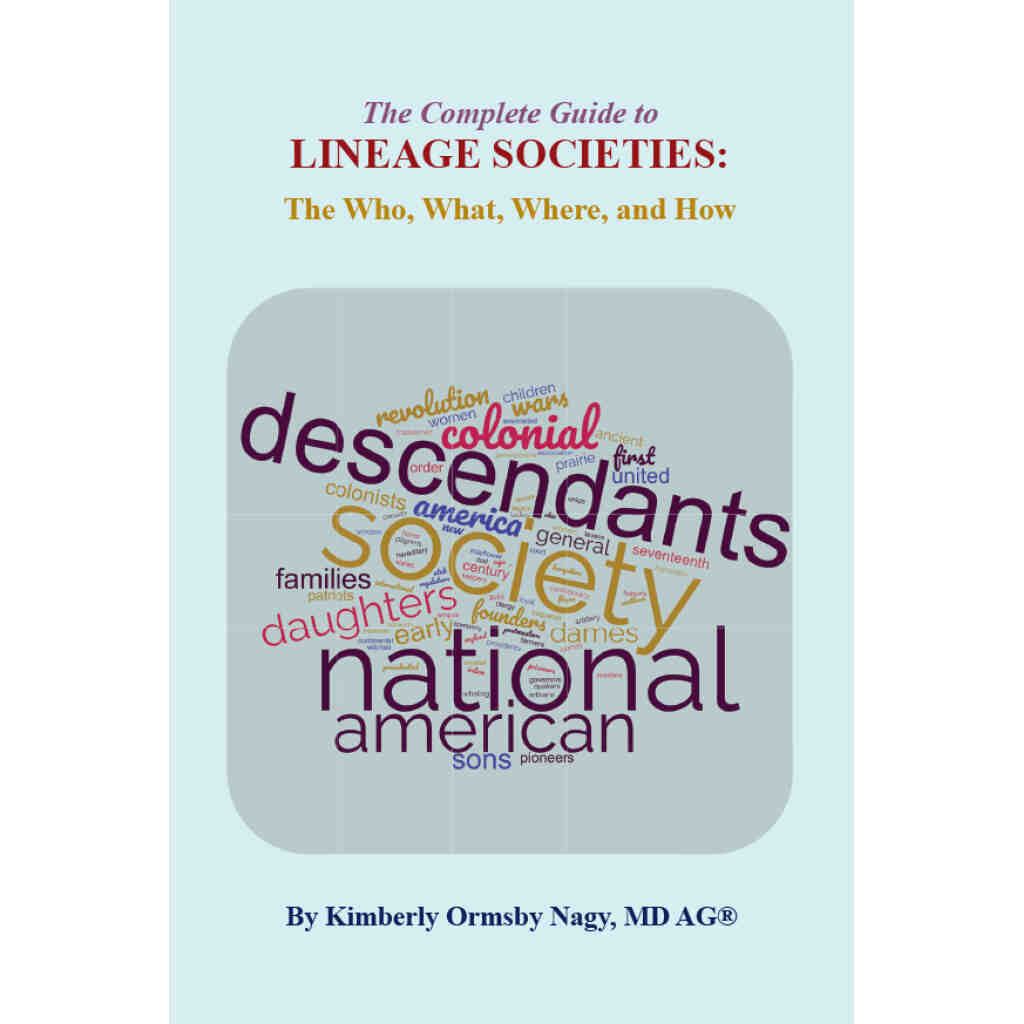
Book Review: The Complete Guide to Lineage Societies

The Complete Guide to Lineage Societies is a unique new book written by Dr. Kimberly Ormsby Nagy, an accredited genealogist who knows a great deal about lineage societies: She's a member of more than three dozen, and has been a Registrar for several societies. 

Now Dr. Nagy has written a concise and informative handbook about lineage societies, explaining what such societies offer, describing how membership works, exploring eligibility, and moving through the application process, step by step.

Considering that my husband's ancestral background could qualify him for several lineage societies, I was interested in this book and appreciated the author's ability to clearly capture the key points of who, what, where, and how in only 80 pages.

The table of contents for this new book is:

Chapter 1: What is a lineage society? The author explains the premise, which is to recognize and honor a specific group of people, such as early settlers in certain regions, those who fought in particular wars, descendants of royalty, and so on. 
Chapter 2: What does a lineage society do? In addition to honoring a certain group of ancestors, a lineage society's mission may focus on historic preservation, a charitable cause, education, or patriotism.
Chapter 3: How to locate a lineage society - A variety of suggestions for how to find and connect with a lineage society, online or on social media and beyond.
Chapter 4: Eligibility - This chapter looks at the two main elements of eligibility: lineage and service.
Chapter 5: Beginning the application process - What to expect when approaching a society about applying for membership.
Chapter 6: Documenting your lineage - One of the two main elements of eligibility is proven lineage from a qualifying ancestor. The author outlines acceptable types of lineage proof (not online family trees!) and provides helpful tips for finding and documenting descent from that key ancestor.
Chapter 7: Documenting your ancestor's qualifying service - The type of "service" is determined by each lineage society; some are based on military service, some on civil activities, some on occupations, etc. This chapter points readers in the direction of sources for service documentation. 
Chapter 8: Completing the application - Illustrated with pages from actual applications, this chapter guides readers through the process of putting specific info on the application for submission to the society.
Chapter 9: What next? Waiting for a response, and what comes after acceptance: going to meetings, reading publications, getting involved.
Chapter 10: Special considerations - A potpourri of possibilities, such as understanding whether collateral descent qualifies and lineage societies for children.
Appendix: Selected listing of lineage societies, some that are well known (General Society of Mayflower Descendants) and some not as well known (Hereditary Order of the Red Dragon), with web contacts.
Selected Bibliography: Books for lineage-related research and sources for researching the "service" of a qualifying ancestor. 

I recommend Dr. Nagy's book as a practical introduction to the world of lineage societies and a roadmap to moving through the entire process, from figuring out what society to join to gathering/documenting lineage and service proof and then working on the application. For readers with intermediate and advanced genealogy research skills, the resources named are likely to be mostly familiar--but curated with an eye toward what lineage societies require for an application to be approved.

Please note: The Genealogical Publishing Company sent me a free review copy of this book, and it has previously provided free review copies of other books. My reviews always reflect my honest opinions, without regard to any outside influence.

Sunday, September 8, 2024

"There Slumbers the Dust of our Father and an Infant Brother"


Traveling to the California Gold Rush in March of 1852, my husband's third great aunt Asenath Cornwell Larimer (1808-1897) wrote in her journal about family members who had passed away and whose burial places she would never see or never see again.

At top, Asenath and two of her children in the 1850 US Census, with unusually accurate info. She was indeed born in Canada (Hallowell, Prince Edward Island). She was 42 years old at the time of the Census, her son James Elmer was 10, and her daughter Nancy Elizabeth was 4. Three other sons were living with family and neighbors, helping as farmhands or learning a trade. She left all her children behind two years after this Census, when she and her brother John Cornwell (1812-1883) set out to seek their fortune in California.

In the first part of their journey west, Asenath and her brother boarded a steamboat that took them past Gallipolis, Ohio, where they had grown up. Asenath looked back on her childhood and thought about the family members she had lost up to that point. She wrote:

There slumbers the dust of our Father [David Cornwell] and an infant brother [unnamed baby Cornwell]. Oh how strangely scattered is the remains of those of us who are dead. Father and brother here [Gallipolis]; Mother at Macarthur's town [Phoebe G Goldsmith Cornwell, buried in McArthur, Ohio]; Sister, her children and my first-born at New Plymouth [Lucinda Cornwell Eggleston, Phoebe Eggleston, unnamed baby Larimer]; my husband [James Larimer], Elkhart, Indiana; brother David [Cornwell Jr.] in Feather River, California and none to care or mourn or look after his remains. 

I've looked for a tombstone or obit for David Cornwell Jr. but found nothing, not surprising in those Gold Rush days. No tombstones for Asenath's infant brother and first-born child, both dead before 1835. They are remembered today because she cared enough to write about them on page 2 of her Gold Rush journal. 

 "Tombstone" is this week's prompt for the #52Ancestors challenge by Amy Johnson Crow. 

Thursday, September 5, 2024

Four Larimer Brothers Fought for the Union


I'm in the home stretch of completing a booklet about my husband's ancestors and their in-laws who fought in all major wars involving the United States, from the American Revolution, the War of 1812, and the US Civil War through the Spanish-American War, World War I, World War II, and the Korean War. I want to describe not only their military service but also their family lives. Most are not in my hubby's direct line, but my goal is to honor and memorialize those in the tree who served their country during wartime.

Four Larimer brothers, my husband's first cousins four times removed, fought for the Union during the US Civil War: Isaac Newton Larimer, Jacob Wright Larimer, John C. Larimer, and Harvey H. Larimer. I used clues from a printed Larimer genealogy book plus the usual research sources (obit, vital records, military records, news reports) to write a brief narrative of each man, with emphasis on military service but also including spouse(s), children, occupation, and other details of interest.

Focus on Isaac and Marilda

At top, an excerpt from my bite-sized bio page about Isaac Newton Larimer (1828-1910), a farmer who enlisted early in the war, despite being married and the father of a growing family. To illustrate, I included a table showing his war service, drawn from the Illinois State Archives. I highlighted two events in bright blue. 

  • During his first major battle, Isaac was captured (one of 55 held) and escaped after 23 days, rejoining his unit.
  • At the Battle of Missionary Ridge, won by the Union, Isaac was shot in the face and nearly died. But he did recover and, with only one good eye, continued serving with his unit until the end of his enlistment period.
Three years and three months after joining the 35th Illinois Infantry, Isaac was mustered out and went home to his family farm. He and his wife Marilda McCreary Larimer (1835-1905) had 11 children, including a youngster who passed away in infancy. I hope Isaac and Marilda told their descendants stories about the early days, including the other three Larimer brothers who served their country. 

Sharing family history more widely

Creating a booklet such as this is one way to let future generations of my husband's family know about the lives of those who came before. Want more ideas about preserving and perpetuating family history? Please see my genealogy book, Planning a Future for Your Family's Past.

As a byproduct of this booklet, I'm repurposing the bite-sized bios of these men and women and posting online. For instance, I've submitted Isaac's service details to his Find a Grave memorial and also adopted his orphaned WikiTree profile, adding his bio and details. This has led to enriching other WikiTree profiles connected to Isaac, such as his wife's profile. There will be more profiles enriched as I continue to share family history in many places so these military ancestors will not be forgotten. 

Monday, September 2, 2024

Back to School with Lola McClure Lower


With school starting, it's a good time to remember the life of my husband's great aunt, Lola A. McClure Lower (1877-1948). Lola graduated from Wabash High School in Indiana in 1894, aged 17, and became a teacher. In 1903 she married Edward A. Lower (1873-1920). The couple had a daughter and two sons together, making their home in Wabash, Indiana.

Edward had already built a solid career as a civil engineer. His employers included a lumber company, a coal company, and several municipalities. In 1900 he was enumerated in the Census along with other civil engineers, a locomotive engineer, and surveyors' assistants who were living and working in the Woodville District of the Chickasaw Nation, part of the territory that became the 46th U.S. state of Oklahoma in 1907. 

Sadly, by 1918, Edward was bedridden and unable to sign his WWI draft registration card on his own. He made an X that was witnessed and signed. By that time, Lola had already gone back to work. With her education and her teaching background, Lola was named as the Wabash truant officer in 1916 (Indianapolis News, Aug 29 1916, p. 20). Edward died in 1920, just 47 years old. 

Lola continued to serve as a truant officer (later known as an attendance officer) for many years. During the Great Depression, she experienced pay problems as Wabash (both city and county) grappled with financial woes. In 1932, the county reduced her salary to $4.24 per day for the 180 days of her contract (The News-Sentinel, Ft. Wayne, Indiana, Sept 12, 1932). 

Worse was yet to come. In 1933, she worked without pay from January through March (possibly beyond) as the county insisted it had not appropriated the funds for her salary and therefore had effectively abolished the position as of the start of that year. Lola went to court, arguing that she worked for the Wabash city board of education and should be paid by the city--and she won her back pay (Ft. Wayne Journal-Gazette, Oct 12, 1935).

From the late 1930s into the early 1940s, Lola worked as an investigator for a local town's trustee and for the state unemployment commission. She was also a long-time volunteer valued for her leadership abilities. She passed away in 1948 at the age of 70. 

In 1985, when her son Edward recorded an oral history about his mother in Wabash, Indiana, he recalled that: "She was a tall, dignified-looking woman. She was musical. She played organs, even pipe organs, always played piano." He added that she was a good cook "but she was always in public life. She was secretary of the Red Cross for 25 years, and she handled the job well. She read law. She knew everything. She was on the board of Associated Charities in Wabash."

I'm remembering Lola McClure Lower as students go back to school across the United States, including her home state of Indiana. 

Friday, August 30, 2024

Freaky Friday Ancestor Switch Wish


Remember the movie Freaky Friday? The most recent version of this body-switch comedy was in 2003, starring Jamie Lee Curtis and Lindsay Lohan. In the movie, a mysterious fortune cookie causes mother and daughter to wake up in each other's bodies. Only a temporary switch, of course--by the end of the movie, each has been switched back and they now share a stronger bond of understanding.

My Freaky Friday wish is to switch places for a single day with a single ancestor: Leni Louise Winkler (1909-1997). Leni (Americanized to Louise after she immigrated here in 1941) was my 1c1r, a dear niece of my maternal grandpa Teddy Schwartz.

The day I would like to be Leni is her wedding day, a Friday, August 2, 1929 in what was then Ungvar, Hungary (now Uzhhorod, Ukraine). Leni was about to turn 20 and she was marrying Jeno Eugene Preisz (1906-1979), their surname later Americanized to Price. Leni's family gathered from far and wide to attend the wedding, including her great uncle Sam Schwartz, an honored guest who came all the way from New York City to serve as a witness. He returned home to New York City on September 4, 1929 (see passenger list from S.S. Homeric above).

As Leni in 1929, I would get to meet not only her parents and siblings and cousins but also her grandmother, Hani Simonowitz Schwartz (1858-1933). This would be a wonderful opportunity to celebrate an especially happy occasion with relatives and friends, people I know today only as names on a family tree.

As Leni in 1929, I wouldn't be aware that in the future, four siblings would be killed in the Holocaust, along with other members of the Schwartz, Simonowitz, and Winkler families. Happily, two of her brothers were survivors who submitted Yad Vashem testimony about relatives who were killed. Sis and I are in touch with a descendant of a Schwartz survivor, a cousin connection we treasure.

As Leni in 1929, I wouldn't yet know that with her husband and young daughter, she would leave Europe during WWII, obtaining passports in Marseilles in January, 1941, and sailing to New York from Lisbon. The three landed in New York City on Friday, April 15, 1941 and went on to build a new life--helping Leni's two brothers when they came to America after the war.

Well, for just one Freaky Friday, I wish I could stand in for Leni as she married on a special Friday in the presence of her loving family and friends. While I'm in Leni's shoes, she would be in mine, having my wonderful Sis show her the family tree and ask for identifications of old family photos. 

Thursday, August 29, 2024

Kossuth Association Plot Photos on Multiple Sites


The Jewish Genealogical Society of New York maintains a database of more than 10,000 society burial plots located in dozens of New York area cemeteries. Recently, the JGSNY asked for photos of society plot gates or columns to be submitted so those who search the database will not only find out the exact location but also see the gates. 


My Farkas ancestors are buried in the Kossuth Association plot of Mount Hebron Cemetery in Queens, New York. Above, the entry in the JGSNY database. Note there's no photo in this screen shot. Very soon there will be! I submitted the composite photo shown at top, to be added to illustrate this burial society's entry in the JGSNY database. Since only one photo can be posted per burial society, the JGSNY recommended putting several photos together into one composite to show more. That's what I did.

Then I went to Find a Grave and added the same composite photo to the cemetery photos of the memorial page for Alex Farkas, who led the cemetery committee for the Kossuth Assn. I'll write a bite-sized bio for this page to explain. After all, family history is written on those gates.

I want to memorialize this burial plot in more than once place not only because it's where my ancestors are buried but also because my ancestors were cofounders of the society, which helped Jewish immigrants from Hungary to get settled in New York City. 

Sunday, August 25, 2024

It's My 16th Blogiversary!


My very first genealogy blog post appeared on August 25, 2008, concerning the search for my great-grandfather Meyer Mahler's death date and place. Since then, I've written nearly 1,850 posts about my family tree, my husband's family tree, genealogy research, family history preservation, methodology, issues, technology, book reviews, vintage postcards, old photos, and more. 

Now I'm entering my 17th year of genealogy blogging, still with many topics to explore. I'm working on a few posts about curating your family history collection (as in my book, Planning a Future for Your Family's Past). Also in the works: posts about revisiting ancestors and research from years ago, getting insight into ancestors' lives through old newspaper items, and lots more!

Thank you, from my heart, to my regular readers . . . and a special thank you to the many cousins and FAN club members (friends, associates, neighbors of my ancestors) who have been in touch through this blog. The genealogy journey continues!

Thursday, August 22, 2024

Grandma Floyda and the Push for Delayed Birth Registrations

Hubby's maternal grandmother, Floyda Mabel Steiner McClure (1878-1948) went to probate court in Cleveland, Ohio in 1944 to register a birth--her own. Two of her older sisters submitted affidavits attesting to Floyda's home birth. They would have been old enough to have known about the birth. Carrie was 8 and Etta Blanche was 14 when their baby sister was born, ninth of nine children of Edward George Steiner (1830-1880) and Elizabeth Jane Rinehart Steiner (1834-1905). 

Millions of births not officially recorded

Originally, I believed Floyda was registering her birth with the court so she could apply for a Social Security number. But then I read newspapers of the time and discovered that this wasn't the only reason for registering births years or decades after the fact. 

In 1940, with Social Security in place and WWII draft registration in force, the question of how to prove name, birth place, and birth place was becoming more urgent. According to the Milwaukee Journal newspaper (Aug 13, 1941), some 60 million people had no legally-acceptable birth documents because they were born before the requirement to officially register births (and sometimes marriages and deaths) with county or state authorities. 

In Ohio, where Floyda was born, probate judges were strongly urging the governor to act to provide a pathway to legally and smoothly register births and correct errors that may have been in the oldest records. According to the Toledo Blade newspaper (Thursday, Jul 18, 1940), about half of the old records in the state were incorrect. Names might have been wrong, dates wrong, even sex recorded incorrectly. Fixing the mistakes and registering births not on the books were priorities, but no standard process existed for doing so.

How to prove birth in Ohio

In 1941, the Ohio House unanimously passed a bill mandating that the state Department of Health set up a system for official filing of birth and death records in the state. The goal was to ease the way for draft registrants and applicants for defense jobs to prove who they were, according to the Wooster Daily Record newspaper (Feb 21, 1941). These registrations would also help in the event of veterans applying for benefits later in life.

By 1942, those without official birth documents were finding help in all kinds of places. Even the US Census Bureau was offering to search its records (for a small fee) and provide documentation of someone being enumerated in a specific place and time (according to the Columbus Evening Dispatch newspaper, Sep 15, 1942). The Census folks were also drawing on WWI draft registration cards as proof of name and birth date/place. An estimated 2.8 million Ohioans were in need of official birth proof at that point.

Floyda's birth is recorded 66 years late

Why Floyda needed or wanted an official birth document, I can't be sure. Her husband Brice Larimer McClure (1878-1970) worked in a defense industry firm and had proof of his own birth, so perhaps the employer(s) were checking that spouses and immediate family passed muster. 

I can't find Floyda in the Social Security claims or death index. She did work during WWII, as a part-timer in a Cleveland department store, but it's unclear whether the store would have requested a Social Security card as part of her employment process.

Most likely Floyda simply wanted to register her birth because of the state's publicity campaign to get all births on the record. And so her older sisters stepped up with affidavits that enabled Floyda to have her birth filed with the state of Ohio 66 years after she was born at home in Nevada, Wyandot County.


Sunday, August 18, 2024

Remembering Dad, the Die-Hard Yankee Fan

My Dad, Harold D. Burk, was born in New York City on September 29, 1909. He died in the Bronx on this day in August of 1978. He was a big fan of baseball and would have enjoyed this lively, well-written book about the development of baseball leagues and super teams (Giants, Dodgers, Yankees) as the modern city of New York took shape. Photos included, highly recommended.

Dad was raised in upper Manhattan and, as a young teen, would have gone to the Polo Grounds to see the New York Giants play baseball. Once the original Yankee Stadium was opened in the Bronx in 1923, however, he regularly took the subway uptown to watch this star-studded team play. 

Dad served in World War II and when he returned home, he went on a blind date with his future wife (Daisy Schwartz, 1919-1981). They married and raised a family in the Bronx as he fulfilled his ambition of becoming an independent travel agent. 

Baseball was an important part of our childhood. Sis and I still remember going to Yankee games with Dad during the Mantle/Maris years when the sluggers were making home run history. Dad taught us to score each play in the program...and he treated us to hot dogs with the works.

Remembering Dad, the die-hard Yankee fan, on this day. He would have been pleased to know that his Yankees of 1978 did not disappoint--they beat the Los Angeles Dodgers in the World Series for the second year in a row!

Wednesday, August 14, 2024

Genealogy Chats on Social Media Platforms - 2025 Update

In the past two years, many former Twitter users have fled to BlueSky, many to Mastodon, many to Threads. So far, I haven't heard of any genealogy chats on Threads. The most active genealogy chats (as of Dec 2025) are: 

#AncestryHour is a UK-based genealogy chat attracting folks from all around, but currently in "show up and chat" mode, without any formal moderator. It takes place on Twitter on Tuesdays, at 2 pm US Eastern (7 pm UK). It's also informally on BlueSky at the same time, so watch for the hashtag #AncestryHour. 

#GenHour, on Thursdays at 3 pm Eastern US/8 pm UK time on BlueSky. #GenHour has attracted dozens of BlueSky users in the genealogy community. Liz Loveland (who posts as ‪@trivvieliz.bsky.social‬) keeps the reminders coming every week on BlueSky. Very lively, so please join the conversation!

Sunday, August 11, 2024

Redo Your Research on Different Sites to Make New Discoveries!


This month I've been plugging in ancestor names to MyHeritage's OldNews.com newspaper site, looking for articles I haven't yet seen. In the past I've searched Newspapers.com and GenealogyBank, now I'm working through the family tree names on OldNews, which has different holdings.

For female ancestors, use multiple search strategies

For female ancestors, I search their maiden names and their married names, with their given name and with their husband's given name. I never know whether a woman (such as my late mom-in-law) will be referred to as Mrs. Marian Wood, Mrs. Marian M. Wood, Mrs. Edgar Wood, Mrs. Edgar J. Wood, etc. I try them all!

Above, the search query and result from my search for my late mother-in-law, Mrs. Edgar Wood (Marian Jane McClure Wood, 1909-1983). She and her husband, Edgar J. Wood (1903-1986) were active in St. Paul's Episcopal Church in East Cleveland, Ohio. But this item in the news from December of 1961 revealed something fascinating that hubby didn't know or remember.

Wait, what?

We knew that my husband's mother, an accomplished ceramic artist who trained under renowned sculpturist Edris Eckhardt, had made a set of creche figures displayed at St. Paul's Church each December. We weren't aware that she had made a set of creche figures that she gave to Washington National Cathedral in Washington, D.C,. according to this news item.

What?! Rather exciting to think that hubby's mom made creche figures that are in the collection of this famous cathedral!

But just to be sure, I emailed the archivist at the cathedral to ask for confirmation. I wrote that I would offer a bit of biographical background on Mrs. Edgar Wood for their files, if indeed the creche figures are really in the cathedral's collection. Watch this space for news once I get an answer. And redo your research on different sites, because hidden gems like this sometimes turn up unexpectedly!

Wednesday, August 7, 2024

Is That a 7 or a 1? The Entire Document Tells the Story


My hubby's great-grandparents, Elizabeth Jane Rinehart (1834-1905) and Edward George Steiner (1830-1880), were married on this date in the 1850s. Elizabeth was the subject of two very nice obits after she died, full of detail with names, dates, places, background on when and where they moved. 

I really appreciated learning so much about her and comparing the details with the paper trail I was gathering. Still, having seen obits with names not spelled correctly and other inaccuracies, I took nothing at face value, especially since the obit at top says Elizabeth married E.J. Steiner, when actually it was E.G. Steiner.

Obits say...

According to Elizabeth's two obits, she and her husband Edward were married on August 7, 1857.

But since I had handwritten notes left by a descendant, showing birth dates of Elizabeth and Edward's children, I really doubted the year cited in the obits. 

Their first child was born and died in October, 1852. The couple had two more children before 1857. I could document, from other sources, those three children's birth/death dates. No wonder I didn't quite believe the obits, given the tradition of, well, tradition in this family with weddings preceding the births of children.

Look at the entire document

Glancing quickly at the original marriage cert, it's easy to see how someone might think the date was 1857. In the image below, the date of the license is 6 August 185_ and the date of the marriage is 7 August 185_. Might be a 7, might be a 1, it's just not easy to distinguish. 

But looking at the rest of the page, the year is clearly 1851. So the obit writers got it wrong and the cert actually indicates that Elizabeth and Edward were married on August 7, 1851. Happy 173rd anniversary to these ancestors.


Monday, August 5, 2024

Finally, an Enumerator Who Enumerated His Own Household


A distant, distant relative of my husband was an enumerator for the 1950 US Census! He's the first enumerator I've ever found in either my tree or hubby's family tree, for any Census. I had no idea he worked for the Census when I began researching his family.


Eric Townsend Brigham (1918-1965) was the grandnephew of the husband of my husband's 2nd cousin 3x removed. (See, I told you he was distant.) Eric was the grandson of a doctor, great-grandson of a lawyer who served as a Congressional Representative of Maine from 1877 to 1883, great-great grandson of a Union officer in the US Civil War. 

Anyway, at the time of the 1950 US Census, Eric had previously worked as a telephone equipment repair tech, and had also had his own car parking business for a time. Yet in the 1950 US Census, there he was, enumerating himself at his residence, saying he worked 28 hours last week as "enumerator, census." His wife (Thelma Claire Jarisch Brigham, 1917-2010) worked 9 hours the previous week as a sewing teacher in elementary and junior high schools. Both were listed with a "G" for employer, meaning they worked for a government agency, as shown in excerpt above. 

Anyone else find a Census enumerator in their tree? An enumerator who enumerated his or her own household? 

This is my "free space" blog post for Amy Johnson Crow's #52Ancestors genealogy prompt for the week. 

Saturday, August 3, 2024

Contribute "Oral History" With or Without Artifacts

Earlier this year, my husband's Wood family sought to donate a 1950s book about the Hermit Club, an iconic club in Cleveland, Ohio, to an institution in that city or state. We had approached three institutions, but only Ohio History Connection wanted this book--the others already had copies in their collections. 

Curate and donate unneeded family history items

Donating books like this slims down our genealogy collection to focus specifically on materials directly related to our family tree. Just as important, these non-family items will now be available to researchers and other folks for today and tomorrow.

Cleveland State University (CSU) didn't want the book but was particularly interested in any oral history about the Wood family's involvement with the Hermit Club. CSU is actively recording and transcribing oral histories about the Cleveland area. I couldn't offer any actual recording but I could offer excerpts from a longer oral history. They said yes, please submit.

Transcribed and annotated oral history 

Back in 1984, my husband had interviewed his father, Edgar James Wood (1903-1986) about his life, including his personal and professional association with the Hermit Club. The taped interview was long and mostly about immediate family, but there were key sections where Ed talked of the Hermit Club in detail.

With my husband, I wrote an annotated oral history based on the interview, explaining background so non-family members would be able to follow along. We inserted quotes from the transcribed oral history in indented paragraphs to show that they were drawn directly from my father-in-law's words. 

So, for example, on the first page we explained how Ed became interested in the piano, admired the Hermit Club, and ultimately was invited to join--unlike other musicians, who had to apply and cross their fingers that they would be chosen. Then we let direct quotes from the taped oral history tell that story in his own words.

Later on the same page, we introduced Ed's story of taking his future wife, Marian, on a first date to a musical evening hosted by a Hermit Club friend. Ed's quote reflects how vividly he recalled that pivotal evening, even more than 50 years later.

To go with the annotated oral history, I submitted a photo of Ed and his wife Marian, plus a close-up photo of the personal book inscription from the Hermit Club historian to Ed. Now these digital items, and Ed's story in his own words, are in CSU's collection, keeping Wood family history alive in an institution in his home town.

Who wants your family's oral history?

Many institutions collect oral histories and written memories, so I encourage you to do an online search for the city or state where ancestors lived plus the phrase "oral history." 

Whether you are the interviewee yourself or someone in your family tree tells of people and places from the past, these stories add to the historical and genealogical record. Save them now for the sake of future generations.

Please, share your family's history--now!

Thursday, August 1, 2024

Book Review: The Complete Guide to FamilyTreeDNA by Roberta Estes


Roberta Estes is the ideal author to explain the practical ins and outs of how to use the powerful tests and tools at FamilyTreeDNA. She's one of the gurus of genetic genealogy and a long-time blogger at DNAeXplained, so she has the scientific background and the writing skill to explain DNA testing and application in a step-by-step way, with examples that help make a very complex topic much more understandable.

As shown above, I've marked many pages to review and reread as I work my way through Roberta's comprehensive new book, The Complete Guide to FamilyTreeDNA, chapter by chapter. 

The brief table of contents is: 

  1. Types of Testing: Y-DNA, Mitochondrial DNA, Autosomal, X-DNA
  2. Setting Yourself Up for Success (how to get started on the FamilyTreeDNA website and provide enough detail to get the most out of testing)
  3. Y-DNA, Your Father's Story (Y-DNA in great detail, types of tests, matches, and more)
  4. Mitochondrial DNA, Your Mother's Story ("not X-DNA," mutations and haplogroups and so much more)
  5. Autosomal DNA, the Family Finder Test (features, matching, chromosome browser and on and on)
  6. X Chromosome, Unique Inheritance Path (a very clear explanation of the X chromosome inheritance path with fan charts and other illustrations)
  7. Ethnicity, MyOrigins (understanding the site's ethnicity estimates and painting population segments on your chromosomes, how to dig deeper)
  8. Advanced Matching (to avoid being overwhelmed by matches, learn to filter match results)
  9. Finding, Joining, and Utilizing Projects (explanation of DNA projects, how to join and get the most out of a project)
  10. Third Party Tools (Genetic Affairs and, yes, DNA Painter)
  11. Creating Your Step-by-Step Roadmap (specific recommendations for what to do when you decide to test and what to do with your results)
Even with Roberta holding my hand page after page, I can see that this process requires close concentration and a measure of time--no quick fixes. Get your spreadsheets ready and prepare for a super deep dive into the tiny details, learning about DYS markers, HVR1, parental phasing, and triangulation, and a lot more. 

The many TIP boxes scattered through the book highlight specific ideas and issues to be aware of. Also, I appreciate the convenient, concise glossary (pp. 231-247). Some terminology is very familiar to me, some is less familiar, so I like the ability to flip to the back of the book and look something up. 

However, I really wish this book had an index. Because endogamy is one of the big challenges I face in applying DNA to my own genealogical research, I would have turned to the index to see what Roberta says about endogamy in various chapters. Fortunately, she wrote about endogamy in a blog post here. So do try searching Roberta's blog as a companion to her book.

By the way, the illustrations in the printed book are NOT in color (because, I imagine, that would raise the price to astronomical levels). If you want to be a power user of FamilyTreeDNA, consider buying the digital version because those illustrations are in color--just like the screens you'll be viewing when you're on FamilyTreeDNA.

Full disclosure: I received a free review copy of the printed book from Genealogical.com but the views expressed in this post are entirely my own. 

Monday, July 29, 2024

"An Excellent Steward" for Family History Collections

Donate old family papers to an institution?

As a quilter, I've enjoyed Jennifer Chiaverini's Elm Creek Quilts series for years. In her latest novel, The Museum of Lost Quilts, characters are tracking down long-lost quilts and documentation to help tell the story of a historic building and the town's past, from before the Civil War to after WWII.

The protagonist, Summer Sullivan, is finishing her master's degree in history and spending part of the summer curating a small but growing collection of antique quilts, also writing museum labels for photos of quilts that are missing but historically significant. Summer reads through old memoirs, letters, newspapers, and other documents in the college library's rare books room, in search of clues to identify and confirm details about these quilts, the quilters who made them, and the people who owned them over the years.

Private letters and more

Summer is fortunate when some local residents come forward with private letters and other materials they've saved from family history. She enthusiastically tells one woman: "If you're looking for an excellent steward for [ancestor's] letters, as well as the rest of the ... family papers, I highly recommend the rare books and special collections department" at the local college library.

The woman is receptive, responding: "For quite a long while, I've wanted these papers to be available for students and local historians. This might be the perfect way to do so. I'll need to think it over and discuss it with my cousins. While I own most of the collection, several boxes belong to other members of the family, and I'd like to have some consensus."

The woman returns several weeks later and tells Summer: "We've decided to gather all of the papers together in a single archive and donate it to a library or museum." She then asks for an introduction to the head archivist at the local college library.

Curate and donate your family history collection

As best-selling author Jennifer Chiaverini emphasizes, local historical societies, college and public libraries, county archives, and many other institutions can be excellent stewards for family history collections. As you plan ahead for the future of your genealogy materials, please talk with your family and consider donating some or all of your collection to an appropriate institution, to keep the family's past alive for future generations. Those old photos and letters may contain clues that help historians in the years to come, just as Summer Sullivan solved some local history mysteries by reading private correspondence in family histories.

Friday, July 26, 2024

Harry Caplan, Photographer and FIL of BIL of Great Uncle Max


While adding ancestor profiles to WikiTree during the recent Connect-A-Thon, I wrote a very brief, tiny bite-sized bio of Harry Caplan (1873-1936), who was the father-in-law of the brother-in-law of my great uncle Max Birk (1891-1953). Max was the younger brother of my paternal grandfather, Isaac Burk.

FIL of BIL is a distant ancestor connection, to be sure, and I doubt that my Max ever met Harry. Their paths wouldn't have crossed geographically nor, given that Max married into Harry's family in June 1936, would they have been likely to meet before Harry's death.

Photographer, own studio

Still, I was intrigued by Harry's occupation as listed in the US Census: Photographer, own gallery. I decided to look for Harry in the New York Public Library's Photographers Identities Catalog (PIC for short). You can access the catalog and search for photographers here.

Given that Harry's surname is spelled with a C, not a K, I had no trouble finding him in the PIC--and the details on the page confirmed what I already knew of him, as shown above. You can see the Harry Caplan page on PIC here. The "locations" section of his page shows his correct birth date and place, and the correct death date/place info.

Brooklyn studio, then Manhattan studios

I was interested to see that Harry originally had his studio in Brooklyn, within walking distance of his apartment. Next, he operated a studio at 104th Street near Madison Avenue, which was a busy and increasingly popular residential area at that time, given the expansion of the New York City subway and elevated train system. Easy access to subway lines meant workers could move uptown and only need to hop the train to commute to a downtown job in the heart of the city.

Then he moved just a few doors away and around the corner to Madison Avenue, perhaps for more foot traffic. Sadly, Harry died of a heart attack in 1936, only 62 years old. But I'm sure many families whose ancestors lived in New York City from 1903-1925 inherited photos he took of their kin.

Tuesday, July 23, 2024

Discovering Matchmaker Great-Aunt Mary's True Birthday


During the post-WWII period, my parents were set up on a blind date by his aunt Mary and her aunt Rose. Today I want to write about a discovery I made while looking into original documents for my great aunt Mary.

Mary Mahler (1896-1979) was the fifth and youngest girl of ten children born to my paternal great-grandparents, immigrants Meyer Mahler and Tillie Jacobs Mahler. Mary married Joseph A. Markell (1895-1975) and they raised a family in New Rochelle, New York.

All these years, I've believed the Social Security app info about Mary's birth date, knowing that Mary herself would have self-reported the info when she registered for Social Security back in July of 1963 (see transcribed record above). In fact I planned to write about Mary's 128th birthday for today's blog post.

Then I decided to look for Mary's original birth record, using the FREE New York City Municipal Archives Historical Vital Records site. I had the birth cert number from Ancestry, plugged it in with the year and the borough, and you can see what I saw right here. Or look at the cert below. 

Without a doubt this is great aunt Mary's birth cert. Her surname spelled creatively (Maller, not Mahler) but her father was indeed Meyer (here, Mayer) although the mother's name is mangled (maiden name was Jacobs not Jacobson, first name was Tillie, not Mary). The home address is absolutely correct, the number of children born to the mother tallies. 

Now I know I should have celebrated Mary's 128th birthday on July 11th, not July 23d. The lesson is to check the original document created as close to the actual event as possible. Interestingly, the Social Security Death Index shows Mary's birth date as July 11, 1896, in conflict with what Mary self-reported on her Social Security application. In the end, the original birth cert (not a transcription, not an extract) is the most solid and reliable evidence of a birth date.

Sunday, July 21, 2024

Wed in Saint Louis En Route to California in 1848


On this day 176 years ago, my hubby's 2d great-grand uncle, Elisha Morgan Bentley (1823?-1884) married his wife Charlotte Raymond (1821-1890) in St. Louis, Missouri. At top, the handwritten registration of this marriage performed on July 21, 1848 by a Justice of the Peace and filed, a bit belatedly, on December 22, 1848. 

The registration notes that Elisha was of Elkhart County, Indiana, and Charlotte was of St. Joseph County, Indiana. Elisha was born in Oswego, New York, and Charlotte was born somewhere in New York State. By the time of their marriage, they had already gone far from their roots. I wondered whether they had met and decided to marry while on the "National Road" which stretched from Maryland to Illinois and then to St. Louis or when traveling further west via the "California Trail" that stretched from Missouri to California.

Either way, the time needed to go from Indiana to California in 1848 was a matter of many months. Perhaps Elisha and Charlotte were acquainted before they embarked on this journey, since the two counties adjoin each other, about 30 miles apart. Or they may have met along the way and tied the knot at a convenient place.

I know Elisha and Charlotte settled in Visalia, Tulare County, California, where he raised cattle. They had two sons. Older son James died at age 20 as a result of an accident. Younger son Charles may have served a stretch in San Quentin and then in Folsom Prison for robbery and assault. If this is the correct Charles E. Bentley, he was recommended for pardon by leading citizens of Visalia, and Tulare County but the Supreme Court of California refused to recommend that the governor pardon him. 

More research is in my future to dig even deeper into this situation. Meanwhile, I'm thinking of Elisha and Charlotte, who were married for 36 years, beginning on July 21, 1848, until Elisha's death in November, 1884.

Thursday, July 18, 2024

Context and More From MyHeritage AI Biographer


I've been looking at how to enrich our understanding of an ancestor's life and write bite-sized bios using input from features on popular genealogy websites. Today I tried MyHeritage's AI Biographer. As shown above, this feature is available from an ancestor's profile. I asked for a detailed bio with historical/social context, not just my great uncle's timeline and key life events.


MyHeritage responded with a neat multi-page pdf sent via email and also on the profile of my ancestor, downloadable and printable. This bio showed his family (with photos if any) including names and dates, plus a brief narrative of his life from birth to marriage to children to death. All was based on my family tree info and the sources attached to my tree, which I can enhance with additional personal details provided by relatives.

The extra historical context and possible last name origins, shown above, were drawn from MyHeritage and OpenAI. Interesting food for thought, and especially appropriate background explanation given my great uncle's decision to leave Lithuania as Jewish people were increasingly persecuted there. Lots of info I can weave into a bite-sized bio!

My first post in this series looked at FamilySearch's Brief Life History feature. The second post looked at Ancestry's AI Insights. This post is about MyHeritage's AI Biographer. All of these features can help us write or enhance bite-sized ancestor bios. 

Wednesday, July 17, 2024

Getting Context from Ancestry's LifeStory with AI Insights


Still in beta testing, AncestryAI is an option to provide historical and social context for some elements of the LifeStory feature on an ancestor's profile page.

Above, the early section of the LifeStory for my great uncle Abraham Berk (1877-1962). This takes the form of a timeline including family events such as his birth and the birth of his siblings, followed by his residential locations in chronological order, marriage, immigration, birth of children, occupation, and actually all events on his profile page.

Next to some of these LifeStory items is an option to Ask AncestryAI about a time and place in the ancestor's life. The AI summary helps add context to the ancestor's background. As shown above, here the AI is explaining what Lithuania was like in 1877, the year of Abraham Berk's birth. 

Other options to learn more about a time and place include what would someone wear to a wedding then, what mourning customs existed then, what was entertainment like then, what local dishes were popular then (see below, about Lancashire's fave foods in 1901).

While much of the AI-generated info is general, it still is a helpful starting point for understanding an ancestor's life and can give clues to fleshing out a bite-sized bio with context. Worth checking out if you have this feature in beta at Ancestry.

Note: Yesterday's blog post looked at FamilySearch's Brief Life History feature. Tomorrow's blog post will look at MyHeritage's AI Biographer feature.

Tuesday, July 16, 2024

Bite-Sized Bio Head Start on FamilySearch

My husband's great uncle Charles Augustus Wood (1862-1895) died on July 18th, 1895, which is 129 years ago this week. 

Looking at his ancestor page on Family Search, I read the "Brief Life History" which is a good head start on a bite-sized bio, based on information and sources attached to this man's Details tab on Family Search.

Basics are included

I like that the brief history includes his full name, birth date and place, full names of parents and their ages when this son was born. 

Also the life history lists full maiden name of his wife, where/when married, and mentions their children. Then it ends with his death date and place, age at death, and burial place. This is an excellent head start or outline for a bite-sized bio. 

Although sources are attached to Charles August Wood that verify the info in his "brief life history," this type of bio is only as good as the sources attached to the ancestor's profile and your interpretation of the sources within context. 

Ideas to flesh it out

Here's what I'd add to flesh out this man's bio without making it too long:

  • Charles's place in family birth order (he was 10th of 17 children born to Thomas and Mary). 
  • Charles's occupation (he was a carpenter, like most of his brothers).
  • Names of children and how many survived childhood.
  • Cause of death, if known (his obit said "la grippe" but death cert said tuberculosis).
  • Maybe add whether his widow remarried.
Brief Life History is only a starting point


Above is the Brief Life History of Mary Slatter Wood (1869-1925), a sister-in-law of Charles Augustus Wood. I would improve in three key ways:

  • Her brief bio says she was married "about 1898" although the source attached provides a specific date and place. Easy to improve.
  •  In 1871, she did not live in a church (Saint Mary Matfelon); that was the civil parish where she was enumerated with her parents and siblings in Whitechapel in London, England. This is easy to clarify.
  • Although the Find a Grave memorial for Mary is attached as a source, the brief bio doesn't mention her burial place. Again, easy to flesh out.
Still a good starting point

Take a look at the Brief Life History for your ancestors on Family Search. Maybe these will be a good starting point for a bite-sized bio for each ancestor that you can flesh out and share on other genealogy sites and with your family. As Diane commented below, these brief histories aren't a brand-new feature but if you haven't focused on them, see whether they jumpstart your writing projects!

For more about bite-sized bios, please see my book, Planning a Future for Your Family's Past.

Saturday, July 13, 2024

Kohlrabi and Radishes in a Bronx Public School Garden


Growing up in the Bronx, Sis and I had never heard of kohlrabi but we liked crunchy radishes. Then we enrolled in the summer gardening program at our local elementary public school and learned how to grow both kohlrabi and radishes, along with beans and carrots and corn and Swiss chard. It was so much fun and kept us busy three days a week from late June until the end of August. 

Big city school garden projects

Bear in mind, we were born long after Victory gardens flourished in public and private places during the WWII period. Through the late 1970s, school gardens were part of a community gardening movement to bring "agriculture" to urban settings. Even earlier in New York City, school and park gardens were set up for children to learn more about nature and get involved in growing food. 

My husband remembers participating in a school garden program in Cleveland, where he grew up. That program had its roots in the early 1900s, and continued until big budget cuts forced closure before 1980.

Beans, bugs, and bug juice

Sis and I were city kids, living in an apartment building one block from a huge park with two playgrounds. Until the garden program, the closest we got to radishes in the raw was seeing them in the local grocery store. 

Our school garden was a fenced-in plot adjacent to the concrete yard where we students played during recess when school was in session. The fence was tall, more than eight feet high, not just to keep out critters but I suspect to discourage anyone from plucking some of our garden bounty.

On summer Mondays, Wednesdays, and Fridays, about a dozen students gathered around the kindly gardening teacher, Mr. Wilson, as he patiently explained the business end of a hoe, calmed us when a bee buzzed by, and offered a cool drink of "bug juice" (maybe Kool-Aid or similar). We raked, created straight rows, put seeds in the ground, pulled weeds, learned about insects, and after weeks of weeding and waiting, we harvested fresh veggies with pride. 

Our family enjoyed the radishes and beans and other familiar veggies . . . but how Mom figured out what to do with the kohlrabi, I'll never know. Um, I wouldn't put it on my plate, let alone in my mouth. But my memories of summers at the local school garden are as fresh as those snappy red radishes we grew.

Did your school have a garden? Wish I had a photo of ours...nobody thought to snap a shot of something we took for granted.