Thursday, January 19, 2023

Library of Congress Images Add Context to Family History


Going beyond ancestor portraits, basic facts, and stories passed down from earlier generations, a family history project might benefit from outside images that add social or historical context. The idea is to provide a more well-rounded picture [pun intended] of ancestors' lives.

That's why I've been looking at the US Library of Congress prints and photos collection. It includes a gazillion digitized images available to view, and sometimes to download, for free. Not just of America, but well beyond.

LOC prints and photographs online catalog

Start by going to the Library of Congress catalog page for prints and photos. One entire area of the collection is devoted to US Civil War images (my husband has 20+ ancestors who served on both sides of that war).

Other featured collections are listed by name on the main page. A tiny sample includes:

  • Stereograph cards
  • Wright brother's negatives
  • African American photos for 1900 Paris Expo
  • Posters from World War I

It's easy to browse specific collections and check whether any of the images are available for free download.

Search by keyword (place, subject, etc)

Another way to find suitable images for family history projects is to use the search box. At top, you can see I searched for "New York City" images and received more than 27,000 results. Most of my immigrant ancestors came through Castle Garden and Ellis Island and remained in the Big Apple, which is why I'm interested in images of the city and its people and institutions. 

I found lots of images depicting aspects of daily life in Manhattan during the first decades of the 20th century--when and where my ancestors first lived upon arrival from Eastern Europe.
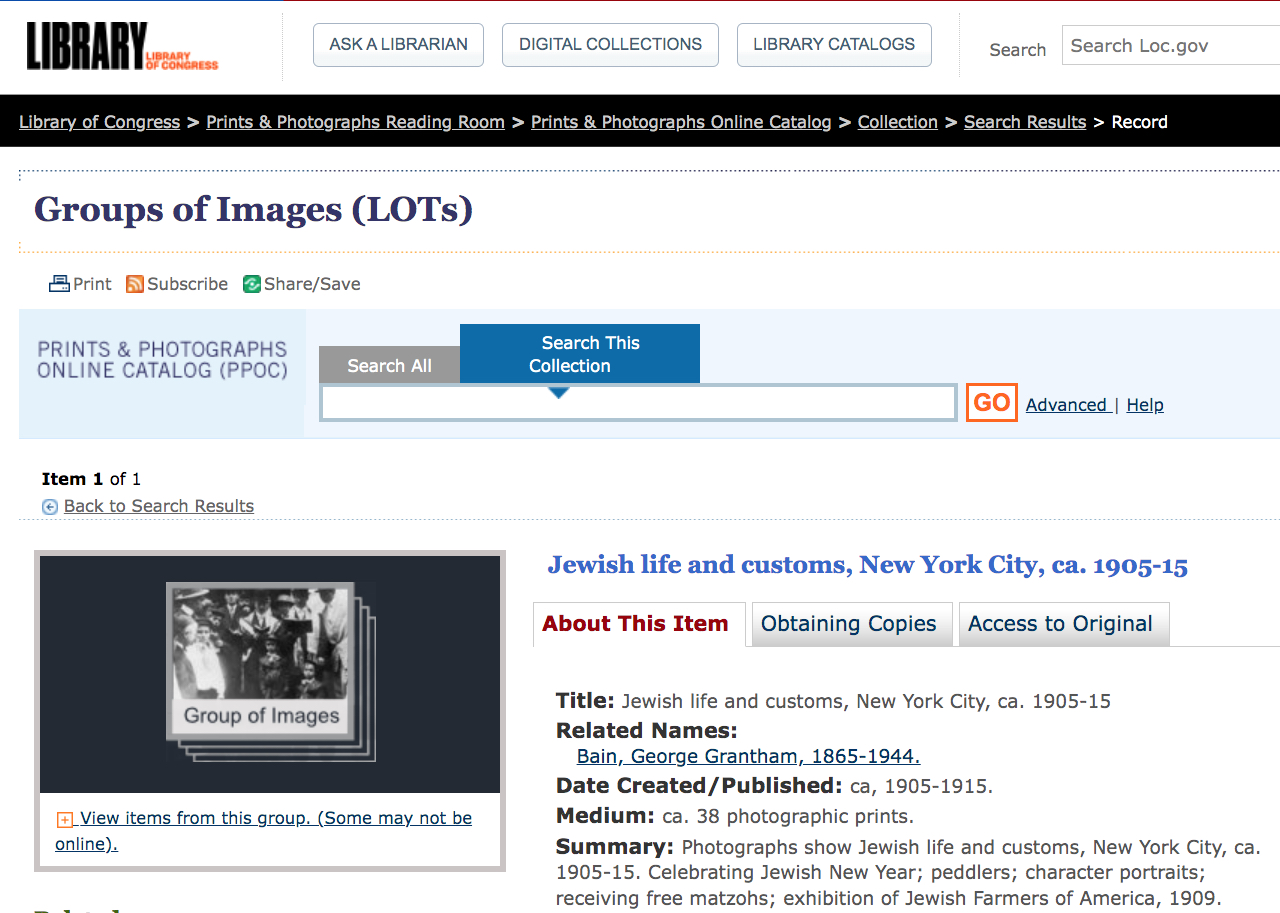


Another search, for images of Jewish life in New York City, resulted in numerous results, including the collection shown in this image, covering the period when my Jewish ancestors were just getting settled in the city. 

This group of images is part of the much larger George Grantham Bain Collection. The Library of Congress notes: "The collection richly documents sports events, theater, celebrities, crime, strikes, disasters, political activities including the woman suffrage campaign, conventions and public celebrations."

Free to use and reuse

The Library of Congress has made free images very accessible with a link at bottom of its home page that leads here.

Down the rabbit hole I go, and if you're interested in images to illuminate your family's history in America (and beyond), do take a look at the Library of Congress.

Sunday, January 15, 2023

The Difference Between Genealogy and Family History?


I asked the Artificial Intelligence bot ChatGPT to explain the difference between genealogy and family history. The AI system wrote three sentences of explanation, as shown above. 

Did the AI get it right? Let me add two more perspectives on this distinction: 

  • The Society of Genealogists notes that genealogy focuses on building an accurate family tree, showing how one generation is connected to the next, whereas family history is broader--incorporating genealogy.
  • Family Tree Magazine columnist Paul Chiddicks wrote a 2021 blog post that continues to generate discussion about the differences between a genealogist and a family historian. 
IMHO, genealogy is narrower than family history. When I began tracing my family tree in 1998, learning about my grandparents' siblings/spouses and going back further in time, I was doing genealogy. 

Once I had the basic branches of my tree in place, I could begin to analyze and understand my ancestor's lives, relationships, and movements within a societal and historical framework--the bigger picture of family history.

What do you think? 

Thursday, January 12, 2023

Grandpa Isaac's Face and Signature on Naturalization Petition


My genealogy journey began 25 years ago, when a cousin researching my mother's family tree asked me about my father's parents. 

Her inquiry sent me on a quest to learn when, where, and how my paternal grandfather Isaac Burk died. This was the good ole days of cranking microfilm readers and using snail mail to order vital records, so it took a good few years.

When I eventually received his death certificate, I learned he had a heart attack and died in 1943 in Washington, D.C. I didn't discover why Grandpa was in Washington and who the informant was on the death cert for a few more years. Spoiler alert: He and Grandma were visiting her favorite sister, whose husband was the informant. 

Still, I didn't know what Grandpa Isaac looked like. I recognized his wife, Henrietta Mahler Burk, in old family photos standing alongside my Dad. However, Grandpa Isaac wasn't in those particular photos.

Once digitized records became available online, I found Grandpa Isaac's face on his petition for naturalization from 1939, along with his signature. It wasn't a great photo (actually kind of faded and faint), but it showed the shape of his face and his features. Going back to older family photos, I could then pick him out, despite changes in weight and age over the years.

Not long ago, I used MyHeritage's photo enhancement/repair tools to fix Grandpa Isaac's photo. There it is at top of this post--my favorite photo because he is the reason I got bitten by the genealogy bug. 

"Favorite photo" is Amy Johnson Crow's prompt for week 2 of the #52Ancestors genealogy challenge.

Tuesday, January 10, 2023

John McClure's Parents Connect Him to WikiTree


One by one, I've been adding my ancestors and my husband's ancestors to the one-tree site WikiTree, double-checking sources and writing bite-sized bios so their entries are more than just names and dates, wherever possible. 

For my tree, I was given an incredible head start by many talented WikiTreers during the December, 2021 challenge when I was extremely fortunate to be the featured guest. Three brick walls smashed on my tree, plus intriguing clues for me to follow up!

Adding hubby's ancestors individually

Now I'm focusing on my husband's tree, entering each ancestor individually. This helps me slow down and analyze all research and relationships carefully, aiming for accuracy and searching for connections. 

At top, the profile I created for hubby's 3d great-grandfather John McClure, whose dates are approximate but birth, marriage, and death places are definite. 

Trying to add his father, Alexander McClure, I discovered that someone had already created a profile for this ancestor and for his second wife Martha [maiden name unk] McClure. 

Connecting to existing profiles 

Now my hubby's branch connects to ancestors who have already been documented on WikiTree, for the first time. That means I can collaborate with researchers working on mutual ancestors on WikiTree, examining their sources and building on their previous research while contributing what I've learned.


In fact, I was able to improve Martha McClure's existing profile and better approximate her death date by adding the above handwritten attestation from John McClure's wedding documentation. It shows his mother Martha McClure swearing her son was over the age of 21 on his wedding day, 8 April 1801, in Rockbridge county, Virginia. 

As I move upward and outward on the McClure branch of the family tree, I'm looking forward to collaborating with other WikiTreers. 

Friday, January 6, 2023

Heirloom Pin from Mom-in-Law I Never Met


During the holidays, I passed down this lovely silver pin to a member of the youngest generation in the family tree. It was given to me by my sister-in-law on the occasion of my marriage to her brother some years ago...and I wanted to share that story, with the pin, so the recipient would know the happy history of this graceful heirloom. 

Telling more stories

My late mother-in-law Marian McClure Wood (1909-1983) was the first owner of this pin. I'm sad to say she passed away before I joined the family. But fortunately, her granddaughter remembers how Marian loved to wear pins, and she also told that story as the pin's new owner listened intently. 

In fact, the family has a number of photos of Marian wearing a pin prominently on her lapel. Not this particular pin, but others. She had personal style as well as an artist's eye. The family has told and retold stories about the small animal statues she made while taking lessons from a world-class ceramicist. Plus I have a box of her needlework creations (tablecloth, gloves, doilies) to share with descendants in the future. My goal is to share heirlooms while telling stories so recipients get a sense of why these items are important to family history.

Keeping her memory alive

How I wish I could have met Marian McClure Wood, a talented, creative woman. I would ask about her creative endeavors and her early life as a much-loved only child. Of course I would ask about her memories of ancestors, with a few specific questions about an in-law who married three times. 

Mom-in-law Marian would probably have been amused to know her son married another Marian, who is a needlework enthusiast and a wearer of pins. 

Most of all, I hope she would be pleased that her creations are still treasured by the family and accompanied by stories about her life, keeping her memory alive for years to come.

"I'd like to meet" is Amy Johnson Crow's first #52Ancestors prompt of 2023. 

Wednesday, January 4, 2023

Check out Fold3 Links on Find a Grave Memorials

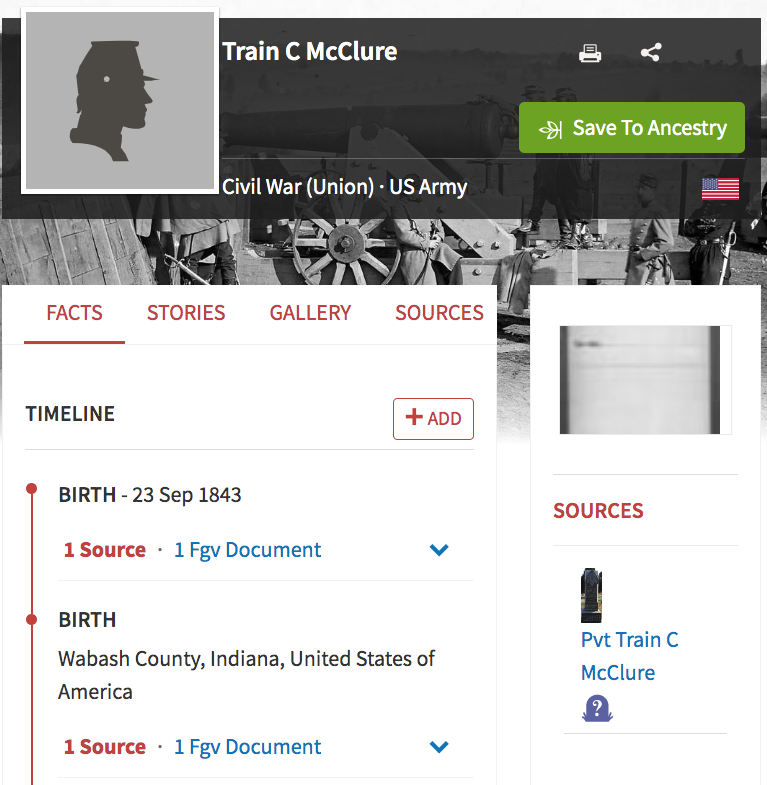
Find a Grave memorial for Pvt Train C McClure

If you have military veterans in your family tree, take a look at the bottom of their Find a Grave memorials. More and more now have a direct link (see orange arrow) from Find a Grave to that veteran's Fold3 memorial page. 

This little link can lead to interesting genealogical information! It's there because Find a Grave and Fold3 are both owned by Ancestry.com.

Fold3 memorial pages are FREE

Go ahead and click the link leading to Fold3--because a memorial page is completely free to view (or create or improve).

Above is part of the Fold3 memorial page for Union Army veteran Train C. McClure, which popped up when I clicked the link from Find a Grave. I can navigate to facts (shown in timeline format), stories, gallery, and sources. 

In the facts section, you'll see that the sources of both the birth date and birth place are 1 Fgv Document. Translation: one Find a Grave page. 

What are the sources?

In the sources section of this memorial page, there are two records attached (see below). 

One is Civil War info from Fold3, and the other is the Find a Grave memorial for Pvt Train C. McClure, marked as a Fgv Document. Since Pvt McClure is in my husband's family tree, I examined everything in detail.

Other documents, images, even photos may be attached to a veteran's Fold3 memorial page, so definitely click to see what you can learn. Save whatever you can to your own computer, attach to your family trees, and follow up any clues.

Sunday, January 1, 2023

What About Twitter and Mastodon for Genealogy?


Having enjoyed the genealogy community on Twitter for 14 years, I'm tentatively keeping my account there despite the chaos that ensued after the new ownership began in October, 2022. For the record, I don't agree at all with the new policies and actions, nor do I like the changed atmosphere. UPDATE NOV 2023: Still don't like the atmosphere on Twitter, supposedly known as X these days. In fact, I had 100 bots a week follow me on Twitter, so I've taken my account there private. No more bots. 

But I very much like the genealogy people I've met on Twitter, and I get a lot out of participating in various genealogy chats. Every other Friday night is the US-based #GenChat (10 pm Eastern). Tuesday afternoon (Eastern time) is the UK-based #AncestryHour. UPDATE: #AncestryHour has been on hiatus since Twitter imposed limits on the number of posts that can be viewed without paying, mid-2023. However, #GenChat is alive and well.

Exploring Mastodon

As a possible Twitter alternative, I joined Mastodon late in 2022. With my interest in family history, I joined via a server (known as an "instance" in the platform's terminology) that is primarily focused on genealogy. It's called Genealysis.social, and you can read more here.

My Mastodon account is: @MarianBWood@genealysis.social (see image at top--with me in one of the MyHeritage AI Time Machine portraits).  

I highly recommend Daniel Loftus's YouTube tutorial on how to use Mastodon. He was an early adopter and knows the ins and outs. TY to Daniel for the master class! The tutorial helped me get up and running while I gain experience. Still, Mastodon is not yet as interactive as Twitter, and other social media platforms may emerge that are even better alternatives.

I'm delighted that there is a list of genealogy and family-history #Geneadons as a pinned toot on Mish Holman's Mastodon account. TY to Mish for making this available on Mastodon, so I can find and follow my family history friends.

As of May, I haven't yet noticed a high volume of genealogy conversation on Mastodon, not anywhere near as much as used to be on Twitter prior to October, 2022. Happily, #GenChat is now on Mastodon, with a small but interested group.

UPDATE NOV 2023: Although Mastodon has not at all become a hotbed of genealogy conversations, #GenChat has definitely picked up steam and attracts a different crowd on Mastodon, especially participants from Europe and down under. It's been fun and worthwhile, though fewer are joining the conversation compared with what used to happen on Twitter.

Saturday, December 31, 2022

Happy Family History New Year!


On December 31, 1914, this colorful penny postcard was mailed to the Cleveland, Ohio home of my husband's uncle, Wallis W. Wood. The children seem to be unwrapping a lucky "pot of gold" for the new year, 1915.

Now, 108 years later, let me wish you a new year of health, happiness, and peace, with a lot of lucky ancestor discoveries!

Tuesday, December 27, 2022

Looking Ahead to 2023 Genealogy Priorities


The year 2023 will be the 25th year of my genealogy journey! In my final post for Amy Johnson Crow's #52Ancestors prompts for 2022, I look ahead to genealogy priorities for the new year.

  • Continue writing bite-sized ancestor bios. During NaGenWriMo in November, I blitzed 70 ancestor bios onto multiple genealogy sites, some bios about people on my tree and some for my husband's tree. I'm still adding bios of spouses and in-laws, and still doing a bit of fresh research when I focus on an ancestor I haven't looked at for a long time. I never know what additional details I may find! By posting bios, I'm sharing what I know with the wider world and keeping the memory of these ancestors alive for the future. Addendum: Also paw through files to curate notes, digitize what's needed, discard what's not needed.
  • Resume my photo album project. I slacked off on moving photos from archival boxes to archival albums, after a strong start earlier in 2022. Now I want to get back to curating and moving photos, digitizing and adding captions where needed, so future generations will know who's who. This is also a way to make old family photos more accessible "on demand" (when a relative shows even the slightest interest). 
  • Research ancestors and FAN club members of particular interest. My tree and hubby's tree have lots of branches and leaves after so many years of genealogical research. Now I'm going to concentrate on people who are particularly important or interesting in my family's history, such as Hinda Ann Mitav and her husband, Isaac Chazan. They hosted my grandfather in Manchester, England, en route from Lithuania to North America in 1901. Hinda is almost certainly a sister of my great-grandma, Necke Gelle Burk.
  • Genealogy presentations. I use Fold3 often but the browse/search functions are not intuitive, so my new talk will share practical tips for navigating the site to find military records and much more. I'll also be showing how and why to create memorial pages on Fold3 for men and women who served in the military. I've retired my talk about social media for genealogy, because of the ever-changing situation on Twitter and my learning curve on Mastadon (I'm at @MarianBWood@genealysis.social). See a list of all my presentations here.
  • Genealogy education. I'm furthering my genealogy knowledge by subscribing to Legacy Family Tree Webinars and attending RootsTech, as well as by continuing my membership in genealogy groups near and far so I can access their programs. Going into my 25th year of genealogy fun, I know enough to know there's a lot more I could and should know.
Readers, wishing you an enjoyable and productive year of genealogy in 2023!

Saturday, December 24, 2022

Merry Christmas Penny Postal Greeting


This penny postal greeting card was received by my husband's ancestors 110 years ago.

The colors are still bright and so is the greeting to you, dear readers!

Here's a hearty greeting from me and mine,

Wishing you a very Merry Christmas time. 

Thursday, December 22, 2022

Donate Your Family History Materials in 2023?

Will 2023 be the year you share your family history with the wider world? 

My good friend Mary just finished indexing the genealogy book her husband wrote about his Brown ancestors. Once it's printed, it will be sent to family members and donated to selected repositories, enabling researchers and relatives to learn more about this family's background. 

The index and sources are important elements, showing at a glance who's mentioned in the book and citing specific resources as evidence. The original materials remain with Mary's family, to be passed down to future generations.

Who wants your family's history or artifacts? 

If you're thinking about donating some or all of your family history materials or artifacts, consider repositories in geographic locations where your ancestors were born, died, married, lived, worked, or frequently vacationed/visited. Also consider major genealogical institutions that have a broader scope.

Check each institution's specific requirements and ask permission  to donate before sending or bringing anything to any repository!


Above, the Genealogy Center at the Allen County Public Library (Fort Wayne, Indiana) emphasizes that donated family histories, including family record pages from family Bibles, will be preserved and available for other researchers. It welcomes both print and digital materials.

Below, FamilySearch.org actively invites donation of genealogies and genealogical materials, if they meet criteria as shown here. Donated family histories will be digitized and available for viewing online.


Don't overlook local repositories

Many local libraries and historical groups want donated family histories and artifacts, as well. Browse their websites or call to ask.


Above, the Henderson public library (Henderson, Nevada) outlines what it accepts, and provides both email and phone contacts for the library. Maybe your local library or historical museum or genealogical society would be interested in your family's materials, but you'll never know until you ask.

LOCKSS

Remember, LOCKSS (lots of copies keep stuff safe).

Especially if you have no heirs for your genealogy collection, donating copies and/or originals is a practical way to preserve your materials. Keep family history out of the recycle bin in 2023 and beyond!

For more ideas, please see my popular guide, Planning a Future for Your Family's Past, available from AmericanAncestors.org and from Amazon (US, Canada, UK, Europe, Australia).

Tuesday, December 20, 2022

Christmas Greetings from Early in the 20th Century


These penny postal greetings date from the early 1900s. They were received by my husband's uncle, Wallis W. Wood, who was then a youngster living in Cleveland, Ohio. 

Printed in beautiful color in Germany, some of the penny post cards sent to the Wood family were purchased in Toledo, Ohio, and others in Chicago, Illinois. All the cards are still in great shape, in the family's hands more than a century later!

Friday, December 16, 2022

Looking Back at 2022 Genealogy Milestones


Now that 2022 is nearly over, it's time to look back at milestones in this 24th year of my genealogy journey.

  • Fun with the 1950 US Census release. On April 1st, this mid-century US Census was made public, and the race was on to find ancestors! Between navigating the US National Archives Census site (with its rudimentary index) and checking FamilySearch.org, MyHeritage.com, and Ancestry.com, I found just about everyone I wanted to locate in 1950. I blogged frequently leading up to the release and afterward as well with tips, techniques, and resources. Only a few stragglers remain to be found...like my paternal 1c2r Frank Morris Jacobs, a WWI veteran who in WWII was working in advertising. 
  • Presented 25 genealogy programs. A new one-year record for me! I presented a dozen how-to talks about finding ancestors in the 1950 US Census, including one in-person program. Among my other popular talks were "Planning a Future for Your Family's Past" and "Bite-Sized Family History Projects." It was an honor to present at the WikiTree Symposium, and record talks for The Genealogy Show and Virtual Genealogy Association anniversary. In addition, I was interviewed for two podcasts about preserving family history for future generations. 
  • Active in genealogy blogging and social media. This year, I've written 140 blog posts. Some were related to Amy Johnson Crow's #52Ancestors in 52 Weeks genealogy prompts, some were for Elizabeth Swanay O’Neal's Genealogy Blog Party. I've been active in many Facebook genealogy groups, also active in Twitter chats such as #AncestryHour and #GenChat, with occasional #ArchivesHashtagParty posts. Given Twitter's problems, I hedged my bets by joining a genealogy-oriented Mastodon server (where I post as @MarianBWood@genealysis.social). I appreciate the growing genealogy community there! 
  • LOCKSS and NaGenWriMo. During 2022, I was increasingly focused on sharing what I know about ancestors, because LOCKSS (lots of copies keep stuff safe). I participated in National Genealogy Writing Month and wrote 70 bite-sized bios of ancestors during November alone. My most popular blog post of 2022 was "Go Ahead and Save My Stuff to Your Tree," part of my plan for LOCKSS. 
  • Cousin connections and elusive ancestors. I 💗 my cousins! It's been a joy to get to know so many during the course of my 24-year genealogy journey, even connecting with a few fairly distant cousins this year. We've shared a couple of photos and confirmed basic dates for mutual ancestors. I hope we can pool our knowledge to make even more progress in fleshing out the lives of elusive ancestors, particularly those who stayed behind in Eastern Europe. 
With the coronavirus pandemic still keeping me close to home for most of 2022, I watched dozens and dozens of informative (often inspiring) genealogy webinars, including at the all-virtual RootsTech (which will be hybrid in 2023), plus the Virtual Genealogy Association and WikiTree, among others. As a member of multiple genealogy societies, I learned a lot from speakers and from discussions with members at virtual meetings throughout the year.  

In all, 2022 was jam-packed and I won't be slowing down in 2023. I have lots of genealogy plans in the works...more about that soon! 

Thursday, December 15, 2022

Family History on Our Family Calendar


Here's the cover of this year's family calendar--no faces, but I assure you everyone was smiling at our summertime reunion.

Customizing a family calendar offers a great opportunity to capture family history in the making! Today's family activities are, after all, tomorrow's treasured memories.

The genealogy angle is that parents, grandparents, and other beloved relatives who have passed away aren't forgotten because we put many of their faces somewhere in the calendar. When recipients turn the calendar page and see faces they remember or can't quite place, the stories start to flow.

Last year's calendar had a special series of photos with my three nieces resting their heads on a favorite uncle's shoulder. The earliest photo was from 1990s, most recent photo from 2021, a reenactment of the first in the series. Fun! 

This is an easy project when using present layouts on major calendar websites. Our family prefers lots of photos but even a few photos per month will keep those memories alive for the future.

Tuesday, December 13, 2022

Forest Cemetery, Traditional Burial Site for Many Wood Ancestors


On this day 75 years ago, my husband's great uncle Marion Elton Wood passed away after a lengthy illness. By tradition, he and a good number of Wood ancestors were buried in Forest Cemetery in Toledo, Ohio, just north of the downtown area.

Marion was born in Toledo on August 29, 1867, the 13th of 17 children of Thomas Haskell Wood and Mary Amanda Demarest. Marion was a life-long Toledo resident, becoming a carpenter like his father and most of his brothers. He and his first wife (Wilhelmina "Minnie" Caroline Miller) were married in Toledo in 1890 and had two children in the city. Their Toledo home was also the first site of the Bethany Evangelical Lutheran Church, which they helped organize in 1917 as charter members.

Sadly, Marion had many losses in his life, including the death of his daughter in 1895 (buried in Forest Cemetery), the death of Minnie in 1918 (buried with her parents in Detroit), and the death of his second wife, Johanna in 1928 (buried in nearby Woodlawn Cemetery with her first husband). Marion died on December 13, 1947, at age 80, and was buried in Forest Cemetery's section P. He was survived by his third wife, his son, three grandchildren, five great-grandkids, and two sisters.

According to a book by local historians, Forest Cemetery is the final resting place of nine police officers, 13 firefighters, 16 Toledo mayors, multiple Civil War veterans, a founder of the University of Toledo, and ship captain Samuel Allen.

As well, Forest Cemetery is the final resting place of many Wood ancestors, including spouses and some of their children. 

"Tradition" is Amy Johnson Crow's #52Ancestors prompt for this week.

Thursday, December 8, 2022

Eyeballing a New York Birth Cert from 1885


I'm writing a bite-sized bio of Carrie Julia Etschel Mahler (1885-1962), who in 1932 married my great uncle Morris Mahler (1888-1958). Those who marry in deserve their own bios on my family tree!

I already knew Carrie's parents' names, from her marriage license...but I didn't have Carrie's birth certificate, and I did hope to harvest a few more details about her early life to include in the bio I'm preparing. Since she was born in New York City, I knew just where to look for her actual birth cert--for free.

New York City Vital Records online

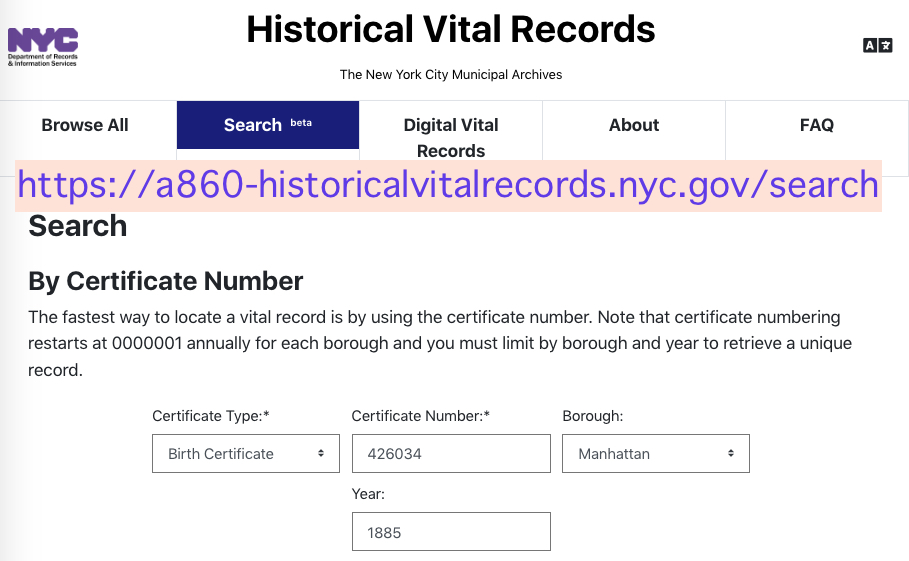
For months, I've enjoyed the convenience of searching for birth, marriage, and death certificates on the New York City Municipal Archives site. The trick is to have an actual cert number to conduct a search and receive a result. 

As it happens, Ancestry has a searchable index to New York City births, 1878-1909, which includes the birth record number. But this isn't always the case. Many times, Italiangen.org is my first stop for a NYC ancestor's vital records number. 

First stop: Italiangen.org


The Italian Genealogical Group has done an incredible job of creating searchable index databases for a variety of New York vital records. To go directly to the databases, use this link. I selected the birth database, included a range of years for Carrie's birth (in case there was a delay in recording her birth), and didn't indicate a specific borough because I wanted to search throughout the city.

Happily, this returned one index result: Carrie J. Etschel, born on April 25, 1885, in Manhattan. This matches what I knew from Carrie's marriage license. The key element on this index result is the CertNbr (meaning cert number), 426034.

Next stop: search historical vital records for NYC


Armed with the cert number, year, and borough, I went to the NYC Muni Archives site and plugged it all into the search function, as shown above. Then I clicked the search button.

Immediately I was able to eyeball Carrie Julia Etschel's birth record from 1885, as shown here. There's a choice of downloading the cert or printing, and of course I downloaded to add to my own files. 

By the way, the cert numbers do not always line up exactly with the search function. So if my result doesn't fit what I expect, I do a new search with a cert number that is one digit higher and one digit lower than the cert number I think is correct. Usually this gets me to the correct image.


Read the cert!

Reading the above cert carefully, not only did I learn the exact address where Carrie was born on First Avenue in Manhattan, but also the birthplace and age of both parents, father's occupation, mother's maiden name, plus how many children the mother had in all (8) and how many were now living (only 3). 

Now I have lots of interesting details about Carrie's family that I can include in her bite-sized bio to be posted on multiple genealogy websites.

Monday, December 5, 2022

Bringing My Cousin Back to Life and Getting Rid of Scraped Photos on FamilySearch


Yesterday I stumbled across an unexpected discovery: Someone unrelated to my family had created a profile for my 1c1r on FamilySearch.org, marking her as "deceased." 

Nope.

My cousin is very much alive and well, as I know from speaking with her last week! I hadn't added her to the Family Search tree and I was flabbergasted to find her there, before her time.  

Changing status to living

The help center of Family Search explains how to change my cousin's status to "living." This is important for privacy reasons, to be sure living people are not visible in the collaborative family tree.

At top, an excerpt from the process. You can find more detail here. More than one person had contributed to my cousin's profile, so I had to submit a request to the system administrator. UPDATE: My cousin is no longer visible on the tree!

Getting unauthorized photos off the tree 

That same contributor also scraped family photos from public Ancestry trees that feature my family and posted them on FamilySearch. Without permission from the copyright holder, photos cannot be simply taken from an outside source such as Ancestry and posted on FamilySearch.

Shown here, one of the photos posted as a "public memory" on an ancestor's profile (see arrow). At bottom right of screen (see orange oval) is the name of the contributor. I clicked on the contributor's name and sent a message, saying I recognized the photos as being taken from Ancestry and I wanted those photos removed.

I further noted that unless permission was specifically granted by someone in my family, posting photos taken from elsewhere violates the FamSearch terms of service. See the excerpt below for background on this specific issue:


Unless the family photos are removed quickly, I will submit a report to FamilySearch. The last time this happened, with a different contributor, my message resulted in family photos being removed within 24 hours.

Have you visited or followed your ancestors lately?

If you haven't visited your ancestors on FamilySearch lately, I suggest you take a look now. Be sure no living relative is visible and mistakenly shown as deceased. At the same time, you might want to check for family photos copied without authorization from outside sources and pasted on ancestors' profiles.

You can "follow" any ancestor visible on the tree and receive weekly notifications of any changes made to that person's profile. While my cousin's status is set to "deceased," I can follow her profile and see when and if her status is changed to "living." I'm also following dozens of other ancestors, mostly to monitor research updates made by cousins and other interested parties.

This helpful article explains exactly how to "follow" someone shown on the collaborative family tree. Go ahead, follow your ancestors!

Sunday, December 4, 2022

Remembering Mom and Auntie in 1919

My mother and my aunt were born on this day in 1919, twin daughters of immigrants Hermina Farkas Schwartz and Theodore Schwartz. 

Left, Dorothy (1919-2001) and right, Daisy (1919-1981), about 1921.

In the year of their birth, 103 years ago, the Great War was finally over. 

It was also the year that the pop-up toaster was invented...rotary dial telephones were introduced...and the famous cartoon character Felix the Cat debuted.

Remembering these wonderful women, with much love, and missing them still on this anniversary of their birth. 

Wednesday, November 30, 2022

NaGenWriMo Family History Writing Wrapup


After an entire 30 days of National Genealogy Writing Month, I've completed and posted 70 bite-sized ancestor bios to document family history.

My methodology: begin with one sibling/spouse cohort in each generation on my tree. Then switch to one sibling/spouse cohort in my hubby's tree, and continue up and down the generations, alternating between my tree and hubby's tree. Switching things up kept me fresh and on my toes! 

By now, I've gotten nearly all bios done back to great-grandparents. Not quite all, because my maternal grandma (Hermina Farkas Schwartz) had a LOT of siblings and most were married with children. Where I haven't yet added spouses/children, I'm naming them in the bios as I write. Their names will be remembered long after NaGenWriMo is finished, because I'm posting on multiple genealogy sites. 

LOCKSS - lots of copies keep stuff safe.

Friday, November 25, 2022

From Immigrant to Head of Thanksgiving Day Parade

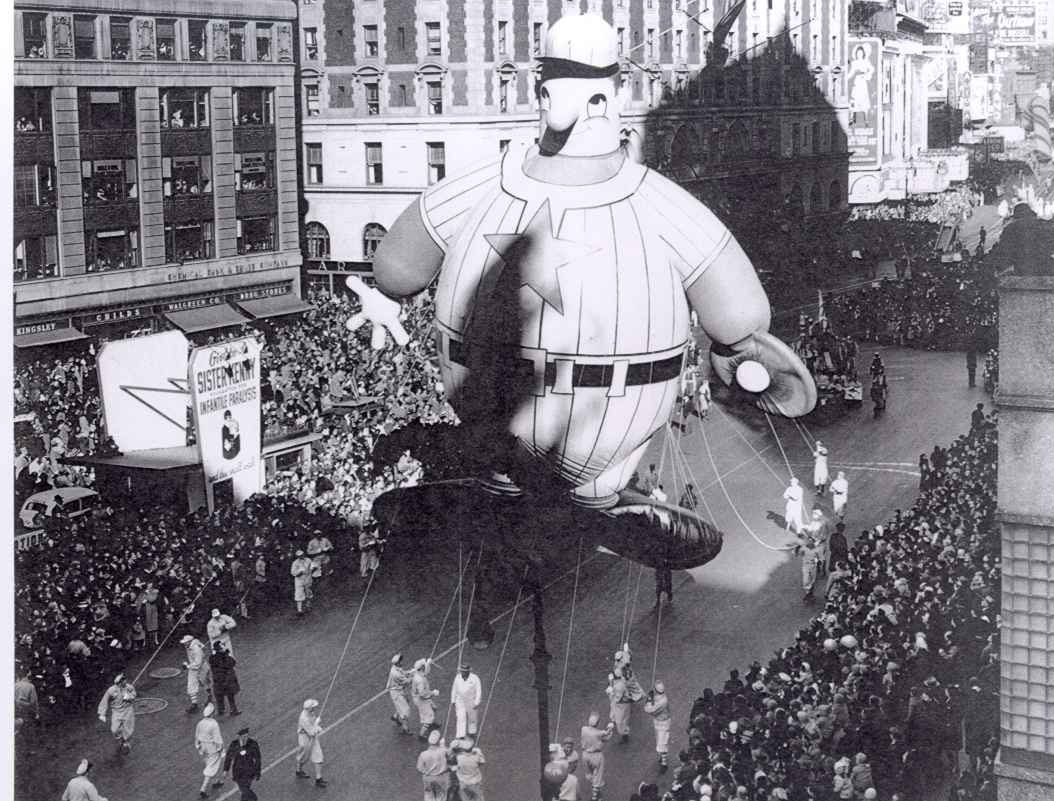
Harold the Baseball Player, balloon shown in the 1946 Macy's Thanksgiving Day Parade. Courtesy Macy's Event Media.

Leona Zonna "Lee" Wallace was born 99 years ago yesterday, on November 24, 1903, in Lodz, Poland. She was the director of the Macy's Thanksgiving Day Parade from the late 1940s until the mid-1950s. Importantly for family history, she was my aunt's life partner starting in that period and continuing for 40+ years.

To honor Lee's memory during this week of Thanksgiving, I've written and posted the following bite-sized bio as part of my NaGenWriMo initiative to document family history online.

Born in Lodz, Poland on 24 Nov 1903, Leona Zonna "Lee" Wallace had two younger brothers who she helped support after the family arrived in America in 1909. Lee worked during the day and attended high school classes at night. In her spare time, she took art lessons, she told a newspaper interviewer in 1952. 

During World War II, Lee worked in labor relations for the Quartermaster Corps, headquartered in Washington, D.C. After the war, she applied to Macy's department store in New York and worked her way up to head of the store's high-profile special events group--including directing the biggest holiday event of the year, the famous Thanksgiving Day Parade. By the 1950s, Lee had earned a national reputation for superbly directing all aspects of the annual parade, from planning to execution. 

In 1952, Lee formed a business partnership with her partner, Dorothy Schwartz (1919-2001). The company was called "Lee Wallace Associates, Parade and Special Events, Consultants." Together, they managed not only the Macy's Thanksgiving parade but also the five-day Bridgeport (CT) Barnum Festival on July 4, 1953. Dorothy (twin sister of my Mom) soon left the business and started a career in high school education. 

Lee and Dorothy shared a deep love of art, theater, and culture. They were devoted to their nieces and nephews, visiting often and taking them on outings to the beach, amusement parks, etc. In later years, Lee's health deteriorated as she suffered a series of strokes. Lee Wallace died on 18 Sept, 1989, at the age of 85.

Today, I'm thinking of my aunt with affection as I keep her memory alive for the future. 

Wednesday, November 23, 2022

Thanksgiving Greetings from 1914


According to the postmark, Rachel Ellen "Nellie" Wood Kirby (1862-1954) sent this colorful Thanksgiving postcard from her home in Chicago to her young Wood nephew in Cleveland on Wednesday, November 25, 1914. 

He was nine that year, and he also received penny postal greetings for Thanksgiving from his first cousins in Toledo, Ohio.

Dear readers, I wish you and your families a most happy and very healthy Thanksgiving.

Tuesday, November 22, 2022

Thanksgiving Week Weddings in the Big Apple

More than a few ancestors in my family tree celebrated a Thanksgiving week wedding during the first half of the twentieth century. 

All married in New York City, and nearly all of the couples (or their immediate family members) appear in photos from my parents' Thanksgiving weekend wedding.

In 1916, maternal cousin Jennie Mandel married Isidore Hartfield. They had two children, although one was born so prematurely that she sadly lived only two days. This couple was at my parents' wedding!

In 1917, paternal cousin Louis Jacob married Katie Rosenberg on the Saturday of Thanksgiving weekend. They were wed in Brooklyn, New York and never left the borough, where they raised their daughter. 

In 1935, maternal cousin Ernest Roth married Fay Barth on the Wednesday before Thanksgiving. They had two children together. Ernest's older sister Margaret was at my parents' wedding!

In 1940, my maternal uncle Fred Shaw married Daisy Ida Katz on Thanksgiving Day. They had two children (my first cousins). Of course this aunt and uncle attended my parents' wedding! 

In 1945, my paternal 1c1r Norma Berg married Allen Mador on Thanksgiving weekend. This couple was at my parents' wedding! 

In 1946, Mom (Daisy Schwartz) and Dad (Harold Burk) were married on Thanksgiving weekend at the Hotel McAlpin in New York City. The photo at top, taken just before the ceremony, shows L to R: mother of the bride Hermina Farkas Schwartz; maid of honor Dorothy Schwartz; and the bride, in her glittery gold lame wedding dress.

Thinking of these ancestral couples with affection and remembering their happy wedding days during this Thanksgiving week! 

Friday, November 18, 2022

Fun Portraits via MyHeritage AI Time Machine


My Heritage has a fun new feature and for a limited time it's free to all. No subscription needed!

Just upload at least 10 personal photos of yourself, and the AI Time Machine turns them into, well, take a look at these examples. 

Above, me as a gentle pirate, not sending anyone across the gangplank. LOL.

Below, I'm some kind of Egyptian queen, then below that, a 1930s English lady ready for a hike across the moors. I'm using some of these as my social media profile photos, they're so much fun.


In the company's words:

With the AI Time Machine™, you can see yourself as an Egyptian pharaoh, a medieval knight or a Viking, a 19th-century lord or lady, and much more, in just a few clicks! Watch this 30-second video to see how it works.

Go ahead and give this a try for free here. It's a hoot! Thank you to My Heritage for this new "time travel" feature.


Wednesday, November 16, 2022

Two Cenotaphs for Arthur Albert Slatter


Among my husband's ancestors, the men of the Slatter family have a tradition of military service. 

Hubby's Whitechapel-born grandmother, Mary Slatter Wood (1869-1925), was the youngest sister of three boys who entered the British military as preteens and grew up to become well-respected military bandmasters in Canada: John Daniel Slatter, Henry Arthur Slatter, and Albert William Slatter. In turn, at least one of the sons of each man went into the military, as well.

Henry Arthur Slatter's oldest son, Arthur Albert Slatter, was born on July 2, 1887 in London, England. He enlisted in the Royal Fusiliers in 1902 and served out his enlistment period by 1914. He then moved to Vancouver, Canada, where his parents had moved. As World War I raged on, Arthur signed up in May of 1915 to serve with the Canadian Overseas Expeditionary Forces. 

Soon Arthur rejoined the Royal Fusiliers and went into battle in Western Europe. Sad to say, he was killed in action on May 20, 1917, before his 30th birthday. 

Now Lance Serjeant Arthur A. Slatter's name is listed among the fallen on the World War I Arras Memorial, including a separate Find a Grave memorial page (see image at top). This is a cenotaph because, as the note on the page indicates, it's not the actual burial site.

Turns out, this is not the only cenotaph where Arthur was memorialized. His parents later put Arthur's name on their joint gravestone in Mountain View Cemetery, Vancouver, Canada.

In writing and reviewing bite-sized bios as part of my #NaGenWriMo initiative during November, I discovered a broken link to Arthur's second cenotaph--the gravestone in Mountain View Cemetery. 

Now I've corrected the link on both of Arthur's parents' Find a Grave memorial pages and will put it into their bite-sized bios on WikiTree, MyHeritage, and other sites, to be sure anyone who wants to view the stone can easily do so.

Tombstones is this week's #52Ancestors prompt by Amy Johnson Crow.

Monday, November 14, 2022

Going Beyond Names and Dates with NaGenWriMo


I'm writing and posting ancestor bios from my family tree and my husband's tree to various genealogy sites as I participate in #NaGenWriMo, National Genealogy Writing Month. 

Without my ancestors, I wouldn't be here. I'm thankful in this month of Thanksgiving to be able to honor their memory with bios, so they won't be forgotten in the future.

Already this month, I've posted or revised bios for more than 30 ancestors. Most recently, I enriched the bite-sized bio of my great aunt Dora Lillie Mahler (1894-1950) on WikiTree, posted the bio on MyHeritage, and called the New York cemetery where she's buried to ask for specifics on her plot location--so I could add the details to Dora's Find a Grave memorial page and her Ancestry profile. 

More Mahler and Jacobs bios (relatives and in-laws) are in my plans for the coming week. These ancestors are from my father's side of the family tree. Today I wrote a bio about Flora Jacobs (1890-1923), the third daughter of Joseph Jacobs and Eva Michalovsky to pass away young, unfortunately.

Even bios that are only narratives flowing together data from Census and vital records, with residence and occupation and birth place/death place, birth order, and other details, help bring ancestors alive. If I can add photos (such as this touching gravestone), even better.

More bios to come.

Friday, November 11, 2022

Saluting Veterans with Fold3 Memorial Pages and More


I've been creating or improving memorial pages on Fold3.com, with the goal of information about military veterans in my and my husband's family trees. Above you see the memorials as I bookmarked them on Fold3, for easy access. 

In hubby's tree, I've memorialized Union soldiers from the US Civil War, such as John W. Larimer. Also I've memorialized World War I and World War II veterans in his tree, including Captain John Daniel Slatter.

In my tree, I've memorialized World War I veterans such as Marine Cpl. Frank Maurice Jacobs, who lost a leg in battle. Also World War II veterans such as Sgt. Dorothy H. Schwartz, a WAC who served overseas.

I'm adding to these memorial pages and establishing new pages during NaGenWriMo month in November, just one way of honoring their service and sacrifices with Veteran's Day in mind. 

To learn more about memorial pages on Fold3, take a look at the help pages here. Tip: These memorials can be linked to your Ancestry tree as well.

Also, after reading Diana Bryan Quinn's blog post about the Military Women's Memorial, I registered my aunt, Sgt. Schwartz, so her WAC military service during WWII will be in their records in time for Veteran's Day 2022. 

Thursday, November 10, 2022

Go Ahead and Save My Stuff to Your Tree


Yes, I've spent 24 years researching ancestors on my family tree and my husband's family tree. Yes, I've spent thousands of dollars ordering vital records from both sides of the Atlantic. 

Yes, I want you to take anything and everything connected to my public family trees and add that stuff to your own tree if we have mutual ancestors. That's why I shared all those things publicly. 

Genealogical clues and cousin bait on my trees

These items are great genealogical clues, and they're also great cousin bait. So go ahead and save to your tree! 

As shown above, 20 members of Ancestry have saved the unique handwritten version of family history jotted down by my husband's grandfather, Brice Larimer McClure (1878-1970). These people were his relatives, and his notes have been fantastic clues for further investigation. Some of the members who saved this to their family tree have been in touch with me to exchange additional information, including a few who are DNA matches with my husband. 

Cousin bait, not just genealogical clues. 

LOCKSS vs "my tree"

I share widely because of LOCKSS: lots of copies keep stuff safe for today and tomorrow. 

I recognize that some people are unhappy when their trees are copied and their materials used without attribution. They've done a lot of work and they would at least like to be recognized for that work when someone else copies from a public tree. Although I certainly understand and respect this perspective, it's not my approach.

When I started on my genealogy journey in 1998, many people kindly shared info with me. They gave me a head-start. Now I'm paying it forward and looking ahead with LOCKSS. 

If I don't want something copied (such as personal photos), I don't post that stuff these days. On the family photos I do post online, I've been adding the name of the person, dates if known, and then "Courtesy ___ Family" to clarify the source (as on this photo of my great uncle, which I posted on WikiTree).

The more people who have ancestor names and supporting materials on their trees, the less likely these ancestors will be forgotten in the decades to come. I want my research to be available long after the distant day when I join my ancestors, not just in the hands of my family but more widely. 

This is why I post trees on multiple sites (WikiTree, Ancestry, MyHeritage, and so on) and add to the FamilySearch tree. I also have heirs on both sides of the tree who will become custodians of my genealogy collection in the future.

What will happen to your family history? Are you taking steps now to keep your genealogy, stories, and materials safe in the years to come?

-

For ideas on how to plan ahead, please see my popular book, Planning a Future for Your Family's Past, available from Amazon US/Canada/UK/Europe. If you're on Kindle Unltd, you can read the ebook for free!

Tuesday, November 8, 2022

Genealogical Corrections Are Good Practice, Not BSOs


As I participate in NaGenWriMo and write family history this month, I have multiple tabs open on my browser: my family trees (Ancestry, MyHeritage, WikiTree, FamilySearch), plus my blog, and Find a Grave.

Ordinarily, I would make a note of any intriguing clues discovered as I write, and keep going with my project, not to be derailed by a bright shiny object (BSO). 

But when I see an error that I can help correct, it's not a bright shiny object but an opportunity to follow good genealogical practice. For the sake of other researchers and family historians, I don't want inaccurate info to be perpetuated. 

Take the Find a Grave memorial page at top. Poor ole George is one of a series of Georges in multiple generations of my husband's Wood family. 

Now I don't know who linked the family members on George's memorial page, but one is incorrect. 

By reading the dates and not just the names, the error jumps out! Was the mother really born two years after the son?? The mother who was linked belongs to another George in another generation, I recognized after a moment.

I immediately sent a correction to the manager of this memorial page, providing the actual mother's memorial number. Within three hours, the correction was online. 

It's only the first week of my NaGenWriMo quest. What other errors will I notice? 

Sunday, November 6, 2022

NaGenWriMo Continues


November is the time for NaGenWriMo--National Genealogy Writing Month. It's not too late to participate! 

Already this month, I've written bite-sized bios of 14 ancestors on my husband's family tree. I'll finish his great aunts and great uncles, then move on to write about my grandparents' siblings--which will keep me busy since they each had many sisters and brothers.

Focusing on one branch at a time allows me to see these people in context and proceed systematically. As I write, I'm making tiny corrections and adding new research to my trees, plus I'm improving or adding Find a Grave memorials. 

Even those who died young can be memorialized with brief bios. I'm writing about the child's position in birth order, names of parents, birth place, any Census or baptism mention, illness, cause of death if known, burial place, any other details.

By posting ancestor bios in multiple places online, I want to keep as much family history as possible from being lost in the decades to come. Anything I write during November is more than was available before this year's NaGenWriMo!

Thursday, November 3, 2022

Friday and Saturday: WikiTree Symposium and WikiTree Day


On November 4 and 5, you're invited to hours and hours of free genealogy talks celebrating WikiTree's 14th anniversary. You can attend any or all sessions and learn from the experts!

Two sessions not to miss are the panel discussions about the future of genealogy with Eowyn Langholf (facilitator), Chris Whitten, Mags Gaulden, Daniel Loftus, Rob Warthen, Roberta Estes and Amy Johnson Crow. Also panel discussion with Eowyn facilitating and panelists Mags Gaulden, Jen Baldwin, LaBrenda Garrett-Nelson, Kathryn Lake Hogan, and Thomas MacEntee.


You can join in some fun activities, including Bingo, trivia, and more. 

It's an honor to be speaking during the November 4th Symposium, at 10 am.

My talk, "Genealogical Clues and Cousin Bait on Find a Grave," was presented live and then available for 30 days on YouTube, where nearly 800 people viewed it.

Thank you to WikiTree!