Sunday, January 17, 2021

No Heirs for Your Family History? Recap


Ken Thomas, the longtime genealogy columnist for the Atlanta Journal-Constitution, suggested I write about what to do if you have no obvious heirs for your family history. 

Based on his suggestion, I wrote a four-part series earlier this month. Here is a quick recap of ideas for how to donate or preserve your family's history for the sake of future generations. 

Background before making decisions

Before you make any final decisions, please read this page from the Society of American Archivists about donating your collection as a whole. Also look at this informative Family Search wiki page about what to do with a genealogy collection. If needed, I urge you to seek professional advice about particularly valuable, quite historic, uniquely specialized, older/archeological, or extremely fragile items in your collection.

Ideas for what to do

In Part 1, I wrote about trying to coordinate your preservation efforts with cousins and other relatives. Someone may be willing to accept all or part of your genealogy collection and keep it safe. In particular, consider how to safeguard some photos and memorabilia of family members without direct descendants--"no cousin left behind." And if you have fine china or silver, offer a place setting or a teaspoon or a teacup to each of your relatives.

In Part 2, I explained the process for identifying potential institutions that might be interested in accepting artifacts and/or possibly some of your genealogy materials. Each institution has its own collection priorities and procedures, so it's important to understand what each museum, library, archive, society, or university is interested in collecting and studying. For more about the actual donation process, see my post here.

In Part 3, I wrote about looking at your collection from the perspective of non-family eyes on your family's history. Neatness counts! Organization is the key, including a written family tree and other documents to help researchers navigate your collection and understand what it contains.

In Part 4, I discussed how to summarize the scope and significance of your family-history collection. Focus on how your ancestors' lives might be of interest to an institution and other researchers. Whether or not you donate any of your materials, do consider offering your family-tree information to an institution. 

Thanks so much to Ken Thomas for suggesting that I cover this very important and very timely topic.

For more about how to plan to keep your genealogy collection safe for the future, please check out my best-selling book, Planning a Future for Your Family's Past. Updated in Sept 2021!

Tuesday, January 12, 2021

Repurposing Ancestor Stories to Share More Widely


Now that I've written a family history booklet about my mother (Daisy Schwartz Burk, 1919-1981) and her twin sister (Dorothy Helen Schwartz, 1919-2001), I'm repurposing the content to share more widely. The bite-sized stories are already written--why not condense, adapt, and post on multiple websites, sharing family history with a larger audience without spending a penny or a pound.

Another approach is to begin with a brief bio you post on a website like FamilySearch or Fold3 or Find a Grave or WikiTree, and use that as the basis for a written booklet or a photobook or some other family-history document for your family to enjoy.

Case Study: Choose Photos, Write Headline

Above, a snippet from the Fold3 memorial page for my aunt, WAC Sgt. Dorothy H. Schwartz, who served during World War II. She's not the first ancestor I've memorialized for free on Fold3, but she's the most recent--a good case study for how to repurpose content.

First, I selected and uploaded several images of my aunt that I had inserted into my booklet. Previously, I had cropped the images to remove extraneous background. For the main profile photo at top left of her Fold3 page, I uploaded a portrait she sent home to her family, prominently featuring the sergeant's stripes on her uniform.

Next, I wrote a headline for my story. My goal was to highlight not just my aunt's military background but also what she did in her life. Therefore, I included her military rank, her full name and dates, and the fact that she was a "decorated WAC" (she earned the Bronze Star in World War II) and, later, a high school teacher.

Case Study: Content for Story

Now I was ready to write the actual story. I consulted the booklet I wrote about my aunt for the main points to include. As context for my aunt's life, I wanted to say something about her family, her education, her specific role in the WACs, and what she did after her honorable discharge. This was covered in my booklet, so all I had to do was copy out sentences, condense where needed, and write smooth transitions.

In the five succinct paragraphs I wrote for the Fold3 memorial, I managed to say:

  • Dorothy was a twin (I included her twin's name and their birthdate).
  • She lived and went to school in the Bronx, NY, then went to Hunter College.
  • She enlisted as a WAC and had a tense voyage across the Atlantic with 650 other WACs headed for Europe. 
  • Exactly what her role was as a WAC, listening in as officers made decisions about bombing and transcribing her notes into written orders.
  • Dorothy received the Bronze Star and wrote the history of her WAC unit.
  • Dorothy returned to school for education courses, then taught at two Bronx high schools until retiring.
  • She later became an advocate for renters' rights and consulted on retirement issues.
  • When Dorothy died and what cemetery she's buried in (next to her twin).
Now the "family legend" of my aunt's meritorious service during World War II is memorialized for the world to see on Fold3. And I posted it on Find a Grave, too!

TY to Amy Johnson Crow for the #52Ancestors prompt of "Family Legend" for week #2 in the 2021 challenge.

--

My presentation, "Bring Family History Alive in Bite-Sized Projects," is part of the all-virtual New England Regional Genealogical Conference in April. I'll be sharing more tips for repurposing ancestor stories. Registration is now open!

Friday, January 8, 2021

Wish List: Cousin Connections


If I could go back in time, I would ask my mother and my father to list the names and addresses of their first and second cousins. Only years after my parents passed away did I discover how extensive their cousin connections really were.  

Cousins? What cousins?

My father never mentioned his Burk cousins, relatives who were actually at his wedding! It took me a decade of research to identify them and find their children, my second cousins. Dad certainly would have been able to rattle off their names, but I never thought to ask until it was too late.

My mother never mentioned her first cousins on the Schwartz side, even though she knew some of them. Using photos and documents, I eventually traced several. I was able to meet one and, happily, get to know a few of my cousins in the next generation.  

For a number of years, I've been doing what I wish my parents had done: Maintaining a list of my cousin connections. One of my goals is to continue this practice, keeping the names and contacts updated and sharing with my relatives.

Write down your cousin connections

Creating a list of cousin contacts will help you and your family (and your heirs) know who's who and how each person is related in the family tree. It's not enough to have a name, address, phone number, and email address in your smartphone contacts. It's really important to explain the relationships. Otherwise, all you have is a list of contacts with no genealogical context.

At top is a sample of my "cousin connections" form. This week, I updated the list for my side of the family tree, and created a new cousin contact list for my husband's side. I'm sharing with immediate family so everyone is on the same page, literally.

Please do your family and future generations a big favor and write down your cousin connections!

--

This is one of the tips in my book, Planning a Future for Your Family's Past, a practical (and affordable) guide to passing your genealogy collection and knowledge to the next generation. Please check it out!

Participating in The Genealogy Blog Party, 2021 Goals!

Tuesday, January 5, 2021

No Heirs for Your Family History? Ideas, Part 4


Captain John Daniel Slatter (1864-1954) 

If you have no family heirs to assume ownership of your genealogy collection in the future, I hope this series will give you some ideas for keeping documents, artifacts, and photos out of the trash or flea markets. This post is about one question: What institution would be interested in your genealogy collection?

Idea: Think about the scope and significance of your collection

Think about your family history collection as a whole and its significance. What does it exemplify, in terms of genealogy and history? What story does it tell about a particular place, a certain period, a group of people, a specific situation or experience? Did your ancestors keep scrapbooks, photo albums, or other items that help tell the story?

What might researchers learn by looking at some or all of your collection? Does your collection include unusual personal items or hard-to-find records that you've managed to collect? Did your ancestors have a brush with history, fame, or notoriety? Were they representative of a larger movement such as immigration or the Gold Rush? 

Try to summarize your collection in a relatively brief "elevator pitch" that captures the essence of your collection. Jot a list of the main surnames, places, years covered, types of materials in your collection, and anything important that a repository should know when considering your collection.

Idea: Take your time and do your homework

Do an online search, based on the scope and significance of your collection, for appropriate institutions. Look at libraries, museums, archives, genealogical societies, historical societies, or other repositories that are in the area where your ancestors lived/worked. Out-of-area institutions may have a research interest in the place or time, so cast a wide net at first. 

Think about what in your ancestor's life might be of interest to a museum. Gold Rush? Irish immigrant? Military service? Pioneer? Civic leader? Scallywag? Some institution, somewhere, may be interested!

Next, click around the website of each repository to find out about its donation policies and preferences. On the NEHGS website, an entire page is devoted to explaining what the institution is interested in collecting and how to take the next step by making contact.

Always, always contact the repository before making any plans. This is where your elevator pitch comes in. And remember that you, not the repository, will be responsible for getting your collection to its destination.

Idea: Contribute your genealogy knowledge

Whether or not you wind up donating your entire collection, do consider contributing your knowledge of your family tree to an institution. Many institutions (local, regional, national, and specialized) are interested in collecting genealogies, even if they won't accept your collection of materials. 

For instance, I contributed the genealogy of the Slatter family to two military archives that collect artifacts about these ancestors of my husband. Neither institution had the background I had collected about Captain John Daniel Slatter (1864-1954, shown in portrait at top of post) and his brother, Bandmaster Henry Arthur Slatter (1866-1942). The archives were both pleased to add to their knowledge of these eminent military bandmasters, and I was happy to share my research.

Earlier posts in my series looked at preparing for non-family eyes on your family history collection, planning to donate a family history artifact, and coordinating with extended family to plan for the future of your collection.

Monday, January 4, 2021

No Heirs for Your Family History? Ideas, Part 3

If you have no obvious heirs to take over your genealogy collection in the future, I hope this series will give you some ideas for keeping documents, artifacts, and photos out of the trash or flea markets.

This post includes a few starting points for getting your genealogy records into shape for donating to an appropriate library, society, museum, archive,  surname/place study group, or another institution. 

As you plan, I highly recommend reading the informative post "what to do with the genealogy and family history" on the Family Search wiki here

Idea: Think about non-family eyes on your genealogy

Institutions usually won't accept a stack of loose papers in haphazard order, like the mess I inherited, as shown at top! Unless a non-family member can make sense of your genealogy paperwork, it will not be useful to anyone.

The point of donating your documents is to help other researchers interested in any of your ancestors or that place or period in history. You may have an unusual set of records in your collection, or a person you've confirmed and documented in your family tree who is not mentioned on other trees, or a photo that connects your family to a certain time/location/event. 

In general, the goal is to organize your genealogy documents so that non-family eyes can understand what's in the collection. Take inventory. Know what you have and figure out a logical way to put your materials in order--by surname or by family group, for instance. Family Search has good ideas here about organizing your files.

Neatness counts. You want your collection to be orderly and organized, without physically changing the materials. No punching holes in documents to insert into binders. No stapling, no rubber bands, no paper clips. 

Idea: Written family tree, sources, and table of contents

You can guide outsiders through your family history by creating or adding detail to a written family tree or chart explaining who's who. 

The Family Search wiki lists many sources of downloadable charts you can use, and you can also download from the National Archives. If you use genealogy software, you can generate reports. Or you may prefer to create a spreadsheet or use another system, as long as it's understandable by non-family eyes.

Cite your sources to show how you know what you know. Other researchers will appreciate seeing sources in writing. Again, neatness counts. So does accuracy. Double-check your spelling, dates, place names, and sources. 

Consider a table of contents for each binder or box or file folder (and label binders and boxes and folders with your trusty label maker). You might assemble all tables of contents into a package that goes with your written family tree, to guide outside eyes through the collection. 

Please don't leave behind a mess like the one I inherited. Little by little, start now to organize your genealogy collection and get it into shape for non-family eyes to understand.

--

Earlier posts in this series looked at donating artifacts to institutions and finding new homes for photos and china with other relatives. More posts to come in this series! 

For additional ideas about sorting your collection and writing instructions for its future, please also see my affordable best-selling genealogy book, Planning a Future for Your Family's Past.

Sunday, January 3, 2021

No Heirs for Your Family History? Ideas, Part 2

If you have no family heirs to take over your genealogy collection in the distant future you join your ancestors, there may be other ways to save your family's history from being tossed in the trash or sold in a flea market. The key is to begin planning early and to think creatively.

My previous post was about approaching relatives to accept some or all of your family history, particularly photos, and about helping to save things from other cousins who have no heirs. Also I mentioned the idea of offering a single china setting (or a teacup, says reader Heather) to relatives.

This post is about researching possible non-family homes for your family's artifacts. NOTE: Seek out professional advice about highly valuable, quite historic, uniquely specialized, older/archeological, or extremely fragile items.  

Idea: Classify your artifact - where would it fit?

My aunt, Dorothy Schwartz (1919-2001), had no direct descendants. She was a WAC during World War II and led an interesting life--one worthy of being remembered. To keep her history alive, my sister and I wanted to donate some items we inherited (such as her Bronze Star citation and the written history of her WAC unit) to an appropriate institution. 

I began by classifying the artifacts in various ways: (1) the items relate to the Women's Army Corps, part of the U.S. Army; (2) they relate to a U.S. Army veteran; (3) they relate to World War II. 

Take a few minutes to classify your artifacts and see how many/which categories they fit into before you go looking for an institution that might be interested in accepting these items. 

In some cases, institutions are looking for specialized items for specific exhibits. The Norwalk CT Historical Society recently put out a call for artifacts related to an upcoming exhibit entitled "Miserable vagrants, petty thieves and scamps: a history of crime in Norwalk.” If that describes your ancestor, find out about the society's process (see illustration at right)!

Idea: Which institutions seem to be a good match?

Next, look at your classifications and search for institutions that have closely-related collections. Think about not only your top choice but your second choice.

I did online searches for the classification phrases Women's Army Corps, U.S. Army veterans, and World War II. Looking at the results, I read about the mission of each institution and also looked at what each institution is interested in collecting.

After doing this research, my conclusion was that the U.S. Army Women's Museum would be the best match for Sgt. Schwartz's artifacts. The website (see illustration at top, with a headshot of my aunt) offers these instructions, which I followed.

We are always actively seeking materials for our collection. If you would like to donate artifacts or archival materials please ensure you contact the Museum before sending anything. If you do not, it is possible the material will be sent directly back to you.

Idea: Understand the institution's process 

Be guided by the institution's process, which usually begins by asking you to make contact and describe the artifact before sending it. I was able to donate my items to the museum, after receiving approval to send them--along with a biographical sketch of my aunt, and her role in the WACs during World War II. My sister and I are happy that our aunt, Sgt. Schwartz, is now represented in the museum's collection.

However, if the institution replies that your artifact doesn't fit in the scope of its collection, or it already has other examples similar to yours, do ask for suggestions of other institutions that usually collect your artifact. Or move down the list of results from your own research and contact your second choice. 

To learn more about the general process of donating to any institution, please see my detailed blog post here.

My next post in this series will have ideas for what to do with your research and documents if you have no family heirs. Remember, these are only ideas--please adapt as appropriate to your situation. Also take a moment to read this Society of American Archivists article about donating your family history collection to an institution.

- This is my entry for the 6th Annual Genealogy Pot-Luck Picnic hosted by my gen friend Elizabeth Swanay O’Neal. 

Saturday, January 2, 2021

No Heirs for Your Family History? Ideas, Part 1


One big reason I wrote Planning a Future for Your Family's Past four years ago was to provide ideas for curating a family history collection and preparing it to be passed to the next generation. The concept struck a chord in the genealogy community -- and my book has been selling steadily ever since.

My book didn't explicitly address what to do if you have no family heirs to take over your genealogy collection, although many of the ideas in the book do apply. 

Today I'm beginning a new series of posts with ideas about possible paths forward if this is your situation. The goal is to keep your family's history from winding up in a garage sale or dumpster. The new year is a great time to begin thinking about what happens to your genealogy--before you join your ancestors! These ideas are meant as starting points for your own plan to protect family history.

NOTE: If you're considering finding a non-family home for your collection as a whole, please read this informative article about the process before you make any changes to your collection.

Idea: Try to coordinate with relatives

Whether you are in touch with nieces, nephews, 1st cousins or 1st cousins once/twice removed or 2d cousins (on either side of your family), you may be able to find someone or more than one relative willing to accept at least a few of the key items in your genealogy collection.

Often, nephews/nieces/cousins are willing to accept a gift of a group family portrait that includes their parents/ancestors as well as yours. Maybe you have such a portrait from a family wedding or reunion. Even if the photo was fairly recent rather than decades in the past, ask whether your relative would be kind enough to take possession of your [hopefully good condition] original for the sake of future generations. 

If you know a certain relative was especially close to your mother or father or a grandparent, consider approaching that relative with the request to safeguard some or all of your family history collection. At the very least, your relative may be willing to accept photos/documents related to part of your shared family tree.

If nothing else, a cousin or niece or nephew who appreciates the value of family history may be willing to take some (or all) of your collection and hold it for their heirs to avoid having that info lost to future generations. 

Idea: No cousin left behind

Also coordinate with relatives to protect photos and documents related to ancestors who had no direct descendants. It's possible that a few relatives could agree to share the collection of these ancestors. 

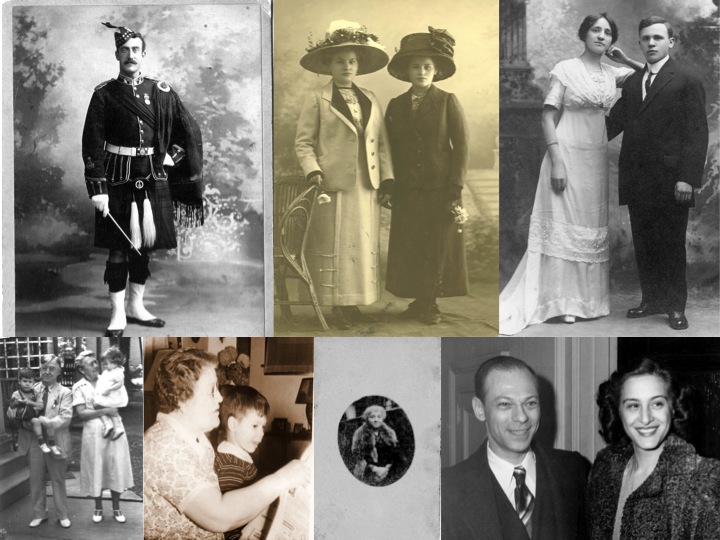
That's how I ended up with the wedding portrait and childhood photos of my 2d cousin Iris, shown at top of this post. She had no direct heirs; her collection went, by default, to her 1st cousin. That cousin held onto the bulk of Iris's photos but asked me to take a few key items because of my interest in the Farkas family's genealogy. She also shared a few photos with another cousin who remembered Iris with great fondness.

Now a selection of Iris's photos will live on with my heirs, labeled and captioned so future generations understand who she was and how she was connected with my grandma Minnie Farkas's family. I want them to at least know Iris's name and her smile, even if they never knew her in person.

Idea: China or silver? Offer one place setting at a time

If you have your own fine china or silver (or an ancestor's tableware inherited in the past), consider asking relatives whether each would accept a single place setting. One setting doesn't take up much space and it would keep the tradition alive in a different household--multiple households, ideally. 

In my extended family, a niece and a cousin accepted a single place setting apiece from an ancestor's tableware, just for the uniqueness and the tradition. Mix and match is in style, remind the younger generation! 

FOR MORE IN THIS SERIES: Please see Part 2, Part 3, and Part 4.

--

"Beginnings" is my #52Ancestors post for Amy Johnson Crow's 2021 challenge.