Tuesday, March 14, 2023

Word Cloud of Hubby's Irish Ancestors


For St. Patrick's Day, I created a lucky four-leaf clover of surnames and places from my husband's Irish ancestry. The free site I used is WordArt.com

As always, I sent "Erin Go Bragh" greeting cards to the grandkids. This year I included a four-question quiz about a few of the Irish ancestors I've been telling them about for years.

  1. Who was the first Brice in our family to be born in America, and where in Ireland did his parents come from?
  2. What happened to our ancestor Robert Larimer after he set sail from Northern Ireland bound for America in the 1740s?
  3. Where in Ireland were Larimer in-laws Thomas McKibbin and Jane Irvine McKibbin born before moving to Turkeytrot, Pennsylvania?
  4. Which Scots-Irish ancestors, born in Donegal, paid for passage to sail to Philadelphia and then walked to Virginia to buy farm land?
Answers:

  1. Brice Smith was the Brice in our family to be born in America, in Pennsylvania in 1756. His parents, William and Jean Smith, were from Limerick. Brice and his wife Eleanor Kenny Smith were hubby's 4th great-grandparents. There is also a Brice in my husband's generation.
  2. Robert Larimer boarded a ship about 1740 to sail across the Atlantic in search of a new life, age 21. Unfortunately, he was shipwrecked and forced to serve as an indentured servant to work off the cost of his rescue. After years of hard work, Robert ran away, married Mary Gallagher, and farmed in Pennsylvania. Later, the couple and their family moved to Rush Creek, Ohio. Robert and Mary were hubby's 5th great-grandparents.
  3. Thomas McKibbin was born in County Down, Ireland, and married his wife Jane Irvine in Ireland before traveling to Pennsylvania about 1812. Later, Thomas and Jane moved west to pioneer in Indiana, where both are buried. Thomas and Jane were in-laws of hubby's Larimer family.
  4. Halbert McClure and his wife, Agnes, were both born in Donegal, although the McClure family is originally from Scotland. Halbert, his wife, their children, and some of Halbert’s brothers sailed to Philadelphia and then walked together to Virginia in the 1700s. Their descendants became farmers in Ohio and then in Indiana. Halbert and Agnes were 5th great-grandparents of my husband.
"Lucky" is the 52 Ancestors theme for this week, from Amy Johnson Crow. 

Saturday, March 11, 2023

Bite-Sized Family History from World War II

It seems my relatives like to learn about family history in small doses. Not for them a big data dump about dozens of ancestors or multiple generations. Keep it focused, keep it simple, they'll pay attention for at least a little while.

This week, I created a bite-sized photo book with snippets of what some ancestors did during World War II--in the military and on the home front. (Photo of photobook will be posted soon!)

Many served in the armed forces. I selected four to profile in some detail: my Dad (US Army), his brother (US Army Air Corps), my aunt (WAC), and my uncle (US Army). Lots of photos and bits of documents brought their stories alive.

I also briefly touched on the military service of Dad's and Mom's first cousins, including one in the US Navy and one in the US Marines Corps. Another of Dad's cousins served in the New York Guard. Nearly every branch of the armed forces was represented in the family tree, and mentioned in the bite-sized book!

Supporting the war on the home front

Beyond the military, our Farkas family had its very own Rosie the Riveter. My great aunt Freda, younger sister of my Grandma Minnie, worked long hours in the Grumman aircraft factory on Long Island. 

Other women in the family tree were supporting the war effort on the home front, as well. My Mom and her twin, plus two cousins, joined the American Woman's Voluntary Services, volunteering for a range of activities including selling war bonds. 

My maternal grandma's Farkas Family Tree association often held war-bond sales during monthly meetings, raising a couple thousand dollars at a clip. Mom was also involved with New York City's civilian Air Warden Service during 1943, checking that curtains were closed for blackouts in case of overnight enemy bombing raids. 

Does your family tree include any Rosie the Riveters? Women's History Month is a great time to show pride in these ancestors by telling their stories in a bite-sized family history project.

Wednesday, March 8, 2023

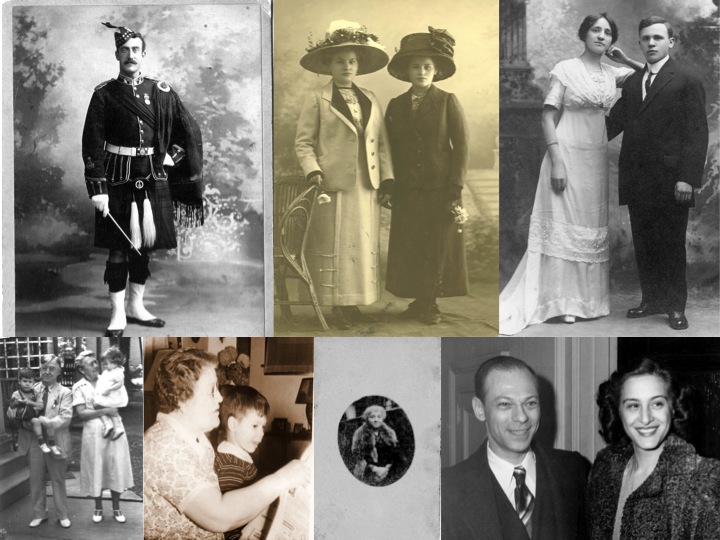
International Women's Day: Honoring the Women in My Family Tree


Today is International Women's Day!

To honor the women in my family tree, let me present:

  • Daisy Schwartz Burk, my Mom
  • Hermina Farkas Schwartz, my maternal Grandma
  • Leni Kunstler Farkas, my maternal great-grandmother
  • Henrietta Mahler Burk, my paternal Grandma
  • Rachel Shuham Jacobs, my paternal great-great-grandmother
  • Tillie Jacobs Mahler, my paternal great-grandmother
Thinking of them with affection and appreciation today, March 8, 2023.

Monday, March 6, 2023

Translating Facts and Artifacts into Family History


Last week, one of my younger relatives asked about the World War II service of our ancestors. Little did he know that he would get answers, lots of answers!

For this young man and other descendants, I'm preparing a little photo book with snapshots, documents, and stories of our ancestors who served. The focus is on my immediate family: Dorothy Schwartz (maternal aunt, a WAC), Fred Shaw (maternal uncle, US Army), Harold Burk (Dad, US Army), Sidney Burk (paternal uncle, US Army Air Corps). Plus a paragraph about my Mom doing her part at home (see below). After all, it is Women's History Month, so Mom and her twin should both be included!

Facts into stories

Dad's honorable discharge documentation recorded the facts of what he did overseas, but no details or explanation (see at top). I had other documentation, from Fold3 and other sources, as well as from family files. I wanted to translate the facts into readable snippets about his role in WWII.

Doing an online search for his 3163d Signal Corps unit, I stumbled on an oral history from someone who served at the same time in the same unit! After reading a summary of the background provided by Alan B. Conlin Jr. in 2013, I was able to write a few lively sentences about the unit's vital wartime role, exactly where they were stationed, and when. 

This fleshed out the facts of Dad's wartime service into a brief story of how the Signal Corps installed and managed communications such as radio and teletype, extremely vital for transmitting troop orders and bombing instructions in the European Theater. 

Artifacts into stories


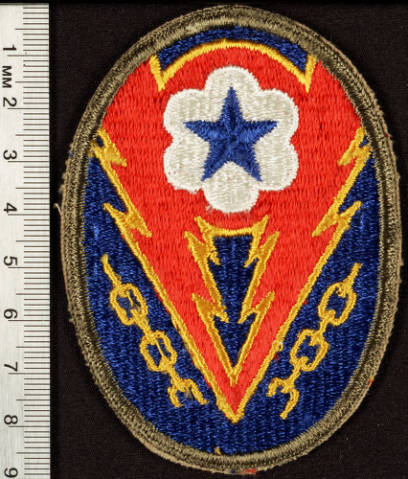
Meanwhile, my wonderful husband was intrigued by the wartime shoulder patch my father had saved all his life. After a bit of online searching, hubby discovered a detailed explanation of the symbolism on the Pritzker Military Museum website. Someone had donated the unit patch and the museum summarized what each element means, as you can see here

In the book I'm preparing, the photo of the patch will be accompanied by a rephrased version of what the patch represents. For sure I wouldn't have recognized that the twin thunderbolts represent V for Victory. Now descendants will know that part of the artifact's story, along with a clear photo of Dad's own patch (being passed down to heirs).

On the home front

Not to leave out my Mom, Daisy Schwartz, I included this image of her Air Warden service in 1943. She didn't serve in the armed forces, but she did work as deputy communications director for the New York City units. 

My book will include a brief description of the function of an air warden, so the document is "translated" into a story of my Mom doing something meaningful to support the war effort on the home front.


With younger folks in mind, these bits of research helped me turn bare facts into actual stories to capture my audience's attention and bring family history alive. 

"Translation" is this week's #52Ancestors theme from Amy Johnson Crow.

Friday, March 3, 2023

Book Review: "Generation By Generation"


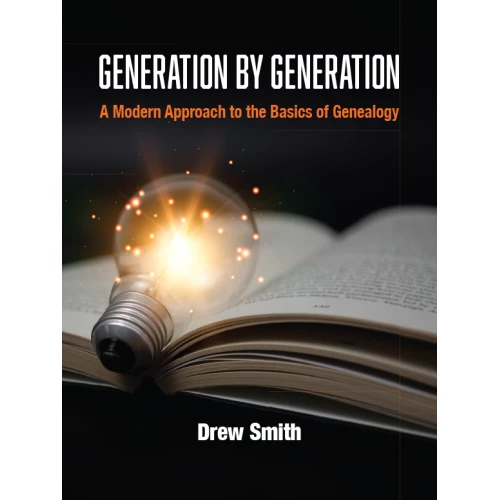
Know any newcomers to genealogy? I encourage you to point them toward a new book designed specifically for people just starting their journey into family history: Generation By Generation, a Modern Approach to the Basics of Genealogy by Drew Smith, from Genealogical.com. Disclosure: Although I received a free copy from the publisher, the opinions in this book review are entirely my own.

Drew is well known as co-host of the Genealogy Guys podcast, founder of the Genealogy Squad Facebook group, and a frequent speaker on genealogy topics. One of his innovations is to organize the research chapters according to how we actually trace a family tree--starting with ourselves and going back in time, one generation at a time:

  • Generations after 1950 in the US
  • Generations from 1880 to 1950 in the US
  • Generations from 1850 to 1880 in the US
  • Generations from 1776 to 1850 in the US
  • Generations in British America before 1776

He also assumes that today's genealogy newbies will be relying on technology, both for research and for documenting family history. Chapter 4 is all about getting organized, with software, bookmarks, etc. Chapter 7 focuses on the four major online genealogy platforms (FamilySearch, Ancestry, MyHeritage, FindMyPast). Truly a modern approach! 

At 170 pages, this large-format book is well-illustrated and highly readable, making the genealogy process more accessible to newcomers. In short, I highly recommend Generation By Generation.

Note: In the introduction, Drew reminds readers to share family history so it can live on, a philosophy dear to my heart. Drew, if you ever write a second edition, my suggestion is to add a brief chapter with a few ideas about how newbies can do that, so ancestors will not be forgotten in the years to come. 

Wednesday, March 1, 2023

Back Up Your Genealogy and More


The first of every month is backup day. 

Don't take any chances with your genealogy! Having lost a few folders of family photos to some computer glitch years ago, I'm careful to back up both automatically and manually.

I have three external hard drives, as you can see, with one specifically for all those wonderful family and family history photos. That drive is where I put my manual backups--meaning that when I create something new or update something, I copy and paste it on that hard drive. All of my genealogy presentations are also backed up on the photo hard drive.

The other two hard drives store daily and weekly backup drives, running automatically in the background. (I schedule my backups at a time when I'm not active on the computer so I can leave it running and step away while the automatic systems do the backups.)

For extra safety, I put genealogy presentations on flash drives in case something doesn't work properly as I'm speaking, and I need to make a switch quickly. Plus I have two cloud backups running every day.

My family trees are on multiple sites, as well as on my RootsMagic8 software. 

Lots of copies keep stuff safe. LOCKSS! Please backup regularly. Your descendants will thank you. 

Thursday, February 23, 2023

Family History as Ancestors Lived It

Famed Presidential scholar/author Doris Kearns Goodwin makes an important point about writing history, which also applies to family history. 

Dr. Goodwin recommends writing history from the perspective of what someone knew at the time, not what we know today as we look back on the past and see events and their consequences.

What did they know, when did they know it?

As an example, in her research for writing about President Franklin D. Roosevelt and First Lady Eleanor Roosevelt, Dr. Goodwin carefully studied their diaries and letters, to get a sense of their thoughts and emotions at particular points in time, particularly over the course of World War II.

Her goal was to write so "the reader could feel what it was like to be Franklin and Eleanor at that time, which means that if they made mistakes, you could at least understand why they did. If they did something admirable, you could feel it with them."

In terms of family history, our ancestors had no way of knowing what would happen when they decided to leave their home country, or get married, or join the military, or change jobs. Today, we can be Monday morning quarterbacks, applauding some ancestors' moves while questioning others. But what could they have known at the time they faced that decision and at each step of the way afterward?

Tell the story as the ancestor lived it

What was it like for my aunt Dorothy Schwartz (1919-2001), a daughter of Hungarian immigrants, to decide to join the WACs in WWII, and eventually make a dangerous trip overseas to serve in war zones? I have some idea about her day-to-day story as it unfolded, thanks to news articles, letters home, family meeting minutes, and the recollections of a friend she made on board the RMS Aquitania when going to war. The NY Times and other publications covered the voyage to Europe because Dorothy and her WAC unit was the first sent overseas in WWII.

As background, Dorothy worked for a few years after high school before attending Hunter College in New York City, her home town. She was ardently pro-democracy during college--her quotes on the subject were included in local news coverage of the time. Dorothy didn't have a clue how World War II would turn out, but she was determined to do her part when she applied for the Women's Army Auxiliary Corps. She didn't even know whether she would be chosen to serve, because 35 women applied for each open position. Once she was chosen, her life took a very different direction than if she had stayed in New York and finished college. Remember, she was only in her early 20s.

Dorothy's letters home during training and after deployment showed her learning to be part of a WAC team, gaining an appreciation for the immense tasks ahead, and developing into a squadron leader. They also revealed her pride in the professionalism she and her WAC colleagues displayed, despite being underestimated by many men in the military and in everyday life. This was a theme that came up over and over again--countering misperceptions through hard work and super-professionalism.

Ancestor's story in context

Decisions like Dorothy's aren't easy, and they change not just the individual's life, but the entire family's situation. Dorothy left her aging parents and her beloved twin sister to become a WAC. She never dreamed she would be away from home for nearly 3 years, nor did she imagine serving alongside Allied bombing squadrons. 

Her letters reveal she felt intense pressure to perform perfectly because thousands of lives depended on her accuracy in recording and transcribing bombing orders. When Dorothy finally came home, she had a huge sense of accomplishment in helping to win the war and fresh confidence in her own capabilities.

We know how these decisions turned out, but our ancestors had to live each day without any idea of the eventual outcome. If we tell as much of the story as we can learn, tell it as it unfolded from the ancestor's perspective, we can help our relatives and future generations appreciate the true drama and suspense of family history. 

Wednesday, February 22, 2023

Happy Twin Birthday


Happy twin birthday to Sis and me, shown here in winter bonnets, all snuggly settled into our deluxe baby buggy. 

We were clearly ready for a bit of a joy-ride around our corner of the Bronx, New York. This is one of my fave photos from our early childhood!