Thursday, March 28, 2024

Share "Work in Progress" Genealogy


These genealogy fan charts will appear on pages 2 and 3 of my latest family history photo book. The book focuses on my husband's paternal grandparents, Mary Slatter (1869-1925) and James Edgar Wood (1871-1939). The colorful charts attract the eyes of readers and show, at a glance, the names and the dates (where known) of their ancestors. 

Thanks to one of the Wood cousins, who began his genealogy quest more than 40 years ago, we have a lot of solid, sourced info about James Edgar Wood's paternal family tree (on right). That same cousin tried for decades to learn more about Mary Amanda Demarest (1831-1897) with little success. 

I joined the "research team" 15 years ago and despite promising leads, we never have been able to prove her parentage with high confidence. This cousin did an intensive analysis of the 1840 US Census in New York City, Mary Amanda's birthplace, and narrowed her possible parentage to the household of Henry Demarest and Catherine Nitchie Demarest. 

Should I include these names on the fan chart or not, given the lack of proof? I returned to the research, looked carefully for fresh leads, came up empty, and decided to go ahead and put them on the tree. I'll explain elsewhere in the text that this is the best guesstimate at this time.

Similarly, the fan chart on the left is missing a lot of names and dates. Despite many years of digging, I haven't been able to go far back on Mary Slatter's family tree. I've been reviewing and reworking my research in search of new leads, without any breakthroughs. This branch of the tree is a real challenge, due to "John" and "Mary" married ancestors in multiple generations, few solid maiden names, common surnames, a lack of specific hometown info, and uneven record-keeping. I do know a great deal about Mary and her siblings and parents, so that's going to be my main focus in the photo book.

Despite the many missing slots on the family tree, I believe it's important to share my "work in progress" genealogy (after 26 years of digging) so descendants know what I know already. Each photo book ends with my name as the creator, and the month and year of printing. This will alert future generations that the information is as of that date. 

Sharing (through photo books, online trees, bite-sized bios, and more) is all part of planning a future for my family's past before I join my ancestors.

Tuesday, March 26, 2024

Tell Them About Telegrams and V-Mail and More


When writing captions or family history stories, tell your audience (younger folks in particular) about anything that might be unfamiliar or outdated, but figures prominently in a photo. The idea is to enhance the meaning of the photo.

When I included the above photo in a photo book about my parents' courtship, wedding, and honeymoon, I wrote a quick caption telling readers about congratulatory telegrams. I have to assume that future generations will have little knowledge of telegrams, since the last Western Union telegram in America was sent in 2006. This photo is a happy reminder that many relatives and friends sent their best wishes to the newlyweds in the form of telegrams delivered to the hotel where they were married.

Similarly, I wrote a brief caption to explain V-Mail when I included a photo of one such letter in a booklet about my aunt, a WAC in World War II. My aunt sent V-mails from France and other European posts, and the V-mails are still in the family (safe in archival boxes). Without an explanation, will readers have any idea that it was common for relatives of those serving overseas to receive V-Mail correspondence during the war? 

Just a sentence or two will avoid confusion and add important context, linking family history with the wider world. Like how "operator" as an occupation when the employer is in New York City's garment district meant someone who sewed, not a telephone operator. 

Friday, March 22, 2024

Family History at the Button Museum


My sis and I recently visited the Button Museum, a collection housed in the Mattatuck Museum in downtown Waterbury, Connecticut. Unexpectedly, we discovered a bit of family history there.

Nicknamed "Brass City," Waterbury was once a major industrial center for metal-based products like clocks, candlesticks, and buttons.

The Button Museum consists of framed shadowboxes displaying themed buttons produced in Waterbury over the years, plus drawers filled with a wide array of buttons sorted by type.

One drawer held buttons produced for WWII uniforms, including three sizes of brass buttons created for the Women's Army Corps. My aunt, Sgt. Dorothy Schwartz (1919-2001) served as a WAC. Although her uniforms are long, long gone, seeing what the buttons looked like was a delightful surprise. 

Also in the collection: brass buttons manufactured for fire and police departments all over America, such as Dayton, Hartford, and other big cities. Plus hundreds and hundreds of graceful and decorative buttons for all types of garments, a nostalgic look back at what was once a way to express personality, status, and belonging. What we saw was mostly metal but also some fabric-covered buttons and other specialty items from the past.

It was a serendipitous day at the museum, showing how family history connects with local and international history through objects arranged by curators. 

Tuesday, March 19, 2024

Book Review: Nothing Really Bad Will Happen


Despite Sigmund Lichtenthal's stubborn, misguided belief that "nothing really bad will happen," he and his family suffered greatly during the Holocaust years. Now Sigmund's great-granddaughter Deborah S. Holman has written a powerful book of fictionalized family history, based on genealogical records, ancestral letters, oral history, and a deep sense of how generational trauma reverberated throughout her family tree. Nothing Really Bad Will Happen is available in print or ebook format on Amazon.

A lovely family tree at the start of the book helps readers follow the names and relationships as people weave in and out of the narrative. Each chapter is titled with a place and date, a good way to orient readers as the years go by and family members move around. Don't miss the "afterward" section where Deb describes who and what motivated her to tell this story and what happened to various relatives mentioned in the book.  

Focus on the patriarch, Sigmund 

The story begins with the author's great-grandfather Sigmund, a highly ambitious man with enormous pride in the prosperous hat company he built from scratch in Vienna over the course of decades. These early chapters reveal the man's incredible drive to be successful and how that affected everyone around him, both positively and negatively.  

By the early 1930s, his son Paul had married Rose and welcomed Sigmund's grandchild, Doris (the author's mother). As Hitler rose to power in Germany, Paul and Rose were thinking seriously about leaving Austria to settle in America. Sigmund, the patriarch of the family, didn't see immediate danger and wasn't at all ready to leave what he had worked so hard to achieve. 

Loss and legacy

The Nazi takeover of Austria in 1938 changed everything for the family, personally and professionally. Sigmund lost control of his company as Nazi officials forced Jewish people to transfer assets to non-Jews. Outraged, Sigmund embarked on many years of frustrating attempts to recover his business and possessions. This never-ending quest would have a major impact on the rest of his life and that of his entire family.

Meanwhile, Sigmund's son Paul was imprisoned in Dachau and then sent to Buchenwald, even as Paul's wife and daughter managed to get out and begin a new life in New Rochelle, New York. Paul was eventually released and reunited with his family in America, although he never fully recovered his health. Sigmund himself woke up to the urgency of getting out of Austria before it was too late. He arrived in New York with his wife in early 1941, only to discover that the Nazis had seized the precious possessions he tried to ship to America, another terrible loss.

A new resilience

Instead of ending with the safe arrival of her immigrant ancestors, Deb devotes the second half of her book to the family's struggles and resiliency during the 1940s, into the 1950s, and beyond. With honesty, sensitivity, and insight, she shows how events from the Holocaust era and even earlier shaped the later decisions and actions of her grandparents and parents. 

Not surprisingly, the hardship of starting over in America only made Sigmund more determined to reclaim what he had lost--a fight for justice that was carried on after his death by his descendants and their descendants, and ultimately by the author. 

Highly recommended!

In Nothing Really Bad Will Happen, my friend Deb has transformed a sprawling  trove of documentation and family lore into a cohesive, compelling story that will resonate with the wider world. She has a talent for capturing emotions, portraying inner motivations, setting a scene, and putting a human face on historical events that destroyed lives and ripped families apart. 

As she developed the narrative, Deb told some of this story in progress on her genealogy blog. More recently, she created a companion website to showcase the sources, photos, and bibliography she used as she wrote the story. I followed her progress from draft to draft and now to the finished book, which I really recommend.

Saturday, March 16, 2024

Sharing Hubby's Irish Roots with Younger Generation


My husband has a number of Irish ancestors, as reflected in his latest DNA results update (above)!
 
 They are far back in the family tree, but we have some names and some dates, plus a few places.

Every year I remind the younger generation of these roots and encourage them to celebrate St. Patrick's Day with pride.

1.    Brice Smith was born in Pennsylvania in 1756. His immigrant parents, William and Jean Smith, were from Limerick. Brice and his wife, Eleanor Kenny Smith, were the 4th great-grandparents of my husband. Two descendants born much later were named Brice in honor of this ancestor.

2.    About 1740, Robert Larimer boarded a ship to sail across the Atlantic in search of a new life, age 21. Unfortunately, he was shipwrecked and forced to serve as an indentured servant to work off the cost of his rescue. After years of hard work, Robert ran away, married Irish-born Mary Gallagher, and farmed in Pennsylvania. Later, the couple and their family moved to Rush Creek, Ohio. Robert and Mary were the 5th great grandparents of my husband.

3.    Thomas McKibbin was born in County Down, Ireland, and married his wife Jane Irvine in Ireland before traveling to Pennsylvania about 1812. Later, Thomas and Jane moved west to pioneer in Indiana, where both were buried. In-laws of hubby’s Larimer family.

4. Halbert McClure and his wife, Agnes, were both born in Donegal, although the McClure family is originally from Isle of Skye in Scotland. Halbert, his wife, their children, and some of Halbert’s brothers sailed to Philadelphia and then walked together to Virginia. Their descendants became farmers in Ohio and then in Indiana. Halbert and Agnes were the 4th great grandparents of my husband.

5.     John and Mary Shehen, both born in Ireland but transplanted to England by 1840s. Their descendant married into the Slatter family, which ultimately left London to settle in North America during the early 1900s. Still researching their Irish roots.

6.     The Short family, apparently Scots-Irish. In-laws of our Larimer family, with intermarriage in several generations. Many doctors, dentists, other professionals in this line of the family tree.

7.     The Work family, originally from County Antrim, Ireland. In-laws of our Larimer family, intermarried in several generations. This branch did a lot of genealogical digging to trace the family's origins in early 1900s through mid-1900s.

8.    David O’Killia or O’Kelly, possibly born in Galway, married Jane Powell in Massachusetts in 1670. 7th great-grandparents of my husband. Still researching this ancestor, a challenge for sure.

I'm keeping these ancestors' names and memories alive by putting them in the spotlight as St. Patrick's Day rolls around.

Wednesday, March 13, 2024

Find a Grave Member for 12 Years


Today is my 12th anniversary of joining Find a Grave to add ancestor memorials, link ancestors to parents/siblings/children, post photos, post bite-sized bios, indicate which ancestors were veterans, offer suggested edits to improve memorials others have created, and use the site for cousin bait. All for free!

Above, my member profile page. Initially, I added a photo to personalize the page, then later added a "bio" listing the main ancestor branches I'm researching. Note that the profile offers the option of listing a "home page" - which, for me, is this genealogy blog. This makes it easy (and free) for cousins and surname researchers to contact me.

Another advantage of Find a Grave (owned by Ancestry) is that its memorials are included in search results on a number of major genealogy platforms, extending the reach of my ancestor memorial pages.

For convenience, I've created a number of virtual cemeteries in which I grouped listings of memorials for my paternal ancestors, my maternal ancestors, hubby's paternal ancestors, hubby's maternal ancestors, and related families. I can share the URL of these virtual cemeteries with relatives who are interested in knowing where family members were buried.

Over the years, several cousins and FAN club members (friends, associates, neighbors of my ancestors) have gotten in touch with me via Find a Grave's messaging feature. And I've connected with a couple of distant cousins because I discovered memorials they had made for our mutual ancestors and I sent them a message.

As I conduct research, I really appreciate when I find a memorial for one of my ancestors and see that someone has carefully photographed the grave, transcribed the info, and maybe even added a couple of extra pieces of info. I've also requested grave photos a few times, and had most of these requests fulfilled. I've thanked these volunteers privately, but this is my public thank-you to the many thousands of volunteers who add memorials and photos on Find a Grave.

Let me say that I entirely agree with the criticisms of Find a Grave for not preventing memorial pages from being created immediately after reports of peopling being killed in a terrible crime or disaster. There must be technical fixes to stop this, and by now, after years of criticism and outrage, it should be a top priority.

For myself, even after a dozen years, I continue to use Find a Grave every week, sometimes every day, to search for clues on memorial pages or add details to improve my ancestors' memorial pages for the sake of future generations.

Monday, March 11, 2024

Have You Checked for Fold3 Memorials?


In my presentations about Fold3, I demonstrate how to search the 39 million Memorial pages devoted to veterans and others, not just from the US but from other countries as well. (NOTE: Fold3 is owned by Ancestry, which also owns FindaGrave. It acquired the UK-based Forces War Records last year, merging it into Fold3.)

Some local and state libraries (and some FamilySearch libraries) offer free access to Fold3, which is also available with an all-access Ancestry subscription. Or you can start a free 7-day trial here. Sign in to begin your search.

Start from home page

To check for any ancestors who might be represented in the Memorials, start at the bottom of Fold3 home page, where you'll see a red banner to Search all Memorials. (Shown in image at top.)

On the search page that comes next, you can select a country or US state, a war, and filter by name of your ancestor. If you just want to get a sense of what a Memorial looks like, browse the full list and select one to view.

Lt. James Vernon Goss

I viewed the Memorial for US Army Air Corps Lt. James Vernon Goss, who died when his plane was hit by enemy fire during WWII. Here's what his Memorial looks like, including a photo of Lt. Goss in his uniform. Details of his service are in the timeline at left.


I labeled a source link at right, which takes you to the Find a Grave page of Lt. Goss. 

Also on the right is a section called "Partners" where a nonprofit is listed: Stories Behind the Stars, which encourages volunteers to research and write the stories of military men and women who died in the service of their country. I've bookmarked this site to explore later!

Getting in touch

The "owner" of Lt. Goss's Memorial, below the Partners heading, is a Fold3 member with the user name HideandSeek69. 

She added the photo and info on the page, and she is the only person authorized to add to the Memorial. 

Since her user name is blue, it's clickable. Go ahead and click!


Her member page shows all her contributions to Fold3. Over the years, she has written brief bios for dozens of service members and posted them on Fold3, with photos when available. 

Now notice the red "contact me" button that's located below the member's name and start date. This is how you can get in touch with a member if you recognize one of the service members and want to exchange info. 

Check for your ancestors

Follow this process to check Fold3 for any Memorials honoring your ancestors. Review the life events and photos posted, review any photos, and pay attention to the "owner" or authorized contributors so you can try to get in touch. 

A Fold3 Memorial page might serve as cousin bait, as well as a very good way to memorialize an ancestor fallen in the line of duty.

Saturday, March 9, 2024

Family History: The Good, the Bad, the Ugly


I'm preparing a photo book about the background of my husband's grandparents (Mary Slatter Wood, 1869-1925 and James Edgar Wood, 1871-1939). The content will the most wide-ranging of any family history project I've done to date.

It will cover the good, the bad, and the ugly of hubby's paternal family tree. 

If I don't convey the stories I've been told and the research I've uncovered, that info won't necessarily be passed along to future generations. I never want my family history or my husband's family history to be lost. 

Whether our ancestors' stories are happy, sad, regrettable, or something in between, I'm doing my best to share with relatives right now. The big exception: I'm not sharing the one or two stories that might be embarrassing or damaging to people still alive. Those particular stories are tucked into my surname files, to be inherited in the far future and rediscovered by my heirs, long after the people involved have passed from the scene.

The good

Mary Slatter, born in London, England, was a devoted, loving mother of four boys and a calming influence on her volatile husband, James. I have Mary's sons' own comments on this subject to add to the photo book. Given Mary's family background, this is an amazing outcome. In fact, the Slatter siblings all turned out well, despite their difficult early years. See the ugly below.

The bad

Well, James Edgar Wood had a temper and his four sons suffered as a result. I have James's sons' own comments on this subject, to be quoted in the photo book. No wonder the sons left home as soon as they were old enough, after their mother Mary died of a heart ailment. All stayed in touch with each other as adults.

James was in the building business in Cleveland, Ohio. He'd put up a house, move his family in after the framing, and they'd live in one finished room or even the attic (!) while he slowly completed the interior. Then he would sell the house even as he had another framed. James, Mary, and the boys moved every other year or, if he worked quickly enough and sold quickly enough, they moved every year. How do I know? Over the years, the addresses on the many postcards sent to one of the boys changed over and over as they moved from one new home to another. The sons didn't have fond memories of their many childhood moves.

The ugly

Mary's father was often out of the picture when she was a child. Poverty-stricken, desperate to survive, Mary and her mother and some siblings were in and out of workhouses in London for several years. Worse, Mary's mother was admitted to an insane asylum, and eventually died there. An ugly period in my husband's family history, but important to be included in my photo book so the names and stories won't be forgotten.

But still...

Despite this ugly start to their lives, the Slatter children grew up and did well. Mary was a dedicated wife and mother, her sister Ada was the same, and their three brothers were all respected military bandmasters in Canada. 

This photo book will have the good, the bad, and the ugly, ending with the resilience of Wood and Slatter ancestors over the generations. 

Tuesday, March 5, 2024

Try It! FamilySearch's New Full-Text Search


If you have ancestors in the United States and Mexico, who may have been named in historical land, probate, or notary records, don't wait to try FamilySearch's new full-text search now available at FamilySearch Labs. It's part of a suite of experimental features you can learn about via this YouTube announcement.

From Browse to Search 

Until now, these mostly handwritten documents were browse-only (and good luck reading the cramped cursive)! But thanks to AI, FamilySearch has unlocked the names and details for us to locate via full-text search. The transcriptions aren't perfect, but they're sure good enough as a head start!

Lisa S. Gorrell explains, step by step, exactly how to search this collection. She also explains in detail, on her other genealogy blog, how to locate all the info needed for a useful source citation. Thank you, Lisa!

Finding Mary Amanda Demarest Wood's Will

Trying the new full-text search, I was able to quickly locate all the probate documents in Toledo, Ohio, including the will, of hubby's paternal great-grandma, Mary Amanda Demarest Wood (1831-1897). Surprisingly, Mary's administrator for the will was one of her younger sons, James Edgar Wood (1871-1939--my husband's grandpa). 

Best of all, the will had a listing of Mary's heirs, with "degree of kin" and "PO address." The heirs continued on the next page. Now I can definitively connect the youngest generation of heirs to the family tree, and continue descendancy research because of the addresses at time of this probate, 1897. Next step, 1900 Census!

NOTE: Although the transcriptions were not entirely correct, still they were a great place to start. The second name on the first list is Frank E. Wood, transcribed by AI tech incorrectly as Frank S. Wood. A few lines down, Robert O. Wood was transcribed incorrectly as Robert B. Wood. 

These are minor quibbles. The big picture is that we can find the documents and check the transcription by comparing with the image on our own. Do try it! Truly a game-changer, thanks to FamilySearch.

Saturday, March 2, 2024

Trying OldNews.com, New from MyHeritage

I've been trying OldNews.com, the new historical newspaper site that was announced at RootsTech by MyHeritage. 

Playing around with a search

The search interface is clean and uncluttered. On first glance, though, it's not clear that users can filter the name, the date(s), the place, even publication name.

But as shown above, after I entered the given name and surname of hubby's great uncle, the renowned Canadian bandmaster Capt. John D. Slatter, I was able to filter by tapping my cursor in the name box. A drop-down menu let me click or unclick to match the exact phrase. I didn't want search results to have "John" or "Slatter" or separated by other words, so I clicked to match the phrase exactly. You may want to try your search both ways, just in case.


Filtering is also possible for publication place, again by tapping the cursor in the publication place box, as shown above. I chose to match the place, because this was Capt. Slatter's hometown. I know he was in news reports all over North America, but for this search, I only wanted news of him in Toronto in a specific time period.


My full search eventually looked like this: exact name, publication year + or _ 20 years, exact place, no publication name (because I wanted to see multiple Toronto newspapers if available).  BTW, I did try "Captain Slatter" but results weren't at all close, at least in this time period. And I didn't try a later time period, which I will do at another point.

Results!

Among other results, up popped a truly wonderful result from the Daily Mail and Empire, Toronto, which I have never seen

It's the origin story of how Capt. Slatter came to be hired as bandmaster of the 48th Highlanders of Toronto. Best of all, it confirms that this illustrious ancestor of my husband did, indeed, live in Detroit (briefly), played with the Grand Opera orchestra there, and was indeed a member of John Philip Sousa's famous band. Wow! I'm thrilled.

IMHO

I wish there was easy, obvious access to a listing of publications that I could check before performing a search. 

I wish I could see at a glance what countries and cities are represented in this newspaper database.

I wish I could specify a certain time period to search, such as 1881-1904, instead of clicking for plus or minus a set number of years.

These enhancements may be on the way, but for now, I'm trying different searches to see what new info I can find.

Thursday, February 29, 2024

New Info Thanks to Keyword Added to Newspaper Search

I'm preparing a photo book about hubby's paternal grandparents, Mary Slatter (1869-1925) and James Edgar Wood (1871-1939). In the process, I'm redoing my research to try to get more info about the work, interests, and family life of their siblings.

George Black (1850-1934) married hubby's great aunt, Jane Wood (1846-1936) about 1898 in Toledo, Ohio. It was her first marriage, his second, according to Census data. Another detail from the Census: George Black was blind. 

Looking for newspaper mentions, I searched on GenealogyBank.com using his name, date range, and home town of Toledo, Ohio. Too many results for a common name. Adding his wife's name was not much help.

Then I tried something a little different, as shown at left: I used "blind" as a keyword in my search. (Great tip: Lisa Gorrell recommends trying an address--maybe a street name--as a keyword.)

Immediately I got a much smaller number of hits, including several news items that actually told me something fascinating about this man's life.

I learned that George helped organize blind people in his city and county, to advocate for legislative action and other actions to help the blind. In fact, he was elected as a trustee of the new organization in December, 1907. Happy to see that George was so active in his community!

Now I'm going to see if I can think up an appropriate keyword for each of the ancestors I'm researching, if their names are fairly common. Maybe a word like their occupation or another characteristic. This will hopefully narrow my search just enough to make the results more meaningful and manageable. 

Monday, February 26, 2024

Save RootsTech Handouts for Today and Tomorrow


I'll be #NotAtRootsTech this year--will be watching from home, and enjoying not just sessions but the social media posts of geneafriends (those in Salt Lake City and those at home).

Some speakers have already mentioned their handouts are available on the RootsTech site. Thank you to Elizabeth Swanay O'Neal for alerting her followers to go ahead and download syllabus materials in advance!

To find sessions with handouts, I started at the speaker page here.

Then I scrolled down past the keynoters to the alphabetical listing of speakers. One by one, I clicked to look at each speaker's sessions. 

For any session that looked interesting--especially if not being broadcast or recorded--I checked for a syllabus download. Above, Jen Baldwin's session on English Ag Lab ancestors...notice the download button below the presentation description. 

With a click, I downloaded, saved in a special folder, and now I'm ready to learn from Jen's expertise by reading and rereading her handout. 

Wash, rinse, repeat for Melissa Barker, Nick Barratt (more ag lab info!), John Boeren, Melanie McComb, and on and on. So many fabulous speakers, so many informative handouts to collect and consult at any time.

Blogger Lisa Gorrell also notes that if you make a schedule of sessions to watch, you can see and download handouts from the schedule.

RootsTech begins live on Leap Day, but downloadable handouts can begin whenever you're ready.

Sunday, February 25, 2024

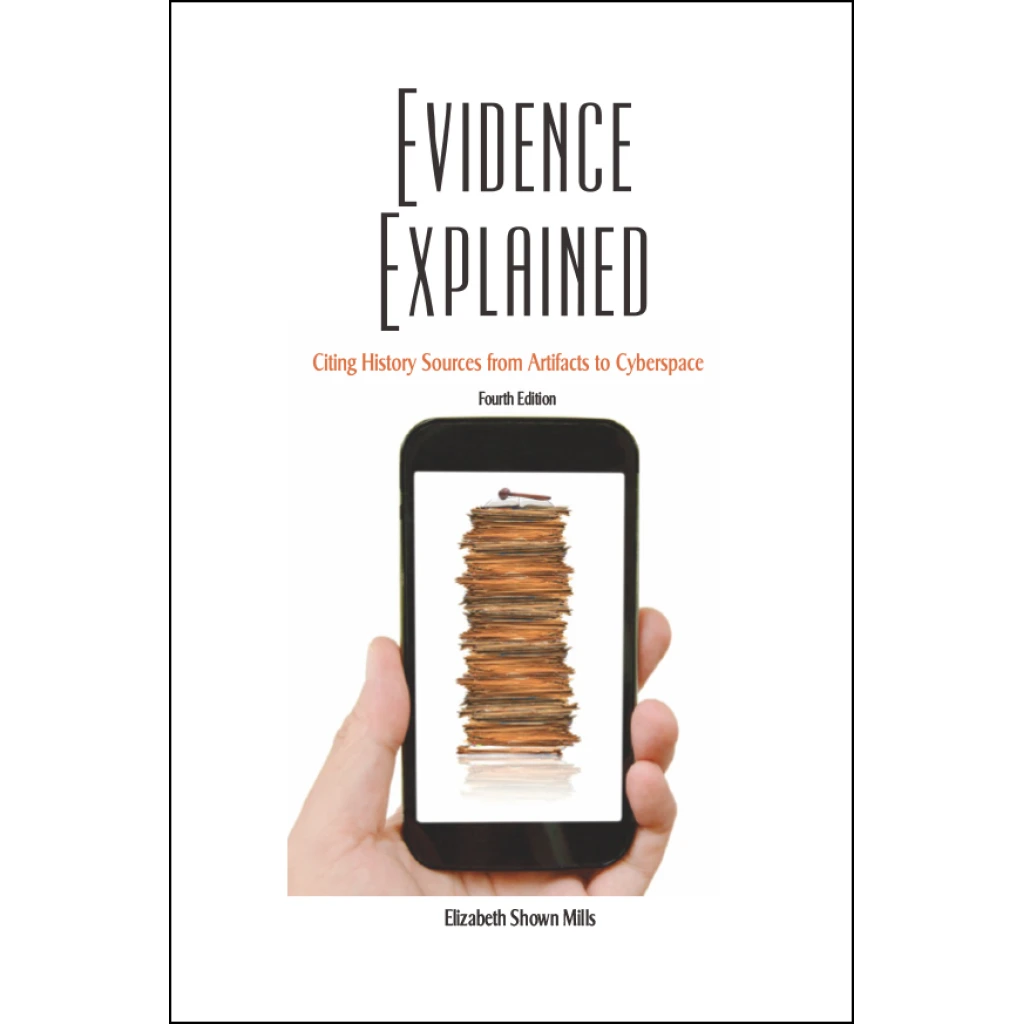
Book Review: Evidence Explained 4th Edition

Author Elizabeth Shown Mills has done a masterful job in revising Evidence Explained, 4th edition, because she's both streamlined and thoughtfully updated the content of this indispensable reference book.

Streamlined and robust

Since the first edition was published in 2007, this has been the gold standard for understanding and citing genealogical sources. 

Actually, it's the platinum standard because of the clear, robust explanations about the wide variety of resources we use to research and document our ancestry. Mills goes well beyond how to cite specific sources--she delves deep into source quality and what that means for the credibility of evidence and, ultimately, the credibility of our conclusions.

What's new?

Here's a look at the contents page:


Note the convenience of 14 citation templates!

Chapter 3 is new in this edition. Instead of printing dozens of sample templates for us to adapt in citing sources, Mills has simplified the examples into 14 templates that become the building blocks of citations. These templates range from basic book and website citation to citing books, magazines, newspapers, databases, authored manuscripts, and even gravestones viewed personally. Easier for readers to understand, easier for readers to implement. 

Mills knows how much information comes from online sources these days, and she carefully demonstrates how to cite such sources. In Chapter 13, p. 624 shows how to cite a video or webinar. In Chapter 15, p. 683 shows how to cite a blog, p. 689 shows how to cite a podcast, and p. 690 shows how to cite posts on social media such as Instagram. You'll even find a page on Generative AI (artificial intelligence) in Chapter 15.

Convenient QuickStart

Don't skip over the grey pages at the front of the book. First is "The Evidence Analysis Process Map," with sources (original or derivative records or authored narrative) that provide information (from an informant who has first-hand, second-hand or unknown level of knowledge) used as evidence for an analysis leading to the genealogical proof of our conclusion. 

Page 1 is a handy QuickStart guide to diving into Evidence Explained, followed by two pages summarizing the basics of source citations, at a glance.

For more about Elizabeth Shown Mills and Evidence Explained, plus tutorials and other bonus material, see her website.

DISCLOSURE: I received a free review copy of this book from Genealogical.com, but the opinions in this review are entirely my own.

Thursday, February 22, 2024

Another Twin Birthday!


Which twin, me or Sis, is standing on the bench (wearing an adorable bonnet) with our Mom in this Bronx playground? 

Who knows?! 

In the photo below, we're lounging in our double baby buggy, waiting to be wheeled through the park and into the playground. 

Celebrating another trip around the sun with my Sis.


Tuesday, February 20, 2024

Bequeath the Story with the Heirloom!


What do you see--maybe an ashtray? Actually, this is an heirloom, and it comes with a story.

My late father-in-law, Edgar James Wood (1903-1986) was a cracker-jack piano player who was proud to be a long-time member of the Hermit Club in Cleveland. Whereas most members had to apply and hope they were accepted, he said (in an oral history interview) he was recruited to join when the former piano player retired.

This was during the the early 1930s, when Ed was dating his future wife (Marian McClure, 1909-1983). Some of the Hermit Club members were also involved in "The Troop," more formally known as the First Cleveland Cavalry, later Troop A, 107th Cavalry, of the Ohio National Guard. 

So Ed joined, too--even though he had never, to that time, ever been on a horse. The Troop assumed its members had no riding experience and geared their training to beginners. Still, Ed and his girlfriend Marian went to a nearby riding academy now and then to get exercise and experience. Ed's Troop commitment lasted about three years, and by that time, Ed and Marian were married and had started a family.

Over the years, Ed remained interested in the Troop, and when it celebrated its 75th Anniversary in 1952, he purchased this commemorative ashtray, which was used only for loose coins. 

From a family history perspective, this is an heirloom with a backstory about a man who was most at home in the city, not on a horse! Without the story, it would be just an ashtray. 

Heirloom is the genealogy prompt for this week's #52Ancestors challenge by Amy Johnson Crow. 

Monday, February 19, 2024

Happy Presidents' Day 2024


In the days when President Lincoln and President Washington were honored with separate Federal holidays on their birthdays, my husband's uncle in Cleveland received these colorful penny postcards from his aunt and uncle in Chicago.

Both of these postcards were sent more than a century ago, part of the Wood family's ongoing plan to stay in touch even when they lived hours away from each other. 

Presidential birthdays were two of many occasions for aunts and uncles to write a line or two to young nieces and nephews!


Wednesday, February 14, 2024

Happy Valentine's Day 1912

My husband's young uncle in Cleveland, Ohio received this delightful penny postal greeting one hundred twelve years ago today. 

It was sent by Rachel Ellen Wood Lewis Kirby(1864-1954), who lived in Chicago.

Nellie signed it "from Aunt Nellie and Uncle Arthur." Actually, her husband was Samuel Arthur Kirby (1860-1939), a barber. Second marriage for both: Nellie had been widowed, Arthur was divorced.

By 1912, the date of this Valentine, Nellie had one child living, a son who sadly died at age 26 exactly three years after his mother sent this card to her nephew. 

Nellie had a great fondness for all her younger relatives and stayed in touch by letter, post card, and visits. Happily, many of her postcards remain in the Wood family today.

Monday, February 12, 2024

Me: 4 Immigrant Grands - Hubby: 1 Immigrant Grand


All four of my grandparents were immigrants from Eastern Europe:

  • Hermina Farkas - b. Berehove, Hungary - arrived with siblings at Ellis Island, as a teenager, joining her parents who had arrived earlier
  • Theodore Schwartz - b. Ungvar, Hungary - arrived at Ellis Island alone, as a teenager
  • Henrietta Mahler - b. Riga, Latvia - arrived at Castle Garden with family, as a teenager
  • Isaac Burk - b. Gargzdai, Lithuania - sailed alone to Canada, later crossed to NY state, in his early 20s
Only one of hubby's grandparents was an immigrant:

  • Mary Slatter - b. Whitechapel, London, England - sailed to Canada alone before crossing into the US, in her mid-20s
Currently, I'm preparing a family history photo book about Mary Slatter and her husband, James Edgar Wood, my hubby's paternal grandparents. Their family backgrounds could not have been more different. Where James's Wood family in America descended from Mayflower passengers and seagoing British ancestors, Mary's Slatter family in England barely survived grinding poverty--and her mother died in a notorious insane asylum. My book will reflect the ups and downs of their lives, the happy times as well as the periods of despair.

It's a privilege to chronicle the perseverance and spirit of these immigrant ancestors, who left their home lands to start a new life in a new country. Without them, and those who came before, we wouldn't be here today.

"Immigration" is the genealogy prompt for week 7 of Amy Johnson Crow's #52Ancestors challenge.

Friday, February 9, 2024

Donating the Hermit Club Book

My late father-in-law, Edgar James Wood (1903-1986) was a long-time member of the Hermit Club in Cleveland, Ohio, a cultural center for music. 

As a young man with a flair for playing the piano, Ed aspired to be a member of this well-known and rather exclusive club, which regularly sponsored musical plays and concerts.

In fact, he had his first date with his future wife at an informal musical evening hosted by a Hermit Club member. He discussed that date in an oral history recording made decades ago, and the member's name is shown in this book.

The Hermit Club's history was written by William H. Thomas, and Ed's copy was inscribed with a dedication by the author (see below).

Now our family is going to donate this specially-inscribed book to give it a safe home in a repository that collects artifacts about Cleveland. Not only will the book be part of the archival collection, so will Ed's connection to the Hermit Club and how it led to romance with Marian Jane McClure (1909-1983).

After approaching two repositories that already had copies of this book, I found a new home for it in the library of Ohio History Connection in Columbus, Ohio.

If you have items in your family history collection that relatives don't want, I urge you to make arrangements to keep them safe before you join your ancestors! For more detail on how and why to donate items, please see my book, Planning a Future for Your Family's Past.

Monday, February 5, 2024

Comparing Bite-Sized Family History Photo Books

Above, two of the bite-sized (6 inch by 6 inch) photo books I made to focus on very specific aspects of family history. I'm quite happy with both of them! Quality is good, color reproduction very nice, lots of customizable options for covers and interior layouts. One is from Shutterfly, which I've used for years, and one is from Mixbook, my first try. 

These bite-sized photo books have been a hit with the younger generation, so I'm sure I'll make more later in the year. One recipient appreciated the pocket-sized book because it was "adorable and informative." Win! 

Shutterfly

At left, the Shutterfly photo book about the WWII military ancestors in my Schwartz and Burk family trees. The six inch square size is measured on the outside covers, from spine to tip. Inside, the pages are 5 5/8 inches wide and tall. This is called an "instant book" on Shutterfly, with 20 pages included in the price of $23.98 with standard hard cover (today's price). Promotions are frequent, so wait for a discount! Professional and long-lasting, I crammed a lot of photos and a bit of text into one little book, and my audience was both pleased and fascinated, rereading and asking questions!

I love Shutterfly's nearly infinite options for customizing every aspect of a photo book, including lots of embellishments like frames for photos and fancy wording like "family." The pages are slightly thicker and have a slight sheen, very easy to read at a glance. It takes time to learn Shutterfly's customizing features, but the results are well worth the learning curve, whether you're making a photo book or some other project (family calendar, etc.). 

Mixbook

At right, the Mixbook photo book about the Mayflower ancestors in my husband's Wood family tree. The outside size is 6 1/4 by 6 1/4 measured from spine to tip of cover. Inside, the pages are 6 inches high and nearly 6 inches wide. This is a "blank canvas" square book, with 21 pages included in the price of $26.18 with standard hard cover (today's price). Definitely watch for a discount! I didn't cram too much into this book, because I was only writing about 5 Mayflower ancestors plus some historical context and naming famous descendants of these ancestors, including President Franklin D. Roosevelt. Very attractive, a quick read and a mini-reference for the younger generation.

Mixbook has somewhat fewer options but also different options, including the ability to quickly and conveniently line up text or photos at top across two-page spreads. It took me less time to learn Mixbook's more intuitive customizing features because of my prior experience with Shutterfly, so the book came together fairly quickly. The pages are slightly thinner and glossier, adding to the polished look. NOTE: Be aware that if you change a Mixbook project within 30 min of ordering, that change will be in your book! 

My preferences

I'm going to go with Mixbook in the future when I make more of these small square books, because its book has a definite size edge over Shutterfly. 

On the other hand, I'm going to stay with Shutterfly for my longer family history books, because I know its customizable features so well.

Which is right for you?

Both are excellent choices for any photo book project, not just a family history project. Both have apps if you prefer to work that way--I use my desktop Mac so I can see every detail without squinting. Really, I like both Mixbook and Shutterfly for photo-heavy family history.

If you've never made a photo book before, I think Mixbook seems a little easier to pick up on your own, with awesome opportunities to customize your project. If you want nearly endless possibilities for colors of page backgrounds, covers, fonts, embellishments, I suggest you consider Shutterfly. Remember that extras cost extra on either site.

Let me encourage you to check out both sites on your own, note the prices of different sizes/types of photo books, and try a book about a favorite ancestor or some other particular element of your family tree--military ancestors, musical ancestors, a black sheep, an extra-special grandma. 

No matter which site you choose, I think you'll be impressed with the quality of the photo book. Just remember to wait for a sale or coupon before you press the "buy" button ;)

Saturday, February 3, 2024

RootsTech Begins on Leap Day


RootsTech kicks off on Leap Day!

Although I won't be at RootsTech in person, I'll be watching presentations from home (maybe in my bunny slippers). So much great online content at no cost!

If you haven't already registered for free, you can do so here.

Then read through the jam-packed listing of events and save sessions to your personal schedule. Above, some of the excellent sessions I'll be attending from home.

I expect to watch some of these sessions live, and the others after RootsTech is over. Maybe I'll watch a few (like DNA sessions) a second time to brush up on specifics. So I'll see you #NotAtRootsTech but on social media, posting about favorite sessions/speakers/handouts. If you're going to be at RootsTech in SLC, I'm looking forward to seeing your photos and posts!

Thursday, February 1, 2024

Newspaper Research Adds Nuance to Family History

As I prepare a new family history photo book about my husband's paternal line, I'm freshening up my research to uncover any new info. 

The last time I wrote a booklet about the family trees of James Edgar Wood (1871-1939) and Mary Slatter Wood (1869-1925) was five years ago. Lots of genealogical content has been digitized since then, especially newspapers being added to databases.

Sure enough, I discovered there's a little more to the story of Mary's Slatter family. I already knew that her sister, Adelaide Mary Ann Slatter (1868-1947), married James Sills Baker on Aug. 23, 1896 in Cleveland, Ohio, as shown in marriage record at top. What I didn't know was exactly where and who was present.

When I searched GenealogyBank for news coverage of Adelaide, I discovered two social items that mentioned Adelaide's father (hubby's great-grandfather) John Slatter (1838-1901). The items are quite similar, so I'll quote from the Cleveland Leader, Aug. 25, 1896, p. 4:

On Thursday evening, a score or more of invited guests assembled at the home of Mr. John Slatter, 433 St. Clair Street, to witness the marriage of his youngest daughter, Miss Adelaide M. Slatter, to Mr. John Sills Baker of Toledo. Mr. Thomas Lees officiated in tying the legal knot. Hearty congratulations were extended to Mr. & Mrs. Baker by their many friends. Supper was served, and the remainder of the evening was devoted to music and a social time. Many choice flowers and presents adorned the parlors. The young couple leave for Toledo, their future home, Saturday morning.

Well, the father hosted the wedding ceremony and supper for his daughter! John had been widowed for the second time the previous year, and worked as a paper hanger. My impression was that his financial situation was rather tenuous. Perhaps the married couple actually paid for their own wedding supper but the father offered his home for the ceremony? I'll never know for sure, of course.

But I'll hold onto the image of a father happily watching his daughter get married. And of course this nuance about great-grandpa John Slatter will be in the new photo book. 

Tuesday, January 30, 2024

Great Aunt Jennie, Gentle Influencer

I absolutely love the in-laws on both sides of my family tree. Today I want to focus on the loving, generous woman who married into my grandmother's Farkas family and became a gentle influencer through the decades.

Jennie [sometimes Jenny] Katz (1886-1974) was born on this day 138 years ago in Malomfalva, Romania. She came to New York in her 20s, and met my great uncle Alexander Farkas (1885-1948) through their involvement in the Kossuth Ferencz Hungarian Literary Sick and Benevolent Society. Alex was one of the founders of this nonprofit group that provided medical assistance, literacy assistance, and burial assistance to Hungarian immigrants in the Big Apple. 

Jennie and Alex married on Christmas Eve in 1916, both 30 years old, with family from both sides attending the wedding. He was in the garment business, she was a talented dressmaker able to copy any style after seeing it in a magazine, no pattern needed. Although the couple had no children together, they were very devoted to family. In fact, it was gentle Jennie who made the suggestion that was a game-changer for her husband's entire family.

It was Jennie's idea to start a family circle that would meet regularly, not just on holidays but all year round. The "charter members" were her husband Alex and his 10 siblings, with their spouses (if any). This family circle evolved into the Farkas Family Tree, a major focal point of social activities starting in 1933 and stretching for the next three decades. The children of charter members became full-fledged members of the tree at the age of 16, even grandchildren ultimately became members, and all enjoyed the camaraderie and food at meetings, year after year, thanks to Jennie's suggestion. 

In 1959, when one of Jennie's nephews was the family tree's historian, he wrote this moving tribute to her:

I would like to dedicate this, my first Farkas Family Tree report, to one of our most ardent members. In her own quiet way, she was probably more responsible than any other in the birth of the Farkas Family Tree. Since the inception of the Tree, I would venture to say that she has been about the most ardent supporter of our organization, and just about the most regular attender of meetings. With great respect and much love, I dedicate this report to Jenny Farkas--AUNT JENNY.

At top is a photo of one pillar at the entrance to the Kossuth Association's burial plot at Mt. Hebron Cemetery in New York, showing Jennie's name. She had been instrumental in making sure immigrants served by the Kossuth Association had affordable burial arrangements, and in planning the entrance gates to the plot. Jennie, her husband Alex, and many in the Farkas Family Tree were buried in this plot.

On this anniversary of Jennie's birth, I want to honor her gentle, loving influence on my Farkas ancestors and keep her memory alive for the future. 

"Influencer" is this week's #52Ancestors genealogy prompt from Amy Johnson Crow.

Wednesday, January 24, 2024

Connecting Family History with History

Yesterday, I pushed the button to order one copy of my latest bite-sized family history project. It's a 6" x 6" photo book about my husband's ancestral connections to five Mayflower passengers. 

Not expensive, not an in-depth project, just a brief take on an important movement in history that had a major impact on Wood family history. I'm forever grateful to a 2c1r who did a deep-dive to follow the Wood lineage back to these Mayflower ancestors.

Before I order multiple copies of the book, I want to be sure it looks the way I envisioned it. Once I have the actual book in my hands, I can examine it carefully, decide on any edits, and then order another single copy to check how the second version looks. Ordering with discount codes, of course ;)

At top, the front cover and spine of my book, the first I've made with Mixbook.com. For the covers, I selected a glossy background with a look of linen texture. Inside pages are light tan background with brown title text and black body text, blue for captions. I found it easy to align headlines and body text on facing pages. Also I learned how to shift pages or photos or spreads when rearranging the order of some content. There are more features to learn, but this was a fun intro to a site I've never used but heard good things about. 


In addition to bite-sized bios of Isaac Allerton, Mary Norris Allerton, Mary Allerton, Francis Cooke, and Degory Priest, I wrote about the social and historical context of the Mayflower voyage. Above, the two-page spread I created to briefly explain the Mayflower Compact, written and signed in November, 1620 as the ship was anchored off present-day Cape Cod. I added the inkwell for visual interest, and used a shadow effect to set off the atmospheric image of the handwritten Compact (not an original, but a later copy).

My book notes that the Compact was signed by three of the five Mayflower passengers in the Wood family tree. (The other two were female and not eligible to sign.) Every schoolchild in America is taught about the Mayflower Compact--now my grandchildren will be able to feel a more personal family-history link to this pivotal event in history. Just as important, this part of family history is less likely to be forgotten in the future.

I can't wait to turn the pages of my book, in about two weeks!


Thursday, January 18, 2024

WikiTree Connect-a-Thon This Weekend

For 72 hours, from Friday at 8 am Eastern US time to Monday at 8 am Eastern US time, WikiTree is holding a worldwide virtual Connect-a-Thon. 

This is an opportunity to "add missing relatives" to the giant, searchable, free family tree on WikiTree.

It's a fun "thon" because we can register to part of teams competing to add the most new profiles to the tree. I'm registered as part of Team L'Chaim, adding both Jewish and non-Jewish ancestor profiles from my line and my husband's line. 

I enjoy the sense of community throughout the weekend, and the opportunity to focus on adding profiles with bite-sized bios to commemorate those who came before. 

I'm also categorizing my ancestors to highlight specific aspects of their lives, such as "48th Highlanders of Canada" for my hubby's renowned bandmaster ancestor, Capt. John Daniel Slatter (1864-1954). If someone is searching for a member of that distinguished Toronto regiment, the category page here shows other profiles already on WikiTree. Ready to connect!

Monday, January 15, 2024

Dr. Martin Luther King at Columbia University, 1961


My hubby was the editor of the Columbia Owl campus newspaper while an undergraduate student at the School of General Studies of Columbia University in Manhattan. 

In 1961, the Owl invited Dr. Martin Luther King, Jr. to speak on the topic of voter registration and civil rights. Several hundred students from area colleges filled the theater to hear Dr. King. The event raised thousands of dollars for the Southern Christian Leadership Conference, an organization devoted to advocating for civil rights. 

Above, my hubby (in dark beard and dark tie) standing next to Dr. King before his inspiring talk. This is one of our family's favorite photos, capturing a special memory as the country celebrates Dr. Martin Luther King Day.

"Favorite photo" is Amy Johnson Crow's #52Ancestors prompt for this week. 

Friday, January 12, 2024

Book Review: "The Last Ships from Hamburg"

Written by historian Steven Ujifusa, The Last Ships from Hamburg traces the rise and fall of Hamburg as a port of hope, profit, and humanity, a jumping-off place for Jewish people and other immigrants seeking to make a new life in America. 

The main focus: the lives and business decisions of wealthy Jewish men in Germany and America who shaped the steamship industry into a well-oiled machine of immigration through East Coast ports of the United States, and beyond. With big money involved, even titans of industry who disliked Jewish execs were willing to do business with them, up to a point.

The narrative is lively and moves along at a good clip, drawing readers in by revealing fascinating personal/professional details about the powerful families that paved the way for immigrants to get out of Russia. It also puts a human face on those fleeing the Russian empire, tracing their difficult journeys to Hamburg, agonizing waits to board ships, even more agonizing waits at Ellis Island. Ujifusa also discusses the reality of American life for many new arrivals, crowded into tenements in the Lower East Side of Manhattan, barely scratching out a living with pushcarts or hunched over sewing in sweat shops. 

Ballin, Schiff, Morgan

The Hamburg-American Line's managing director and visionary leader was Hamburg-born Albert Ballin, a Jewish man who cultivated ties with Kaiser Wilhelm and other bigwigs of Germany, England, and the United States. In building up the Hamburg-America Line, he created a transportation network that brought immigrants (including Russian and Eastern European Jews) to Hamburg, screened them for health problems that might cause them to be rejected at Ellis Island, even offered kosher meals on his steamships. In fact, ticket sales to immigrants were absolutely essential to the financial stability of the Hamburg-America Line. 

Jacob Schiff was the Frankfurt-born managing partner of Kuhn, Loeb & Co, an influential US investment bank that advised powerhouse transportation firms like the Pennsylvania Railroad and the Union Pacific. In addition to being a major Jewish philanthropist, Schiff fought against the anti-immigration movement that gripped America even as persecution and pogroms threatened the lives of Jews in Russia leading up to WWI.

J.P. Morgan helped bail out the US government when it was under pressure because of dwindling gold reserves in 1895. He was a master of combining companies into giant trusts that competed on a massive scale. Although his businesses had to coexist with Jewish-managed company competitors, he disliked Jews. Yet his International Mercantile Marine shipping trust, a major player in the shipping and transportation industry, ultimately forged a deal with Albert Ballin's Hamburg-America line, to the benefit of both firms.

Crossing to safety

The book also tells the nail-biting story of hundreds of thousands of Jewish families who sailed to America from 1881-1914. Often these folks couldn't legally leave Russia, so Hamburg-America facilitated border crossings. In effect, two steamship lines were allowed to privatize the Russia-Prussia border station. They allowed immigrants with tickets for America to pass through, then moving to inspection stations for screening and fumigation. These immigrants were ultimately able to cross the pond, cheering at the Statue of Liberty as they entered New York Harbor to start over. Among the prominent descendants of Jewish immigrants are Lauren Bacall, Fanny Brice, David Sarnoff, Sam Goldwyn, and many more, including the author's great-grandparents.  

My ancestors were among the many who left Eastern Europe and crossed the Atlantic to safety before World War I. The book cites 1907 as the peak year for European immigration to America, with more than a million newcomers passing through Ellis Island. However, as the final chapters chronicle, anti-immigration sentiment among powerful US legislators and the social elite increased the pressure to slam shut the door to new arrivals. By 1923, Congress had passed new laws that made it all but impossible for immigrants from Southern and Eastern Europe to make it to America. 

Ups and Downs of the Hamburg-America Line

Because I have ancestors who boarded Hamburg-American ships in Hamburg or Cuxhaven, I was particularly interested in the mechanics of getting immigrants from one place to another. The author explains that Russia, in particular, didn't make it easy for anyone to leave...officially. But the Hamburg-America line had agents who could help immigrants with steamship tickets to cross borders, get to ports via railroad or other transportation, and find them decent shelter until their ships departed. 

My ancestor, Bela Roth (1860-1941), brother-in-law to my great-grandmother, left Hungary for New York City twice on ships of the Hamburg-American line. In 1907, he and his family sailed from Hamburg to New York aboard the fairly luxurious Kaiserin Auguste Victoria, a Hamburg-America ship originally launched in 1889 with great fanfare, as this book describes. 

Also in the book is the story of the Hamburg-America's SS Vaterland, which made its maiden voyage from Cuxhaven to America in May of 1914. My Bela Roth, a merchant, sailed with his family on the same Vaterland from Cuxhaven to New York in July of 1914. This time, he remained in New York, declaring his intention to apply for citizenship in 1917. 

The Vaterland was a sleek, speedy ship that, on August 1, 1914, happened to be docked at Hoboken, New Jersey when Germany and Austria-Hungary declared war on Russia in the aftermath of the murder of Archduke Ferdinand and his wife, Sophie, Duchess of Hohenberg.

With the onset of war, thousands of immigrants were stranded in German ports, holding tickets for America. The author describes the desperation of the steamship lines, trying to stay financially solvent, and the scrambling of Jacob Schiff and others trying to get Jewish people out of the Russian Empire without the convenience of the usual German ports. It was the end of an era in so many ways.

If you have immigrant ancestors who sailed to America during the period of 1881-1914, especially if they were leaving from Russia or Eastern Europe and arriving on the East Coast, I heartily recommend picking up this book. See Publishers Weekly write-up here.
Tuesday, January 9, 2024

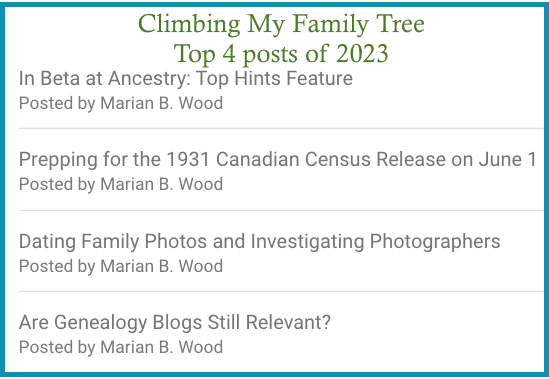
Top Four Blog Posts of 2023


During 2023, I wrote 117 posts. These four had the most views of the year:

  • In Beta at Ancestry: Top Hints. Read the full post here. I was interested in testing this new Ancestry feature, which were designed to show hints that "will help you make better discoveries." Well, no more top hints, only hints on Ancestry. The usual hints, organized according to all hints, record hints, photo hints, story hints, tree hints, and 1950 US Census hints. I do check hints on occasion, when I'm focusing on a particular ancestor, but I don't go systematically through the thousands of hints for each tree.
  • Prepping for the 1931 Canadian Census Release. Read the full post here. Good info for planning, and putting Census answers into context. Rather than try to find elusive Canadian ancestors through searching by home address, I waited for indexing and easily found most of my targeted ancestors. As Gail Dever recently noted, the 1931 Canadian Census is now fully indexed and conveniently searchable (with multiple variables) on FamilySearch. 
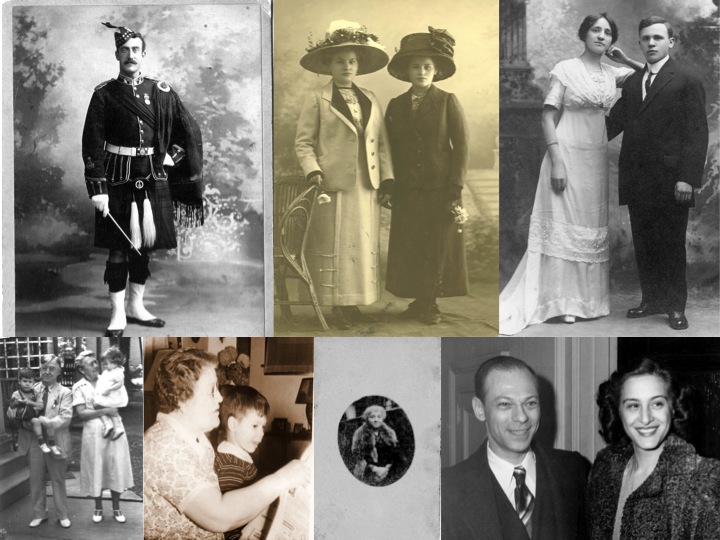
  • Dating Family Photos, Investigating Photographers. Read the full post here. I've tried the MyHeritage PhotoDater on multiple photos and I like how it attempts to narrow the range of years, giving me a bit of a headstart. I still like researching photographers like Beldegreen, who took many of the photos of my immigrant maternal grandparents.
  • Are Genealogy Blogs Still Relevant? Read full post here. This is my 16th year of genealogy blogging (and my 26th year of researching family history). Yes, I definitely think genealogy blogs remain relevant, even in this era of videos and short-form social media platforms. As I said in my August post, I sincerely appreciate the genealogy bloggers who have been offering tips and tricks and stories and more. You all inspire me to keep digging and keep blogging.