Monday, January 29, 2018

Testing Ancestry's "We Remember" Site

Ancestry has a new site in beta, "We Remember." A few days ago, I gave it a try. First I had to log in (using either Ancestry or Facebook user/password combo). After several aborted tries with Firefox, I switched to Chrome as my browser and was able to proceed. The interface was sluggish in both browsers, but presumably this will change over time.

At top, the memorial after I entered the requested info:

- Name of person (Dorothy Helen Schwartz)
- whether MD, Ph.D., etc. (this info doesn't appear on the memorial, not sure why)
- full birth and death dates (NOTE: only birth year and death year appear on the memorial)
- city and state/country of death (doesn't appear on memorial, not sure why)
- 250 words about her (plus an obit, if available)
- indicate whether she was family, friend, etc.

Next, I was asked to submit an obit if desired and write a "memory" of my aunt, including a photo of my choice. Alas, my first "memory" and related photo disappeared. The next memory was successfully saved and appears on Dorothy's public memorial page.

What do I think of "We Remember" so far? This will be my only attempt unless and until the interface is speedier and more reliable. Also, I believe all the requested info should appear in full on memorials. Why not show full birth and death dates rather than simply truncate to year only? Why not show MD or Ph.D. on the page? My aunt was justifiably proud of her Ph.D., and I had to mention it in the memorial text since it doesn't show after her name in the title.

Why the 250-word limit for the bio on the memorial page? This isn't Twitter--it's supposed to be a memorial, and no meaningful bio can be squeezed into so few words. In some views of the memorial, no middle name or initial appears--which can make it tough to locate just the right person. Again, I can't imagine the reason for this limitation.

I'm not sure that setting up "We Remember" memorials will do anything more meaningful genealogically than my Ancestry trees, my Find a Grave memorials, and my blog posts. But I'm willing to be convinced if the interface improves, the presentation of details is expanded, and a chorus of other genealogy enthusiasts find some value in this site.

Sunday, January 28, 2018

52 Ancestors #5: The Genealogical Bonanza of the 1950 Census

1950 US Census Form
It's hard to believe the bonanza of information waiting for genealogists when the 1950 Census is released in April, 2022. You can download the blank form for yourself here.

And the 1950 Census release is only 50 months away. But if I'm really, really lucky, some of my ancestors were chosen as a "sample" to answer in-depth questions! You'll hope your ancestors were "sampled" too when you realize what's "in the Census" (the title of Amy Johnson Crow's #52Ancestors challenge this week).

One in five people were chosen as a "sample" to answer detailed questions like (1) Where was this person living in 1949 (farm or not, same county/state, same house)? (2) Where were mother and father born (country)? (3) Highest grade of school completed? (4) Individual and household income--separate questions for work income, other income from interest and benefits--number of weeks worked/looking for work? (5) Military service in WWI, WWII, or other time?

And that's just the sample questions. The Census itself required enumerators to list each household with the head first, followed by his wife (I know, I know, it was the 1950s, don't blame me!), and children in age order, followed by non-family members living in the household. And the relationship of non-family members to the head was supposed to be listed too!

Age and state of birth (or country) is listed for each person. Importantly, if age is under one year, month of birth will be listed. Married, divorced, never married, widowed, separated. And wait, there's more. For each person over 14, the enumerator had to describe the kind of work and the industry worked in.

I'm particularly interested in ancestors who died not long after the 1950 Census. For instance, my great aunt Dora Lillie Mahler (1893-1950) died only a couple of months after the Census was taken. Another great aunt, Nellie Block (1878-1950), died that December.

Where were they living? What were they doing? Since NYC has not made 1950 death certs available (a decision being challenged by the wonderful folks at Reclaim the Records), I have only their brief obits for now. As you can see by the details in the 1950 Census, I'll know a LOT more about them in 50 months. Happily, I have a good idea of which Enumeration Districts to check when the Census is released. And I can hardly wait.

Saturday, January 27, 2018

International Holocaust Remembrance Day: The Schwartz Family of Ungvar

My grandfather (Tivador "Teddy" Schwartz, 1887-1965) was the first in his family to come to America from the family's home in Ungvar, Hungary (now Uzhhorod, Ukraine). The next to arrive was my great uncle (Samuel Schwartz, 1883-1954). These two brothers saved their nickels and helped pay for one of their younger sisters to come in 1906 (Mary "Marushka" Schwartz, 1891-1959).

Their parents, Herman Yehuda Schwartz and Hani Simonowitz Schwartz, stayed behind in Ungvar, along with a number of siblings. Separated by thousands of miles, the family stayed in touch with letters and photo cards like the one at top, which shows four Schwartz siblings in Ungvar in 1915.

By the time of World War II, the parents had passed away but the siblings who remained in Hungary all were grown and had families of their own. None but Tivador, Sam, and Mary ever moved to America.

I'm very sad to say that those who remained behind were killed during the Holocaust, with one exception: my grandfather's niece, Viola Schwartz. According to her video testimony, found through the U.S. Holocaust Memorial Museum among other repositories, she was an eye witness to the tragedy that everyone else from the Schwartz family had been rounded up and sent to concentration camps, where they--like so many Jewish families-- perished.

On this international day of remembrance, my post honors the memory of my Schwartz ancestors and all others who were killed during the Holocaust. I feel a great sense of loss for who they were and who they and their descendants might have become. And I want to pay loving tribute to the Schwartz survivor, my cousin Viola, a strong and courageous woman.

Never forget!

Sunday, January 21, 2018

52 Ancestors #4: Inviting GGM Elizabeth Rinehart Steiner to Tea

In this 4th week of Amy Johnson Crow's #52Ancestors challenge, "Invite to Dinner," I want to invite my husband's maternal great-grandma, Elizabeth Rinehart Steiner, to tea.

This matriarch grew up in a pioneering family, and I'd like to ask about her daily life, her dreams, her happiness, her disappointments, her thoughts of the future, and her view of the past.

Elizabeth was born on 18 February 1834 in an area later organized into Ashland County, Ohio. No official record of her birth can be found. She died on 4 November 1905 in Upper Sandusky, Wyandot County, Ohio. The Probate Court there hasn't located her death record. I do have two obits that offer a lot of clues to Elizabeth's life.

Elizabeth married hubby's maternal great-grandpa Edward George Steiner (1839-1880) on 7 August 1851, at age 17, in Crawford County, Ohio. (The obit has the year incorrect--I have the marriage license from 1851, and it indicates Elizabeth needed her father's permission to marry.)

Together, they had 9 children. Their first two children died young, unfortunately. My husband is a grandson of their ninth child, Floyda Mabel Steiner.

There are so many questions to ask GGM, but I'll limit myself to six since this is, after all, tea time:
  1. What was it like growing up as the daughter of a pioneering family in the 1830s? 
  2. Were the family stories true: Rinehart and Steiner were supposedly from Switzerland? Or were they from Germany or Austria or another area?
  3. How did you meet your future husband, and what kind of life did you envision with him?
  4. Is the family story true: that you chose the name Floyda for your youngest child because you were hoping for a boy after five boys in a row?
  5. What did you think of the Suffrage Movement and the idea of women gaining the right to vote?
  6. Of all the changes you witnessed and experienced in your 71 years of life, which most surprised or astonished you, and why?

Saturday, January 20, 2018

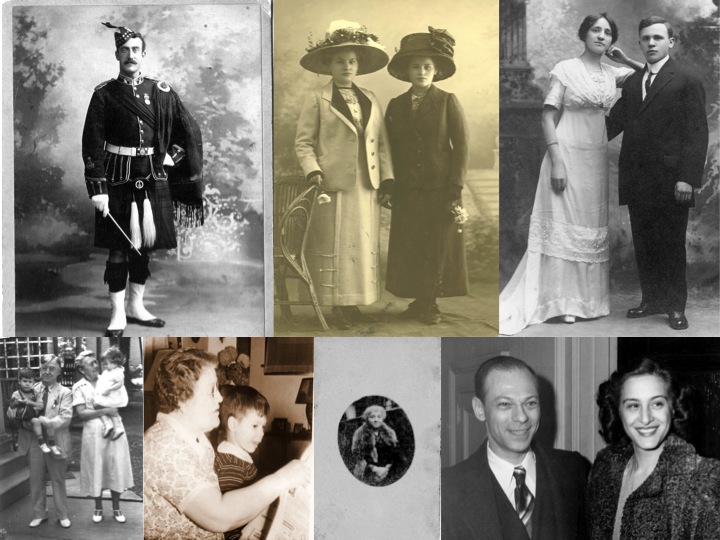
Family History Lesson From My Maiden Aunt

My paternal great aunt Nellie never married, had no children. But lately, I've been thinking about her importance in my family's history. She was the older sister of my grandpa Isaac Burk, born in Gargzdai, Lithuania. Nellie, Isaac, and four other siblings came to North America around the turn of the 20th century. Researching them has taken me 20 years, in part because I began with nothing except Isaac's name--and in part because there were so many different spellings of the family's surname.

Five of the six siblings married within a few years after they left Lithuania. Only Nellie never married. Here are the six siblings, listed in birth order.
  • Abraham Burke (1877-1962) (aka Berk) - later married, had children
  • Nellie Block (1878?-1950) - never married, no children
  • Isaac Burk (1882-1943) (aka Birk) - later married, had children
  • Meyer Berg (1883-1981) - later married, had children
  • Jennie Birk (1890-1972) - later married, no children
  • Max (Motel) Birk (1892-1953) - later married, no children

Nellie is the lady in lace, shown in the center of the photo at top with one of her brothers, probably Meyer, and her younger sister, Jennie. Below, Nellie's obit has Grandpa Isaac's name incorrect, but it's definitely hers. (I'm still looking for her burial place.)

Why is Nellie's story important to the family history? She seems to have been the first of the Burk siblings to come to North America, before 1900. (I'm still looking for her name on a passenger list.) I don't know how many unmarried young ladies were the first in their families to cross the Atlantic and live in a big US city. (Nellie was a boarder in other Jewish families' apartments, usually, not living on her own.) Why and when did she leave home?

Nellie was already in Manhattan by 1904. Grandpa Isaac listed her as the relative he was coming to see when crossing from Canada to New York. He had left Lithuania and gone to Manchester, England, then sailed to Canada, and finally entered America, saying he was coming to his sister Nellie. Yes, chain migration.

I believe I've found Nellie in the 1900 Census, 1905 NY Census, and 1910 Census. I have her as the addressee of a 1930s wedding invitation sent by a cousin in England. And I see her face in my parents' wedding photos, circa 1946. She was wearing a corsage and standing next to her brother Meyer and her brother Abraham, an honored guest at the marriage of her nephew--my father.

The lesson I draw from my maiden aunt's life is that every person in the family tree has an influence on the family's history. She was present at family gatherings, she touched the lives of parents/siblings/nieces/nephews/cousins, and she influenced the course of family history in ways I may not even know about.

Was Nellie responsible for blazing the trail out of the old country? I don't know for sure, and it seems a bit of a stretch to assume she left first. But I do know she was part of her brother Isaac's decision to cross from Canada to America--and, ultimately, that decision led to his getting married, raising a family, and my parents getting married. I owe this maiden aunt a great debt of gratitude!

Sometimes people say that since they have no descendants, their family history isn't really important to anyone. I disagree. Nellie (and her brother Max and sister Jennie) prove the importance of every story to the family's history. Each person played a role in family dynamics, each story adds texture, detail, and context to the overall family history.

Because Nellie, Max, and Jennie had no descendants, it's up to me as the self-appointed family historian to keep their memories alive. My second cousins have filled in a lot of the blanks. As the months pass, I hope to discover even more clues to their roles in the immediate family and in other related families.
Wednesday, January 17, 2018

52 Ancestors #3: Which Grandparents Lived to Meet Their Grandchildren?

For week 3 of Amy Johnson Crow's latest #52Ancestors challenge, titled "Longevity," I'm looking at which grandparents outlived the other, and who in each couple got to meet their grandchildren.

At right, my maternal grandparents in 1911, the year they married: Hermina Farkas (1886-1964) and Theodore Schwartz (1887-1965). Although Grandma Minnie and Grandpa Teddy both died at the age of 77, Grandpa Teddy had longevity on his side: He passed away just a few days short of his 78th birthday. Minnie and Teddy got to meet all five of their grandchildren.


At left, my paternal grandparents in 1937, at the wedding of their younger daughter. They were Henrietta Mahler (1881-1954) and Isaac Burk (1882-1943). Grandma Yetta died at 72, while Grandpa Isaac died at 61 (well before my time). Isaac never met any of his five grandchildren; the first grandchild was born the year after his death, and named in his honor. Yetta knew all but one of their grandchildren, missing the youngest (named in her honor) by only a year.

At right, my husband's maternal grandparents:
Brice Larimer McClure (1878-1970) and Floyda Mabel Steiner (1878-1948). Granddaddy Brice died just shy of his 92nd birthday, while Grandma Floyda died at 70. Brice's longevity meant that he got to meet all three of his grandchildren but not all of his great-grandchildren.
At left, my husband's paternal grandparents: James Edgar Wood (1871-1939) and Mary Slatter (1869-1925). Sadly, Grandma Mary was only 55 when she passed away, and none of her children had yet married. Grandpa James died at 67, having met two of his three grandchildren--who were then tiny tykes.

Saturday, January 13, 2018

Chicken Post or Egg Post?

Genealogy blogging feels like a chicken or egg thing.
  • When I want to write a post, I research someone or try a new research tool. (Chicken post)
  • When I research someone or learn a new research technique, I want to write a blog post. (Egg post)
Which comes first? It depends on what I want to accomplish. Chicken or egg, I always learn something.

During January, I'm participating in Amy Johnson Crow's #52Ancestors challenges, which will provide blog prompts and ideas every week. Weeks #1 and #2 are crossed off my list already. Only 50 more to go, meaning I'll be doing more research on 50 more ancestors. These are chicken posts ;) And I'm participating in the Genealogy Blog Party, which is hosted by Elizabeth O'Neal--more prompts to give me ideas for chicken posts.

Other bloggers also inspire me. I've been reading Janice Sellers' "Events in my family tree" series. And reading Randy Seaver's occasional posts about using RootsMagic features. These gave me the idea for a chicken post, a post where I start by wanting to write and use that as the impetus to learn something or research someone.

I originally wanted to find something timely in the family tree to write about. To do that, I had to learn how to use my RootsMagic "calendar report" function, which I've never investigated. With multiple family trees, I need multiple calendars.

The software allows me to check a box and get a calendar with only living people, as a reminder to send birthday or anniversary greetings. However, I wish the software would also let me check a box and have no living people on the calendar.

The results: My maternal Schwartz tree calendar for January has a few birthdays and wedding anniversaries. My husband's Wood tree for January is so crowded with names and occasions that the software had to print more than 20 names and dates on a separate piece of paper! This makes sense, since his tree has more than 2,700 names, and my maternal tree has fewer than 1,000 names.

On January 13th, the Wood tree shows the marriage of Thomas Short and Margaret Larimer, 176 years ago. I have Margaret's death date, not her birth date (still can't find it, despite an hour of searching this morning), and I have Thomas's birth date but not his death date (still can't find it, darn it). They're on my list to continue researching.

But as part of my research into these two Wood ancestors, I tried out the search function of Elephind, that wonderful free newspaper website--it's searchable from the home page!

In addition, I forced myself to search using the new Find A Grave interface, which I dislike. Unfortunately, no sign of Thomas and Margaret, but at least I'm getting used to the new interface. A little.

This is what a chicken post looks like. I also like egg posts. Both are fun and keep me excited about #genealogy blogging.