Friday, June 3, 2022

One Ulysses in the Family Tree


My husband's family tree has a number of ancestors apparently named after famous people in American history. Only one person in the tree was named for a general well known for his role in winning the bloodiest conflict ever on American soil. Little historical tid-bits like this help get the younger generation interested in our family's history!

Benjamin Franklin (inventor and statesman)

Two men with this name: 

    - Benjamin Franklin Steiner, 1840-1924

    - Benjamin Franklin Smith, 1794-1835

George Washington (first US President)

One man with this name:

    - George Washington Howland, 1855-before 1884

John Quincy (Adams - sixth US President)

Two men with this name:

    - John Quincy Steiner, 1862-1941 (a son of Benjamin Franklin Steiner)

    - John Quincy Steiner, 1894-1909

Thomas Jefferson (third US President)

One young man with this name:

    - Thomas Jefferson Isaiah Haskell Wood, 1848-1861

John Marshall (early Chief Justice of US Supreme Court)

One young man with this name:

    - John Marshall Taber Wood, 1850-1859

Ulysses (Grant - Union General, then US President)

The only boy in the Wood family tree named Ulysses was born just a few months after Confederate General Robert E. Lee surrendered to Union General Ulysses S Grant in 1865. Grant was later elected as the 18th US President, serving two terms from 1869 to 1877.

    - Ulysses Larimer, born on September 1st, 1865, died on August 18th, 1870. 

Little Ulysses Larimer was buried in Brown Cemetery, Millersburg, Elkhart, Indiana, with other members of his family.

--

This is my post for Amy Johnson Crow's #52Ancestors challenge, this week with the theme of "conflict."

Monday, May 30, 2022

Why I'm Staying with FindaGrave


Despite the many criticisms of FindaGrave.com, I'm sticking with it. 

There are valid criticisms, to be sure, as this post by "Legal Genealogist" Judy Russell shows. Rather than throw the baby out with the bath water and stop participating because some volunteers misuse FindaGrave, I'm choosing the other path. 

I'm doubling down to improve the memorials of ancestors and in-laws in my family tree and my husband's family tree. 

The site, now owned by Ancestry, is completely free and available worldwide. 

Not every cemetery on the planet is represented, and certainly not every burial site or columbarium. 

Still, FindaGrave has long been a convenient site for me to memorialize ancestors, link relatives to other family members, and create virtual cemeteries so I can share with my own family. It's genealogy but it's also a whole lot more.

On Memorial Day and Veterans' Day, I like to leave virtual flowers or flags on the  memorial pages of ancestors (mine and hubby's) who served in the military, honoring their memory and service. 

Above, three generations of my husband's Larimer cousins who served their country, one in the Union Army, one in World War I, and one in the Korean and Vietnam Wars.

All were memorialized on FindaGrave by other volunteers who took the time to photograph grave stones and list the names. Picking up from there, other volunteers (including me) have linked these men to their spouses, parents, and children, and in some cases, written bite-sized bios to add more detail about their lives. 

In my view, virtual memorials help keep alive the names of these ancestors and make info about their burial places (and their lives) discoverable for anyone doing a search. 

For me, this is a great way to share family history now and to publicly show my respect for those who came before me. That's why I'm staying with FindaGrave, despite the ongoing and quite valid criticisms and definite need for improvement. I will also add my voice to the chorus letting Ancestry know about the need to take action and address misuse of its FindaGrave platform.

Thursday, May 26, 2022

Yearbook Photos of Ancestors Who Served in the Military

This is a combination post for Memorial Day 2022 and for this week's #52Ancestors prompt of "yearbook," honoring two ancestors who served during World War II.

My Aunt, the WWII WAC 

My aunt, Dorothy Schwartz (1919-2001), served overseas as a US Army WAC in World War II. 

Dorothy and her twin sister Daisy Schwartz (my Mom, 1919-1981) graduated from James Monroe High School in the Bronx, New York, in January of 1936. 

This was the same south Bronx high school attended by their older brother Frederick (see below).

When World War II broke out, Auntie Dorothy was attending Hunter College in Manhattan. 

She enlisted in the Women's Army Corps on September 11, 1942, and later was promoted to become Sgt. Schwartz (see photo at right). 

Dorothy was awarded the Bronze Star for "meritorious service in direct support of operations against the enemy." Back in civilian life, she finished college, went to work, then returned to school for education courses and became a high school teacher.

My Uncle, the WWII Army Teacher

My uncle, Frederick Schwartz (1912-1991), graduated from James Monroe High School in the Bronx, New York, in June of 1928. He was only 16.

He worked part-time as he went to college, aiming to become a high school teacher.

By the time Uncle Fred was drafted into the US Army on Nov 10, 1943, he was teaching at Stuyvesant High School in New York City. He was also married with a baby just a few months old.

Following basic training, much of Fred's three years in the US Army was devoted to teaching. At the end of the war, he held classes teaching soldiers how to navigate the Army system to receive benefits and apply skills to civilian life. 

I dedicate this post to my aunt and uncle, with affection and gratitude for their service.

Tuesday, May 24, 2022

Open Mic Night: Challenges Faced by Genealogy Groups


Friday night's #GenChat on Twitter was an open mic hour of chat about genealogy and family history and related topics. 

One tweet kicked off a spirited conversation that has continued with additional comments posted for several days, and from multiple countries:

Does anyone else who volunteers with a historical & genealogical society struggle to find volunteers? I have been volunteering at a society for 4 years now as trustee and they have not gained any new volunteers.

This is not a new challenge, to be sure. During the pandemic period in particular, some groups are struggling while others have tried to adapt to remain relevant in a changing world. Lots of groups have had this conversation internally. #GenChat's discussion was impromptu, not structured and has attracted additional tweeted comments in recent days.

During the wide-ranging discussion, some tweets mentioned an entrenched "old guard" of officers unwilling to try new ideas. Other tweets observed that younger people often don't feel welcomed by older members. Still other tweets noted the need for new blood and new outreach techniques. 

You can read most of the comments by looking for #GenChat hashtag on Twitter, with posts dated May 20 and later. Some posts don't have the hashtag, so here are an even dozen representative comments about the challenges of keeping genealogical and historical society groups alive and well. 

Tweets from the discussion

"...Sometimes there is problem of “old heads” running off “newbies” — refusing to try new ways or ideas — or just not relinquishing reins where they should. Great way to kill an org."

"It is worlds easier to collaborate and help from a distance than ever before! (Whether that distance is across the country or just across town.) But too many genealogy societies insist on not trying anything new."

"At the last [genealogy] fair I went to there was one group that seemed to hold everyone's attention but wouldn't talk to anyone outside the group."

"I hear from so many younger genealogists that their societies aren't welcoming. How do we bridge the gap?"

"Societies, overall, are *way* too passive in recruiting volunteers. They don’t ask specific people, nor do they have good job descriptions. “We need volunteers for XYZ project.” Ok, but what will they *do* and what skills and time commitment are required?"

"Common issue. Many [genealogy groups] were founded at a time when working patterns were different. Today, some feel unwelcoming. I feel there will be big changes in the next few years. Some will go, some will merge, experiments with different platforms. Big societies and hyper local ones."

"My local society has trouble finding volunteers for committee chairs and the board officers but [people] are willing to volunteer for one-off jobs all the time." 

"I think some may be somewhat hostile to trying new things too, i.e. using social media to promote themselves and get the word out about their organization. I remember seeing a family history society that had ZERO social media presence."

"A lot to learn from attachment theory. People feel attached to what they have, changing it elicits a grieving process which people try to avoid because it is painful. How do we acknowledge and work through it?" 

"If a society is trying to draw members only through programming, they’re doomed. Instead, they need to show why they are unique, why they are *valuable* to the public. They go broad, when they should be going deep."

"Unique and value are the key words. Some "deep" specialized societies have great member resources not just interesting programs. Some "broad" clubs demonstrate value via networking, mentoring, more. Need to articulate real benefits to attract people & volunteers."

"Maybe not enough people understand the importance of knowing and preserving their history. They need to understand their history connects them to the global world."

What do you think? 

This is a huge topic, and while the #GenChat hour only scratched the surface, it got people thinking and commenting about challenges and opportunities.

Please join the conversation by leaving a comment on my blog or by tweeting using the hashtag #GenChat so we can all read and chime in!

Sunday, May 22, 2022

1950 US Census Hints: Filter by Name


In the weeks since Ancestry.com began delivering 1950 US Census hints to my family trees, I've been enjoying the convenience of reviewing and adding this information to ancestor profiles.

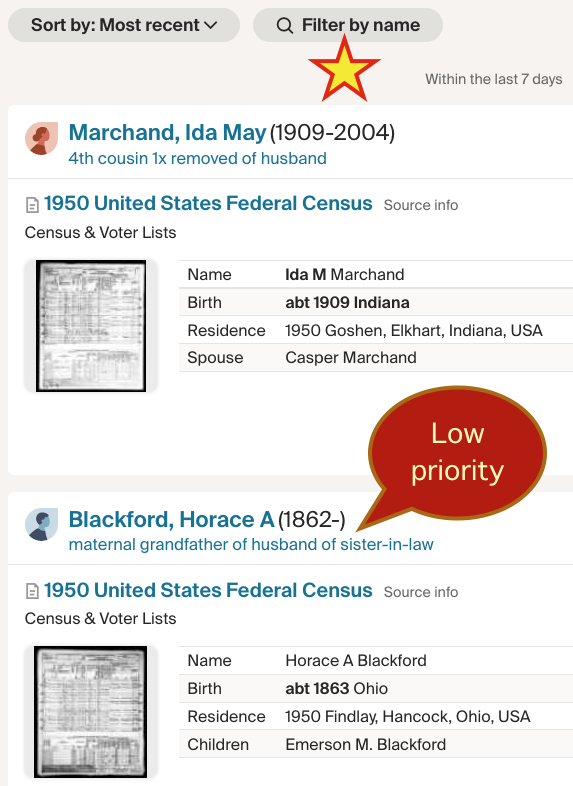
By now, there are LOTS of hints. The default hint arrangement is by most recent hint added to my list.

But at this point, I'm being choosier about who I want to see first.

As shown above, Blackford is a recent addition to my hint list, but a low priority because the relationship is quite distant. Maternal grandfather of husband of sister-in-law! Not a high priority.

To see more of the people I care more about, I'm going to filter my 1950 US Census hints by name (see star at top). Then I can specify the closer ancestors I want to see first (see image below).

Filter by first name or last name or both

Later, I'll go back and review the remaining hints for distant ancestors.

Hope you're having fun finding ancestors and the FAN club (friends, associates, neighbors) in the 1950 Census. 

Thursday, May 19, 2022

What's Wrong with This Picture?

One of the most famous gravestone typos of all time is on a stone at the Old Mission Cemetery in Upper Sandusky, Ohio. 

My hubby's grandparents are buried in Old Mission (Brice Larimer McClure and Floyda Steiner McClure), which is how we happened to see and photograph the headstone shown here.

Can you spot the mistake?

The Find a Grave memorial for Christiana Haag offers more info here.

In my family tree, the headstone for a great uncle shows an incorrect date--a discrepancy I discovered when I obtained his death cert. 

This stone with a typo is a great reminder: Even if a name, date, or age is "carved in stone," we still need to check and confirm!

This photo is, as my friend says, "a grave mistake."

Tuesday, May 17, 2022

Curating and Sharing Old Family Photos


This week I've been moving "old" family photos into archival photo albums. The ultimate goal is to encourage relatives to page through the albums now and then.

Currently, I'm sorting and arranging hundreds and hundreds of snapshots from the more recent past--meaning 2010 back through the 1960s. I'm saving the very oldest photos for last, because I'll be using a different kind of photo album for those odd-sized prints.

Happily, most of the photos have the month and year of development auto-printed on the back (as shown at top, left) or on the front border. This is a big help in sparking memories about who, what, when, where, and why, for captioning purposes.

There are a LOT of near duplicate photos, for a very good reason. In the pre-digital age, we would often take two or even three photos of the same person or scene, because we weren't always sure which would come out well (if any). That's why there are SO many photos to reorganize into albums.

As I sort through the photos, I'm curating by:

  • Tossing out of focus or very poor quality photos, like the one at top right. 
  • Saving only one of exact double and triple prints, sending most of the dupes to relatives as a surprise.
  • Putting the best photo in the album and inserting a near-duplicate underneath the best print. The near-dupe isn't visible but it's available in the album, if I don't send one or more to relatives right now ;)
Curating doesn't take much time but it will focus attention on the most important photos from our family's past. It also means the albums will not have too many multiple versions of the near-same photo. 

Plus it's fun to share the dupes and near-dupes with relatives now--and it gets a conversation going about family history.

I may even create a few photo books with themes such as weddings, graduations, or holidays, featuring different ancestors and relatives through the years. It's another way to keep alive the memory of our ancestors, gone but not forgotten.

Saturday, May 14, 2022

Saving Family Letters for Future Generations

My aunt Dorothy Schwartz (1919-2001) was a prodigious correspondent, writing monthly letters to relatives near and far. 

I have dozens of letters and a few postcards written to one of her nieces, dating from the early 1980s and continuing until shortly before her death nearly 20 years later. 

"Auntie" wrote of life after retiring from her teaching career, about her travels, about being in touch with relatives, about her health, and more.

I found some really interesting family history tidbits in her letters. Did Dorothy's grandpa Moritz Farkas (1867-1936) play favorites? Dorothy says Moritz's oldest daughter was his favorite--even though another of Moritz's daughters insisted she was always the favorite. And that's just one example.

Put a sleeve on it

Yesterday I finished carefully unfolding and inserting each letter into a clear archival resealable sleeve, sliding the envelope in the back of each sleeve, to keep everything safe for the future. (This was long after I had removed staples, clips, and rubber bands.)

The letters, flat and straight in their sleeves, will be organized chronologically. Some don't have years, just day and month at top of the letter, and a few have no envelopes with postmarks. I'll have to "guess" the year based on what each undated letter says. At some point, I'll scan the letters but for now, I want to smooth them out and keep them safe.

Next step: For easy storage, I like to box things up.

Box things up 

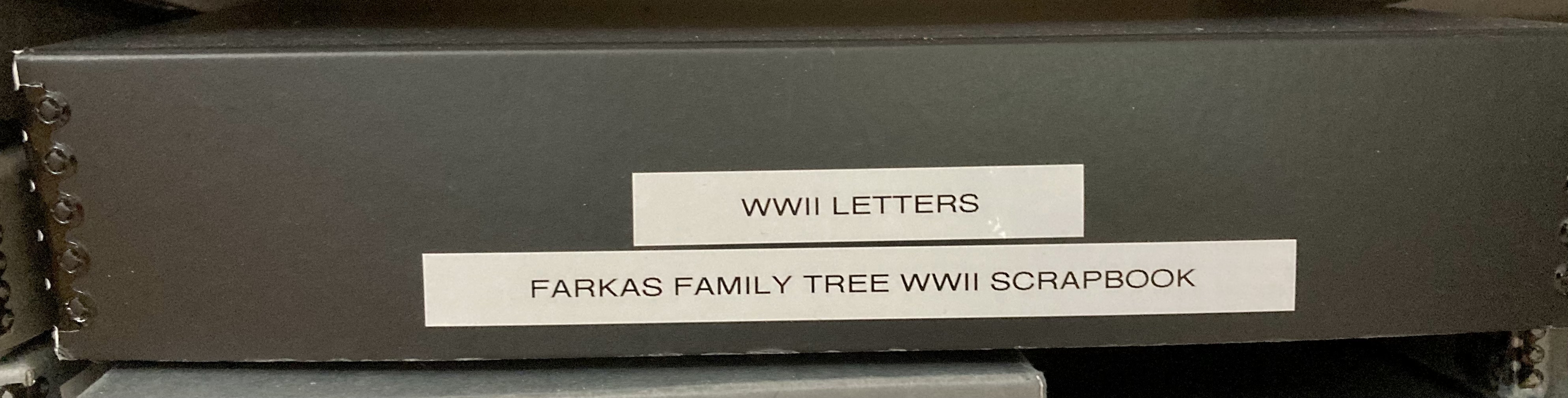
My favorite storage method is the archival box. As shown above, I buy boxes with metal corners so they can be stacked 6 high without giving way. Boxes come in a variety of sizes to fit nearly every kind of genealogical item that can lay flat, such as a document or a photo or an album or even a Bible.

I use my trusty label maker to add a descriptive label on the short side and the long side of each box, so I can read the contents no matter which side faces out.

As soon as I finish arranging my aunt's letters, that box will join the rest of the archival boxes of documents and photos in my home office--including the box above, containing letters written home during World War II by service members in my Farkas family tree. 

Transcribe for accessibility

I've previously transcribed the WWII letters and sent copies of the letters and transcriptions to my cousins, the children and grandchildren of those service members. Years ago, I transcribed letters written to my mother during the late 1940s, when she met and was courted by my father. Other letters still await transcription.

Meanwhile, the letters are safely stored and will go to designated genealogy heirs when I join my ancestors someday.

--

For more about organizing, curating, and preserving family history for the sake of future generations and future researchers, please take a look at my concise, affordable book, Planning a Future for Your Family's Past, available on Amazon, at the American Ancestors book store/catalog, and at the Newberry Library book store.

Thursday, May 12, 2022

Drool-worthy Food from Family History


When I indexed the 30 years of meeting notes from my mother's Farkas Family Tree association, I never thought to index the foods so carefully and deliciously described. Those meeting minutes have given me lots of genealogy clues and insights into family history dynamics over the years. This week, I drooled over the talk of food!

The tree (known within the family as the FFT) was formed in 1933 by the adult children of Lena Kunstler Farkas (1865-1938) and Morris Farkas (1857-1936), who left Hungary for a new life in America at the turn of the 20th century. 

Since their descendants mostly lived in the New York City area, the tree meetings provided a structure for relatives to see each other often.

Not only did the tree conduct "business," such as purchasing cemetery plots, it also served as a focal point for socializing all year. And socializing means food, right?!

From dessert to full meals

In the first year, a Depression period, only desserts were described, such as home-made cheese strudel served by my great aunt Jennie Katz Farkas (1886-1974) in December, 1933.

It didn't take very long for a little culinary rivalry to creep in. Sometimes meeting hosts and hostesses offered a big spread of delicatessen meats, cheeses and salads. Others prepared roast beef with lots of side dishes, served buffet style. 

Turkey wasn't just for Thanksgiving. Given the size of the crowd (at least 15 adults per meeting, plus their children), cooking a turkey made sense. The minutes for one meeting, echoing comments in others, say: "A bee-line was made straight for the delicious turkey, salads, and all the trimmings." 

One night late in the 1930s, when the FFT met at the apartment of my maternal grandparents, Theodore Schwartz (1887-1965) and Hermina Farkas Schwartz (1886-1964), the secretary reported in the minutes: 

"Our host and hostess for the evening, Ted and Min, rather outdid themselves in the preparation of a meal before this meeting. But the guests did the [hot] dogs--and I don't mean Skippy--justice. But we must not forget the many side dishes accompanying the dogs. Sauerkraut, potato salad, beans, and others were not spared. I am sure the guests of the evening would have preferred to sleep after that, to the "hard" work that they proceeded to put in." [Note: the actual business meeting lasted for an hour, followed by card playing "until all hours."]

War-time meetings and beyond

During World War II, rationing and food shortages forced the hosting families to change their menus, I noticed as I read through the meeting minutes. 

One hostess was "congratulated and thanked for the franks and trimmings" she served after business was concluded. How did this come about? A clue in another set of meeting minutes, when a hostess reminded relatives to please bring their ration books so they could get enough of certain foods, especially for holiday meals.

After the war, so many of the members were busy with growing families (marriages, children, grandchildren) that the FFT met less often. The tree organized a yearly summer picnic in the park or at the beach, with barbecued franks and burgers. But no more holiday meals for 50 at home. Instead, the FFT held big Thanksgiving bashes in Manhattan hotels or restaurants during the 1950s, so all members could enjoy the festivities without food prep, cooking, or cleanup.

Here's my great aunt Ella's favorite rice pudding recipe--more custard than rice. She wrote it for 6-8 servings, scaling up for the family tree crowds. She didn't note size of baking dish, probably a buttered two-quart oven-safe pan, so just experiment!

Ella's Custardy Rice Pudding

1/4 cup rice

1 TB butter

1/3 cup sugar

1 tsp salt (for water)

2 1/2 - 3 cups milk (adjust as needed)

3 eggs, well beaten

cinnamon (optional)

Directions: Heat oven to 350 degrees. Meanwhile, boil rice in a lot of salted water. Drain and place cooked rice in oven-safe deep dish. Add butter and sugar to rice, mix, and then pour at least 2 1/2 cups of milk over all, until 1" from top of dish. Mix again. Now fold eggs into mixture, very gently. Top with sprinkling of cinnamon if desired, and bake for 40 minutes. Turn off oven and leave dish in for 10 more minutes. Remove gently, cool on rack for a few minutes, serve warm or chilled.

This is my "Food and Drink" post for Amy Johnson Crow's weekly #52Ancestors prompt.
Sunday, May 8, 2022

In the May Show for Mother's Day, 1950


My late mom-in-law, Marian Jane McClure Wood (1909-1983) became interested in ceramic sculpture as a hobby in the late 1940s. She took classes at Oxford Elementary School in Cleveland Heights, Ohio, with a renowned ceramicist, Edris Eckhardt

Marian became so interested in ceramics that her husband and father built her a kiln in the basement of the family home in Cleveland Heights so she could fire her sculptures.

Like all area artists and craftspeople, she aspired to have her creations shown in the Cleveland Museum of Art's prestigious juried May Show, held (of course) every May since 1919.

In fact, Marian had four works accepted for May Shows: a zebra sculpture in 1948; a zebra and a "Spring Night" sculpture in 1949; and a sculpture called "The Champ" in 1950. 

The zebra shown at top has the date 1950 scratched into the underside. That year, Mother's Day was celebrated on May 14th.

In the 1950 Census, I found Marian and her husband, Edgar James Wood (1903-1983) enumerated at home on Cleveland Heights Boulevard, the house where she created and fired her ceramic artworks. 

On Mother's Day of 2022, I'm honoring the mom-in-law I never met and the sculptures she created, special heirlooms with a special story for descendants to treasure through the years ahead.

Happy Mother's Day to all moms, yesterday--today--tomorrow! 💕

Saturday, May 7, 2022

Did the 1950 US Census Enhance My Family Tree?

The 1950 US Census release has brought new excitement and fresh energy to my genealogy research! It's been fun looking for ancestors, sometimes by browsing one page at a time, and feeling the thrill of discovery.

But has this new resource actually enhanced my family tree? 

Happy surprises

I was pleased that at least some of the adult ancestors in my tree and my hubby's tree were chosen to answer sample questions. One reported an astonishing $30,000 as annual income in 1949--the equivalent of more than $300,000 today, and quite a fortune for the time.

Some birthplace answers simultaneously made me happy and confirmed my research. In 1950, Lithuania was in the clutches of what was then the USSR. Yet many of my paternal ancestors (Burk, Birk, Berk) answered "Lithuania" when asked about their birthplace (which I know was Gargzdai, Lithuania). 

I noticed a number of interesting occupations in our trees. One of my Dad's first cousins was the manager of a "5 & 10 cent store." Those don't exist any more. Two of the big chains of the time were Woolworth and Kresge (which later evolved into Kmart), but I don't know whether this cousin worked for either of them.

Another surprise was seeing my aunt Dorothy, who was a WAC in WWII, at age 30 still living at home with her parents. I know from family sources that she found her own apartment in 1950, and now I know it was after April 1st. Interestingly, she was chosen to answer sample questions but was not asked about her military service, because of her gender. Only males were asked that question!

Intriguing mysteries

The Census also turned up the heat on a few mysteries. For example, in the 1940 US Census, my great uncle David Mahler (1882-1964) was shown as married, but no wife in the household. In the 1950 US Census, he's shown as widowed. When he died, his death cert said he was widowed (sister was the informant). 

I've chased multiple people named David Mahler through multiple research sources and not yet found where or when my great uncle was married. He was quite the wanderer when younger, and could have married in nearly any state at any time. More research is in my future.

Checking hints, documenting details

My pace of research accelerated further when Ancestry's 1950 US Census hints began popping up this week. 

It's quick and easy to attach the 1950 Census to each person in my tree, and I'm transcribing key details onto each ancestor profile--allowing relatives to see, at a glance, where our family was and what they were doing at that point in time.

I'm also updating my virtual cemeteries on Find a Grave as I look at these ancestors and link family members. And I'm suggesting edits to ancestor memorial pages based on the latest research. Over time, I'll be improving my family trees on other sites, little by little.

Grain of salt

Because 1950 isn't that long ago, my relatives and I can almost always figure out whether the Census information makes sense. Too often, it's incomplete or flat-out inaccurate.


One great uncle and aunt were listed only by name with clearly approximate ages, no occupation or birthplace or anything else. The enumerator wrote: "all information available - given by superintendent after 4 calls." So in the 1950 US Census "fact" block on these ancestors' profiles, I inserted a warning: Info other than address was provided by building superintendent, not reliable. 

In other cases, enumerators indicated that neighbors or others had given the information. One in-law was listed as "Enid" even though her name was actually "Lena." Not even close! 

No wonder I consider Census data to be clues, not facts, and carefully double-check and correlate with other sources.

Bottom line: The 1950 US Census has been a plus for my genealogy, reenergizing my voyage of ancestor discovery and reinforcing the need to confirm new info in the context of what I've already proven.

Thursday, May 5, 2022

1950 US Census: Decoding Birthplaces, Relationships


Although I can usually read the handwritten answers in the 1950 US Census, I wanted to see how the Census Bureau coded some answers for tabulation and analysis. Also, if handwriting is unclear or illegible, deciphering the codes will help me figure out what was written down.

With sincere gratitude to Steve Morse and Joel Weintraub, I used their special page to decode birthplace if born in the United States, birthplace if born in another country (and citizenship), and how related to head of household. 

At top, some random examples I plugged into the special Steve Morse page. This shows how the drop-down menus work. I experimented to see all the coding possibilities and then looked at codes on some actual Census pages where my ancestors were mentioned.

By the way, remember that the coding only puts into numbers what the enumerator wrote. And the enumerator wrote what the resident said (or a neighbor said). Not necessarily the truth, but what the enumerator was told.

State & country codes - naturalization too!

At right, coding for birth in Maryland = 052, coding for birth in  Pennsylvania = 023. 

Since this Census page was from New York state, only non-New York codes were entered on the pages. 
 
The last entry in this excerpt shows Russia as country of birth for someone who answered "Yes" about being a naturalized citizen.

This entry was coded as 155 = born in Union of Soviet Socialist Republics, US citizen. Note that the initial 1 in the code stands for naturalized.

If this country code had said 255, it would mean born in Union of Soviet Socialist Republics, but not a US citizen. 

If this country code had said 355, it would mean born in Union of Soviet Socialist Republics, and parents are US citizens.


Relationship to head of household

At left, coding for three people in multiple households on a Census page. 

The step-daughter in this example is coded as 3, which stands for son, daughter, or step-child. NOT included in this code are sons-in-law and daughters-in-law, coded separately as as 4. 

The sister of head is coded as 7. This code covers brothers, sisters, brothers-in-law, sisters-in-law, nephews, nieces, uncles, aunts, grandparents, cousins, and so on. 

The lodger in a household is coded as 9, meaning non-relative of head of household.

Decoding the codes is a fun extra as I wring every bit of info from what enumerators recorded about my ancestors during the 1950 US Census. 


BIG NEWS! Ancestry has uploaded an "early version" of the index for the entire 1950 US Census. For more, see Crista Cowan on YouTube here.

Tuesday, May 3, 2022

Decoding Ancestor Occupations in 1950 US Census


When the 1950 US Census was released last month, I located dozens of ancestors, noted the basic details for each, and downloaded the Census pages for further study.

Now I'm comparing what was written as an ancestor's occupation/industry to what the codes say, at the far right of each line. These codes were added much later in the process as the government tabulated and analyzed 1950 Census data.

Travel agent = 300 (agent)

My entrepreneurial father (Harold Burk) and his brother (Sidney Burk), who lived a few doors away from each other in the Bronx, were travel agents in my Dad's travel business. At top is an excerpt from their Census page. 

Both were coded as O (working in own business), occupation 300 (agents), industry 808 (miscellaneous business services), and 3 (class code for "own business"). 

Steve Morse & Joel Weintraub decipher the codes 


The reason I was able to decipher these codes easily, as shown above, was by looking them up on a very convenient page provided by Steve Morse and Joel Weintraub, found here

Codes are particularly important when the enumerator's handwriting is unclear or the occupation or industry aren't legible. Just plug in the codes and see, at least in a general way, what our ancestors said they did for work.

More specific coding?

The 1950 Census training manual stressed that enumerators were to be as clear and specific as possible when recording occupation/industry. In fact, what the enumerator listed as occupation/industry for my Dad and uncle was quite specific. 

Yet the coding of this information was anything but specific, IMHO. 

So I looked up the occupation "travel agent" in the official Alphabetical Listing of Occupations and Industries from 1950 (link here leads to a pdf), where all the numerical codes are shown. 

The snippet from "travel agent" shown above says:

  • "300" correctly corresponds to the general category of agents.
  • "Ind" indicates that the next set of numbers will be "industry." 
  • "568" is an industry code for services incidental to transportation.

Surely 568 would have been a better classification for my father's travel agent business than, say, 808 = miscellaneous business services?

For more about the 1950 US Census, please see my summary page here.

Sunday, May 1, 2022

LOCKSS: Back Up Your Family History!


Every day is backup day but especially on the 1st of every month, I take a moment to be sure my family trees, family booklets, old photos, files, ancestor coloring books, and other documents are safe with multiple backup methods.

This is the LOCKSS principle in action: Lots of copies keep stuff safe. 

Not only do I have backups in the cloud and on two external drives, I also send selected items to relatives. 

Plus I have family trees and ancestor bios on multiple genealogy sites. 

These are a few of the ways I preserve family history for today and for tomorrow.

Thursday, April 28, 2022

Digitally Donate Your Genealogy?


Although not everything is online, I really appreciate being able to access digitized photos, letters, postcards, and documents when researching my family tree.

In fact, some museums, libraries, historical societies, and other institutions welcome the digital donation of old photos and printed items. This is a great way to share family history without physically letting go of the actual items.

Above, a screen grab from the online Case Western Reserve Encyclopedia of Cleveland History. The photo is one of several digitally donated by my husband's family, along with names, dates, and places. 

These digital images now accompany the online history of the Cleveland Heights Youth Theater. Pictured here is a rehearsal of a 1950s children's TV show that was broadcast from downtown Cleveland. 

By donating these digital images, the family is helping others learn more about the youth theater and the key role it played in the lives of participants.

Do you have photos, documents, postcards, printed genealogies, or other items from the past that might be of interest to an institution if digitally donated? Think of this as another way to share your family's history!

--

For more about preserving family history for the future, please see my concise guide, Planning a Future for Your Family's Past.

Wednesday, April 27, 2022

Finding Tiny Bits of Family History in Old Negatives


My late father-in-law, Edgar James Wood (1903-1986), was a lifelong photography buff, leaving behind hundreds of negatives, photos, and slides. Starting at the age of 14, he photographed his family, his home, his travels, and more.

As I reorganize Ed's collection in preparation for storing in archival albums, I'm  scanning some of the negatives he never printed. 

Turn negatives into photos

There are a number of apps that will do this (see Elizabeth Swanay O’Neal's Heart of the Family post here). 

Or do scan the negative, then invert the image using photo software (as I showed in my blog post here).

Once the negative is displayed electronically as a positive, it's much easier to enlarge and figure out who or what was photographed. Otherwise, the family history might remain trapped on the negative--which may deteriorate before too long.

Enlarge and look for clues

The photo at top, from a negative I scanned and inverted, was taken about 1919 by Ed Wood. It was sandwiched between photos of his brothers, which were dated that year (this particular negative had no date). 

Enlarged on the screen, a clue stood out. Reflected in the mirror is the headboard of a bed. My husband and I recognized its distinctive shape instantly, because one almost exactly like it was part of the Wood family's household for decades. Perhaps Ed's father, a busy carpenter and builder, made the headboards for the family? 

With this clue in mind, I strongly believe we're looking at the bedroom of my husband's grandparents--the parents of the teenaged photographer who snapped the photo circa 1919. 

My hubby noticed that there's no doorknob on the door, only an old-fashioned latch that lifts, with a bolt for locking. I'm charmed by the wallpaper and the fabric covering the shelf, plus the graceful chair--a glimpse of how these ancestors lived.

By turning negatives into viewable photos and enlarging the images, it's easier to notice and share clues like these--tiny insights into the family's past. 

--

For more ideas about preserving the family's past for the sake of future generations, please see my recently updated book (available in print or as an ebook), Planning a Future for Your Family's Past.

Monday, April 25, 2022

1950 US Census: Formats For Citing Your Source


Now that I'm downloading 1950 US Census records from the US National Archives to attach to ancestors on my family trees, I'm thinking about how to document my source for these key records. In general, there are several acceptable citation formats, as summarized by the U.S. Census Bureau

Here are two possibilities updated for the 1950 Census in particular.

Citation example following suggestion of Elizabeth Shown Mills

Genealogy expert Elizabeth Shown Mills has citation suggestions on the Facebook page for her best-selling book, Evidence Explained, and on her own Facebook page, both original posts dated April 1. 

Following her recommendation, here's to cite the three-person family of Louis Woolf, which begins on line 5 and ends on line 7 of the Census excerpt shown above. 

1950 U.S. Census, Westchester County, NY, New Rochelle, ED 67-43, sheet 9, household 105, lines 7-9 (Louis Woolf family); U.S. National Archives, 1950 Census (https://1950Census.archives.gov/search). 

Note that the street address isn't needed, nor are the names of other people in the family, because all of that is covered by the household number and line numbers.

Citation example following suggestion of Claire Kluskens

Claire Kluskens, Genealogical Projects Archivist for the U.S. National Archives, suggests a slightly different format for citing this Census as a genealogical source. You can see her suggestion on the History Hub here.

Following her recommendation, here's how to cite the same three-person family of Louis Woolf.

Louis Woolf family, Lines 7-9, Sheet 9, Enumeration District 67-43, New Rochelle, Westchester County, New York; Seventeenth Census of the United States, 1950; Record Group 29, Records of the Bureau of the Census; National Archives and Records Administration, Washington, DC, downloaded from https://1950census.archives.gov/ on April 23, 2022.

Citation example following Ancestry's format


Above, how Ancestry cited the 1950 US Census as the source of a different record I just attached to my family tree. Note that the citation includes year, record group, residence date, and the town, county, state. I can edit this citation on my Ancestry tree to add more specifics (family name, ED, sheet number, HH number, line numbers, etc.). As it stands, I would need those extra details to retrace my research path.

IMHO: Short, sweet, and practical 

My personal plan is to adapt the formal citation formats. Short, sweet, and to the point will work best for my personal purposes.

As long as I provide specifics, I believe others will be able to retrace my steps and see what I saw about an ancestor in the 1950 Census, at any time in the future. 

Here's my concise but detailed version of the citation, neither formal nor official by any means.

1950 U.S. Census, New Rochelle, Westchester County, NY, ED 67-43, sheet 9, household 105, lines 7-9 (Louis Woolf family).

This is my preference, for personal use, and it may not work for everyone. 

IMHO, the key elements of documenting a source are shown in my abbreviated version, for my personal use: I cited the 1950 US Census, providing the town, county, state, ED, sheet number, household number, and line numbers, plus head of household and family name. 

"Document" is this week's #52Ancestors prompt from Amy Johnson Crow.

Friday, April 22, 2022

1950 US Census: Seeking Big-City Ancestors on NARA site?


Having located nearly all of the closer ancestors I wanted to find in the 1950 US Census, I'm branching out to more distant ancestors.

At left, my search on the US National Archives site for someone living on East 141st Street in Cleveland, which is ED 92-945. 

Searching quickly only for Cuyahoga County, Ohio, ED 92-945, I was surprised to see "No Records Found" as shown here on the results page. 

Simply choosing the state/county and entering a specific ED is not enough to find ancestors living in big cities! 

Look for big city in NARA drop-down menu

NARA's drop-down menu for county does have a city/state choice of Cleveland, Cuyahoga. I didn't choose that option initially, but I quickly figured out how to improve my search.


Once I redid my search, and chose the city along with the county and the ED, the correct population schedules showed up in the results.

I checked with several experienced researchers and they confirm that if the city is one of the choices on the drop-down menu for county, be sure to select the city. 

Thursday, April 21, 2022

Two Volumes of "Scots-Irish Links" by David Dobson


My husband's family tree includes the McClure family from Donegal but originally from Isle of Skye, ancestors who are known as Scots-Irish. 

So when the Genealogical Publishing Company kindly sent me a review copy of the two volumes that make up David Dobson's latest work, I was delighted to take a look. 

Disclaimer: Although I received this publication for free, please note that the opinions in this post are entirely my own.

Consolidated index is handy

Scots-Irish Links, Consolidated Edition, consists of two volumes, each more than 900 pages, reprints of carefully-researched works that were previously published. If you have an intense interest in Scots-Irish genealogy, and need to consult surname-based research going back hundreds of years, these pricey volumes might be worth the investment.

What makes them particularly useful is that each volume contains a consolidated index. Instead of having to look up names in more than a dozen briefer books researched by Dobson in earlier years, today the reader can flip through a single index at the end of each volume.

Searching for McClure names in County Donegal, I found a listing for Robert McClure, as well as a listing for John McClure. 

These clear, concise entries told me not just surname and given name but also the location and the year, along with an abbreviated reference I could follow back to the source.

More about sources 

Dobson provides a listing of "references" indicating the meaning of the abbreviated citations in each volume (see sample here). 

As a researcher based in New England, I'm not familiar with most of these sources. It's been a good learning experience to follow up--especially considering that I hope to discover other Scots-Irish ancestors from my husband's family tree in some of these sources!

Scots-Irish Links by David Dobson is available as a two-volume set or individually priced. See the Genealogical Publishing website for more information about contents and pricing.

Tuesday, April 19, 2022

Elusive Ancestors Hiding in the 1950 US Census

The positives: I've had very good success finding many ancestors in the recently released 1950 US Census. 

The negatives: Some folks remain stubbornly elusive. 

No 1950ish address

The top reason I haven't found a particular ancestor is because I have no 1950ish address. Even if I have a 1940s address, some of these people moved frequently.  Remember, it was a time of great mobility in America and there was also an acute housing shortage in many regions.

Where's wounded WWI vet Frank Maurice Jacobs (1896-1974), my 1c2r? I'd hoped he was still living in the residential Hotel Tudor in New York City, which was his 1942 address while working in the advertising industry. Nope, he didn't show up when I browsed the many dozens of pages for that Enumeration District. With no 1950 address, he could be anywhere in Manhattan (or possibly an outer borough, although I doubt it). When full indexing is complete for New York, I'll do a deep search for him by given name, middle initial, and birthplace, with possibly other search twists.

No longer living on own

Another reason I haven't found an older ancestor is because he or she moved into a retirement home or was living with an adult child whose address I don't yet know.

This might very well be the case with hubby's great aunt Nellie (Rachel Ellen) Wood Kirby (1864-1954), who has been elusive, as I wrote a few days ago. In the 1940 Census, Nellie was in a Chicago apartment. When she died in 1954, she was in a nursing home. I've browsed the Census for both Enumeration Districts and she turned up in neither place. She's on the back burner until full indexing for Illinois is ready and I can search by name and birthplace and/or other search parameters.

Wood, Smith: common names

Let's face it: Wood, my husband's surname, isn't exactly unique. His uncle John A. Wood (1908-1980) is a tough case, since I don't yet have a clue which state, let alone which county, he might have been in. I know his 1951 address when he got married--but he wasn't there in 1950 when I looked! He's on the back burner until full indexing for Indiana and nearby states has been completed. Then I can search for him with his middle initial and birthplace and/or other search parameters.

Similarly, my great aunt Sarah Mahler married a man named Sam Smith and they moved to California during the 1940s. Sam never used a middle initial. When full indexing is ready, I'll search for a household with Sam, Sarah, and one of their children, or use some other creative strategy--they can run but they can't hide. 

Searching by name, initial, birthplace, and/or other fields (like age) might turn my negatives into more positive results!

PS: Try searching state, county, surname on NARA IF not a big city

Before the Census is fully indexed for all states by those big genealogy sites, try searching state, county, and surname on the US National Archives 1950 Census page. That's only if your target ancestor was NOT in a big city.

I wanted to find my hubby's grandfather Brice L. McClure, who wasn't where the family remembered him living in 1950. After a variety of searches that went nowhere, I tried looking where he and his late wife had lived when she died in 1948--in a town in Wyandot county, Ohio. 

Success! He was living in that very same house, about to sell it and move out of the county. But not yet. So even before the big genealogy sites finish indexing bit states, try the NARA site because its indexing is fair enough to find someone, even with creative spelling.

"Negatives" - Amy Johnson Crow's #52Ancestors theme for week 16.

Sunday, April 17, 2022

Happy Easter Photo from 1913


Alas, I never met my late mom-in-law, Marian Jane McClure Wood (1909-1983). She was the beloved only child of Brice Larimer McClure (1878-1970) and Floyda Mabel Steiner McClure (1878-1948). 

Here she is, all dolled up for Easter, in a 1913 photo that I've colorized using My Heritage's photo enhancement tools. What an adorable face (made clearer by My Heritage)! 

Saturday, April 16, 2022

Penny Postcards from Easter of 1914


In April of 1914, my hubby's uncle Wallis W. Wood (1905-1957) received two colorful Easter postcards. 

He lived in Cleveland, Ohio and received penny postal greetings for every conceivable holiday, sent by his Wood and Slatter relatives.

Shown at left is the postcard from his aunt, "Nellie" Wood Kirby (1864-1954) and her husband, Arthur Kirby (1860-1939). 

Nellie was an older sister of Wallis's father, James Edgar Wood (1871-1939).


Although I've tried to find Nellie in the 1950 US Census, I haven't yet succeeded. I checked the 1949 Chicago directory (online for free at the Library of Congress) and didn't see her name listed under Kirby. 

Nellie was living in a nursing home when she died, and I haven't found her there in the 1950 Census, nor at the address where she lived in 1945, according to the city directory. I'll keep looking!

Here's a pretty postcard sent to Wallis by his aunt Ada Mary Ann Slatter Baker (1868-1947), who lived in Toledo, Ohio when she mailed this card.

By 1920, Ada and her husband, James Sills Baker (1866-1937) were living in Cleveland and most likely visited with Wallis and his family quite often.

Ada was the older sister of Wallis's mother, Mary Slatter Wood (1869-1925). 

Now 108 years later, these postcards live on in the Wood family's collection!


Friday, April 15, 2022

Honor Roll Project: WWI Memorial in Oxford, CT


One hundred and five years after the United States entered World War I to fight on the side of the Allies, I visited the war memorial in Oxford, Connecticut, to photograph and transcribe the names for Heather Wilkinson Rojo's Honor Roll Project. This honors their service and makes the names searchable for descendants.

Mounted on a boulder and visible from a winding state road, the memorial says:

Erected in honor of those from Oxford who served their country
in the World War, 1917-1919

Albert E. Arnold 

Maurice C. Barry

Carl Benson 

Frank W. Carlson 

Ole S. Christensen 

Albert G. Dahinden 

Ralph E. Davis 

Thomas F. Derry 

Alfred S. Donahue 

Henry D. Field 

Albert H. Graf 

Albert G. Hansen 

William R. Houlihan 

Reid P. Hubbell 

Frederick Knapp 

Maurice Levy 

Samuel Levy 

Arthur Lundin 

Frank D. Marshall 

*Thomas Marshall 

Clarence McConnie 

Walter J. Mitchell 

Albert J. Mitchell 

*Homer Olmsted 

Edgar C. Palmer 

Frederick W. Pfeiffer 

Clarence F. Roberts 

Herbert Roberts 

Ben Salvesen 

Chauncey B. Sanford 

Clifford H. Smith 

Herman Sonnenstuhl 

August J. Tilquist 

Frank Trevelin 

John H. Townsend 

James F. Townsend 

Edward N. Williams

* = Lost their lives in World War I

Wednesday, April 13, 2022

Add a Transcription to Improve NARA's 1950 Census Index


Waiting for the big genealogy sites to index the entire 1950 US Census, I've been using the US National Archives site to locate my ancestors in that Census. Thankfully, NARA released a preliminary name index along with the images of the Census sheets, allowing for both name search and browsing. 

I've been most successful in locating ancestors when I try my search by inputting the state, county, Enumeration District, and surname of head of household.

Searching for Carrie

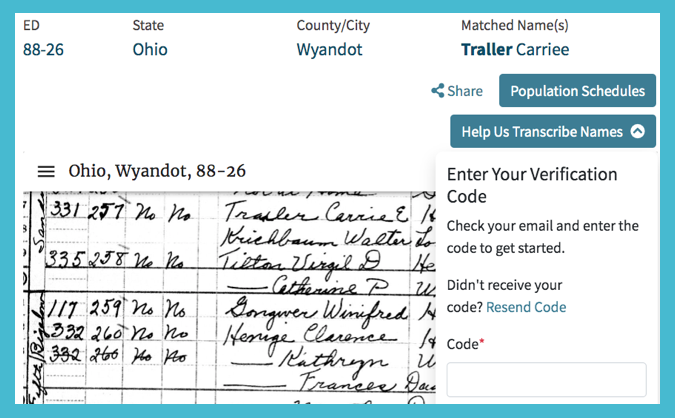
Above, results of my search for hubby's great aunt in ED 88-26 of Wyandot County, Ohio. Her name was Carrie E. Traxler. My search was for Traxler Carrie because the automated systems transcribed what they "read" on each line, and head of household was listed Surname Given

NARA's system can match on creative spelling, and the first result was the ancestor I wanted--even though the transcription wasn't perfect. Her name was NOT Traller Carriee, as the system read the enumerator's handwriting. But it's close!

Adding a transcription

NARA welcomes the public's assistance in adding correct transcriptions. It will accept both transcriptions that correct what the automated system says AND transcriptions that correct what the enumerator wrote. Note that this will not alter the actual Census in any way. It will improve the search system so others can find ancestors on the NARA 1950 Census site.

After I made a note of the line number where my husband's great aunt appears, here's how I added a transcription to correct her name as transcribed by the automated system.

First, I clicked the button to "Help Us Transcribe Names" and entered my email. NARA sent me a six-digit verification code, which I entered so I could begin my transcription. 


Next, I used the NARA drop-down menu to indicate line number...which took me to a blank of the screen shown above. I typed "Traxler" for last name, "Carrie" for first name, and "E" for middle name--all of which are shown in cursive handwriting on the Census form, but not accurately read by the automated system.

Other family members with same surname in same HH?


After submitting a transcription, NARA said thank you and invited me to "Add a transcription to the next line."

If Carrie Traxler's household included a husband or child or anyone with same surname directly below her name, I would click to add their surname.

This is a key step for families that share a surname and were enumerated in the same household. I didn't do it for Carrie, but I did do it for many other ancestors who had folks with same surname in that HH. 

Otherwise, the search system can't find these people by their full names. Remember, they would have been enumerated with a dash for surname, followed by a given name. My transcription replaces the dash with the actual surname.

"How do you spell that?" is the #52Ancestors prompt by Amy Johnson Crow for week #15.

Thursday, April 7, 2022

1950 US Census: Check Out Family Members in NARA's Index


Oh, I'm doing the genealogy happy dance! I've been finding lots of ancestors in the 1950 US Census on the US National Archives site. 

The index isn't perfect, but it works surprisingly well. Do check it out!

At a minimum, search by city and state, then enter the head of household's name in this order: Surname Given. 

Ideally, first input city, state, and Enumeration District, let the ED load, and then enter the HH head's name.

In 90% of my searches, the NARA results show me the exact page where my ancestor has been enumerated. 

If not, I then look carefully at the index summary for the top result before moving on. 

Shown above are the extracted names for a Census page in Jackson, Michigan. My search was for Farkas Fred (Surname, Given).

Two names are in bold in this search result. The first is FREDE (not my guy). The second is FARKAS. But wait, who's this Arthur Farkas? Um...

Before I rejected this result, I checked out the names of other people in that household and hooray! This is the correct family. It was recorded on a call-back sheet (meaning the family wasn't home when enumerator originally visited) and all the other names in the household are correct, as is the occupation of the head of household. 

My guess: neighbors supplied as much information as they could remember. They just didn't remember this ancestor's first name correctly. Everything else matches. Did I learn anything new? Well, the address was different from what I expected. And my search technique turned up the ancestors I wanted to locate. All I had to do was check it out thoroughly before moving to the next result.

"Check it out" is this week's #52Ancestors prompt from Amy Johnson Crow.

Monday, April 4, 2022

1950 US Census: Read the Notes!


Enumerators sometimes wrote notes on the 1950 US Census. The notes section may be near top, middle, or bottom of the page, depending on which version of the questionnaire was being used.

In most cases, the notes mentioned where a missing resident might be enumerated elsewhere in that ED (sheet number, line number). At least two of my ancestors, living in big city apartments, weren't home on the first call--and were never actually interviewed. The notes said something like "Superintendent provided information after 4 calls." 

Enumerators occasionally noted that they had left income forms for residents to fill out and return confidentially. Others noted the presence of more than one apartment at a dwelling or the fact that an address was a vacant dwelling.

You just never know what little details you'll learn if you read the notes! Some interesting notes I've found so far:

  • "Line 26--Person just arrived from Canada. Sister-in-law supplied information and couldn't tell former occupation."
  • "Lines 6-8 - Respondent vague on answers--couldn't remember ages."
  • "Line __, serial no. 80. Rent of $40.00 is out of reason, about $15.00 should be right."
  • "I left [Census] line for a locked gate and then I got information from neighbors."
  • "Person is in reserve Navy."
  • "Information given by daughter staying there while parents are away."
  • "Line 1 is a female even though name is William T."
  • "On vacation, don't know when she will be home."
I'm delighted to participate in this month's Genealogy Blog Party by going back to the 1950s!