This week's #52Ancestors genealogy prompt, by Amy Johnson Crow, is war and peace.
Adventures in #Genealogy . . . learning new methodology, finding out about ancestors, documenting #FamilyHistory, and connecting with cousins! Now on BlueSky as @climbingfamilytree.bsky.social
Pages
- Home
- Wm Tyler Bentley story
- Isaac & Henrietta Birk's story
- Abraham & Annie Berk's Story
- Farkas & Kunstler, Hungary
- Mary A. Demarest's story
- Rachel & Jonah Jacobs
- Robt & Mary Larimer's story
- Meyer & Tillie Mahler's story
- McClure, Donegal
- Wood family, Ohio
- McKibbin, Larimer, Work
- Schwartz family, Ungvar
- Steiner & Rinehart
- John & Mary Slatter's story
- MY GENEALOGY PRESENTATIONS
Monday, November 6, 2023
The WWII Veteran Who Enlisted at Age 45
Thursday, November 2, 2023
Downsizing a Figure Skating Program from 2008
The program is still in mint condition...I even saved the ticket stub!
I decided to try to donate these items to a repository that collects materials related to the city of Danbury. It's important to not only identify potential institutions but also to ask permission to donate.
With a quick search. I discovered that the Danbury Museum is actively collecting materials such as these. I submitted an inquiry along with photos of the program/ticket.
Within a day, I received an email from the collections manager, who wrote: "I’m very pleased to say yes to adding this to our collection. I don’t think we have anything from this event and very little of this era in general, so this is a definite yes."
I will be signing a certificate of gift conveying ownership of the program and ticket stub to the museum, and will be delivering everything in person.
The museum will gain fresh materials for its collection, and I will feel good that these items have a safe new home, not in the rubbish or recycle bin.
Do you have items nobody in your family wants, so you want to find them a new home? Learn how to proceed by viewing my free talk "Keep Your Family's History Safe for the Future!" during the WikiTree Symposium this week, starting on Friday, Nov. 3, at 5 pm Eastern. For more about the speakers and free presentations, see the full listing here. I'm looking forward to a weekend of genealogy education and fun!
Wednesday, November 1, 2023
Back Up Your Family History!
The first day of every month--more often, preferably--is a great time to back up all of your family history files. Thomas MacEntee has great advice about the importance of a 3-2-1 Backup Plan.
As someone who lost dozens of digitized photos a few years ago when an external drive malfunctioned, I'm careful to back up frequently in multiple ways.
I have 3 external hard drives (different types, with one dedicated to photos), plus a cloud system that automatically backs up daily, plus individual flash drives for current projects (such as genealogy presentations). Also I put very important projects on my laptop as well, for easy/instant access if my desktop Mac has a hiccup.
Don't lose any of your family history. Today's the day to get into a routine and back up everything!
Tuesday, October 31, 2023
Colorful Penny Postcard from Halloween Past
The greeting asked whether the boy was practicing his violin or had decided to stop taking lessons. (Spoiler alert: he quit!)
In the early 1900s, hubby's Wood family throughout the Midwest stayed in touch via this type of penny postcard, colorful and convenient, not to mention affordable. Thankfully, 110 years later, the colors remain bright and the handwritten message is still legible today.
For more about the history of the postcard, and the craze for penny postal greetings, see this page.
Monday, October 30, 2023
Spirited Halloween Crafts, Future Family History
Three generations of my family (ages 4 and up) enjoyed a morning of spirited Halloween crafts last week.
Not only did we have a fun time, we created memories that will be part of family history in the future, with photos as conversation starters. Maybe we'll look back on this craft day as the, uh, ghost of Halloween past!
Of course these spirited beauties will be represented in the family photo calendar for 2024.
Happy Halloween, and may you have treats, no tricks.
Top: ghost, deep-sea fish, panda. Bottom: sad princess, watermelon, watermelon with sparkly rainbow.
"Spirits" is the 52 Ancestors prompt for week 44, from Amy Johnson Crow.
Thursday, October 26, 2023
Do You Participate? One, Two, Three
IMHO, here are one, two, three ways to participate even if you don't want to serve as an officer or chair a committee:
- Show up. Gen clubs and societies take care and spend money to plan programs that will be meaningful for members. Seems obvious, but a great way to show support as a member is to attend meetings (virtually or in person). As a bonus, ask the speaker a question and/or tell the program chair what you think of the presentation. If it's a virtual program, read and try to participate in the chat--often I get good ideas or make connections based on chat comments.
- Offer input. Most societies survey members about topics or speakers they're interested in, genealogical origins they're researching, and so on. They really want to hear from us. If we don't provide input and feedback, societies can't plan programs and/or library purchases that will be of benefit to members. One local club recently asked for input about genealogy books we're buying to donate to the library where we meet. Several people responded, and soon the library will be expanding its genealogy section with the club's donated books. Good for the club, good for the community.
- Submit content. Most societies have a newsletter or social media presence--and they generally welcome content from members. Consider submitting a sentence or two about a local gen resource or an upcoming conference, or a paragraph or two about a conference you attended or a genealogical book review. Or pipe up during a meeting when asked to comment on something new. Sharing benefits everyone and adds value to membership.
Please consider participating so local clubs and societies stay strong and vibrant.
Sunday, October 22, 2023
Happy 112th Anniversary to Minnie and Teddy
On this day in 1911, my immigrant maternal grandparents got married on the Lower East Side of Manhattan. Hermina "Minnie" Farkas (1886-1964) and Theodore "Teddy" Schwartz (1887-1965) were born in different towns in Hungary, and both arrived at Ellis Island in 1901 when they were just teenagers. The path to their wedding wasn't smooth, since Minnie's parents weren't crazy about Teddy at first. But over time, she won them over.
That's the lede, and I didn't bury it. In fact, I put it front and center on the cover of my colorful family history photo book, to get readers intrigued by previewing the lives of these ancestors. This is my approach, which fits with my goal of making family history accessible and maybe even fascinating for younger audiences. Your approach might be different, of course, depending on your audience and your goals.
Inside the book, I wrote that my grandparents were married for 52 years, working side by side for much of that time in Teddy's Dairy grocery store in the Bronx, New York. I put in pictures of big family get-togethers (captioned) and mentioned their charitable works. Also, I traced their parents' histories, from birthplaces to marriage to burial places, and summarized what happened to their siblings. Finally, I talked just a bit about their descendants (my readers) and included some contemporary photos. My readers will, I hope, open the book in the decades to come and smile at what will by then be quote old family photos unquote ;)
No matter how you tell your family's story, I think it helps to cater to the interests and preferences of your audience--today and tomorrow.
Wednesday, October 18, 2023
Occupation as a Theme in Family History
![]() |
| Home built by James E. Wood on Lancelot Ave., Cleveland Hts, Ohio |
In my husband's family tree, multiple generations of people had the same occupation. Another recurring pattern was younger generations choosing vastly different occupations than the generations who came before. The theme of occupation can be a really good hook for sharing bite-sized family history stories, no matter what your ancestors did for a living.
Slatter: Military men
My husband's three great uncles in the Slatter family were military bandmasters, and their sons also joined the military. I've written a few bite-sized family history bios of these men, and found lots of rich research, in particular, about Captain John Daniel Slatter (1864-1954) and Bandmaster Henry Arthur Slatter (1866-1942). But even without the extra details about how Capt. Slatter popularized the kiltie band, I can organize stories around the multiple generations of Slatters who served their country in wartime and in peacetime.
Younger relatives in our family were quite interested in the dramatic backstory of how the three Slatter brothers got their military training, starting in their preteen years. They were also fascinated by artifacts such as this WWI handkerchief, passed down in the family for more than a century. The theme of military career has been a hook for me to tell quick stories on Memorial Day and Veterans Day, not just in bite-sized bios, photo books, and on websites.
Wood: Carpenters for generations, then none
My husband's grandfather, James Edgar Wood (1871-1939) plus James's brothers and father and earlier generations going back many generations were--as the name Wood implies--carpenters. Earlier Wood ancestors were shipbuilders and general carpenters, later Wood ancestors applied carpentry to build railroad carriages, homes, and other things.
The family still has several photos of homes built by grandfather Wood in Cleveland and Cleveland Heights, Ohio, during the first three decades of the 1900s. At top, the photo shows a home Wood built on Lancelot Ave, Cleveland Heights, as it looks today--more than a century after it was constructed. The grandchildren were impressed that their ancestor built a home so sturdy that it looks very good even after so many decades.
Then I tell the youngsters that our Wood line no longer has any carpenters. After James, the next generation went into professional careers such as stockbroker, insurance, and company management. That abrupt shift got their attention, sparking conversation about the older careers and the newer careers.
Lower: Attendance officer and breadwinner
There were women teachers in several branches of my husband's family tree during the first decades of the 1900s, but usually they stopped teaching soon after marriage. Hubby's grand aunt, Lola McClure Lower (1877-1948), wasn't a teacher, though she worked in schools when she became the breadwinner of her family after her husband, a civil engineer, was confined to bed.
Lola built a career as a truant officer in Wabash, Indiana, and became well-respected in the field, giving presentations to regional conferences. How she found time to volunteer for the Red Cross for 25 years, I'll never know. Telling her story is an opportunity to hear what younger relatives think about her choice of occupation! Plus an opportunity to discuss societal and economic changes during the 20th century as more women entered the workforce.
IMHO, any occupation, in any time period, can be an engaging theme for sharing family history stories. Just don't bury the lede.
Monday, October 16, 2023
Family History as News: Don't Bury the Lede
When I write family history stories and create family history photo books, I put the important stuff close to the beginning. Why? It's an old but still relevant journalism adage: don't bury the lede.
In other words, don't wait to reveal key information until later in the story...unless there is a really compelling reason to build up to it slowly.
Will our audience pay attention?
For family historians, simply getting the attention of our audience can be a challenge. Encouraging them to keep reading or listening to a story about ancestors is often a challenge as well. Every family history incident has some drama or mystery or fascinating element--it's up to us to shape the narrative and keep the audience engaged.
If we bury the lede, we make the audience wait for the payoff to the story. Um, maybe they won't stick around until the second paragraph or second page to find out what happened to that ancestor.
But if we give them a strong hint or outright reveal the most exciting or important details near the start, our audience will know right away why this story is worth their time. I hope they'll be intrigued enough to continue to find out who, what, when, where, and why. Especially why!
It's news to them!
For example, when I blogged about my grandpa Isaac last week, my first paragraph didn't hide what was going to happen--it led with the sad fact of his death while visiting relatives. Then I told the story leading up to his unexpected death. No need for suspense, 80 years after the fact, IMHO.
Family history isn't exactly news coverage but I feel these stories are, in fact, news to our younger relatives. Maybe they've heard the story before, but not with the new discovery I just made. Or maybe they've never heard about what other people did or said about the story and how it rippled through the family in the past. There's always a way to make genealogy fresh and interesting.
That's why, as the family historian conveying ancestral news to the next generation and beyond, I believe it's up to me to put the lede up front.
Wednesday, October 11, 2023
How Floyda Won Her Divorce Plus Alimony and Court Costs
In my current family-history photo book, I'm telling the story of my husband's maternal grandparents, Floyda Mabel Steiner McClure (1878-1948) and Brice Larimer McClure (1878-1970). One page is devoted to Floyda's first marriage, to an affluent local farmer in Upper Sandusky, Ohio, in 1898. Three years later, Floyda left him and filed for divorce--very unusual for a woman in her early 20s in small-town Ohio, circa 1901.
Which court house?
A few years ago, I called two county court houses in the area to see which might have the divorce files. Turns out Floyda filed in the closest court to her hometown, much to my surprise. Other ancestors I've researched filed for divorce in a neighboring county or even another state. Not Floyda. I imagine her mother and sisters stood by her as she prepared to confront her husband in the court room.
It cost me only $3 and postage to obtain photocopies of all the divorce documentation by snail mail. Here's what I learned, all of which I'm sharing in my photo book.
Floyda's side
Floyda alleged that her husband was verbally abusive (calling her a "damn hen" and jeering that she was low-bred, among other taunts and curses I won't repeat here). She said he was also physically abusive (scratching her face, kicking her, threatening to do more).
Her husband's side
Her husband's attorney responded to the petition with just a few handwritten lines to the court. The lawyer wrote "that the facts stated therein are not sufficient to constitute a course of action." Note that the lawyer didn't dispute Floyda's version, just said the allegations weren't enough to lead to divorce. Hmmmm.
No-show leads to divorce
Floyda's husband failed to respond in person to the court summons and the judge therefore ruled entirely in Floyda's favor, granting the divorce and all she requested in her petition.
At top is the accounting of how much Floyda won: $215 in alimony and full payment of her divorce costs (in all, worth $8,400 in today's money).
The court also ruled she could return to her husband's home and retrieve her own belongings. Floyda now legally resumed using her maiden name. I found her mentioned in newspaper social items as "Miss Floyda Steiner" once again.
Only recently did I figure out how Miss Steiner met Mister McClure. That story is also in the current photo book!
Sunday, October 8, 2023
The Tragic Last Trip of Grandpa Isaac
Wednesday, October 4, 2023
Mark Your Calendar for WikiTree 15th Anniversary Events
This is WikiTree's 15th anniversary year and the celebration will take place over three days in early November.
Fifteen years of building a free, worldwide collaborative family tree, with more than a million genealogy folks adding more than 35 million ancestor profiles.
You're invited to attend any or all of the free genealogy presentations on November 3-4 plus a virtual party on November 5! Door prizes are part of the celebration too.
More than 30 speakers are participating, and the program also includes a panel discussion about artificial intelligence and genealogy.
You don't want to miss this special event! Take a look at the full schedule here.
Please mark your calendar and save the dates...including my presentation, "Keep Your Family's History Safe for the Future," on Friday, Nov. 3, at 5 pm Eastern. Watch my talk on YouTube with this link.
Monday, October 2, 2023
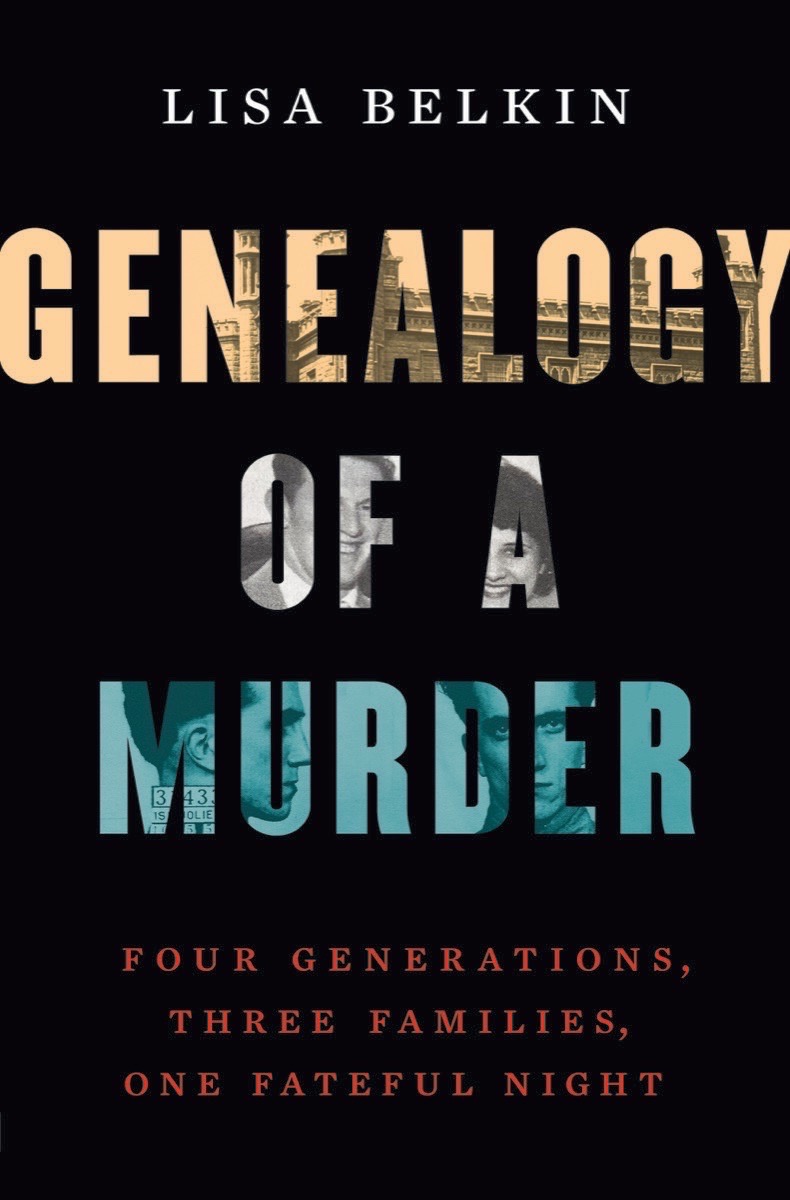
Book Review: Genealogy of a Murder
The true-crime book Genealogy of a Murder by Lisa Belkin is meticulously researched, somewhat sprawling yet quite absorbing because of her focus on the family history backstories that shaped the character and actions of three men in the lead-up to the tragic shooting of a policeman in 1960.
The police officer who died was David Troy, the shooter was Joseph DeSalvo, and the person who first mentioned the crime to the author was her stepfather, Dr. Alvin Tarlov, a man haunted by the role he inadvertently played in this crime.
Exploring how family history affects our lives, the author writes in her introduction: "We shape history even as we are shaped by it. We owe thanks (and blame) to our ancestors, and an explanation (and an apology) to our descendants. We are actors without a script, travelers without a map, gamblers who don't know the odds." No wonder I was attracted to this book!
Lots of family history
I admire the way Lisa puts each man's family history into the social, economic, historical, and religious context of the time and place, revealing the hidden influences on what these men thought, felt, and did. She labels each chapter to make it easier to know who we're following, where they are, and the date (or period). Readers come to understand how the hopes, ambitions, fears, and concerns of grandparents, parents, siblings, spouses, bosses, and coworkers swayed the decisions and actions of these men--leading to an unanticipated but deadly result.
As readers, we get an accessible deep-dive into history as these people lived it and as they shaped it. I was surprised to meet the notorious murderers Leopold and Loeb, follow along as experimenters searched for malaria cures, find out about the early days of motorcycle racing, and see different aspects of prison life, all key elements of the main story. So much detail but, in the end, important for us to get a sense of why this murder was committed.
Consult the family trees, then read about the crime
Because Genealogy of a Murder is a lengthy book, and because of the genealogy angle, I recommend first reading and bookmarking pages xx and xxi, where four family trees are shown. Next, I recommend reading pages 3-8 for an overview.
Then I suggest skipping ahead to July 4, 1960 (starting on p. 280) to learn about the actual crime. I think it's helpful to know what happened before returning to the early part of the book and reading Lisa's chronological narrative starting with the 1900s (p. 11).
For myself, once I understood the crime, I was more patient in following the genealogy background, which Lisa carefully assembled from a myriad of sources, including contemporary news accounts, historical resources and documents, and interviews with descendants.
Last suggestion: if you have time, read the chatty notes starting on p. 369. The author tells us what genealogical details she couldn't find, where she looked, and where she did learn valuable details. I smiled when I saw Lisa giving credit to, among other experts, genealogist Melanie McComb of the NEHGS!
Tuesday, September 26, 2023
Surprise! How Floyda Met Brice
Lo and behold, I believe I have solved a long-standing mystery: How did Floyda Mabel Steiner (1878-1948) meet master mechanic Brice Larimer McClure (1878-1948)? They were married on June 10, 1903, in Upper Sandusky, Ohio, where the Steiner family lived. But Brice was from Wabash, Indiana. Until now, my hypothesis was that his work for the railroad industry took him to Upper Sandusky. Turns out, that hypothesis was only partly correct, according to my latest research.
Newspaper social items
Using newspaper databases, I found Brice mentioned several times in a Huntington, Indiana paper, in columns about current and previous employees of the Erie Railroad. In 1899, several social notes said Brice (living in Huntington) regularly visited his family in his old hometown of Wabash, Indiana.
In March of 1902, this Huntington newspaper reported: "Brice McClure and Ott Christain, two former Erie machinists, were in the city today from Kokomo." Okay, Brice was no longer living or working in Huntington but he and his associate visited anyway. Seeing friends? Or . . .
Looking for Floyda, I found a social item from Huntington in September of 1902, with the newspaper reporting: "Miss Floyda Steiner, who has been a guest at the F.W. Rhuark home several weeks, returned to her home in Upper Sandusky, Ohio today."
Key FAN Club link
This rang a bell about Floyda's sister Etta Blanche, married to Erie railroad mechanic Frank W. Rhuark. I went back to the 1900 US Census for the Rhuarks in Huntington, Indiana. They had a roomer with them: Otto Cristman, a machinist just like Frank Rhuark. Just like Brice. Snippet at top shows the Census, names creatively spelled.
In the past, I had no idea who this roomer was...but it's now clear he was a key member of the FAN club: a work associate of both Frank AND Brice. This man was the missing link, a definite connection between Brice and Floyda's family.
Matchmaker sister and brother-in-law?!
Knowing that Brice and Ott had earlier worked for Erie RR, where Frank worked, and Ott once roomed with the Rhuarks, I conclude that Rhuarks were almost certainly involved in introducing Brice to Floyda, Blanche's sister.
Another reason for this matchmaker activity to occur away from Floyda's hometown is that she divorced her abusive first husband in 1901. Divorce was still uncommon and Floyda's family probably felt she had a better chance of meeting eligible men elsewhere. Thank you, Blanche and Frank, for setting the stage for Floyda and Brice to meet and marry.
"Surprise" is this week's 52 Ancestors genealogy prompt from Amy Johnson Crow. Never give up, and keep redoing your searches because new info becomes available all the time. I sure was surprised and happy to finally solve this family history mystery!
Sunday, September 24, 2023
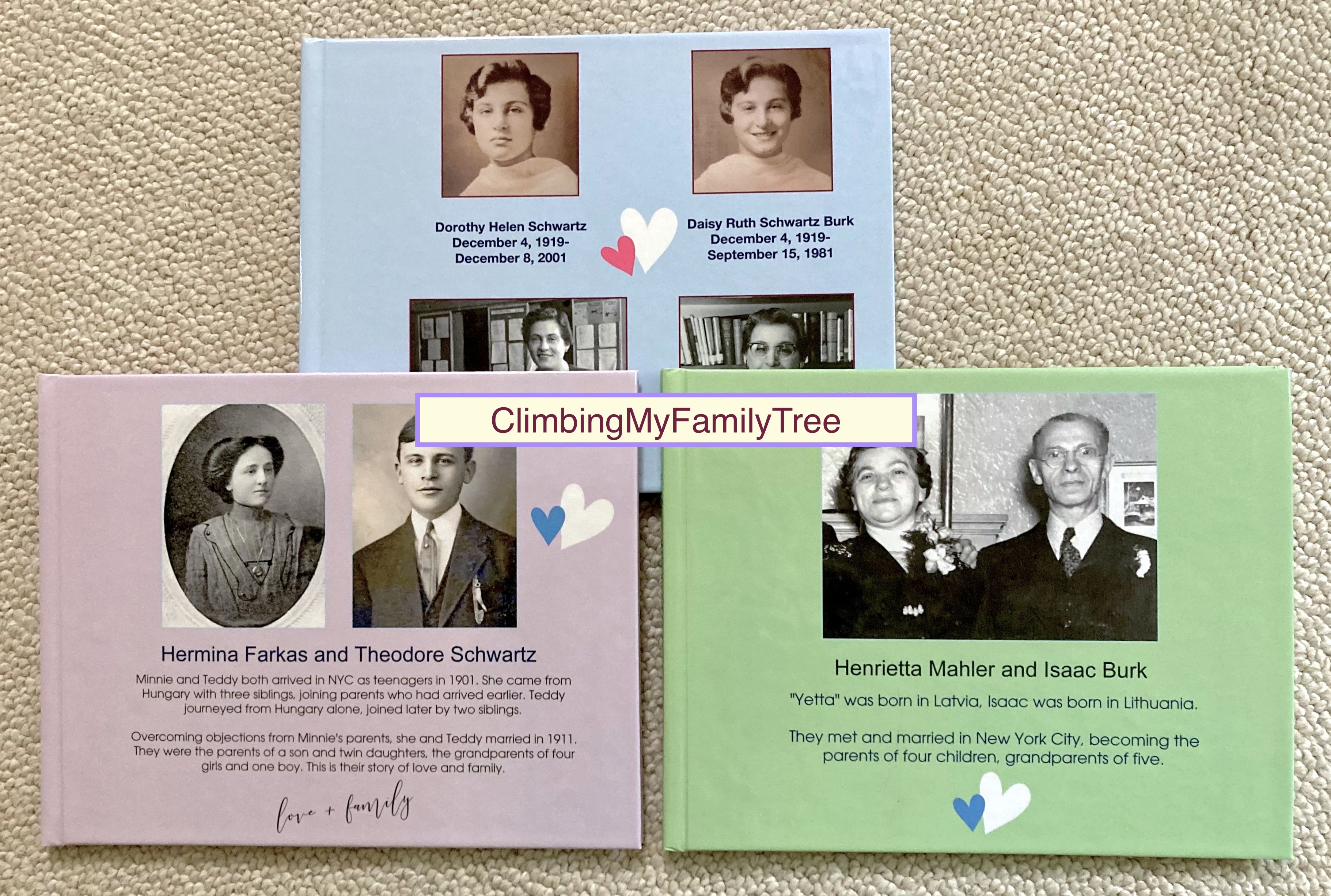
Inside My Family History Photo Books
This year I've been making a series of professional photo books as bite-sized family history projects, to be read, spark questions/conversations, and then saved for the future. Above, three from my family...two more are in the works for hubby's family.
Each of my photo books contains 20 pages, plus a glossy front and back cover. The front cover introduces the ancestors and how they are related to our family, plus a sentence or two to intrigue my readers. The covers are colorful and inviting to suggest a lively story inside.
This is just my approach--yours may be different, depending on your goals and your audience. My goal is to share family history in a conversational way, with affection and an insider's perspective so descendants get to know the people and understand a bit about family dynamics back in the day.
The interior can be expanded to many more pages but my readers (in the next generation and hopefully generations after that) don't need or want every last detail. If they want, they can take a look at my online trees to get every fact and review every document.
"Black and white is boring" according to my audience, so every page pops with color, whether it's colorful text, a bright frame surrounding a photo or two-tone hearts or other embellishments.
Curated content, illustrations and info
I curate the interior content to include basic info, life highlights, family relationships, and interesting stories, liberally illustrated with photos, maps, and snippets of genealogy documents (such as passport photos, ancestor signatures, etc). Inside a typical photo book is:
- Title page: Eye-catching photo(s) with a brief summary of how my readers are related to these people. I use wording such as..."Minnie and Teddy were the grandparents of X, Y, and Z, the great-grandparents of A, B, C, and D, the great-great grandparents of M, N, and O." Also on the title page, I include a quick overview of the arc of these ancestors' lives, like a story.
- Pages 2/3: Backstory of one ancestor, such as my grandma Minnie. Usually I begin with when she was born, who her parents were, birth order and siblings, place of birth and what was happening in that place/that family at that time. Any dramatic events are also included (death of a sibling, for instance). This two-page spread covers birth, childhood, and possibly immigration or education. Illustrations may be a map, a childhood photo(s), diploma, passenger manifest, birth record. Not a dry encyclopedia page, but a story.
- Pages 4/5: Backstory of another ancestor, such as my grandpa Teddy in a two-page spread. If this ancestor's early life intersects with the other ancestor covered in the book, I say where and when. Again, I look for the drama to keep readers turning the pages to find out what happens next.
- Pages 6/7/8/9: Following each ancestor's path from old country to new life in the United States. Occupation, helping family get settled, bringing more relatives along, how the ancestors met and their courtship and wedding. My maternal grandma Minnie and her family rode in a horse-drawn carriage to her wedding, which I noted in one book to bring the scene to life for readers. Minnie's parents were far from rich but they marked the day in style once they accepted her choice of husband (she rejected an arranged marriage). Also I included the bride and groom's signatures from their marriage cert. Not all ancestors could write well, but these two had flowing handwriting.
- Pages 10 through 15: Adult life/married life of these ancestors. For grandma Minnie and grandpa Teddy, I showed her with her children, described where they lived and the schools where the children were educated (using yearbook photos, autograph books as illustrations). I showed Teddy in his grocery store and told the story of how he was robbed during the Great Depression. Also I explained how the Farkas Family Tree (grandma's side) was founded and what role Teddy and Minnie and their children played in this organization, which lasted from 1933 to 1965. Large photos of big family events, with identification so the names and faces will be remembered.
- Pages 16/17: What happened to the siblings/in-laws of these ancestors? In the Minnie/Teddy book, I briefly summarized the lives of their siblings and spouses if any, adding photos with captions so this isn't just a list of names. Each of my books has a couple of pages of "What happened to..." because those folks were part of the family tree, whether they lived close by or far away.
- Page 18: My generation: I include photos of me and my Sis with some 1st and 2nd cousins as concrete links between family history of the past and relatives of today. I don't want cousins to be forgotten!
- Pages 19/20: Timeline of these ancestors' lives, in chronological order, from birth to immigration to marriage to children to later life to death and burial. I include Census years, saying that so-and-so was enumerated as living at ___ with occupation of ___. I might add that "cousin so-and-so was also living here," such as an immigrant cousin enumerated as a boarder. This is where I can mention many events that are "facts" but with a "story" angle. An address with context helps: "Fox Street in the South Bronx, at the time a good neighborhood for raising children."
Tuesday, September 19, 2023
Hubby's Ancestors Worked on the Railroad
As I create new family history photo books about my husband's maternal and paternal grandparents/great-grandparents, I'm doing a bit of research to provide historical, social, and economic context for their lives.
Two of my husband's Wood ancestors, father and son carpenters, were employed by a giant railroad in Toledo. In the 1880 city directory, paternal great-grandpa Thomas Haskell Wood (1809-1890) is listed as "coach builder, LS & MS R'y." His son, hubby's great uncle Alfred O. Wood (1855-1895), is listed as "carpenter, LS & MS R'y." Not everyone's occupation was listed with an employer--clearly this employer was important to the economy in Toledo, Ohio.
At top, you can see that Toledo, Ohio was a major center of the Lake Shore & Michigan South Railway (known as the LS&MS). Look at all the railroad lines feeding into it, at the western edge of Lake Erie (red circle). Lots of employment opportunities in a growth industry! This railway system evolved over the years.
McClure ancestors worked for railroads
Other men in hubby's family tree also worked in the railroad industry. According to the 1880 US Census for Wabash, Indiana, my husband's maternal great-grandpa William Madison McClure (1849-1887) worked for a railroad. In the 1900 Census for Wabash, William's son John N. McClure (1840-1919) was enumerated as an engineer for a railroad.
Another son of William, Brice Larimer McClure (1878-1970), hubby's maternal grandpa, also worked for a railroad, beginning about 1900. Family lore says he was a master mechanic for the Big Four, formed later than LS & MS and focused on travel in Ohio and the midwest.
Brice and his new bride (Floyda Mabel Steiner, 1878-1948), moved to Cleveland, Ohio in the middle of first decade of the 1900s. For at least a decade, they lived fairly close to the railyards there so he could easily commute to work. As a master mechanic with his own tools, he had his pick of jobs and worked in a variety of industries. In fact, he delayed retirement past the age of 65 to work during World War II, when his expertise was important to the war effort.
In my family history photo books, I'm going to summarize this interesting context in a few sentences plus include a map or two to inform descendants of how and where grandparents and great-grandparents made their living back in the day.
Sunday, September 17, 2023
New Family History Photo Book, New Surname Word Cloud
The front cover will have the wedding portraits of my husband's maternal grandparents, Floyda Steiner McClure (1878-1948) and Brice Larimer McClure (1878-1970), the main subjects of this book.
The point of making a professional photo book is that it looks polished and attractive, as well as being sturdy enough to last for a long time, so family history will live on and on. I see these books as worthwhile investments in perpetuating the story of our ancestors...buying on sale or with discounts to keep costs down.
This book, like my earlier photo books, will be heavy on captioned family photos and include cropped scans of a few key documents. Not one of my younger readers will have heard of a delayed birth record--something I hope will intrigue them.
Wednesday, September 13, 2023
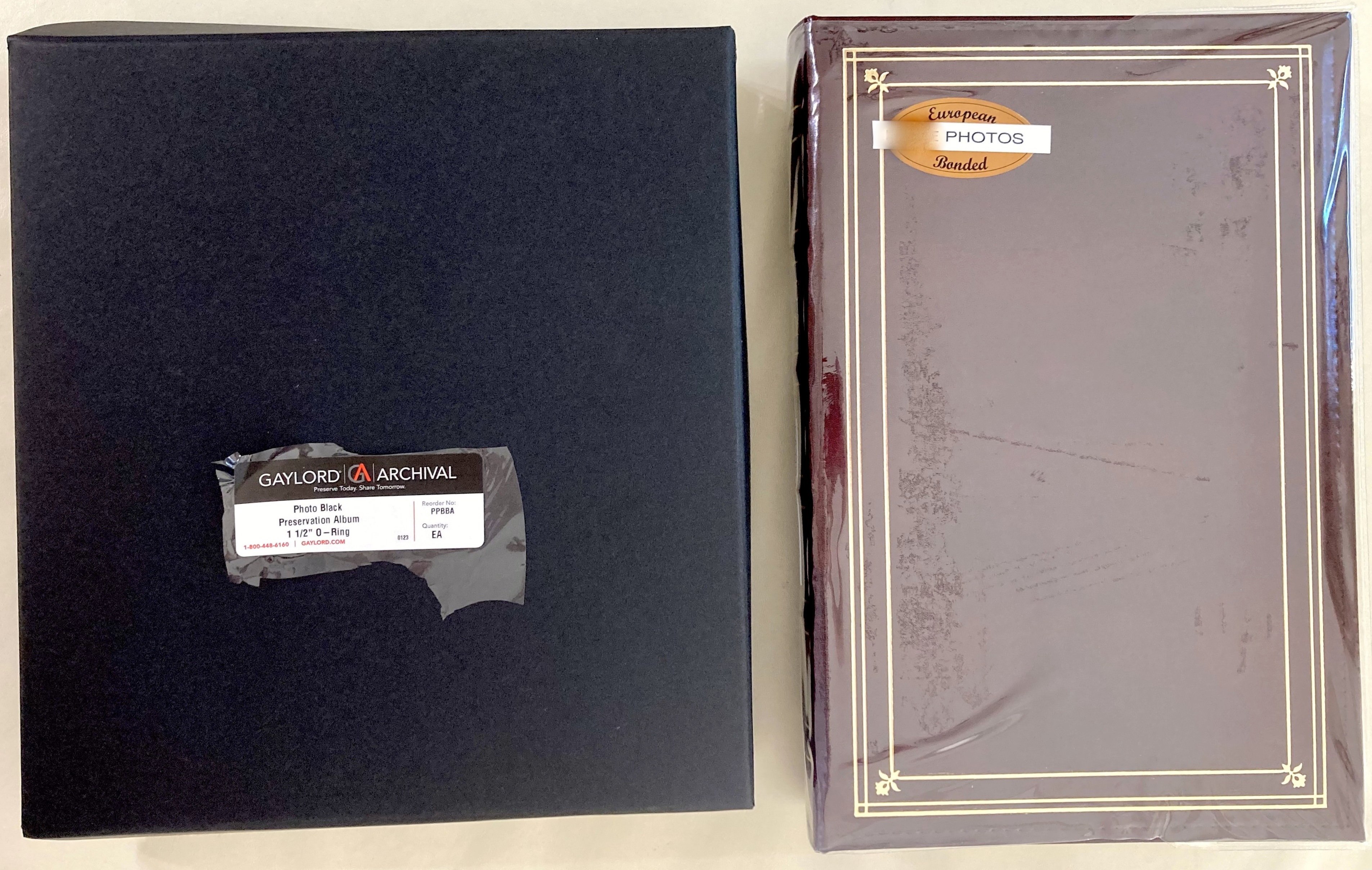
Trying Different Archival Photo Albums
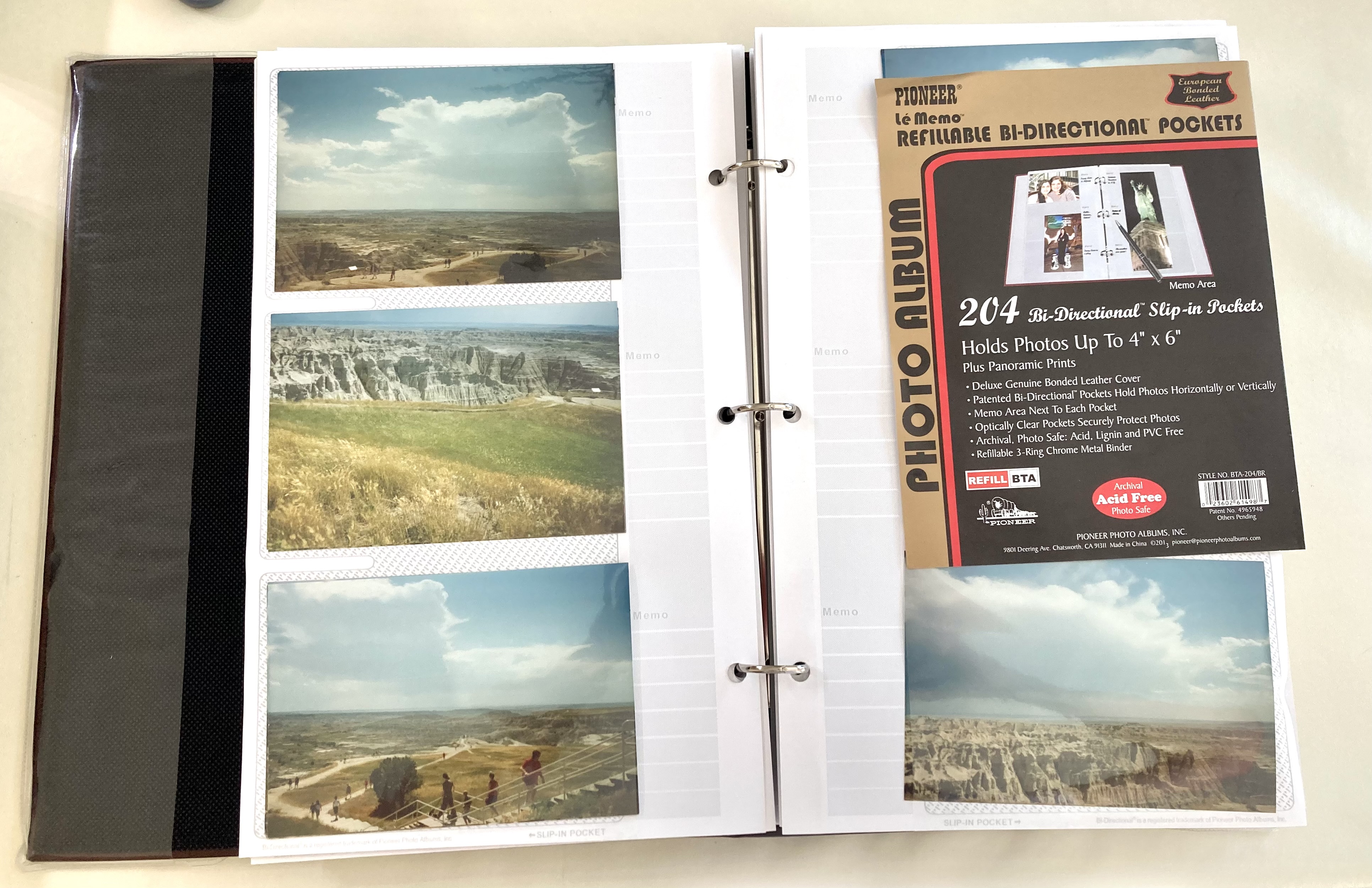
At top, two albums I'm trying out. At left is the Gaylord Archival Photo Preservation Album, which is actually a binder inside an archival box, easily stacked (it has reinforcing metal corners). At right is the sturdy Pioneer Pocket Photo Album, a tall album designed to stand upright or be stacked flat on a shelf.
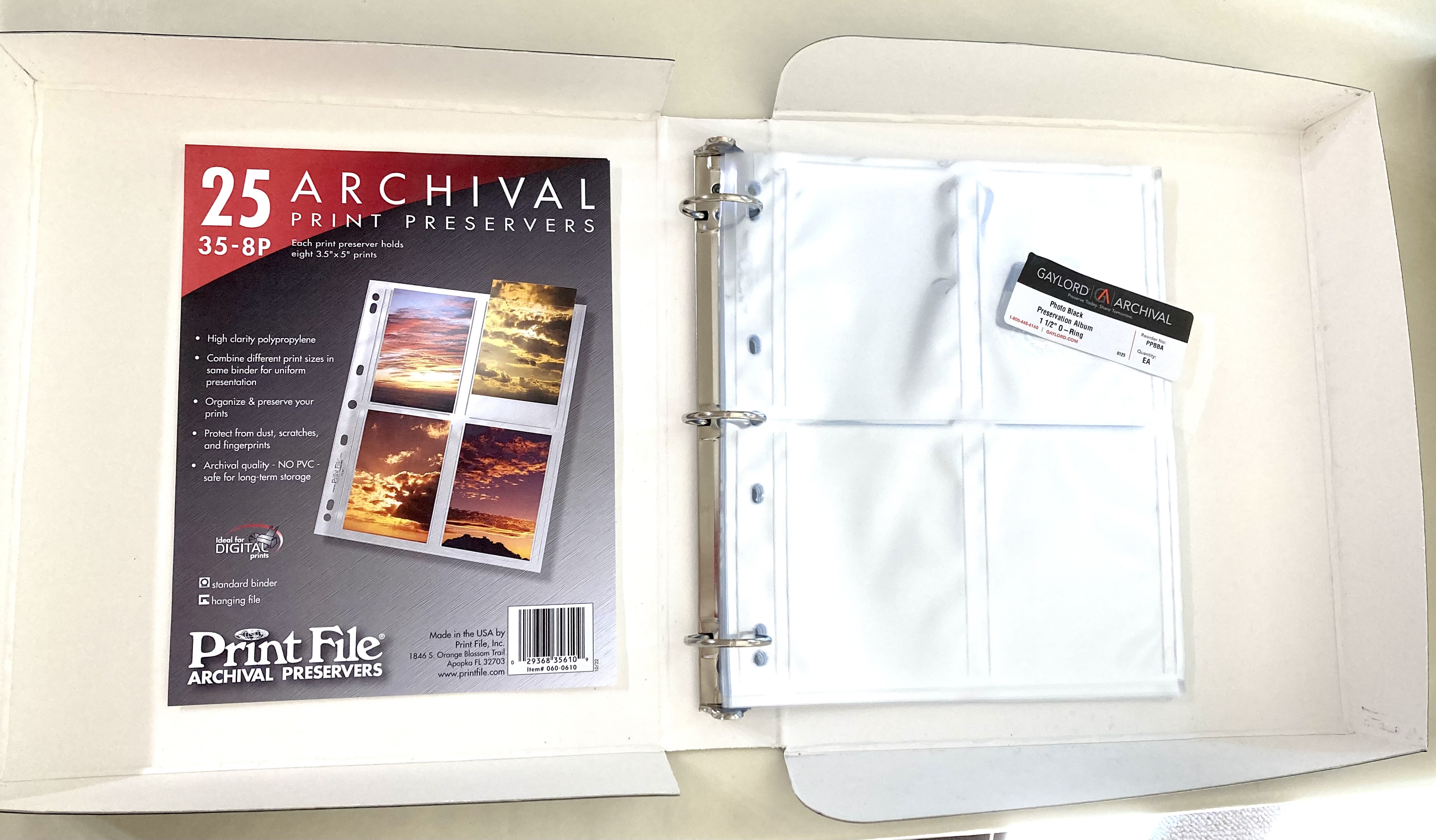
I'm a fan of archival boxes in general, because they look neat and keep the contents flat and in good shape. Above, a peek inside the box, showing the three-ring binder and archival sleeves for 3.5" x 5" photos (or smaller sizes). I have dozens of tiny black-and-white photos taken by my late dad-in-law, which will fit in these sleeves and stay put. For caption purposes, I can include notes inside the box. An advantage is that the box will hold many more sleeves to store many more photos, which are doubly safe: inside sleeves and within the archival box. Here's a closeup of the Pioneer album, which holds archival sleeves for 4" x 6" photos (or smaller images sizes). I slipped in a few photos as part of my test. The sleeves have space for written captions next to photos, a real plus because I can jot notes as I go. Although these albums are too tall to stand upright on my bookshelf, they can lay flat or be stacked. In my first try, I crammed too many sleeves into the binder and had to order a second binder to hold the overflow (lesson learned).
My test is a work in progress, and I don't have a clear preference quite yet. Either album format will keep photos in good shape for the future. No matter how you store your family photos, in albums or boxes or binders, I encourage you to think "archival" so the images and captions will be safe for the sake of many generations to come.
Tuesday, September 12, 2023
Leona Walasyk from Lodz Becomes Lee Wallace in Hackensack
As shown in the last line of the above 1950 US Census excerpt, Lee was born in Poland. By the 1930s, possibly earlier, Lee had Americanized her name to Wallace, and until I saw the 1950 Census I wasn't sure what her surname used to be. In 1950, she was enumerated as a "head of household" despite living in the same very nice home in Hackensack, New Jersey with her two brothers, Charles Walasyk and Edward Walasyk, who never changed their names.* Correction: They changed their names later in life.
Charles, also enumerated as a head, was married with two children in the household, working as a salesman. In addition, their brother Edward, a water engineer, was staying with them in Hackensack. He was married and actually lived elsewhere with his family, but was enumerated with his siblings on this Census day in 1950.
My research shows Edward was not born in Poland but actually in New Jersey, as was Charles, so I'm fairly sure none of the Walasyk/Wallace siblings actually spoke with the enumerator in 1950. Talk about prosperity: The spacious Hackensack home where they all lived in 1950 is now updated and worth a pretty penny.
Back in 1950, Lee was doing quite well, which you wouldn't know from simply reading her enumerated occupation: "public relations, department store."
I've written before that Lee headed up the famous, fabulous Macy's Thanksgiving Day Parade for a number of years, including 1950. Around this time, my mother's twin sister Dorothy went to work for Macy's and met Lee. The two hit it off, personally and professionally.
Not only did they work on the parade together, they were hired to assist with the annual Barnum Festival in Bridgeport, Connecticut in 1953. In March of that year, the Bridgeport Telegram reported that Miss Lee Wallace had "built up the Macy parade to the biggest balloon parade in the country." The final sentence of the news item reads: "Accompanying Miss Wallace was Miss Dorothy H. Schwartz, her associate."
My aunt Dorothy Schwartz (1919-2001) soon left the world of parades and publicity to become a high school teacher in the Bronx, driving from New Jersey every work day. I later learned that Lee and Dorothy were savvy with their household finances, being able to afford a brand new car every other year as well as annual summer and winter vacations. Aunt Lee had no trace of an accent, and she never spoke of her past to me, a little girl who appreciated her affection and attention.
This week's #52Ancestors prompt from Amy Johnson Crow is "prosperity."
Friday, September 8, 2023
In Beta at Ancestry: Top Hints Feature
In beta at Ancestry is a feature called Top Hints, which I'm exploring this week.
The leaf symbol captioned "beta" in the image above is where to click for "top hints for 10 people in your tree." Not every Ancestry member may have this new feature, but it is interesting because it calls attention to people from across the tree, people I may have not worked on recently. I know, I know, hints can be misleading or outright ridiculous. But ya just never know, so I do look now and then. This feature is like a variety-pack of hints from across the tree.
Clicking on the beta leaf brought up the list at right in the image. One name is blank here because it's a living relative. To look at the hints in more detail, click on the down arrow at right of each name. In my first list of hints, all were actual records or indexes, like Census documents, marriage/death indexes, or draft registrations, which I can evaluate individually. No ship illustrations or DNA strands, so far.
Above, how Ancestry explains and introduces "Top Hints."
For me, Top Hints is something to check first thing in the morning before I dive into an ongoing project, or when I have a spare 10-15 minutes at any point. Take a look and see whether you have this beta feature and how well it works for you.
As you can see from the image at top, I'm also having fun with the new fan feature in Ancestry, which I learned about from a blog post by Diane Henriks. I haven't been able to change the number of generations displayed, so as she says, this feature must still be in beta. I like the suggested ancestors shown in green on the fan, hints that I can review and, mostly, reject unless there's solid evidence to investigate.
IMHO, I'm the quality assurance person on my family trees, deciding whether to accept or reject any hint after looking at the source's credibility and relevance. Most "possible parent" hints get rejected, but occasionally those with real sources lead me in promising new directions.
Tuesday, September 5, 2023
Honor Roll: Part 5, Korean War Veterans from Bethlehem, Connecticut
This is my final post transcribing names of military veterans from memorial plaques on the historic green of Bethlehem, Connecticut. The first post in this series explains the purpose of the Honor Roll Project, originated by Heather Wilkinson Rojo and hosted here.
Roll of Honor
Dedicated to the men and women of the town of Bethlehem who served their country during the Korean War, June 25, 1950-January 9, 1955 - Erected by the Citizens of Bethlehem, May 30, 1982
Monday, September 4, 2023
A Family of Tradesmen = My Summer Favorite In-Laws
This summer, my favorite in-laws (in my husband's family tree) are the Cornwell family, a multigenerational family of silversmiths/watchmakers/jewelry store proprietors.
Asenath Cornwell (1808-1897) married James Larimer (1806-1847), my hubby's 3d great-grand uncle. As I posted a few months ago, Asenath was widowed early and made the bold decision to go to the Gold Rush with her brother, John Cornwell, in 1852. Brother and sister wrote journals of their journey and experiences. The journals are fascinating first-person accounts of that time and place.
John Cornwell (1812-1883) was a lifelong jeweler, watchmaker, and silversmith. He understood the value of gold and was sorely disappointed not to find very much during his Gold Rush years. No doubt his family was disappointed as well, since his wife and children remained in Athens, Ohio, when he was panning for gold in California. Occasionally John put gold dust into a letter for his wife Ann, but he never struck it rich.
Returning to Athens in 1856, John opened the jewelry store that successive generations of Cornwell descendants operated until 2019. As shown in the Census lines at top, John's occupation in 1860 was watchmaker, in 1870 it was silver smith, and in 1880 it was jewelry (creatively spelled).
John's son David Coleman Cornwell (1844-1938) served in Company B of the 141st Regt of the Ohio Volunteer Infantry during the US Civil War. After the war, he followed the family trade, becoming a silversmith and jeweler. Retiring in his 60s, David was already twice widowed.
Still, he couldn't stop thinking about a young lady he used to know from Athens, Ellen Jane Sams (1855-1938). Somehow David tracked her down in Illinois, according to a news report in May of 1909, discovered she too had been widowed, and quickly proposed. They were happily married for 29 years until Ellen's death in 1938. David died just a few months later.
With colorful stories like these, you can see why the Cornwell in-laws are my summer favorites.
"Tradesman" is Amy Johnson Crow's genealogy prompt for this week in her #52Ancestors series.
Sunday, September 3, 2023
Honor Roll: Part 4, Vietnam War Veterans from Bethlehem, Connecticut
In this 4th post about military memorials on the green at Bethlehem, Connecticut, I'm transcribing the wording and names of veterans from this stately plaque as part of the Honor Roll Project. My first post explains the overall project. The goal is to transcribe veterans' names and make them more accessible for descendants and relatives who search online.
Roll of Honor
Dedicated to the young men and women of the community, who by their patriotism and loyalty served God and country during the Viet-Nam War, December 22, 1961-May 7, 1975
Friday, September 1, 2023
Honor Roll: Part 3, WWII Veterans from Bethlehem, Connecticut
This is Part 3 in my series, photographing and transcribing names of veterans memorialized on plaques gracing the historic town green in Bethlehem, Connecticut. Part 1 explains more about the Honor Roll Project by Heather Wilkinson Rojo. This WWII plaque, unlike any of the previous Bethlehem plaques I transcribed, includes the name of a servicewoman, Ruth H. Goodrich.
Bethlehem WWII veterans plaque
Erected by the people of the Town of Bethlehem to commemorate the patriotism and loyalty of those who served their country during World War II. Dedicated 1947.
*Peter S. Sproule [star usually indicates war casualty]
Leon W. Banks
Thomas C. Bate, Jr.
Mark G. Kitchin
Wednesday, August 30, 2023
Honor Roll: Part 2, War of 1812 Veterans from Bethlehem, Connecticut
In this second part of my series of posts for Heather Wilkinson Rojo's Honor Roll Project, I photographed and transcribed this plaque honoring the military veterans of Bethlehem, Connecticut, who served America during the War of 1812. Part 1 shows veterans of Bethlehem who served in WWI and the US Civil War.
Dedicated to the Men of Bethlehem Who by Their Devotion and Loyalty Preserved Our Country in the War of 1812
Monday, August 28, 2023
Honor Roll: Veterans from Bethlehem, Connecticut
On a beautiful summer's day, Sis and I visited Veteran's Memorial Park in Bethlehem, Connecticut for a quilt show. During that visit, we photographed a number of dignified plaques remembering local veterans who served their country in the American Revolution, War of 1812, Civil War, WWI, WWII, Korean War, and Vietnam War.
Honor Roll Project
My photos and transcriptions are part of Heather Wilkinson Rojo's Honor Roll Project. Although she is not actively promoting this project these days, due to lack of interest during the pandemic years, I'm delighted she will add my Bethlehem links to her project page.
The meaning of this project, in Heather's words: "The transcribed names make the soldiers available for search engines, so that descendants and family members can find them on the internet."
This is the first in a multipart series honoring the military veterans of Bethlehem, CT whose names are inscribed on the town's memorial plaques. Part 2 features veterans from the War of 1812. Part 3 features WWII veterans. Part 4 features Vietnam War veterans. Part 5 features Korean War veterans.
Bethlehem Memorial: Civil War and WWI
This plaque reads:
A tribute to the valor of the men of Bethlehem who fought for freedom and humanity
Civil War, 1861-1865
Joseph Boyce
Gideon D. Crane
William B. Crane