Tuesday, August 22, 2023

Are Genealogy Blogs Still Relevant?


Years ago, I followed and browsed hundreds of genealogy blogs each week. Some focused on the blogger's own family's history; some explained technical aspects of genealogy; some discussed researching specific geographic locations or ethnic groups; some examined old family photos; some documented particular cemeteries; some profiled military ancestors; and on and on. 

I didn't read every post, but I skimmed whatever caught my eye and sometimes found myself marveling at somebody's unexpected discovery. Found myself cheering for bloggers who found elusive ancestors, following along as bloggers visited graveyards or ancestral villages in search of new connections, hoped bloggers would finally get their hands on something that confirmed long-held hypotheses. 

From genealogy bloggers, I learned so many new tips and tricks that helped me with specific websites or software or research resources or translation challenges. Along the way, I enjoyed getting a sense of each blogger's personality, interests, and family history background. 

That was then, this is now

Today, after removing bloggers who haven't posted anything at all in 2023, my feed is down to just 45 genealogy blogs--some of which have only a handful of posts so far this year. In addition, I periodically dip into selected blogs written by Geneabloggers members. But here again, some bloggers have ceased posting in recent years or post quite irregularly. 

I know there are bloggers who've transitioned to videos and podcasts rather than writing individual blog posts. Also some have chosen a deep dive into more interactive social media and cut back on blog posts. 

Meanwhile, the world of social media has been fragmented in recent months by the ongoing turmoil on Twitter/X and the emergence of competitors such as Mastodon and BlueSky and Threads and ... [fill in the blank with latest and greatest]. Thankfully, Facebook genealogy groups continue to offer advice and assistance when participants need local knowledge or research suggestions. Although I'm not on Instagram, some genealogy folks love the platform. I'm on Pinterest but only to pin my blog posts. 

Why read? Why blog?

Despite all the alternatives, I believe genealogy blogs are still relevant. In fact, I hope blogging (or family history websites) will be making a comeback. The genealogy community is strong and vibrant and generous with help and ideas. I can't count the number of times I've learned about a new technique or specialized resource from a blogger, and as a result, made a fresh discovery or gained fresh insight. 

With a genealogy blog, I can write what I like, whenever I feel like writing, and it's available for you whenever you feel like reading. Nobody is restricting the length of my blog posts or the topics or how many posts I can write. Nobody is throttling your ability to follow my blog or read any post. I get blogging ideas from my own research, from the brickwalls I face or the discoveries I make, from posts by other bloggers, from comments by readers, and from prompts such as the #52Ancestors series from Amy Johnson Crow.

As I've said in the past, for privacy reasons, I don't name living relatives. If I want to mention a relative who's alive and kicking, I might refer to "Cousin B" or "Philly Cuz." My personal choice is to avoid posting family history info that might cause distress or harm to someone still living. So far as I know, there are no bigamists or murderers in my family tree, but if I discovered one and a descendant was still alive, I wouldn't blog about that situation. 

And, as a reader pointed out in a comment, blogs are excellent cousin bait, today and tomorrow. Posts are available 24/7 whenever anyone is searching for a surname or ancestral town that I've mentioned at any point in the past.

I've been on this genealogy journey for 25 years, and blogging about it for nearly 16 years (my Sweet Sixteen blogiversary is in a few days). If you're a genealogy blogger, I thank you for helping me along on this journey and inspiring me to keep digging. If you're not blogging, maybe this is a good time to begin?

Sunday, August 13, 2023

Dating Family Photos and Investigating Photographers

Most of the old family photos I inherited had no dates but had some clues to help me determine when, not just who. Now MyHeritage had introduced its new PhotoDater feature, which provides an estimated date as a starting point if we need clues. IMHO, it's a very exciting feature that is well worth taking for a spin.

Dates plus/minus 5 years

The first photo I tried was of my Dad, Harold Burk (1909-1978), holding his elementary school diploma after graduating from PS 171 in East Harlem, NYC. (Today, that school is Patrick Henry Elementary School.) Since I have Dad's diploma, I know the exact date of graduation, even though there is no year noted on the photo itself. In less than a minute after I uploaded this photo, MyHeritage's PhotoDater suggested an estimated date of 1923. Right on the nose! 

Although I don't expect PhotoDater to pinpoint the exact year for every photo, this is a quick and easy way to estimate the dates of mystery photos, in particular. Be aware that the feature typically provides a date that is plus or minus 5 years. Also, the technology intended to date photos taken between 1860 and 1990.

Of course, nothing replaces the in-depth expertise and insights of professionals like Maureen Taylor, the Photo Detective and Sherlock Cohn, the Photo Genealogist. But estimating the date of a family history photo via PhotoDater can at least put me on track toward more complete identification. I highly recommend this new feature and suggest you give it a try! For more info, see the MyHeritage blog here.

Researching a photographer?


Since all four of my immigrant grandparents settled in New York City, I was pleased to discover the NYC Public Library's Photographers' Identities Catalog. This database isn't confined to the Big Apple, but it does have many of the photographers who snapped my ancestors' posed portraits.

Above, I filtered my catalog search by surname of the photographer, Beldegreen. Two are in the catalog--including the one I sought, Gustave Beldegreen. 

Below, when I clicked on Gustave Beldegreen in the results, I got this page, showing that some of his photos are in the collection of the Museum of Jewish Heritage (link also), sources of info (links), and birth/death dates, studio locations. I can compare the studio locations with the home addresses of my ancestors to narrow down the date/place if the photographer's full info is missing from an old photo. Try this with one of the photographers from an old family photo in your collection! Again, the link to the catalog is here.

ONE MORE LINK! Thanks to a kind geneadon on Mastodon, here's a link to Langdon's List of US photographers active in the 19th and 20th centuries. My guy Beldegreen is on the list, having been named in a city directory. Another resource new to me!

Thursday, August 10, 2023

WikiTree Day Celebrations, Nov 3-5

WikiTree Day Symposium imageWikiTree, the free site where participants add ancestors to build one family tree, is celebrating its 15th anniversary in early November. 

Everyone is invited to enjoy two days of free virtual genealogy presentations plus trivia quizzes, prizes, and more. 

I'm one of two dozen speakers speaking on Friday, November 3 and Saturday, November 4. Symposium speakers and topics are listed here. The virtual celebration continues on Sunday, November 5, with panel discussions, exploration of AI and genealogy, and of course a party is on the schedule, as shown here.

My 15-minute talk, scheduled for 5 pm Eastern time on November 3, is: 

Keep Your Family's History Safe for the Future! At times, the safest place for some family history items may be in the collection of a museum, library, archive, genealogical society, or another institution. Learn about the process for donating an ancestral artifact, from investigating potential repositories and understanding their collection priorities to documenting your item's provenance, approaching curators, receiving approval to donate, and signing a deed of gift transferring ownership to the institution. 

Here's where to register for WikiTree Day (did I mention this virtual content is entirely free?!). Mark your calendar to attend any or all events in November. See you then! 

Tuesday, August 8, 2023

Work, Larimer, and Short Family Reunions, 1900-1920


On and off for two decades, my husband's Larimer ancestors gathered with their Work and Short cousins/in-laws/friends for reunions in and around Elkhart, Indiana. Cynthia H. Larimer (1814-1882) married Abel Everett Work (1815-1898) in Fairfield County, Ohio, in 1836, and her niece Margaret Larimer (1825-1877) married Thomas Short (1820-1885) in Elkhart County, Indiana in 1842. Each of the news items reporting on these reunions added a few clues to help me identify children, grandchildren, and in-laws as I researched relationships, full names, and dates for this part of the family tree.

The three families of Work, Larimer, and Short "are bound by ties of blood and early friendships," as reported in the reunion coverage by the Elkhart Daily Review of June 26, 1901. This news item listed some of the 110 reunion attendees, including the "dean of the party," my hubby's 2d great-grandpa, Brice Larimer (1819-1906), the oldest participant. At this time, the three families had an actual organization, with elected officers who planned the reunions in advance.

Some creative math is used to count the number of annual reunions held. The 1901 news item said the Work, Larimer, and Short families were holding their second annual reunion. When the same newspaper covered the three-family reunion in 1903, it was called the fifth annual reunion. 😉

A scaled-down reunion was held in 1904, according to this same newspaper, with only Work relatives in attendance instead of all three families being represented. In 1906, the Elkhart Weekly Review reported that up to 50 attendees were expected at a three-family reunion in August. 

Finally, the Elkhart Truth of May 20, 1920 described a Work-Larimer reunion held by "descendants of Abel Everett Work and Isaac Larimer." The Work, Larimer, and Short branches of the family tree were all represented. Maybe that was the last reunion, because I haven't found further news coverage. I'm grateful for any news coverage at all, adding to the clues as I check every name, age, family connection, and location.

To commemorate these intertwined families, including surnames of earlier and later generations, I created the colorful word cloud at top. Here's the free site I used.

"Reunion" is this week's genealogy prompt for #52Ancestors, from Amy Johnson Crow. 

Friday, August 4, 2023

How My Immigrant Grandparents Helped Other Immigrants in NYC


My maternal grandparents were immigrants from Hungary who came through Ellis Island as teenagers, years before they met each other. 

Theodore "Teddy" Schwartz arrived alone in March of 1901, at age 14, and parlayed his flair for languages into a job as runner for the steamship lines. Hermina "Minnie" Farkas arrived with three siblings in November of 1901, age 15, joining her parents who had earlier come to New York City. She sewed silk ties to earn money for the household while learning English at night classes.

Leaders in the Kossuth Ferencz Association

Minnie, Teddy, and some of their siblings were active in the Kossuth Ferencz Literary, Sick & Benevolent Association, from its founding in 1904 in New York City. My grandparents were still teenagers and had only lived in the Big Apple for a few years at that time, and they barely had two nickels to rub together, yet they jumped right into a new group to help other Hungarian immigrants get a fresh start. 

Happily, I have a 1909 souvenir booklet for the Kossuth Association's fifth anniversary, in Hungarian, that describes the group and its accomplishments. I typed a few words into Google Translate for quick translations, but I really wanted more specifics about what the Kossuth Association did for immigrants.

Google Lens helps with translation

Yesterday I tried Google Lens on my iPad, which involves photographing the page or a few sentences and then having the app translate what it "reads." I'm not a tech wizard, so for more about the mechanics, please do an online search for articles or videos like this one. Google Lens is compatible with both Apple and Android devices.

At top, a side-by-side comparison of the 1909 financial report in Hungarian (original) and English (via Google Lens). This quick-and-dirty translation is far from perfect, I'm well aware, but it does suggest how the Kossuth Association actually served immigrants. 

Services for immigrants

The association had a good deal of money in the bank ($436 in 1909 is worth $14,600 today). It spent the money on renting a ballroom for its big yearend fundraiser, buying a library cabinet and books, badges for its members, and 11 medals to award to officers ("medals" not properly translated by Google Lens, but I checked with Google Translate). 

The accounting also shows a small advance payment to a cemetery--part of the association's affordable burial services for members. Later, the group purchased a large plot at Mt. Hebron Cemetery in Queens, New York, where nearly 600 members and their families are buried (including my immigrant grandparents). 

What this financial accounting doesn't show is that the association had a long-time physician, Dr. B. Hohenberg, to help members. So as the full association name indicates, it provided literary services (books), medical aid (a physician's care), burial services plus even more by partnering with other agencies and service groups in the area.

Over the years, my Grandpa Teddy served multiple terms as Kossuth's treasurer. My Grandma Minnie's brothers Alex and Albert served multiple terms as president and in other official positions. Both Alex and Albert met their wives through Kossuth activities. Alex and his wife Jennie were movers and shakers on the cemetery committee. Of course I've described their dedication to volunteerism in my most recent family history photo book, about my Farkas and Schwartz ancestors. This is one way I'm keeping family history alive for future generations. 

Tuesday, August 1, 2023

Backup Day: LOCKSS and Paperless Genealogy


LOCKSS = Lots of copies keeps stuff safe! Academics came up with this phrase to describe a systematic process of digitizing and securing multiple copies of key data, at a decentralized level.

For genealogists, this translates into:

  • Back up often (ideally, every day if you make significant changes to files on your computer - preferably, once a week or at a bare minimum, once a month).
  • Use multiple methods of backing up (as shown above, this can include external hard drives, USB drives, plus cloud backups and other methods--not just in your home but also externally just in case).
  • Share data with your family (digitally, with paper, or both - decentralizing).
  • Share data, with privacy in mind, on selected genealogy sites (I use WikiTree, Ancestry, MyHeritage, FindMyPast, Find a Grave, and more).
  • If you've digitized old family photos, be sure those files are secure in more than one place (decentralizing).
And please, don't go entirely paperless. Original documents and photos, in particular, are very important for today and tomorrow, but printouts of stuff downloaded from online sources can be recycled or shredded IMHO. Here's one approach.

Finally, remember to test and replace your backup hardware every so often. Hard drives don't last forever...I've upgraded one of my hard drives since taking the photo at top. As I say in my book, Planning a Future for Your Family's Past, it's money well spent when we preserve digitized files and images from our family's past so they won't be lost and can be shared with future generations in the coming years.

Thursday, July 27, 2023

When Grandpa Teddy Made News in 1937


A few years after I began my genealogy journey, I used my local library's access to the New York Times historical database to research my parents and grandparents. Since many ancestors lived and worked in the New York City area, I expected to find mainly birth/marriage/death notices and an occasional mention of a business or a graduation.

What a jolt to find a news item about an armed robbery spree on the night of December 16, 1937. The first store robbed was owned by my grandpa, Theodore Schwartz (1887-1965). Here's what the reporter wrote:

Band Robs 3 Stores; three armed men get $300 in series of Bronx raids

Three armed men within an hour and a half held up three storekeepers in the Bronx last night and escaped with $300. About 9:30 o'clock they entered the grocery store of Theodore Schwartz at 679 Fox Street, hit him on the head with a pistol butt when he resisted, and took $50. Half an hour later, they went into the grocery store of Louise Lepperman at 422 Jackson Avenue and hit him with a pistol, but left quickly when his wife screamed from a back room. In another half an hour, they forced Leonard Gaglio and his brother, Milton, liquor dealers at 1012 Morris Park Avenue, into a back room and took $250.

Yikes, this was during the Depression when money as scarce and store owners sweated over every penny. The $50 stolen from Grandpa Teddy 86 years ago would be worth about $1,000 in 2023. Poor Grandpa had to go home and give Grandma the terrible news--it must have been an awful scene. Let me add that in 1937, the Bronx was not a high-crime area, but shopkeepers who stayed open late were a tempting target for sure. 

Grandpa Teddy and Grandma Minnie (Hermina Farkas Schwartz, 1888-1964) owned and operated a small dairy store for about 40 years, changing locations a couple of times and finally selling and retiring in 1955. No news coverage of all the years of routine drudgery, opening the store early and closing it late six or seven days a week, standing on their feet for hours, trying to cover all the bills.

Using the wonderful photo enhancement tools at MyHeritage, I brought Grandpa and his store to life in a way that recalls his usual good humor, not the terror of being robbed at gunpoint. Of course I'm telling Grandpa's story of being "in the news" in my latest Farkas/Schwartz family history photo book.

"In the news" is this week's 52 Ancestors genealogy challenge from Amy Johnson Crow.

Monday, July 24, 2023

Book Review: "History for Genealogists"


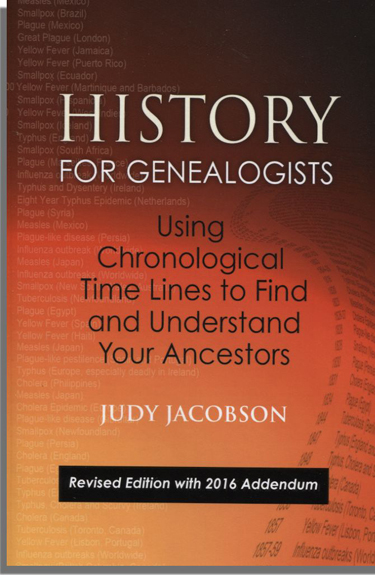
As a fan of timelines for family history, I have a great appreciation for the many condensed historical timelines and background explanations included in Judy Jacobson's History for Genealogists, published by Genealogical.com and updated in 2016. 

The subtitle of this book really says it all: 

Using chronological time lines to find and understand your ancestors.

In ten chapters plus bibliography, index, and addendum covering the 20th century's two big wars and Great Depression, as well as a 20th century fashion and leisure timeline, Jacobson provides the building blocks needed to put our ancestors into historical and social context. And, as she ably points out, understanding chronology can help us locate elusive ancestors by suggesting where people might be at a certain point in history.

The index is excellent, more than 30 pages long. I found it particularly helpful for pinpointing pages with info and timelines on ethnic groups, immigration patterns, military conflicts, state-by-state settlement, Westward expansion, and many other specific topics. Interestingly, "Mayflower" was not an index entry but "Plymouth" and "Plymouth Colony" were both in the index. So do consider a variety of ways to describe your ancestor's past and investigate all of this terminology in the index.

Here is the jam-packed table of contents:

  1. Seeing Ancestors in Historical Context
  2. Creating a Time Line: Why? How? Case Studies
  3. Why Did They Leave? Military, foreign skirmishes, racism/injustice/unrest, politics, religion, disease, economics, disasters
  4. How Did They Go? By road, rail, water, air
  5. Coming to America (including historic migration patterns, traditional trails and roads)
  6. Myths, Confusions, Secrets, and Lies
  7. Even Harder to Find Missing Persons (including name changes, slaves, orphan trains, place-name changes, changing boundaries, more)
  8. Social History and Community Genealogy (immigration, industrial revolution, associations/unions, genealogy in books, oral histories)
  9. State by State Timelines (including Colonial times)
  10. Region by Region Timelines (North America and well beyond)
For folks like me who are researching immigrant ancestors in my tree and hubby's tree, the chapter on coming to America (Chapter 5) includes a 4-page detailed timeline of who tended to leave their European homelands and settle in North America. My hubby's tree includes Scots-Irish who were part of the movement shown in the timeline on p. 66 and discussed on 11 other pages in the book. My own immigrant grandparents are put in historical context by the timeline on Russia (and nearby places, including Lithuania) beginning on page 238. And as a native of the Bronx, the New York state timeline is of great interest.

I highly recommend this book as a reference tool for understanding the sweep of family history and putting individual decisions into the context of local, regional, national, and international history.

Please note: I was given a free copy of this book for review purposes, but my opinions are entirely my own.