Wednesday, July 19, 2023

Chronicling My Farkas Ancestors


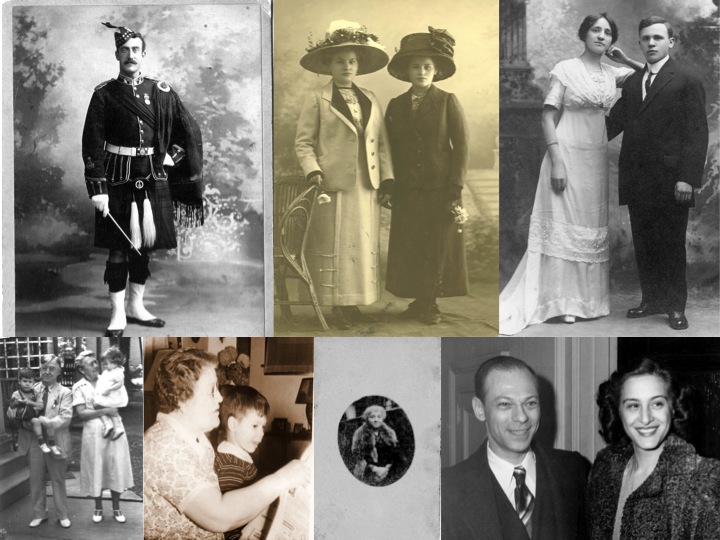
My latest family history photo book is about my Farkas ancestors, starting with the journey-takers who came to America at the turn of the 20th century. 

Great-grandfather Moritz Farkas (1857-1946), born in Hungary, was financially ruined when a hail storm destroyed his crops, leading him to sail to New York in search of a new life in 1899. A year later, his wife, great-grandma Leni Kunstler Farkas (1865-1938) followed him to New York. Their eight children arrived at Ellis Island in two groups during the next couple of years...and then they got to meet the three youngest children who were born in Manhattan.

My grandma Hermina Farkas was in the first group of children to be reunited with their parents in a tenement in the Lower East Side of Manhattan. Refusing an arranged marriage, she married grandpa Theodore Schwartz in 1911. 

The photo book under construction includes a colorful word cloud featuring the many surnames and given names of the Farkas and Kunstler and Schwartz ancestors in my family tree. I use this free word cloud generator.

Just this week, I wrote a brief bio of my great uncle Fred Farkas (1903-1980) for the photo book. Fred, named for his late grandfather in Hungary, became an accountant and worked for Stinson Aircraft during WWII. Later, he became vice president and controller for Jacobson's Department Stores in Jackson, Michigan. 

Happy birthday to Fred, born on July 15th, 120 years ago this week. He and his parents and siblings are among the Farkas ancestors I'm chronicling in this latest photo book.

"Birthday" is the week 29 genealogy prompt for Amy Johnson Crow's #52Ancestors series. 

Thursday, July 13, 2023

Looking for Little Marks on Census Pages

In recent months, my local library (bless them!) has acquired a dozen genealogy books from Pen & Sword, focusing on family history research across the pond. One by one, I'm borrowing these books and trying new approaches for tracing UK ancestors in my family tree and my husband's tree.

Learning about the UK Census

This week I read Emma Jolly's excellent, detailed Guide to Tracing Your Family History Using the Census. The 2020 edition is updated from her earlier book, and explores the specifics and context of Census documents from England, Wales, Ireland, and Scotland. This guide gave me a better appreciation of who and what I might actually find in the Census records. 

Emma's book goes beyond the actual Census questions to explain why various questions were added or changed every ten years, and what to be aware of when interpreting answers. Because I'm a Bronx native, her summary of historical context was especially helpful for understanding the background and evolution of UK Census documentation from early days to the 20th century. 

Just as important, Emma decoded the marks delineating separate households and separate dwellings, which I had not paid close attention to when I originally looked at these Census documents. I know the little clues to check on US Census documents (such as the X in a circle in the 1940 US Census, showing which household member spoke with the enumerator) but I'm far less familiar with Census documents from elsewhere.

Check those little marks

With Emma's guide in mind, I revisited the 1871 Census of England page for Sarah Harris Slatter Shuttleworth (1814-1872), hubby's great-great grandmother, and her second husband, John Shuttleworth (1812-1878). The transcribed record shows three names of grandchildren in the household, but I *always* try to look at the actual image if available.

As shown directly above, John and Sarah were enumerated at the bottom of a Census page, with only two grandkids listed. I've circled in red the double diagonal lines that indicate the end of a dwelling, just above John's name. Notice there's no mark after the second grandchild, who's the last name on the page.

At the top of the next page is the third grandkid, and near her name, a single diagonal line--end of a household, not end of a dwelling. Three more names are listed in a separate household at same dwelling, then a double diagonal line--end of that dwelling.

Small marks but meaningful, because not seeing the end of a household was a reminder to check the next Census page for the remaining grandchild who was actually listed on the transcribed record. Folks who regularly search these UK Census documents are, I'm sure, very aware of these small marks, but I'm still getting comfortable with the context and nuances of genealogy documents from across the pond.

Note: Shuttleworth became a middle name for a few boys born in later generations. Seems to me that the grandchildren wanted to honor their step-grandfather by perpetuating his surname. He must have been a positive influence!

Sunday, July 9, 2023

Mid-Year Progress on 2023 Genealogy Priorities


Here we are, halfway through 2023! Randy Seaver's Saturday Night Genealogy Fun prompt is to write an update on the status of our goals and priorities for the year.

At the start of my 25th year as family historian, I said my priorities would be: 

  • Continue writing bite-sized ancestor bios - I'm slowly but steadily writing and posting more bios, mainly short ones, on multiple genealogy platforms. When I come across an ancestor or ancestor-in-law without a FindaGrave memorial, I jot a memo to create one, as I did for my husband's 1c1r Edward Sherman Lower and his wife, Jeanette Jenkins Lower. NOTE: I don't mention living people in bios, for privacy reasons.
  • Research ancestors and FAN club members of particular interest - Yes, moving ahead with this especially in-laws. Just this week I went down the rabbit hole researching the cousins of my hubby's 2c3r Elfie Asenath Mosse. Fascinating family background--collecting colorful stories that I know will engage the next generation.
  • Genealogy presentations - It was a busy first half for presentations, including my new Fold3 program, which I presented six times. The most-requested talk remains Planning A Future for Your Family's Past, which I'll be giving again in September for the folks at WHAGS (West Houston Area Genealogy Society).
  • Genealogy education - I've watched a ton of informative webinars so far in 2023, including live talks hosted by various genealogy clubs. TY to the many thoughtful presenters who provide detailed handouts, which guide me in applying what I've learned even weeks after the talk. 
  • Resume moving photos into archival photo albums - um, no progress yet but my Sis will be helping me in coming months. For now, old family photos are stored safely in archival boxes.

    A top priority I didn't even have at the start of 2023 is to create professional photo books of specific ancestors, families, and/or events. Early this year, a young relative asked about our family's participation during World War II. Oh yes, I know a lot about that topic and created a small (6 inch x 6 inch) photo book filled with photos and stories. Currently, I'm creating my fourth photo book of the year, the longest book because I knew these ancestors personally and have lots of photos and anecdotes. 

    More family history photo books to come and more genealogical adventures to come, including my second WikiTree Connect-A-Thon of 2023, beginning on July 14th. 

    Wednesday, July 5, 2023

    Book Review: "Yours Truly"


    Journalist and professional obit writer James R. Hagerty has read and written a lot of obits. In Yours Truly, he explains why and how each of us should write our own story, sooner rather than later. As Hagerty says in his intro:

    "Someday the story of your life will be written. The only question is how well or how badly it will be written--what sort of picture it will leave behind for friends and family members, including those not yet born."

    Every family historian who's ever researched an ancestor will appreciate the significance (even the thrill!) of discovering an obit in a newspaper or, these days, on a website. The best obits, in Hagerty's view, reveal more than just bare facts, giving a glimpse of the person's personality, attitudes, ambitions, struggles, dreams, accomplishments, and disappointments.

    Yours Truly is a concise and engaging how-to book, an encouraging road map for writing a life story (whether in print or recorded). Chapter 6 includes specific questions to answer, including earliest memories, the best and worst periods of our lives, and more. "In life stories, generic will never do," Hagerty advises, because it's the details and quirks that give a real sense of the person. 

    Chapter 17 covers sensitive issues about honesty, with the caveat: "When you write a life story you don't have to give away all your secrets or resurrect all your family feuds." Still, the author suggests acknowledging some of our shortcomings or at least admitting when our plans didn't work out as we'd hoped.

    Be sure to include historical context, such as what was happening on the day of your birth, and verify oral history, says Hagerty. His own research showed that the day he was born was cool and rainy, even though his mother remembered it as a hot summer day.

    In the end, there are a variety of reasons to take the time to tell our life story, Hagerty says: "It's a way to acknowledge your failures, explain a few things your friends and family could never understand, celebrate whatever good fortune you've had, and thank those who gave you a hand or a smile when you needed it."

    Yours Truly is punctuated with dozens of readable, fascinating life stories that are anything but dry and generic, whether about someone famous or an ordinary person. Readers learn how to bring life to a life story, showing a bit about what makes each person tick, with touches of vivid imagery or an unexpected last-minute twist we never see coming. 

    I enthusiastically recommend James R. Hagerty's book for ideas and motivation as we document the lives of our ancestors and tell the stories of our own lives.

    Want to see the author interviewed about Yours Truly? Enjoy this YouTube interview conducted by Malaprop's Book store.

    Tuesday, July 4, 2023

    Ancestors Born on the 4th of July

    My husband and I both have ancestors who were born on July 4th, Independence Day. I'm celebrating them with this penny postal greeting card sent to the Wood family 116 years ago.

    In hubby's family tree, Thomas Jefferson Isaiah Haskell Wood was born on July 4, 1848 in Plaquemine, Iberville, Louisiana. He was the second of 17 children born to my husband's great-grandparents, Thomas Haskell Wood and Mary Amanda Demarest. Unfortunately, according to the Wood family bible, this young man drowned in 1861, at the age of 12, while the family was living in what is now Huntington, West Virginia. 

    In my family tree, great uncle Samuel Schwartz was born on July 4, 1883, in Ungvar, Hungary, which is now Uzhhorod, Ukraine. His younger brother, my grandpa Theodore, was the first to leave for America. Sam followed in his footsteps three years later, in 1904. While researching his life, I was surprised that Sam returned home to Hungary 25 years after he left, to attend the wedding of his niece, Leni Winkler, who married Jeno "Eugene" Preisz (Price). Happy to know that Sam saw their family in person, since grandpa was never able to return to Hungary.

    Happy Independence Day 2023!

    Saturday, July 1, 2023

    Happy Canada Day! 1931 Census Shows Cousin Rose's Maiden Name Too


    Happy Canada Day! Now that Ancestry has done an incredible job of quickly indexing the 1931 Canadian Census, I'm having fun finding records for the ancestors who lived there. As always, I compare Census info with what I already know, as a double-check on accuracy.

    My 1c1r, Rose Berk (1904-1994), was the oldest child of my great-uncle Abraham Berk (1877-1962) and his wife, Anna Horwich Berk (1880?-1948).

    Rose married Abraham Marks (originally Marcovitz) in Montreal on December 20, 1925, as shown at top in this excerpt from the Drouin Collection. The groom was born in Romania, bride born in England, and those birthplaces match other records I've found for them both.

    When I researched Rose and Abraham in Montreal in the 1931 Canadian Census, I was surprised to see Rose's maiden name shown as her middle name! Not spelled as it was in her family (Berk was the usual spelling prior to marriage) but clearly recognizable.


    However, as circled in red above, I also discovered an inaccuracy. According to this Census, Rose's father was born in England. Nope. Her father, Abraham Berk, was most definitely born in Gargzdai, Lithuania, along with all of his siblings (including my paternal grandfather, Isaac Burk--yes, he spelled his surname differently from his siblings). Yet Rose and her mother were, in fact, born in England, as noted by the enumerator.

    Reading Ken McKinlay's decoding of the abbreviations shown next to parents' birthplaces, I see Rose's parents are coded as BB = father and mother born as British subjects. Nope. If Rose's father had been correctly listed as born in Lithuania or Russia, the coding should have been FB = father born in foreign country, mother born as a British subject. But as shown, the coding corresponds to what the enumerator was apparently told--both parents born in England, even though not true.

    An interesting twist: Because Rose's maiden name is shown in this Census, I believe she was most likely the one to answer questions on behalf of the family. Either she didn't understand the question about father's birthplace or she misinterpreted the question to be about citizenship. This inaccuracy is why I like to compare Census answers to what I've already confirmed from other documentation.

    Wednesday, June 28, 2023

    Checking Page Two--Twice--for Great Uncle Albert

    My great uncle Albert Farkas (1888-1956) died on this date, 67 years ago. I'm focusing on my Farkas ancestors as part of my series of family history photo books.

    Albert and his wife, Sari Klein Farkas (1901-1982) often entertained dozens of Farkas relatives for big holidays, according to meeting minutes from the Farkas family tree association, 1933-on. Albert didn't marry Sari until he was in his early 30s, and I know from descendants that they were warm-hearted, generous people who put family first. 

    Before Albert met Sari, he served in the U.S. Army during World War I. Two of Albert's military documents had significant info on the first and the second pages. Of course, not all info on every document is indexed, another reason to check page two (and beyond if a document has a page 3 or even more pages). One click beyond page 1 and I had even more of his story!

    WWI Draft Registration - 2 pages

    At top, page 1 of my great uncle's WWI draft registration paperwork. Relatives told me Albert was trying to establish a business in Canada in the 1910s. On this page, Albert says he's a manufacturer, living at the Rainier Grand Hotel in Seattle, Washington. 

    Also he says he was naturalized on his father's naturalization. Interestingly, the town of birth is not listed, only Hungary as country of birth. 

    On page 2 is the reason why Albert did not register when he was required to do so: "Was in Canada on June 5th, 1917 and arrived in Seattle this date" [meaning Jan 19, 1918, date of his registration]. I'm pretty sure he was aware of the legal requirement to register, just dragged his feet. And of course once registered...

    WWI Abstract of Service - 2 pages 

    Albert was inducted into the U.S. Army on Aug 26, 1918, as shown on page 1 of his Abstract of Service (U.S. Adjutant General's Office). Also shown on page 1 was his correct birth town (NagyBereg, Hungary).

    This first page shows how Albert was moved from a Depot Brigade to Camp Gordon, GA, then to Company A, 329th Infantry on Dec 5, 1918. But since this page shows he was overseas from Oct 1918-May 1919, there must be more to the story. 

    And there is more, on page 2, where I see he was placed in Company G of the 310th Infantry until his discharge.

    Thinking of you, great uncle Albert, gone but definitely not forgotten. 

    Friday, June 23, 2023

    What Did Mom Know About Family History?

    When Roots became a national phenomenon in 1977, I was riveted to the TV set and asked my mother to write me a letter about her parents' ancestry. She typed a few paragraphs of what little she knew about Hermina "Minnie" Farkas (1886-1964) and Theodore "Teddy" Schwartz (1887-1965), my maternal grandparents.

    I read the letter, and then . . . I filed it away, for more than 20 years. Somehow I knew I would want it in the years ahead, when I could no longer ask Mom about her family's past. Fast-forward to 1998, when I began my genealogy journey, and returned to this letter for clues as starting points for additional research.

    What Mom knew--and what she didn't know

    Over the years, I learned that some of what my mother wrote in her letter was correct, some was slightly off, and much was incomplete. A few examples:

    • Grandpa Teddy came from peasant people in Czechoslovakia, arriving in America at 13 years old. Correct: Teddy was 13 when he arrived, turning 14 just a few weeks later. Incorrect: not of peasant people--they were actually middle class, according to first-hand info from Teddy's niece. Correct: his hometown of Ungvar was part of Czechoslovakia but only briefly, today being in Ukraine. Mom didn't know the name of her father's hometown, but happily, it did appear on Teddy's Social Security application, among other documents.
    • Teddy's brother and sister came to America also, but the rest of his family was killed in the Holocaust. Correct: His brother and sister came to America. Not entirely correct: Although most members of Teddy's family were, sadly, killed in the Holocaust, his niece and one or two other folks escaped, thankfully. Apparently, Mom had no idea that after WWII, her father was in touch with his niece, a  survivor of Auschwitz.
    • Grandma Minnie's parents/grandparents were prosperous farmers, renting farmland from an admiral. They didn't insure the crop one year and it failed, leaving her father financially ruined--the reason he left Hungary to come to New York City. Correct: I confirmed that the men in the family were managers of a big-shot's acreage in Hungary. Unconfirmed: the crop failure, but that story was passed down in multiple lines of the family tree, and it makes sense as the catalyst for leaving an otherwise comfortable home life, so I accept there has to be some truth to the story. 
    • A teenaged Minnie came to America after her parents, with 2-3 younger siblings "under her wing" for the voyage. Correct. Two years after her father left Hungary, one year after her mother left Hungary, Minnie and three siblings arrived at Ellis Island to be reunited with their parents. Minnie celebrated her 15th birthday on board the S. S. Amsterdam enroute to America.

    Preserving my grandparents' lives in a photo book

    Mom's letter offered many clues to jump-start my research into her parents and grandparents. Now, 25 years into my genealogy adventures, I'm preserving this family history in my latest professional photo book. In addition to photos of Grandpa Teddy and Grandma Minnie, I'm including photos of their siblings, their parents, the ships that brought them to America, their signatures, and much more.

    For me, a creating a professional photo book is a worthwhile investment in safeguarding family history for the sake of those who come after. I want future generations to know more about the background of our ancestors than my Mom did!