Wednesday, May 3, 2023

Really Brief Bite-Sized Bios From WikiTree Connect-A-Thon


During the weekend of April 21-24, I was one of 749 people who participated in the WikiTree Connect-A-Thon. The goal was to add as many ancestors as possible to WikiTree's free shared family tree, with a minimum of one source and a bit of biographical content. The camaraderie was wonderful and I enjoyed the opportunity to really concentrate on documenting ancestors during a defined time period. This is part of my plan to share family history across multiple platforms.

An amazing 76,995 ancestors total were added to WikiTree during the weekend. I added 107 ancestors, mostly from the paternal side of my family--especially in-laws of in-laws who were not represented at all on WikiTree but now are there.

Given the limited time I could spend on each profile, the bios were brief, more like a teeny nibble than bite-sized ;). It helps that WikiTree automatically weaves together a few facts into a narrative biography, based on what the user inputs on each profile.

The bio in the image above is representative of what I had time to write during a busy weekend of genealogy: This man was born in ___, son of ___ and ___, WWII military service, occupation, name of wife, number of children with her, death. Plus two specific sources, including one with a link to this ancestor's Find a Grave memorial page. WikiTree shows, at a glance, the names of his parents and his wife and sibling.

In the coming weeks, I'll be revisiting the new profiles to flesh them out with better bios and additional sources/links. And of course I'm continuing my bite-sized family history bio projects with posts on other genealogy websites. 

Tuesday, May 2, 2023

So Many Sites to Memorialize Ancestors


After 25 years of genealogy research, I've learned a lot about my ancestors--and I want to be sure this information isn't lost in the years to come.

For the past few years, I've been writing bite-sized ancestor bios and posting on key genealogy sites. The idea is to share family history more widely, and bios are also possible cousin bait. 

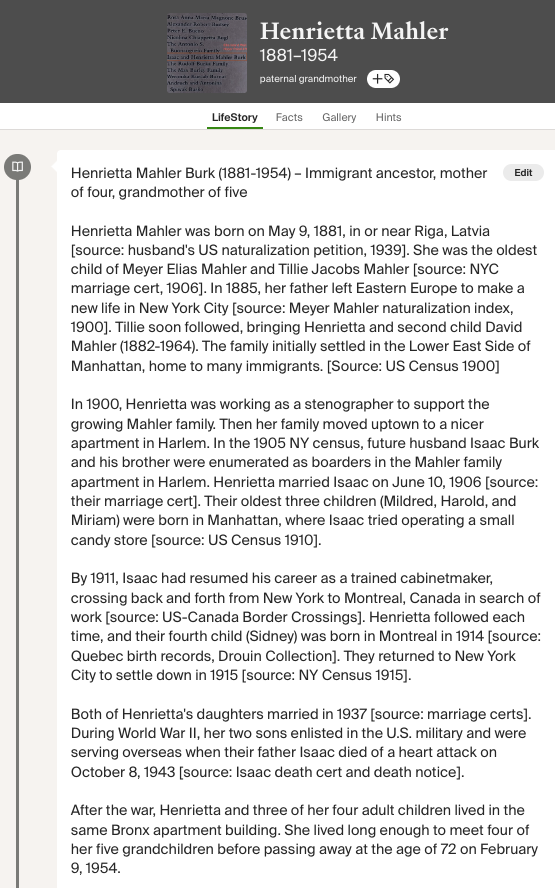
Above, four websites where I've posted the same bio and photo of my paternal grandmother, Henrietta "Yetta" Mahler Burk (1881-1954). 

Clockwise, from top left:

WikiTree is a free collaborative tree site that's growing fast and has the added benefits of sources and (if you wish) DNA connections. I also appreciate the ability to link to profile pages for each parent, each child, each spouse, each sibling. Plus WikiTreers are a friendly bunch!

MyHeritage.com is a subscription site that designates a place on each ancestor profile for a biography. If you want to learn more about how to post a bite-sized bio on MyHeritage, please read my article in the Knowledge Base. Bonus: MyHeritage has many nifty photo tools for enhancing/repairing/colorizing old family photos.

FamilySearch.org came online in 1999 and is the world's largest free collaborative tree site. Grandma Henrietta is well represented with photo, bio, research. A great site, and I'm glad that MyHeritage includes FamilySearch tree results when I research my ancestors.

Find a Grave, now owned by Ancestry, is another free place to post ancestor bios. I especially like that the 226 million+ memorial pages from this site are indexed and appear in search results on Ancestry, Family Search, Fold3, and more. 

Reader Diane asks whether I'm going to use Ancestry's new Storymaker Studio or MyHeritage's DeepStory for telling ancestors' stories. I tried DeepStory, and found it engaging but I do need more experimentation to refine the story and choose the right ancestor photo. It would intrigue the younger generation, but it can't be put on the bookshelf like a photobook, ready at any time for any audience. So far, I haven't yet tried Storymaker Studio but it's on my list to investigate this year.


PLUS: On Ancestry, there is a convenient space under "LifeStory" to type or paste in a full bio! I just did that for Henrietta Mahler Burk, as shown above. Another great way to share family history in narrative form.

Happy 142d birthday, Grandma Yetta, on May 9th. Your name, face, and life story are not forgotten! I'm currently creating a professional photobook about you and Grandpa Isaac, as a keepsake for your grandchildren and great-grandchildren.

Friday, April 28, 2023

Bird-Brain Pets in Family History


Living in a New York City apartment, my parents felt we had no space or time for four-legged pets. But we did have a parakeet, always blue, always a boy! 


Directly above, Maxie, sitting on the shoulder of "Aunt" Lee Wallace, the life partner of my Auntie Dorothy Schwartz.

At top of post, you can see Tyrone, another parakeet pet, sitting on "Sha," the favorite doll of my niece. That niece, now grown up with a family of her own, has two big dogs she dearly loves.

Back in the day, my sisters and I got a kick out of our bird-brain pets, teaching them to speak intelligent phrases like "Stupid birdie." 

"Pets" is the week 18 prompt from Amy Johnson Crow's genealogy challenge, #52Ancestors. 

Thursday, April 27, 2023

Turning the FAN Club into the FANI or FANIL or KFAN Club

Over the 25 years of my genealogy journey, I've learned to investigate friends, associates, and neighbors (FAN Club) of ancestors to try to understand any relationships, familial and otherwise. More than once, I discovered that a "family friend" or neighbor was actually a relative.

What about rechristening the FAN Club as the FANI Club, to explicitly include in-laws? OR call it FANIL Club (for in-law, maybe FANI is not the best acronym). OR KFAN (for Kinfolk)!

Many of my hubby's Larimer ancestors settled in Indiana in the 1800s. A good number intermarried with men and women from the McKibbin family, the Short family, and the Work family. Investigating the in-law situation helped me untangle the cousin connection and recognize naming and marriage patterns in multiple generations.

As a result, I've come to suspect that these families were related in some way across the pond, well before they left for America. Some of the obits hint at that, and some of the old newspaper coverage of family reunions a century ago make that claim. No proof yet, but intriguing to investigate by scrutinizing in-laws.

Currently I'm looking at a family genealogy book (digitized and available for browsing or download via FamilySearch) called: "A family history of Murrays, McKibbins, Smiths, Planks, Neffs, and related families of Elkhart and LaGrange Counties in Indiana." As shown in the excerpted index, these families intermarried with Larimer folks, including some of my hubby's Larimers. 

The detailed index is a huge help, so I can focus on one Larimer at a time. I've already found a couple of fresh leads to follow and confirm through additional research. 

My takeaways: (1) do look at in-laws in the family tree, because some may actually be cousins or descendants of confirmed cousins; and (2) do check for digitized genealogy books in the Family Search collection.

Friday, April 21, 2023

Free Talks at Virtual Genealogical Association Birthday Party - April 22


On Saturday, April 22, the Virtual Genealogical Association is throwing a Zoom birthday party and everyone is invited! 

Here's the schedule and a link to register to see lots of FREE talks about family history.

My live talk about Find a Grave and cousin bait begins about 9:25 am Eastern. 

Speakers, prizes, trivia. Please give it a try...did I mention this special virtual event is free?!

Thursday, April 20, 2023

Bite-Sized Family History: Upgrading to Professional Photobooks

For the past decade, I've been compiling bite-sized family history booklets to share facts, stories, and photos with my relatives. Choosing a specific focus helps me manage each project so it doesn't become overwhelming for me or my readers.

Now I'm in the process of converting my many paper-based family history booklets into professionally-produced photobooks, one at a time. In the past, I had a local copy shop print my bite-sized booklets in color on heavyweight paper, then I put them into a plastic sleeve or a binder for each recipient. But I've noticed the earlier booklets are becoming worn looking, pages getting creased and torn. Some of the thinner booklets have been lost in the shuffle. 

I'm ready to upgrade, little by little. Why pay more for a professional photobook?

  • Professional photobooks are much higher quality, more polished looking. The photos are sharper, the layouts more sophisticated. 
  • Professional photobooks will far outlast my previous paper-based booklets. 
  • Professional photobooks can be customized so photos are larger or smaller, text areas carry more words, headlines are in different colors, etc. The creative possibilities are endless.
  • Professional photobooks impress my readers more than the paper-based booklets. I found this out with my small (6 inch by 6 inch) photobook about ancestors in World War II. Readers responded very enthusiastically!
  • Remember: Watch for discounts and sales. Some photobook sites announce discounts for major holidays...others offer free "extra pages" or other specials. Shop around and see which site meets your needs.
At top, the cover of my latest bite-sized project in progress, a photobook (8 x 11 inches) about my Mom and her twin sister. I first created this in paper booklet form two years ago. Transformed into a photobook, it will be a more durable keepsake that readers can page through again and again for years to come.


Plus I finally know the names of all the people in all the photos so my captions will be more complete! An older cousin reached back into her memory to identify the two "mystery children" in the above photo as part of the FAN club (friends, associates, neighbors), not relatives. We also dated the photo after carefully studying the apparent ages of the kids. 

Redoing my family history into a professional photobook offers an opportunity to correct, add, subtract, and focus. Everyone is identified by full name AND I inserted info from the 1950 US Census, among other changes. The paper-based booklets looked quite good, but these look really great.

Without question, photobooks are much more costly than paper booklets. For me, after 25 years of researching my family tree, it's a worthwhile investment in memorializing ancestors for the long term--but let me stress again that I wait for a sale to order. Actually, I'll first order a single copy to see how the book looks. Then I can either tinker or reorder for all my readers (on sale of course). 

--

Bring Family History Alive in Bite-Sized Projects is one of my genealogy presentations--learn more here.

Saturday, April 15, 2023

Bite-Sized Ancestor Bios: Ideas from #GenChat


Last night and this morning, the #GenChat topic (on Twitter and Mastodon) was "Bite-Sized Ancestor Bios." To stimulate conversation as guest expert, I created a series of questions that participants answered in tweets or toots. Here's a recap--lots of ideas and food for thought! No right or wrong answers. "Everyone deserves to be remembered" as GenChat host Christine says. 

#GenChat Ice-breaker: Have you written any ancestor biographies, bite-sized or not?

Comments: Most folks have written at least a few ancestor bios. A bite-sized bio, no matter how brief, is more informative than no bio at all. One person said this was a good way to document both genealogy research and family lore (more about "lore" later). Several have been blogging ancestor bios for some time. Someone self-published the detailed bio of an ancestor after years of research. A few pointed to their growing number of bios on WikiTree profiles. 

One participant started with bullet points to get the ball rolling. Sometimes bios can be time-consuming if cross-reference related ancestors, research, etc. Preparing to write a bio, someone noted sources, research plans, timeline. What do you need to know before writing?

There was discussion about how short or long a bite-sized bio might be. Depends on the space available, what you know about an ancestor, the attention span of your audience, how much you want to include or need to include to help others understand that ancestor. 

Q1: What are the pros and cons of bite-sized bios?

Pros: the ability to commemorate an ancestor, preserve something of that person's life, humanize that person. Quick to research/write, quick for audience to absorb without getting overwhelmed. Interesting ancestor anecdote might spark interest among family members. Main facts at least summarize ancestor's life, putting in highlights and context adds dimension. Especially for ancestors without descendants and those who died quite young, a way to keep their memories alive. 

Cons: Difficult to choose what to include/exclude. Room for stories? Or just a teaser to capture interest, build excitement? If it's too brief, is it just a story about one episode in ancestor's life? Only include unproven "family lore" if room for explanation/proof, to avoid having anyone copy unproven info and perpetuate it. (My thought: label it clearly as "family story" or "family legend" so it will be remembered even if not proven, because adds color and personality--mention if any facts contradict or might maybe possibly tend to confirm but not actually prove.) If large family tree, might have a lot of bios to write, so prioritize (see later question). 

Q2: What to include, what to exclude in bite-sized bios?

Starting points to consider including: basic facts (birth, marriage, death); family situation/relationships; occupation; one or more notable highlights (good or bad). Also: migration, religion, military, cause of death.

Consider excluding: full names/data about living people, to protect privacy; info that could be hurtful or otherwise cause problems for living people; disclosing something consequential family doesn't know in an ancestor's bio. Keep info in your files for future if not include now.

Q3: When you know a little about an ancestor, how do you create a bite-sized bio? When you know a lot about an ancestor?

Comments: Harder to write when we know a lot because must decide on focus, such as occupation or an award/honor or whether ancestor was known/close to relatives still alive. What makes that ancestor "newsworthy" for the audience? What do we most want our audience to know? General outline might include: birth, parents, spouse/kids if any, residence, interesting fact, date of death (maybe cause). Focus on a theme if possible, breaking down into bite-sized chunks.

When we know a little: "Elevator pitch," set a goal for a small number of sentences. Mention in bio what you don't know, creates a bit of drama. Choose specific focus to do a deeper dive: occupation (specifically that person or in general type of occ that person had), immigration, schooling (or lack).

If on WikiTree, try the automatic bio generator here. It uses factual data entered by user (birth date, death date, etc) woven into narrative form, bite-sized bio that can be enhanced at later date if you want.

Q4: How can you share bite-sized bios with family and more widely?

Comments: Profiles on WikiTree and other genealogy platforms; in blog posts; in a book or letter or handout; at reunion; in family Facebook group; on family chat thread; on a family or surname or genealogy website; email to relatives; submit to selected libraries/archives/genealogy societies; post as "memory" to FamilySearch; on family calendar, one ancestor per month; posting on social media with visual to attract interest (or ask for help identifying more faces); send in cards on relatives' birthdays; during video calls, audio calls; as captions for photos; on Find a Grave, Fold3, other sites that are searchable; on ornaments, maps, more.

Q5: How do you set priorities for bite-sized ancestor biography projects?

Comments: Create a list (or spreadsheet) of ancestors you want to write about, some with bite-sized bios and some with longer bios. Or prioritize direct ancestors, followed by siblings/spouses of direct ancestors, first cousins of direct ancestors, etc. Or pick one generation to start. Or a single family to profile. Or write about ancestors you never met. Or be spontaneous, depending on which ancestor or line "calls" to you. Try to write regularly, maybe one bio a week or whatever fits your schedule.

Want to participate or follow along during #GenChat on Twitter or Mastodon?

Schedule is 2d and 4th Friday of every month on Twitter, then Saturday morning on Mastodon. For more, see the GenChat website.

#GenChat on Twitter: @_genchat

#GenChat on Mastodon: @genchat@lor.sh

Tuesday, April 11, 2023

How My Immigrant Grandparents Signed Their Names


Some of my immigrant grandparents had lovely, flowing handwriting when signing their names...others wrote more haltingly.

Maternal grandparents

At top, the 1911 signature of my Hungarian-born maternal grandfather, Theodore Schwartz (1887-1965), on his US naturalization cert. He arrived at Ellis Island, alone, at the age of 14. In New York, Teddy initially worked as a runner for steamship lines. I'm sure he put his name to many documents then and later as owner of a small dairy store in the Bronx, NY. His formal education stopped early, but he had an ear and affinity for languages. He also regularly wrote to his son and daughter serving in the military during World War II.

Above, the 1911 signature of my Hungarian-born maternal grandmother, Hermina Farkas (1886-1964). She was 24 years old when she signed this marriage license to wed Theodore Schwartz. Another flowing, cursive signature. She signed lots of paperwork during her life, helping her husband Teddy run their dairy store. She was, for a year or two, secretary of the Farkas Family Tree (formed by herself and her siblings) and signed the monthly meeting minutes. 

Paternal grandparents


Here's the signature of my paternal grandpa, Isaac Burk (1882-1943), on his World War II draft registration card. Born in Lithuania, Isaac came to North America at the age of 21. He was a self-employed carpenter and cabinetmaker. Isaac's signature looked halting, but was recognizable. On his 1906 marriage certificate (see below), he was transitioning to a more "Americanized" version of his name. The signature reads "Isaak Berk" but the official name on the document was "Isaac Burk" on this and all subsequent documents.


My paternal grandma, Henrietta Mahler (1881-1954) was born in Latvia and arrived in New York before she was 10 years old. She and Isaac Burk married in 1906, and it's clear that her signature was less halting than his, as shown on this marriage license. Henrietta (nicknamed Yetta in the family) wrote letters and sent packages to Isaac's cousins in Manchester, England, during and after World War II. How do I know? The cousins wrote back--and one of my relatives saved those notes, time capsules of the era and of family history.