Tuesday, March 5, 2024

Try It! FamilySearch's New Full-Text Search


If you have ancestors in the United States and Mexico, who may have been named in historical land, probate, or notary records, don't wait to try FamilySearch's new full-text search now available at FamilySearch Labs. It's part of a suite of experimental features you can learn about via this YouTube announcement.

From Browse to Search 

Until now, these mostly handwritten documents were browse-only (and good luck reading the cramped cursive)! But thanks to AI, FamilySearch has unlocked the names and details for us to locate via full-text search. The transcriptions aren't perfect, but they're sure good enough as a head start!

Lisa S. Gorrell explains, step by step, exactly how to search this collection. She also explains in detail, on her other genealogy blog, how to locate all the info needed for a useful source citation. Thank you, Lisa!

Finding Mary Amanda Demarest Wood's Will

Trying the new full-text search, I was able to quickly locate all the probate documents in Toledo, Ohio, including the will, of hubby's paternal great-grandma, Mary Amanda Demarest Wood (1831-1897). Surprisingly, Mary's administrator for the will was one of her younger sons, James Edgar Wood (1871-1939--my husband's grandpa). 

Best of all, the will had a listing of Mary's heirs, with "degree of kin" and "PO address." The heirs continued on the next page. Now I can definitively connect the youngest generation of heirs to the family tree, and continue descendancy research because of the addresses at time of this probate, 1897. Next step, 1900 Census!

NOTE: Although the transcriptions were not entirely correct, still they were a great place to start. The second name on the first list is Frank E. Wood, transcribed by AI tech incorrectly as Frank S. Wood. A few lines down, Robert O. Wood was transcribed incorrectly as Robert B. Wood. 

These are minor quibbles. The big picture is that we can find the documents and check the transcription by comparing with the image on our own. Do try it! Truly a game-changer, thanks to FamilySearch.

Saturday, March 2, 2024

Trying OldNews.com, New from MyHeritage

I've been trying OldNews.com, the new historical newspaper site that was announced at RootsTech by MyHeritage. 

Playing around with a search

The search interface is clean and uncluttered. On first glance, though, it's not clear that users can filter the name, the date(s), the place, even publication name.

But as shown above, after I entered the given name and surname of hubby's great uncle, the renowned Canadian bandmaster Capt. John D. Slatter, I was able to filter by tapping my cursor in the name box. A drop-down menu let me click or unclick to match the exact phrase. I didn't want search results to have "John" or "Slatter" or separated by other words, so I clicked to match the phrase exactly. You may want to try your search both ways, just in case.


Filtering is also possible for publication place, again by tapping the cursor in the publication place box, as shown above. I chose to match the place, because this was Capt. Slatter's hometown. I know he was in news reports all over North America, but for this search, I only wanted news of him in Toronto in a specific time period.


My full search eventually looked like this: exact name, publication year + or _ 20 years, exact place, no publication name (because I wanted to see multiple Toronto newspapers if available).  BTW, I did try "Captain Slatter" but results weren't at all close, at least in this time period. And I didn't try a later time period, which I will do at another point.

Results!

Among other results, up popped a truly wonderful result from the Daily Mail and Empire, Toronto, which I have never seen

It's the origin story of how Capt. Slatter came to be hired as bandmaster of the 48th Highlanders of Toronto. Best of all, it confirms that this illustrious ancestor of my husband did, indeed, live in Detroit (briefly), played with the Grand Opera orchestra there, and was indeed a member of John Philip Sousa's famous band. Wow! I'm thrilled.

IMHO

I wish there was easy, obvious access to a listing of publications that I could check before performing a search. 

I wish I could see at a glance what countries and cities are represented in this newspaper database.

I wish I could specify a certain time period to search, such as 1881-1904, instead of clicking for plus or minus a set number of years.

These enhancements may be on the way, but for now, I'm trying different searches to see what new info I can find.

Thursday, February 29, 2024

New Info Thanks to Keyword Added to Newspaper Search

I'm preparing a photo book about hubby's paternal grandparents, Mary Slatter (1869-1925) and James Edgar Wood (1871-1939). In the process, I'm redoing my research to try to get more info about the work, interests, and family life of their siblings.

George Black (1850-1934) married hubby's great aunt, Jane Wood (1846-1936) about 1898 in Toledo, Ohio. It was her first marriage, his second, according to Census data. Another detail from the Census: George Black was blind. 

Looking for newspaper mentions, I searched on GenealogyBank.com using his name, date range, and home town of Toledo, Ohio. Too many results for a common name. Adding his wife's name was not much help.

Then I tried something a little different, as shown at left: I used "blind" as a keyword in my search. (Great tip: Lisa Gorrell recommends trying an address--maybe a street name--as a keyword.)

Immediately I got a much smaller number of hits, including several news items that actually told me something fascinating about this man's life.

I learned that George helped organize blind people in his city and county, to advocate for legislative action and other actions to help the blind. In fact, he was elected as a trustee of the new organization in December, 1907. Happy to see that George was so active in his community!

Now I'm going to see if I can think up an appropriate keyword for each of the ancestors I'm researching, if their names are fairly common. Maybe a word like their occupation or another characteristic. This will hopefully narrow my search just enough to make the results more meaningful and manageable. 

Monday, February 26, 2024

Save RootsTech Handouts for Today and Tomorrow


I'll be #NotAtRootsTech this year--will be watching from home, and enjoying not just sessions but the social media posts of geneafriends (those in Salt Lake City and those at home).

Some speakers have already mentioned their handouts are available on the RootsTech site. Thank you to Elizabeth Swanay O'Neal for alerting her followers to go ahead and download syllabus materials in advance!

To find sessions with handouts, I started at the speaker page here.

Then I scrolled down past the keynoters to the alphabetical listing of speakers. One by one, I clicked to look at each speaker's sessions. 

For any session that looked interesting--especially if not being broadcast or recorded--I checked for a syllabus download. Above, Jen Baldwin's session on English Ag Lab ancestors...notice the download button below the presentation description. 

With a click, I downloaded, saved in a special folder, and now I'm ready to learn from Jen's expertise by reading and rereading her handout. 

Wash, rinse, repeat for Melissa Barker, Nick Barratt (more ag lab info!), John Boeren, Melanie McComb, and on and on. So many fabulous speakers, so many informative handouts to collect and consult at any time.

Blogger Lisa Gorrell also notes that if you make a schedule of sessions to watch, you can see and download handouts from the schedule.

RootsTech begins live on Leap Day, but downloadable handouts can begin whenever you're ready.

Sunday, February 25, 2024

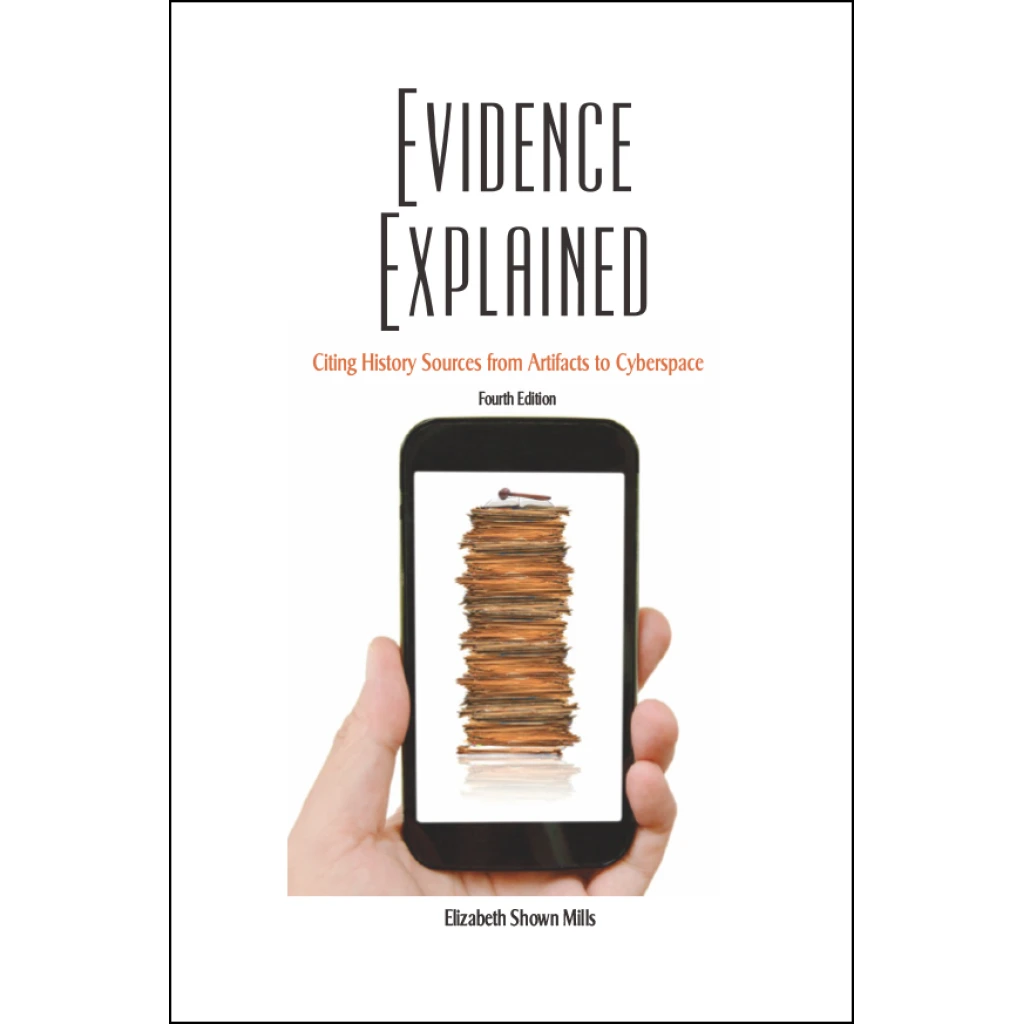
Book Review: Evidence Explained 4th Edition

Author Elizabeth Shown Mills has done a masterful job in revising Evidence Explained, 4th edition, because she's both streamlined and thoughtfully updated the content of this indispensable reference book.

Streamlined and robust

Since the first edition was published in 2007, this has been the gold standard for understanding and citing genealogical sources. 

Actually, it's the platinum standard because of the clear, robust explanations about the wide variety of resources we use to research and document our ancestry. Mills goes well beyond how to cite specific sources--she delves deep into source quality and what that means for the credibility of evidence and, ultimately, the credibility of our conclusions.

What's new?

Here's a look at the contents page:


Note the convenience of 14 citation templates!

Chapter 3 is new in this edition. Instead of printing dozens of sample templates for us to adapt in citing sources, Mills has simplified the examples into 14 templates that become the building blocks of citations. These templates range from basic book and website citation to citing books, magazines, newspapers, databases, authored manuscripts, and even gravestones viewed personally. Easier for readers to understand, easier for readers to implement. 

Mills knows how much information comes from online sources these days, and she carefully demonstrates how to cite such sources. In Chapter 13, p. 624 shows how to cite a video or webinar. In Chapter 15, p. 683 shows how to cite a blog, p. 689 shows how to cite a podcast, and p. 690 shows how to cite posts on social media such as Instagram. You'll even find a page on Generative AI (artificial intelligence) in Chapter 15.

Convenient QuickStart

Don't skip over the grey pages at the front of the book. First is "The Evidence Analysis Process Map," with sources (original or derivative records or authored narrative) that provide information (from an informant who has first-hand, second-hand or unknown level of knowledge) used as evidence for an analysis leading to the genealogical proof of our conclusion. 

Page 1 is a handy QuickStart guide to diving into Evidence Explained, followed by two pages summarizing the basics of source citations, at a glance.

For more about Elizabeth Shown Mills and Evidence Explained, plus tutorials and other bonus material, see her website.

DISCLOSURE: I received a free review copy of this book from Genealogical.com, but the opinions in this review are entirely my own.

Thursday, February 22, 2024

Another Twin Birthday!


Which twin, me or Sis, is standing on the bench (wearing an adorable bonnet) with our Mom in this Bronx playground? 

Who knows?! 

In the photo below, we're lounging in our double baby buggy, waiting to be wheeled through the park and into the playground. 

Celebrating another trip around the sun with my Sis.


Tuesday, February 20, 2024

Bequeath the Story with the Heirloom!


What do you see--maybe an ashtray? Actually, this is an heirloom, and it comes with a story.

My late father-in-law, Edgar James Wood (1903-1986) was a cracker-jack piano player who was proud to be a long-time member of the Hermit Club in Cleveland. Whereas most members had to apply and hope they were accepted, he said (in an oral history interview) he was recruited to join when the former piano player retired.

This was during the the early 1930s, when Ed was dating his future wife (Marian McClure, 1909-1983). Some of the Hermit Club members were also involved in "The Troop," more formally known as the First Cleveland Cavalry, later Troop A, 107th Cavalry, of the Ohio National Guard. 

So Ed joined, too--even though he had never, to that time, ever been on a horse. The Troop assumed its members had no riding experience and geared their training to beginners. Still, Ed and his girlfriend Marian went to a nearby riding academy now and then to get exercise and experience. Ed's Troop commitment lasted about three years, and by that time, Ed and Marian were married and had started a family.

Over the years, Ed remained interested in the Troop, and when it celebrated its 75th Anniversary in 1952, he purchased this commemorative ashtray, which was used only for loose coins. 

From a family history perspective, this is an heirloom with a backstory about a man who was most at home in the city, not on a horse! Without the story, it would be just an ashtray. 

Heirloom is the genealogy prompt for this week's #52Ancestors challenge by Amy Johnson Crow.