Friday, July 24, 2020

Old Country Images as Cousin Bait

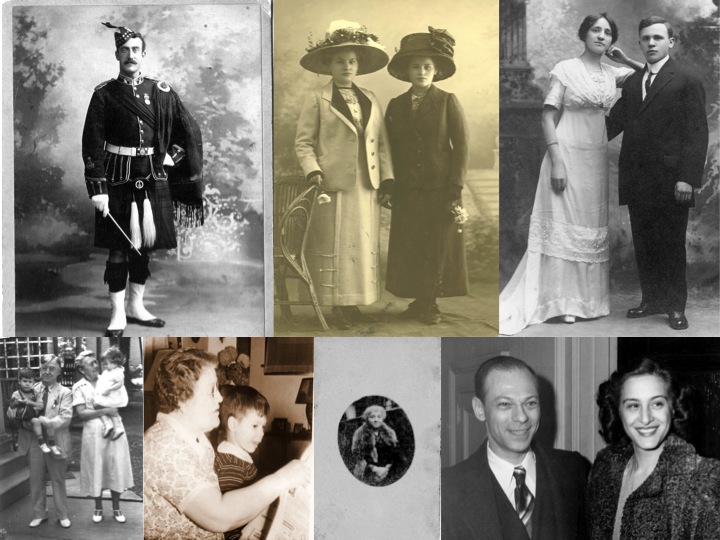
Excerpt of results from image search for "Ungvar"

My maternal grandfather Theodore "Teddy" Schwartz (1887-1965) was born and raised in Ungvar, Hungary--known these days as Uzhhorod, Ukraine. He left in 1902 and he never returned to the "old country," although his son visited twice during the 1930s.

Ungvar was a bustling market town--really a city, and so well documented! A simple search for images of Ungvar turned up hundreds of vintage photos, old and new postcards, travel posters, vacation photos, and much more. Actually, any image tagged as Ungvar wound up being included in my search results.

Ungvar Tag as Cousin Bait

At top, a snippet of the images in my pages of results. These results included numerous old photos I have posted in blogging about ancestors from Ungvar. In this small excerpt, you see a photo of one of my Schwartz great aunts and her husband, along with a link to my blog as the source.

Could such images, tagged as Ungvar, serve as cousin bait for distant relatives researching the "old country" where our mutual ancestors lived? That's my hope.

The Kossuth Connection

Kossuth Lajos "space" in Ungvar, 1915
The 1915 photo above was among the first results in my search. I smiled when I read the name of this wide street, as printed on the postcard: Kossuth Lajos. Kossuth was a legendary politician and orator who advocated for Hungarian freedom.

In 1905, my Schwartz and Farkas ancestors organized a benevolent society in New York City, named for Kossuth's son Ferenc, also a freedom fighter.

The 1915 street scene gives me another sense of connection between the old country of my grandfather's birth (Ungvar) and his home in the new world (New York City).

"Old Country" is this week's #52Ancestors prompt. Thank you to Amy Johnson Crow for these thought-provoking genealogy prompts!

Wednesday, July 22, 2020

Hubby's Ancestors in the Civil War: Part 3, Teenaged Thomas

After taking steps to identify potential Civil War veterans in my hubby's family tree, I found 21 likely possibilities to investigate.

I used Ancestry's Civil War collections, Family Search records for Massachusetts, state records, newspaper databases, city directories, and other sources to get a better picture of these ancestors' lives.

One by one, I'm writing about these ancestors for a family history booklet for the grandsons who are riveted by the Ken Burns Civil War documentary.

My first ancestor of focus was a teenager from the Wood branch of the family tree.

Thomas F. Wood of New Bedford

Thomas F. Wood (1843-1925) was my husband's 1st cousin, twice removed. He was born and buried in the whaling center of New Bedford, Massachusetts.

Pvt Thomas F. Wood
Civil War documentation
The son of tinplate worker Isaiah Wood and Mary T. White, Thomas also became a tinplate worker during his teenage years. When the Civil War erupted, Thomas took up arms (with his parents' permission, as shown on the documentation at right).

Private Thomas F. Wood of the Militia 

Searching local newspapers of the time, I found Thomas listed as a private in a local volunteer militia group called the New Bedford City Guards.

This militia was soon recruited into the Union Army for a nine-month enlistment. Thomas joined Company E of the Massachusetts 3d Infantry Regiment. He was mustered in on September 23, 1862 at Camp Joe Hooker, Lakeville, Mass, 20 miles north of his home in New Bedford. (This camp, named for "Fighting Joe" Hooker, even had its own newspaper, the Camp Gazette!)

Civil War Service in the Mass 3d Infantry Regiment

Thomas and his fellow soldiers were moved further north to Boston, where they boarded steamers and disembarked days later at New Bern, North Carolina. His regiment made several expeditions in the area, including Foster's Expedition to Goldsboro, North Carolina in December of 1862. This operation successfully burned down a bridge to disrupt key supply lines of the Confederacy.

In April of 1863, Thomas and his regiment helped to provide relief to Union Army troops at Little Washington, North Carolina. According to another Union soldier's diary of the time, the massed Union forces engaged with the Confederate Army on April 9, 1863 and used artillery to push back the Southern troops.

Thomas was mustered out of the 3d Regiment on June 26, 1863, again at Camp Hooker in Lakeville, Massachusetts. But that wasn't the end of his Civil War service.

Civil War Pension Card for Thomas F. Wood
of New Bedford, Massachusetts
Civil War Service in the 15th Unattached Company

Thirteen months after Thomas left the 3d Mass Infantry Regiment, he enlisted as a sergeant in the 15th Unattached Company. This 100-day enlistment began on July 29, 1864. He was mustered out on November 5, 1864.

Sgt. Wood served with the 15th at Fort Warren on George's Island, an important post guarding the entrance to Boston Harbor.

Post-War Life

After his military service, Thomas returned to civilian life. In the 1865 Massachusetts Census, he was again a tinplate worker, living at home with his parents. He married Ellen L. Dean in 1868.

Changing his career with the times, Thomas became a steam and gas fitter (according to 1900 Census). His Civil War pension card indicates that he filed for invalid status in 1905.

In his 60s, he was a partner in a steam factory (1910 Census). He did not list any occupation in the 1920 Census, when in his mid-70s, but he did say he owned his New Bedford home "free"--without a mortgage.

After Thomas's death in April of 1925, his widow Ellen L. Dean Wood received his Civil War pension until she died on July 1, 1926. Her death date was shown in the city directory of New Bedford, Massachusetts (see below).

From 1926 City Directory of
New Bedford, MA

Sunday, July 19, 2020

Hubby's Ancestors in the Civil War: Part 2 (Mayflower Connection)

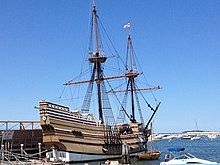
https://en.wikipedia.org/wiki/Mayflower
In Part 1 of this series, I applied multiple criteria to screen for potential Civil War ancestors in my husband's family tree: (1) organizing male ancestors according to birthdate to identify those of military age in the 1860s, (2) eliminating men who died before the war and who were not in America at the time, and (3) prioritizing ancestors closer to the main tree.

This reduced the number of possible Civil War veterans to research from 71 men to 33 men.

Next, I peeked at the 1910 U.S. Census to see which ancestors said they were veterans--a clue, not definitive evidence. This gave me positive clues for a good number, but what about those not alive in 1910?

Quick-and-Dirty Search for Civil War Activities

For ancestors who died before the 1910 Census, I did a quick-and-dirty search on Ancestry. Did these men register for the Civil War draft? If so, did they actually serve?

Between checking the 1910 Census and my quick-and-dirty search, I reduced the number of possible Civil War veterans from 33 to 20 [correction: 21, now that I've identified Lemuel C. Wood, Jr. as a vet]. This list included great-great uncles, cousins of various types, and two men married to great-great-aunts.

Mayflower Connections 

Along the way to profiling my husband's Civil War veterans, I filled in many blanks on the family tree and looked at family connections to prioritize my research.

A name that made the initial list due to his birth year was Thomas F. Wood (1843-1925), my husband's 1st cousin, twice removed. He was born and died in the whaling center of New Bedford, Massachusetts, the son of Isaiah Wood and Mary T. White.

As I climbed Thomas's family tree, I saw that his grandfather Isaiah Wood was descended from Mayflower passenger Mary Norris and her husband, Thomas Cushman of the Fortune. Thomas's grandmother Harriet Taber was descended from Mayflower passenger Francis Cooke.

Having made these connections, I immediately determined that Thomas F. Wood was to be the focus of my first Civil War investigation. More in Part 3!

Friday, July 17, 2020

Which of Hubby's Ancestors Were in the Civil War? Part 1

The 1910 US Census asked about veteran status.
UA = Union Army service during the Civil War.
Thank you, Ken Burns, for getting the younger generation interested in ancestors who fought in the U.S. Civil War!

A young relative just mentioned watching the popular Ken Burns documentary series The Civil War for the first time.

Me: "Hey, I'm writing a family history booklet about your Civil War ancestors."

Young relative: "Wow, we had ancestors in the Civil War?"

Me: "More than one! Wait till you hear their stories." [Doing the genealogy happy dance--a descendant asking about ancestor stories!]

First Step: Who Was Old Enough to Serve?

From previous research, I'd already identified 10 ancestors of my husband who served in the Union Army. That was just a start.

Now I needed to go through his family tree in a systematic way to see who else might have served in the Civil War. Given the migration patterns in my husband's family (including Ohio Fever that attracted Northeastern ancestors to settle the Ohio River area), I expected to find NO service for the Confederacy, only for the Union side.

My first step was to use RootsMagic7 to sort the family tree by birthdate. I printed the report and used a red pen to mark men eligible for the draft or enlistment. As a rough guide, I was going to investigate those born between the mid-1820s and the late 1840s.

The initial list included 71 men of eligible age for military service.

Second Step: Ancestral Relationship and Location

After deleting a few male ancestors who died just before the Civil War, I examined ancestral relationships and locations. My goal was to eliminate men who had an indirect connection to the family tree and men who lived in another country during the Civil War years.

Name by name, I dropped ancestors such as "father-in-law of niece of 1c2r" as well as ancestors who arrived in America after 1865.

This shortened the list to 33 male cousins and great-great-uncles of eligible age who were living in the United States from 1860 to 1865.

Third Step: The 1910 US Census Clue

Before doing serious Civil War research, I took a quick shortcut to see, as a clue in the 1910 US Census, which of the men on the list had indicated they were veterans.

This clue only works if the male ancestor was still alive in 1910 (he served as late as 1865, so he would not be a spring chicken). And of course it only works if the man or his relative knew enough to tell the enumerator about his military service. Remember, this is a CLUE, still to be verified by further research.

See the snippet at top? The 3d column from the far right on the 1910 Census was a question about whether the person was a veteran.

For Union Army veterans, like my husband's ancestor in this example, the enumerator would write "UA." The National Archives posted this list of veterans' codes for 1910:

  • "UN" for Union Navy
  • "UA" for Union Army
  • "CA" for Confederate Army
  • "CN" for Confederate Navy

In Part 2, I'll describe my next steps in determining which of my husband's ancestors were in the Civil War, where, and when.

Wednesday, July 15, 2020

Union Army Pensions and Reunions Were Both Newsworthy

Train Caldwell McClure (second from left in top row) at Union Army reunion on Aug. 18, 1922
In researching Union Army veterans in my husband's family tree, I was interested to see newspapers reporting on military pensions. Not surprisingly, Civil War reunions were also newsworthy, especially decades after the war's end.

Train Caldwell McClure's Union Army Pension

Hubby's great-great-uncle Train Caldwell McClure (1843-1934) enlisted in Company A of the 89th Indiana Infantry Regiment at the end of July, 1863, in his hometown of Wabash, Indiana. He was mustered out in Mobile, Alabama, on July 19, 1865, having fought in key battles such as capturing Mobile and defending it from the Confederate Army.

On November 22, 1892, the Indianapolis Journal reported that Train was one of dozens of Indiana veterans to be granted military pensions for their Civil War service.

On July 15, 1898, the Indiana State Journal reported on new pension amounts. Train's pension went up from $6 monthly to $8 monthly (see excerpt at left).  In today's dollars, $8 = $247. Not such a tiny pension after all.

Train Caldwell McClure's Civil War Reunions

Train went home to Wabash, Indiana after the war. He married Gulia E. Swain (1847-1920) in 1867. As their family expanded to four children, he operated an oil mill (extracting oil from crops) and later worked as a janitor.

According to news accounts, Train participated in more than one Civil War reunion of Union Army veterans. At top, a clip from the News-Sentinel of Fort Wayne, Indiana, dated September 23, 1922, shows Train with a dozen other vets at a luncheon reunion on August 18, 1922. The caption notes that their ages totaled 1,040 years. This was nearly 60 years after the Civil War ended, and veterans were all in their 70s and 80s by then.


Train also went from Wabash, Indiana to Washington, D.C., to attend the First Reunion of the Survivors of the Army of the Tennessee on September 21-23, 1892. I located his name among the attendees from the 89th Regiment (above) in a book about the reunion (via Google Books, see cover at left).

Wabash to Washington is a trip of 600 miles. Since Wabash was a major railroad hub, Train could change trains [no pun intended] and arrive in Washington without too much hassle.

BTW, Train is not as uncommon a name as I originally thought. I wrote five years ago about how he came to have that name.
--
"Newsworthy" is this week's prompt for #52Ancestors.

Local Knowledge, Part 4: Big Apple, Fine Print

Brooklyn directory dated August, 1941
had listings "corrected to July 10, 1941"
Read the fine print to date a source.

That's my local knowledge tip for today.

It actually works for every source in every location.

But in New York City, finding the date of a phone directory takes a bit more effort, because the entire city population is NOT listed in a single, massive directory. No, New York has five boroughs, each of which has its own quite large phone book.

Five boroughs, five phone books, and--just to make things more interesting--five different cutoff dates for listings. Which borough did your ancestor live in, and when? The fine print matters in the Big Apple.

August Cover Date Means . . . ?

In my previous post about searching free NYC telephone directories, I showed a sample from a 1941 Brooklyn phone directory. The snippet at top is a repeat because I want to emphasize that the cover date was August, 1941.

I clicked to the official page 1 of that directory to read the fine print. It said: "This issue corrected to July 10, 1941."

So what? If I search the August edition for an ancestor who moved to a new Brooklyn address on or after July 11, I either won't find that person or I'll find outdated information. A missing listing might mean . . . passed away, or married, or changed name, or moved away.

Or if someone's missing, it might mean no phone (ever or only for that particular year). That was the explanation when I couldn't find ancestors who, it turned out, were living as boarders in someone else's apartment. I discovered them in an earlier directory and in a later directory, both times in their own apartment.

Five Boroughs, Five Cut-off Dates for 1940

Looking at the 1940 phone directories digitized and posted online by the New York Public Library, I was surprised to see that each borough's directory had a different cut-off date for listings.
  • Manhattan (1940 directory): "This issue corrected to November 9, 1939."
  • Bronx (Winter 1939-40 directory): "This issue corrected to October 19, 1939."
  • Brooklyn (Winter 1939-40 directory): "This issue corrected to January 4, 1940." 
  • Queens (Winter 1939-40 directory): "This issue corrected to December 13, 1939." 
  • Staten Island (Winter 1939-40 directory): This issue corrected to January 9, 1940."
I had ancestors in four of these five boroughs, so I needed to know where to look and check the dates of each edition. "New York City, 1940" wasn't enough.

Tuesday, July 14, 2020

Local Knowledge, Part 3: Free Big Apple Directories

Easy access to free New York City phone books via stevemorse.org


Knowing that May 1 of every year was Moving Day in New York City helped me understand the timing of moves for siblings of my paternal grandfather, Isaac Burk (1882-1943). That was Part 1 of my series on local knowledge of Big Apple genealogy resources.

In Part 2 of my series, I used free NYC Municipal Archives tax records to find clear b/w photos of the buildings where ancestors lived in 1940.

Now for Part 3. I wanted to look up my grandpa's New York-based siblings in 1940s phone directories, relying on local knowledge for free access.

New York Public Library's Virtual Resources

The New York Public Library is a fabulous source of genealogical resources, not only for researching New York ancestors but well beyond. Many of its resources have been digitized and posted online, available for free without a library card on a 24/7 basis.

The library's digital collection includes New York City directories, which it has been scanning and posting in recent years. This makes valuable genealogical info widely available to anyone, anywhere, who wants to search for a person or a business in the Big Apple, going back as far as 1786. These directories also feature interesting advertising and street maps of the time (context!).

Actually, the library's virtual collection includes both city directories (pre-telephone era) and phone directories--the latter for the five boroughs (Manhattan, Bronx, Brooklyn, Queens, and Staten Island).

Not all borough directories are posted and not all years are available, but this an excellent source to tap if your ancestors lived or worked in New York City.

Steve Morse's Super-Easy Search 


My favorite way to search 1940 NYC phone directories for free is through Steve Morse's One-Step access to the books, borough by borough (snippet at top shows a sample from my research).

If you use this one-step access, select a borough on the drop down menu at top left of the search screen. Then click the arrows to progress through pages, or do a name search, or skip to the proper alphabetical page for the name you want.

The snippet shows my search for grandpa Isaac's brother Max Birk, who lived in Brooklyn in 1940. I specified "Brooklyn" as the borough and typed in "Birk" as the name. Steve Morse's super-easy search tool brought me to the page showing Max Birk at 602 Avenue T in Brooklyn, NY. This is the correct address for that time, as it matches Max's 1940 Census location.

By the way, I searched the 1940 Bronx phone book for Paul and Jennie Salkowitz (Jennie was Max and Isaac's sister). They weren't listed. Why? The light bulb went on: According to the 1940 U.S. Census, Jennie and her husband were boarders in somebody else's apartment. No way to have a phone of their own! They moved shortly afterward (on Moving Day, May 1, I'm willing to wager) and had a phone number in later directories.

Internet Archive: Browse Page by Page

There's a third way of accessing some NYC phone directories for free: via Internet Archive. The collection here is more limited. Happily, I did find a 1941 Brooklyn, NY phone directory for free.


Shown here is Max Birk's entry in this Brooklyn phone book, located by browsing page by page. Note the directory's specific date: August, 1941. That's a clue to check the dates on your sources, especially fast-changing phone directories in fast-growing cities like New York. More about dates in Part 4 of my series.