- SCHWARTZ/FARKAS FAMILY: Above, my aunt Dorothy Schwartz (1919-2001), who was a high school teacher of typing, stenography, and business subjects. This is her faculty picture from a yearbook dated nearly 40 years ago. My uncle Fred Shaw (1912-1991) was a high school history teacher who wrote civics textbooks; his wife, Daisy Katz Shaw (1913-1985), was an educational guidance counselor who became Director of the Bureau of Vocational and Occupational Guidance in New York City. My great aunt, Ella Farkas Lenney (1897-1991) taught in the New York school system for years.
- McCLURE FAMILY: Hubby's great aunt, Lola McClure Lower (1877-1948) was a truant officer in Wabash, Indiana public schools in 1920. By 1930, her occupation had changed to "attendance officer, public schools" in Wabash (see Census excerpt above). Hubby's great aunt, Anna Adaline McClure (1854-1928) was a teacher when she married Samuel Cook, a mason, in Petoskey, Michigan, in 1897.
Adventures in #Genealogy . . . learning new methodology, finding out about ancestors, documenting #FamilyHistory, and connecting with cousins! Now on BlueSky as @climbingfamilytree.bsky.social
Pages
- Home
- Wm Tyler Bentley story
- Isaac & Henrietta Birk's story
- Abraham & Annie Berk's Story
- Farkas & Kunstler, Hungary
- Mary A. Demarest's story
- Rachel & Jonah Jacobs
- Robt & Mary Larimer's story
- Meyer & Tillie Mahler's story
- McClure, Donegal
- Wood family, Ohio
- McKibbin, Larimer, Work
- Schwartz family, Ungvar
- Steiner & Rinehart
- John & Mary Slatter's story
- MY GENEALOGY PRESENTATIONS
Saturday, September 2, 2017
School's in Session: Ancestors in Education
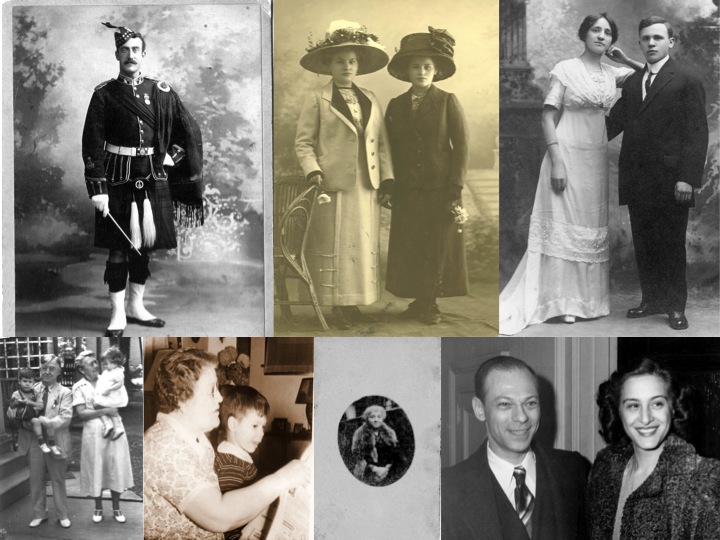
School days are here again, a good reason to remember some ancestors who were teachers or otherwise involved in education:
Friday, August 25, 2017
Blogiversary #9: Fewer Brickwalls, More DNA and Facebook Connections
What a year 2017 has been (and it's not over)! Nine years ago, when I first began blogging about my genealogy adventures, I knew the names of only four of the eleven people in this photo from my parents' wedding album. Earlier this year, thanks to Mom's address book and Cousin Ira's cache of letters, I smashed a brickwall blocking me from researching Grandpa Isaac Burk. Now I have a new set of friendly cousins and the names of all the people in this photo. And more info about my father's father's father, Elias Solomon Birk.
This was DNA year for me. Thanks to "known" cousins on both sides of the family who kindly agreed to test, I have a lot more "probable" cousins (we're still investigating our connections). It was especially helpful and motivating to meet DNA experts at the IAJGS, where I gave my talk on Planning a Future for Your Family's Past. I also attended DNA sessions at NERGC, where I spoke on the same "planning a future" topic. (For a calendar of my upcoming presentations, please see the masthead tab above.)
This year will go down in American history for the unique solar eclipse that swept the nation . . . for my genealogical journey, it will be remembered as the year I created detailed family memory booklets for my husband's Wood-Slatter tree and his McClure-Steiner tree. (For sample pages, see my blog post here.)
My Facebook genealogy persona Benjamin McClure (memorialized on family T-shirts) has had a wonderful time making new genealogy friends and both posting questions and answering queries. Benji is also active on Pinterest. I really appreciate how many people are very generous with their knowledge and take the time to help solve family history mysteries via social media!
Plus I got to meet many genealogy bloggers in person at conferences this year. It was wonderful to say hello and get acquainted without a keyboard for a change.
Thank you to my relatives and readers for checking out my posts, leaving comments, and sharing ideas. Looking forward to Blogiversary #10 next year!
This was DNA year for me. Thanks to "known" cousins on both sides of the family who kindly agreed to test, I have a lot more "probable" cousins (we're still investigating our connections). It was especially helpful and motivating to meet DNA experts at the IAJGS, where I gave my talk on Planning a Future for Your Family's Past. I also attended DNA sessions at NERGC, where I spoke on the same "planning a future" topic. (For a calendar of my upcoming presentations, please see the masthead tab above.)
| Future genealogy: Using a pinhole viewer on Eclipse Day |
This year will go down in American history for the unique solar eclipse that swept the nation . . . for my genealogical journey, it will be remembered as the year I created detailed family memory booklets for my husband's Wood-Slatter tree and his McClure-Steiner tree. (For sample pages, see my blog post here.)
My Facebook genealogy persona Benjamin McClure (memorialized on family T-shirts) has had a wonderful time making new genealogy friends and both posting questions and answering queries. Benji is also active on Pinterest. I really appreciate how many people are very generous with their knowledge and take the time to help solve family history mysteries via social media!
Plus I got to meet many genealogy bloggers in person at conferences this year. It was wonderful to say hello and get acquainted without a keyboard for a change.
Thank you to my relatives and readers for checking out my posts, leaving comments, and sharing ideas. Looking forward to Blogiversary #10 next year!
Labels:
Benjamin McClure,
Birk,
blogiversary,
Burk,
DNA,
Facebook,
IAJGS,
McClure,
NERGC,
Slatter,
Solar Eclipse 2017,
Steiner,
Wood
Saturday, August 19, 2017
Junk or Joy? Think of Future Generations!
So many people are following the fad for saving only possessions that spark "joy" (based on best-selling author Marie Kondo's The Life-Changing Magic of Tidying Up). But this doesn't mean throwing out family history along with the family china that none of the kids or grandkids wants right now. UPDATE: Today's New York Times has a similar article, focusing on how many downsizers are coping with younger relatives' disinterest in having the family china, furniture, etc.
The author of the Washington Post article says that "passing down at least some of those possessions creates an important connection between generations and has a vital part in a family’s history." Her advice: save a few select things rather than everything. "Choose things that have special meaning — a serving dish that you used every Thanksgiving, old family photos . . . "
That's why the "chickie pitcher" shown at top is still in the family, while the magazine shown at right is not.
This pitcher, passed down in the Wood family, was part of holiday meals for as my hubby can remember (and that's a long way back). His mother, Marian McClure Wood, would put it out along with coffee and dessert on Thanksgiving and other occasions. We've continued the tradition in our family!
The Workbasket magazine, however, is a different kind of keepsake. My mother, Daisy Schwartz Burk, was an avid needleworker and subscribed to this magazine for at least a decade. But as part of my Genealogy Go-Over and in the pantheon of heirlooms, the four issues held by the family for 50 years have a very low priority.
Rather than relegate these good condition magazines to the flea market or recycle bin, I found them a new home: the Missouri History Museum, which collects magazines issued by Missouri-based publishers. The museum lacked the particular issues I was offering, and was especially pleased that the address labels were still attached.
I signed a deed of gift (similar to the one shown here) and donated all four issues, along with a brief paragraph describing my mother and her love of needlework. It gives me joy to know that Mom's name will forever be attached to magazines preserved and held in the museum archives.
(May I suggest: For more ideas about how to sort your genealogical collection and the possibilities of donating artifacts, please see my book Planning a Future for Your Family's Past.)
Friday, August 18, 2017
Friday's Faces from the Past: Remembering Dad and Counting His Cousins
Remembering Dad--Harold D. Burk (1909-1978) on the 39th anniversary of his death. This happy photo shows him arriving in Hawaii on a special tour for travel agents (a career he began before being drafted for WWII and resumed when he returned from serving in Europe and married Mom).
Having smashed a major brick wall on Dad's side of the family, I can finally name all twenty of his far-flung first cousins.
- Rose, Lilly, Bill, and "Punky," the four children of Abraham Berk (1877-1962)
- Sylvia, Harold, Milton, Norma, and Larry, the five children of Meyer Berg (1883-1981)
- Miriam, "Buddy," Harvey, Jules, and Hilda, the five children of Sarah Mahler Smith (1889-1974)
- Mike and Sylvia, the two children of Ida Mahler Volk (1892-1971)
- Myron, Daniel, Robert, and Ruth, the four children of Mary Mahler Markell (1896-1979)
Sunday, August 13, 2017
Saturday Night Genea-Fun: How Many in My Genea-Database?
Randy Seaver's latest Saturday Night Genealogy Fun challenge this week is: How many people are in your gen software database or online tree(s)?
Since I'm a new user of RootsMagic 7, I tried this challenge using the largest tree in my database: Hubby's Wood/Larimer/Slatter/McClure/Steiner tree.
As shown above, this tree has 2665 people and--I'm happy to see--19,084 citations. I'm going to organize my citations and format them correctly, without being too slavish. Sure, I want other people to be able to replicate my research and locate specific records or details. But I agree with the philosophy of Nancy Messier's "My Ancestors and Me" blog: "Done is better than perfect."
Shown at right, my Ancestry tree overview for the same family tree. Number of people is identical, because the synch is up-to-date. I try not to add people until I've investigated the relationship and sources to be reasonably certain these ancestors really belong on the tree.
Note that the number of hints is three times the number of people! When I have a moment, I'll whittle that down by clicking to "ignore" hints for ancestors like "wife of brother-in-law of third cousin once removed of husband's uncle." Then I can concentrate on vetting the hints of people more closely aligned with the tree.
Since I'm a new user of RootsMagic 7, I tried this challenge using the largest tree in my database: Hubby's Wood/Larimer/Slatter/McClure/Steiner tree.
As shown above, this tree has 2665 people and--I'm happy to see--19,084 citations. I'm going to organize my citations and format them correctly, without being too slavish. Sure, I want other people to be able to replicate my research and locate specific records or details. But I agree with the philosophy of Nancy Messier's "My Ancestors and Me" blog: "Done is better than perfect."
Shown at right, my Ancestry tree overview for the same family tree. Number of people is identical, because the synch is up-to-date. I try not to add people until I've investigated the relationship and sources to be reasonably certain these ancestors really belong on the tree.
Note that the number of hints is three times the number of people! When I have a moment, I'll whittle that down by clicking to "ignore" hints for ancestors like "wife of brother-in-law of third cousin once removed of husband's uncle." Then I can concentrate on vetting the hints of people more closely aligned with the tree.
Labels:
Genea-Musings,
Larimer,
McClure,
Randy Seaver,
RootsMagic,
Saturday Night Genealogy Fun,
Slatter,
Steiner,
Wood
Friday, August 11, 2017
Friday's Faces from the Past: Did Uncle Benji Smile?
It's up to us, before we join our ancestors, to keep the stories, photos, and memories of past generations alive for the benefit of future generations.
Here are just a few methods I've tried.
- Tell ancestor stories with dramatic flair. Our ancestors really did lead lives that were courageous (pioneers), happy (family or success), sad (early death), challenging (bankruptcy), or something in between. Find the drama and accentuate it to bring these ancestors to life. My maternal grandma threw a suitor's engagement ring out the window when she refused an arranged marriage. Isn't that dramatic? Hubby's grandpa was a master mechanic who worked on an early automobile model, making his mark on history in a small but significant way. Telling dramatic stories over and over does, I'm happy to say, make an impression.
- Put an ancestor's face on a T-shirt. I think Benjamin McClure looks ancestral (and characteristically resolute) on this T-shirt worn by his great-great-grandson. Did "Uncle Benji" ever smile? I can ask every younger relative who sees this shirt. In private, I bet he did. But this was his public face, as a civic leader.
- Make copies of ancestor photos and give them to siblings, cousins, grandkids. Include a note explaining who's who. Pick a special date--for instance, St. Paddy's Day, for Irish ancestors--and make inexpensive photos to send inside a greeting card. The more relatives who come to recognize ancestors by face and name, the better. Okay, I'm still the only person who can identify most older ancestors in photos, but I'm hoping that someday relatives will be able to pick out at least one or two individuals they didn't know before. Plus I'm glad to know that these photo copies are widely dispersed within the family, not simply stuck inside my files.
- Tell stories about what ancestors didn't talk about. My immigrant grandparents and great-grandparents never spoke of the trip from their home towns in Hungary, Latvia, and Lithuania to New York City. But knowing the name of the ships, the time of year, and length of the voyages, and the distance between the home towns and the ports of departure, I can weave together a pretty decent narrative for each one. No, they didn't come "cabin class." So this kind of story illustrates determination and perseverance (occasionally desperation).
- Remind young relatives who and what ancestors left behind. None of my immigrant grandparents or great-grandparents ever returned to their home towns after arriving in New York. Younger relatives are taken aback when reminded that these ancestors often left home at an early age (Grandpa Teddy Schwartz was 14), knowing that the journey would be one-way only. Imagine.
Sunday, August 6, 2017
Weighing the Evidence on Grandpa's Birthplace
Six of my Burk (aka Berg/Berk/Birk/Burke) ancestors came to North America from Lithuania. The oldest of the siblings, Abraham, settled in Montreal. All the others lived for decades in New York City.
In birth order, they were:
Of course I'm putting the most weight on primary (original) sources created by "someone with first hand knowledge . . . created at or about the time an event occurred." Primary information (from original sources) tends to be more reliable, even though the person who provided the info may not remember correctly or may answer inaccurately for some other reason.
I've assembled the following evidence about the siblings' birthplace.
According to the Jewish Genealogy Communities Database, nearly all of these places are, essentially, other names for one place: Gargzdai, Lithuania (sometimes not spelled correctly or only spelled phonetically).
This evidence leads me to conclude that Grandpa Isaac and his siblings came from Gargzdai. That's my story, and I'm sticking to it. Plus I'm going to change the family tree so that every one of the siblings shows this as their birthplace.
In birth order, they were:
- Abraham Berk (1877-1962)
- Nellie Block (1878-1950)
- Isaac Burk (1882-1943) - Hi, Grandpa!
- Meyer Berg (1883-1981)
- Jennie Birk (1890-1972)
- Max (Matel) Berk (1892-1953)
Of course I'm putting the most weight on primary (original) sources created by "someone with first hand knowledge . . . created at or about the time an event occurred." Primary information (from original sources) tends to be more reliable, even though the person who provided the info may not remember correctly or may answer inaccurately for some other reason.
I've assembled the following evidence about the siblings' birthplace.
- Abraham Berk's Canadian naturalization petition listed Gordz, Kovno, Russia as his birthplace. When Abraham entered America in 1919 to visit his brother Isaac, he said he was born in Gorst-Kovna-Russia. Abraham provided all this info.
- Nellie Block never declared any birthplace that I can find, unfortunately. I don't believe she ever married, nor did she apply for Social Security or naturalization.
- Isaac Burk told US border officials in 1904 that he was born in Gerst, Russia, when he entered America from Canada. His 1939 naturalization papers and WWII draft registration show Lithuania as his birthplace (Isaac provided the info). Grandpa Isaac was buried in a cemetery plot that's part of the Sons of Telsh society. That adds to the indirect evidence in a small way.
- Meyer Berg's passenger manifest from 1903 shows Gelsen, Kovno as his most recent residence. His WWI draft record shows Gorsd, Russia as his birthplace; his WWII draft record shows Gorso, Russia as his birthplace. Meyer's naturalization petition from 1920 shows his birthplace as Kovna, Russia. Meyer provided this info.
- Jennie Birk's 1966 passport lists Lithuania as her birthplace. Her husband Paul Salkowitz listed Gardzai, Lithuania, as his birthplace on naturalization papers, but didn't show anything for her birthplace. Best of all, Jennie's marriage license from 1919 shows Garsden, Russia as her birthplace, info provided by her.
- Max Berk's 1920 naturalization petition shows Kovno, Russia as his birthplace. His 1906 passenger manifest shows Korst as his last residence. Max provided this info.
According to the Jewish Genealogy Communities Database, nearly all of these places are, essentially, other names for one place: Gargzdai, Lithuania (sometimes not spelled correctly or only spelled phonetically).
This evidence leads me to conclude that Grandpa Isaac and his siblings came from Gargzdai. That's my story, and I'm sticking to it. Plus I'm going to change the family tree so that every one of the siblings shows this as their birthplace.
Labels:
Berg,
Berk,
Birk,
Burk,
Burke,
Evidence Explained,
Gargzdai,
Genealogical Proof Standard,
genealogy,
Lithuania
Subscribe to:
Comments (Atom)


