Tuesday, August 1, 2023

Backup Day: LOCKSS and Paperless Genealogy


LOCKSS = Lots of copies keeps stuff safe! Academics came up with this phrase to describe a systematic process of digitizing and securing multiple copies of key data, at a decentralized level.

For genealogists, this translates into:

  • Back up often (ideally, every day if you make significant changes to files on your computer - preferably, once a week or at a bare minimum, once a month).
  • Use multiple methods of backing up (as shown above, this can include external hard drives, USB drives, plus cloud backups and other methods--not just in your home but also externally just in case).
  • Share data with your family (digitally, with paper, or both - decentralizing).
  • Share data, with privacy in mind, on selected genealogy sites (I use WikiTree, Ancestry, MyHeritage, FindMyPast, Find a Grave, and more).
  • If you've digitized old family photos, be sure those files are secure in more than one place (decentralizing).
And please, don't go entirely paperless. Original documents and photos, in particular, are very important for today and tomorrow, but printouts of stuff downloaded from online sources can be recycled or shredded IMHO. Here's one approach.

Finally, remember to test and replace your backup hardware every so often. Hard drives don't last forever...I've upgraded one of my hard drives since taking the photo at top. As I say in my book, Planning a Future for Your Family's Past, it's money well spent when we preserve digitized files and images from our family's past so they won't be lost and can be shared with future generations in the coming years.

Thursday, July 27, 2023

When Grandpa Teddy Made News in 1937


A few years after I began my genealogy journey, I used my local library's access to the New York Times historical database to research my parents and grandparents. Since many ancestors lived and worked in the New York City area, I expected to find mainly birth/marriage/death notices and an occasional mention of a business or a graduation.

What a jolt to find a news item about an armed robbery spree on the night of December 16, 1937. The first store robbed was owned by my grandpa, Theodore Schwartz (1887-1965). Here's what the reporter wrote:

Band Robs 3 Stores; three armed men get $300 in series of Bronx raids

Three armed men within an hour and a half held up three storekeepers in the Bronx last night and escaped with $300. About 9:30 o'clock they entered the grocery store of Theodore Schwartz at 679 Fox Street, hit him on the head with a pistol butt when he resisted, and took $50. Half an hour later, they went into the grocery store of Louise Lepperman at 422 Jackson Avenue and hit him with a pistol, but left quickly when his wife screamed from a back room. In another half an hour, they forced Leonard Gaglio and his brother, Milton, liquor dealers at 1012 Morris Park Avenue, into a back room and took $250.

Yikes, this was during the Depression when money as scarce and store owners sweated over every penny. The $50 stolen from Grandpa Teddy 86 years ago would be worth about $1,000 in 2023. Poor Grandpa had to go home and give Grandma the terrible news--it must have been an awful scene. Let me add that in 1937, the Bronx was not a high-crime area, but shopkeepers who stayed open late were a tempting target for sure. 

Grandpa Teddy and Grandma Minnie (Hermina Farkas Schwartz, 1888-1964) owned and operated a small dairy store for about 40 years, changing locations a couple of times and finally selling and retiring in 1955. No news coverage of all the years of routine drudgery, opening the store early and closing it late six or seven days a week, standing on their feet for hours, trying to cover all the bills.

Using the wonderful photo enhancement tools at MyHeritage, I brought Grandpa and his store to life in a way that recalls his usual good humor, not the terror of being robbed at gunpoint. Of course I'm telling Grandpa's story of being "in the news" in my latest Farkas/Schwartz family history photo book.

"In the news" is this week's 52 Ancestors genealogy challenge from Amy Johnson Crow.

Monday, July 24, 2023

Book Review: "History for Genealogists"


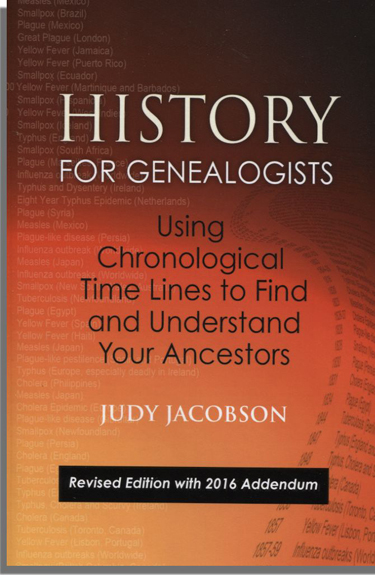
As a fan of timelines for family history, I have a great appreciation for the many condensed historical timelines and background explanations included in Judy Jacobson's History for Genealogists, published by Genealogical.com and updated in 2016. 

The subtitle of this book really says it all: 

Using chronological time lines to find and understand your ancestors.

In ten chapters plus bibliography, index, and addendum covering the 20th century's two big wars and Great Depression, as well as a 20th century fashion and leisure timeline, Jacobson provides the building blocks needed to put our ancestors into historical and social context. And, as she ably points out, understanding chronology can help us locate elusive ancestors by suggesting where people might be at a certain point in history.

The index is excellent, more than 30 pages long. I found it particularly helpful for pinpointing pages with info and timelines on ethnic groups, immigration patterns, military conflicts, state-by-state settlement, Westward expansion, and many other specific topics. Interestingly, "Mayflower" was not an index entry but "Plymouth" and "Plymouth Colony" were both in the index. So do consider a variety of ways to describe your ancestor's past and investigate all of this terminology in the index.

Here is the jam-packed table of contents:

  1. Seeing Ancestors in Historical Context
  2. Creating a Time Line: Why? How? Case Studies
  3. Why Did They Leave? Military, foreign skirmishes, racism/injustice/unrest, politics, religion, disease, economics, disasters
  4. How Did They Go? By road, rail, water, air
  5. Coming to America (including historic migration patterns, traditional trails and roads)
  6. Myths, Confusions, Secrets, and Lies
  7. Even Harder to Find Missing Persons (including name changes, slaves, orphan trains, place-name changes, changing boundaries, more)
  8. Social History and Community Genealogy (immigration, industrial revolution, associations/unions, genealogy in books, oral histories)
  9. State by State Timelines (including Colonial times)
  10. Region by Region Timelines (North America and well beyond)
For folks like me who are researching immigrant ancestors in my tree and hubby's tree, the chapter on coming to America (Chapter 5) includes a 4-page detailed timeline of who tended to leave their European homelands and settle in North America. My hubby's tree includes Scots-Irish who were part of the movement shown in the timeline on p. 66 and discussed on 11 other pages in the book. My own immigrant grandparents are put in historical context by the timeline on Russia (and nearby places, including Lithuania) beginning on page 238. And as a native of the Bronx, the New York state timeline is of great interest.

I highly recommend this book as a reference tool for understanding the sweep of family history and putting individual decisions into the context of local, regional, national, and international history.

Please note: I was given a free copy of this book for review purposes, but my opinions are entirely my own.

Wednesday, July 19, 2023

Chronicling My Farkas Ancestors


My latest family history photo book is about my Farkas ancestors, starting with the journey-takers who came to America at the turn of the 20th century. 

Great-grandfather Moritz Farkas (1857-1946), born in Hungary, was financially ruined when a hail storm destroyed his crops, leading him to sail to New York in search of a new life in 1899. A year later, his wife, great-grandma Leni Kunstler Farkas (1865-1938) followed him to New York. Their eight children arrived at Ellis Island in two groups during the next couple of years...and then they got to meet the three youngest children who were born in Manhattan.

My grandma Hermina Farkas was in the first group of children to be reunited with their parents in a tenement in the Lower East Side of Manhattan. Refusing an arranged marriage, she married grandpa Theodore Schwartz in 1911. 

The photo book under construction includes a colorful word cloud featuring the many surnames and given names of the Farkas and Kunstler and Schwartz ancestors in my family tree. I use this free word cloud generator.

Just this week, I wrote a brief bio of my great uncle Fred Farkas (1903-1980) for the photo book. Fred, named for his late grandfather in Hungary, became an accountant and worked for Stinson Aircraft during WWII. Later, he became vice president and controller for Jacobson's Department Stores in Jackson, Michigan. 

Happy birthday to Fred, born on July 15th, 120 years ago this week. He and his parents and siblings are among the Farkas ancestors I'm chronicling in this latest photo book.

"Birthday" is the week 29 genealogy prompt for Amy Johnson Crow's #52Ancestors series. 

Thursday, July 13, 2023

Looking for Little Marks on Census Pages

In recent months, my local library (bless them!) has acquired a dozen genealogy books from Pen & Sword, focusing on family history research across the pond. One by one, I'm borrowing these books and trying new approaches for tracing UK ancestors in my family tree and my husband's tree.

Learning about the UK Census

This week I read Emma Jolly's excellent, detailed Guide to Tracing Your Family History Using the Census. The 2020 edition is updated from her earlier book, and explores the specifics and context of Census documents from England, Wales, Ireland, and Scotland. This guide gave me a better appreciation of who and what I might actually find in the Census records. 

Emma's book goes beyond the actual Census questions to explain why various questions were added or changed every ten years, and what to be aware of when interpreting answers. Because I'm a Bronx native, her summary of historical context was especially helpful for understanding the background and evolution of UK Census documentation from early days to the 20th century. 

Just as important, Emma decoded the marks delineating separate households and separate dwellings, which I had not paid close attention to when I originally looked at these Census documents. I know the little clues to check on US Census documents (such as the X in a circle in the 1940 US Census, showing which household member spoke with the enumerator) but I'm far less familiar with Census documents from elsewhere.

Check those little marks

With Emma's guide in mind, I revisited the 1871 Census of England page for Sarah Harris Slatter Shuttleworth (1814-1872), hubby's great-great grandmother, and her second husband, John Shuttleworth (1812-1878). The transcribed record shows three names of grandchildren in the household, but I *always* try to look at the actual image if available.

As shown directly above, John and Sarah were enumerated at the bottom of a Census page, with only two grandkids listed. I've circled in red the double diagonal lines that indicate the end of a dwelling, just above John's name. Notice there's no mark after the second grandchild, who's the last name on the page.

At the top of the next page is the third grandkid, and near her name, a single diagonal line--end of a household, not end of a dwelling. Three more names are listed in a separate household at same dwelling, then a double diagonal line--end of that dwelling.

Small marks but meaningful, because not seeing the end of a household was a reminder to check the next Census page for the remaining grandchild who was actually listed on the transcribed record. Folks who regularly search these UK Census documents are, I'm sure, very aware of these small marks, but I'm still getting comfortable with the context and nuances of genealogy documents from across the pond.

Note: Shuttleworth became a middle name for a few boys born in later generations. Seems to me that the grandchildren wanted to honor their step-grandfather by perpetuating his surname. He must have been a positive influence!