Friday, June 23, 2023

What Did Mom Know About Family History?

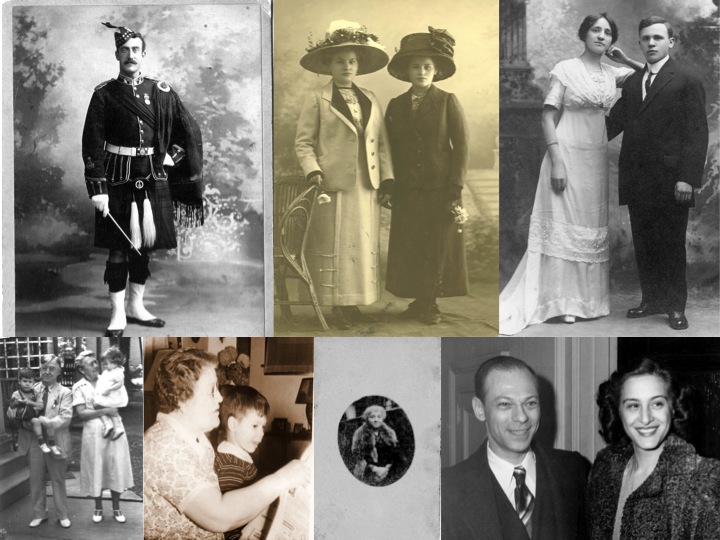
When Roots became a national phenomenon in 1977, I was riveted to the TV set and asked my mother to write me a letter about her parents' ancestry. She typed a few paragraphs of what little she knew about Hermina "Minnie" Farkas (1886-1964) and Theodore "Teddy" Schwartz (1887-1965), my maternal grandparents.

I read the letter, and then . . . I filed it away, for more than 20 years. Somehow I knew I would want it in the years ahead, when I could no longer ask Mom about her family's past. Fast-forward to 1998, when I began my genealogy journey, and returned to this letter for clues as starting points for additional research.

What Mom knew--and what she didn't know

Over the years, I learned that some of what my mother wrote in her letter was correct, some was slightly off, and much was incomplete. A few examples:

  • Grandpa Teddy came from peasant people in Czechoslovakia, arriving in America at 13 years old. Correct: Teddy was 13 when he arrived, turning 14 just a few weeks later. Incorrect: not of peasant people--they were actually middle class, according to first-hand info from Teddy's niece. Correct: his hometown of Ungvar was part of Czechoslovakia but only briefly, today being in Ukraine. Mom didn't know the name of her father's hometown, but happily, it did appear on Teddy's Social Security application, among other documents.
  • Teddy's brother and sister came to America also, but the rest of his family was killed in the Holocaust. Correct: His brother and sister came to America. Not entirely correct: Although most members of Teddy's family were, sadly, killed in the Holocaust, his niece and one or two other folks escaped, thankfully. Apparently, Mom had no idea that after WWII, her father was in touch with his niece, a  survivor of Auschwitz.
  • Grandma Minnie's parents/grandparents were prosperous farmers, renting farmland from an admiral. They didn't insure the crop one year and it failed, leaving her father financially ruined--the reason he left Hungary to come to New York City. Correct: I confirmed that the men in the family were managers of a big-shot's acreage in Hungary. Unconfirmed: the crop failure, but that story was passed down in multiple lines of the family tree, and it makes sense as the catalyst for leaving an otherwise comfortable home life, so I accept there has to be some truth to the story. 
  • A teenaged Minnie came to America after her parents, with 2-3 younger siblings "under her wing" for the voyage. Correct. Two years after her father left Hungary, one year after her mother left Hungary, Minnie and three siblings arrived at Ellis Island to be reunited with their parents. Minnie celebrated her 15th birthday on board the S. S. Amsterdam enroute to America.

Preserving my grandparents' lives in a photo book

Mom's letter offered many clues to jump-start my research into her parents and grandparents. Now, 25 years into my genealogy adventures, I'm preserving this family history in my latest professional photo book. In addition to photos of Grandpa Teddy and Grandma Minnie, I'm including photos of their siblings, their parents, the ships that brought them to America, their signatures, and much more.

For me, a creating a professional photo book is a worthwhile investment in safeguarding family history for the sake of those who come after. I want future generations to know more about the background of our ancestors than my Mom did!

Tuesday, June 20, 2023

Putting Names to Faces in Family History Photos


As I continue creating family history photo books and printed materials, I'm using different ways of identifying ancestors in old photos:

  • Digitally superimpose names on the photo.
  • Number the faces, caption using numbers with names.
  • Near photo, list names separately with explanation such as "left to right."
  • Number or name people on an outline of the photo.

Names on photo

At right, my favorite method is to digitally caption with names directly on the people in each photo.

I use bright colors for the names, which stand out against the black and white or sepia of the scanned photos. The advantage is readers can quickly and easily tell who's who, without looking elsewhere on the page or on another page for names. But in some cases, photos are too crowded to use this method of identification.

On a Mac, I use the preview application to add text to these photos, but I think nearly all photo programs have the capability to do this.

Numbers on photo, names listed separately

Another method is to number the people in the photo, then add a caption listing who's who according to number. I use this method when identifying a large number of people in one photo, because there's simply no room for names.

At left, an excerpt from a family celebration photo where Sis and I are shown (40 and 41) with our mother (33) and our grandparents (23 and 24). 

This photo will appear on the left page, and the identifying names will appear on the right, something like this: 

23) Hermina Farkas Schwartz

24) Theodore Schwartz      . . . and so on.

"Left to right" listing in separate caption

When I originally captioned the photo from my parents' wedding shown at right, I used the traditional method of listing people like this, in a caption below the photo:

At the 1946 wedding of Daisy and Harold, seated in front row, left to right: Abraham Berk, Harold Burk, Daisy Schwartz Burk, Lily Berk Goldberg.

These days, I include birth/death dates and relationships to encapsulate more info in less space. So a revised version of this caption would be:

At the 1946 wedding of Daisy and Harold, seated in front row, left to right: Abraham Berk (1877-1962, groom's uncle), Harold Burk (1909-1978, groom), Daisy Schwartz Burk (1919-1981, bride), Lily Berk Goldberg (1906-1957, groom's first cousin).

This kind of caption can be shown next to, above, or below the photo, maybe even on a facing page. 


Number or name on outline of photo

One more fun idea, suggested during today's #AncestryHour chat on Twitter: turn a copy of the photo into an outline or a pencil sketch, then digitally superimpose numbers or names without obscuring the original. 

Above, my sis and me, in a pencil sketch version of the family celebration photo. Here, I put a number on each person...but if there was room, I could have squeezed in at least a first name, if not a full name. In other words, show the full original photo on one page and then on facing page or directly below, this outline version with numbers or names. Full caption could be below the outline version or opposite, depending on space. 

No matter how I caption, I want the audience to recognize which name goes to which face, and not have to turn the page to puzzle things out! 

Saturday, June 17, 2023

Honoring Immigrant Great-Grandpa Moritz for Father's Day


For Father's Day, I'm remembering the patriarch of the Farkas family tree in America. 

My great-grandpa Moritz Farkas (1857-1936) left Hungary in August of 1899, disembarking and remaining in New York City. The catalyst for this journey was a devastating hail storm that wiped out his crops and left him deeply in debt. 

After Moritz established himself in the Big Apple, his wife Leni Kunstler Farkas (1865-1938) joined him in 1900. Their first eight children followed them through Ellis Island within the next two years. (My grandma Hermina was their second oldest child.) Moritz and Leni expanded their family with three more children in New York City.  

To honor these immigrant ancestors, one of my great uncles paid for "The Moritz Farkas Family" to be inscribed on the Ellis Island Wall of Honor, panel 132 (image at top). 

At right is the photo of Moritz now on his memorial page on Find a Grave. I digitally put his name on the photo and included the attribution "Courtesy Farkas family."

Of course Moritz and Leni will make an appearance in my next family history photo book, about my maternal grandparents, Hermina Farkas and Theodore Schwartz

Happy Father's Day, great-grandpa Moritz. I was born long after you passed away, so sadly, I couldn't get to know you . . . but I know that without your decision to sail to New York City in 1899, I wouldn't be here today. You are remembered with great affection.

Friday, June 16, 2023

Family History Photo Book: Timeline Helps Readers and Myself

Family historians know the chronology of key ancestors' lives, but the next generation may not understand the flow as easily. 

That's why, in each of my ancestor photo books, I'm including a timeline to show major events in order.

Timeline helps readers

Who was born first? Who got married when and where? When did our immigrant ancestors arrive in North America? The timeline shows readers this info at a glance. I use terminology like "1850s" or "1855ish" when the year is only an approximation. I also cover ongoing activities, such as children going to school, in a range of years.

From my most recent book about paternal grandma Henrietta "Yetta" Mahler and paternal grandpa Isaac Burk, here is one of the timeline pages I created. The timeline continued to another few lines on the following page, ending with the year these ancestors passed away.

My audience tells me over and over that quote black and white is boring unquote so I add color on every page. Here, the title of the page is in blue and the text is in black on an ivory background. Small colored hearts catch the eye and reflect my feeling that these ancestors are held in our hearts.

Timeline helps me

Creating a draft timeline also reminds me of important events as I assemble what I need for a new photo book: 

  • Photos from different periods in ancestors' lives (sharpen/crop/fix before using, check resolution so photos will reproduce well)
  • Selected documents or excerpts (a few intriguing ones such as a marriage cert, a naturalization cert, etc)
  • Signatures (enlarged/cropped from ancestors' documents)
  • Postcards, maps, other illustrations as appropriate
  • Bite-sized bios of focus ancestors, plus their parents, siblings, in-laws, children, which become even more bite-sized in my books.
Watch for more posts as I continue developing my third ancestor photo book, about my maternal grandparents, Hermina Farkas and Theodore Schwartz

Tuesday, June 13, 2023

Using a Timeline to Spot Gaps in Family History


I'm currently working on a "brief" family history of Elfie Asenath Mosse (1867-1939), the first and longest-serving librarian of the Santa Monica Public Library in California, holding that position for 49 years. I'm proud to say this incredible woman was my husband's 2c3r. 

Elfie was the descendant of strong, pioneering men and women on both sides of her family tree. Her maternal grandmother Asenath Cornwell Larimer and her father D'Alva Mosse were both in the California Gold Rush during the 1850-1853 period. Elfie would have heard those stories growing up, and seen the Gold Rush journal written by Asenath. She would most likely have heard the stories of her great uncle, John Cornwell, who wrote his own journal about being part of the Gold Rush.

Further back in time, Elfie's tree included a patriotic veteran of the US War of 1812 and Loyalist ancestors who fled the United States during the American Revolution. Some ancestors were early settlers in Indiana and Ohio. She also had uncles fighting for the Union side in the US Civil War. Fascinating ancestors with dramatic stories that shaped Elfie's view of herself and her pivotal role in civic life.

Identifying a gap

After researching Elfie's background, I created a timeline showing the chronology of who, what, when, and where. Even when I didn't have an exact year for an event, I could at least see what was going on around that time--and identify a few gaps in the family history I've been writing.

Elfie's family was often described as among the earliest living in Santa Monica. But when did they arrive? As shown in the image at top, I spotted that gap in family events between 1874 and 1877, and set out to fill it.

Filling the gap

Using free digitized newspapers on the Santa Monica public library's website, I discovered a story about Elfie's grandmother purchasing 6 lots in Santa Monica on July 15, 1875, the very first day that land was offered for sale. 

A "look back" article described the birth of Santa Monica and explained that people came from all over California to buy this undeveloped land. As it turned out, lots could not be had cheaply, as buyers originally expected. "No lot sold for less than $75, and some of them brought the huge price of $500!" wrote Kate L. Cowick in the Evening Outlook (Santa Monica) of February 11, 1932. Asenath Larimer featured prominently in the article as "grandmother of Miss Elfie Asenath Mosse, now librarian of the Santa Monica public library."

Thanks to the timeline, I was reminded to dig a little deeper. Happily, I found solid evidence of quite a significant event in Elfie's life--now added to the family history.