Tuesday, March 21, 2023

Small Family History Book Brings Wartime Activities to Life


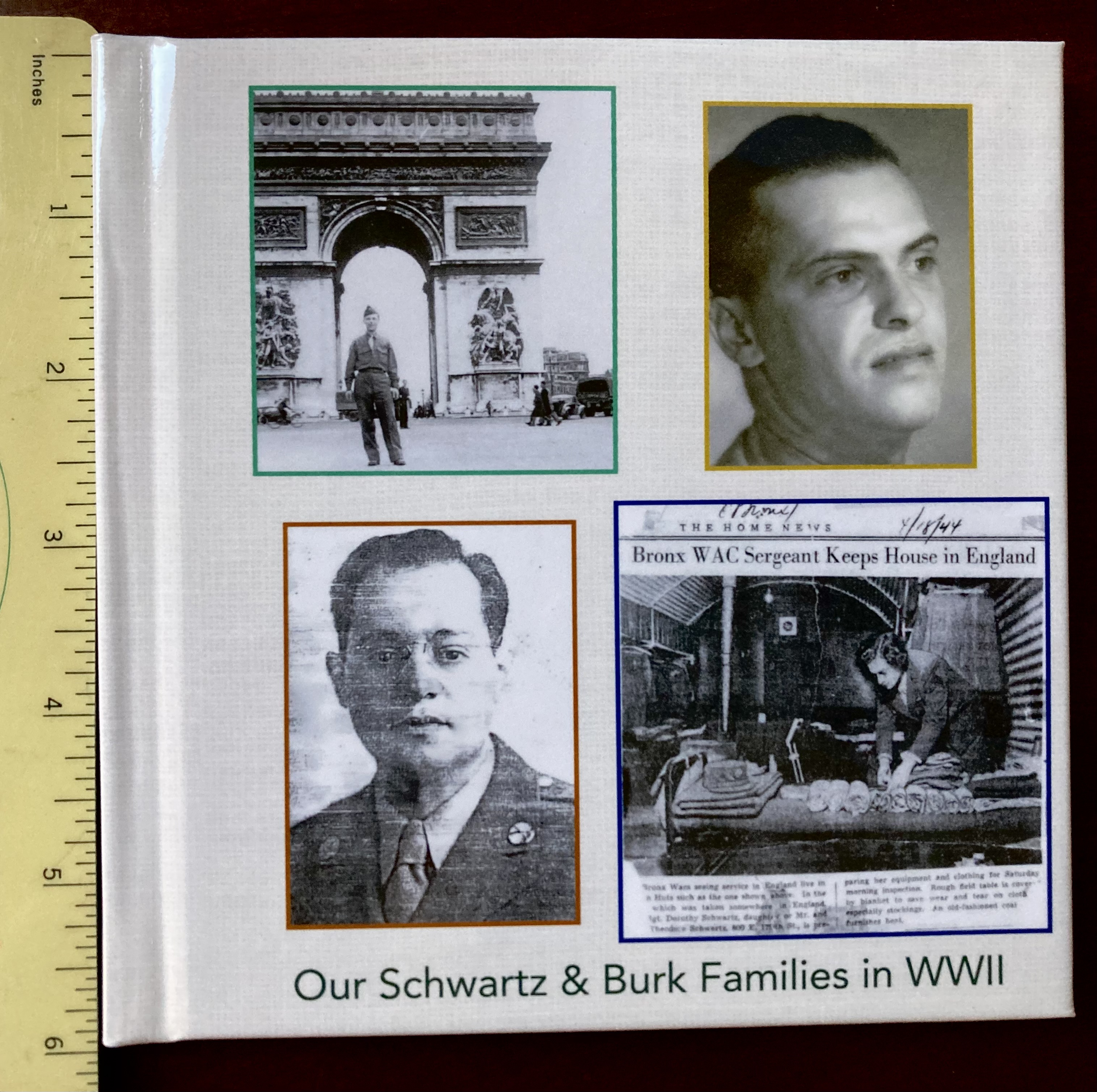
Early this month, a young relative asked about our family in World War II. In response, I created a small (six inch by six inch) photobook focused mainly on the military service of my Dad, my two uncles, and my aunt. Bite-sized family history projects like this don't take a lot of time to prepare and don't overwhelm the audience with details--using images to bring ancestors and stories to life.

The cover (see above) shows the four focus ancestors, with a colorful border around each image. Even a small touch of color is important because the next generation has complained that "black and white is boring." The text is dark green, and the background is light tan, avoiding the dreaded black-and-white that makes eyes roll among my younger audience.


On the back cover, I repeated the two most colorful images from the inside pages. Top left, the unit shoulder patch from Dad's US Army unit. He was in the 3163d US Signal Service Company, and everything on that patch has significance, from the thunderbolts forming a V for victory to the blue star in a white background, which stands for the Army Service Forces, and the broken chains, freeing Europe from the Axis. I explained the significance inside the book.

Lower right on the back cover is the shoulder patch for the 9th US Air Force, to which my aunt's WAC unit was attached. This particular image is from that WAC's unit history, researched and written by my aunt, Sgt. Schwartz.

Inside, I also included a few sentences (with photos) about the military service of Dad and Mom's first cousins, noting that Mom was in the New York City Air Warden Service. 

This attractive bite-sized book has a hard cover and looks professional, with flashes of color throughout. Now the next generation will know that our Schwartz and Burk ancestors were active during World War II in the US Army, US Army Air Force, US Marines, US Navy, US WACs, and on the home front as well.

Sunday, March 19, 2023

LOCKSS via Find a Grave


After I join my ancestors, I don't want my family history to be forgotten or lost. That's why I've been sharing far and wide, knowing that LOCKSS - lots of copies keep stuff safe.

In addition to documenting my family tree and hubby's family tree on multiple websites, I've made Find a Grave a big part of my LOCKSS plan. Membership in Find a Grave is free: register, create a member profile (you can list surnames you're researching, great cousin bait!), and get started. 

Create memorials, link relatives, add bios

I'm steadily going through my trees and checking for Find a Grave memorials. I add a page for ancestors who have none, when I know where those people were buried (or cremated or memorialized on a cenotaph, like hubby's cousin here). Little by little, I'm also adding bite-sized bios, as shown on hubby's cousin's page.

If a memorial already exists, I link the memorial pages of ancestors who were related to each other. That way the memorial will show an ancestor's parents/spouse/children/sibling(s) as family context--and clues for other researchers. This also gives me a push to conduct a bit of research if I'm missing a date or a relationship.

Nearly all the memorial managers I've dealt with have approved my edits quickly and completely. The wonderful manager whose bio I show here holds a few ancestral memorials from my tree. He's posted all suggested edits within a day or two, and also made one transfer at my request. He is the ideal manager IMHO. I've heard so so many complaints about managers who won't transfer memorials, won't make edits, but rarely have I had a bad experience and I'm not easily deterred from my mission of LOCKSS.

Once or twice I had to explain my edits to a memorial manager by showing documentation. For instance, when there was no headstone, I proved someone's name was wrong in the cemetery's index and the manager changed the page. This doesn't happen often, but I can understand a manager striving for accuracy might want to know "how I know."

On the other hand, I disagreed with an edit suggested by a researcher trying to be helpful. The edit suggested adding "Jr" to the ancestor's name because his father was "Sr." Um, the younger guy had a different middle name than his dad AND never in his life did he use the "Jr" suffix (lots of documentation on this guy). We had a polite exchange of messages when I rejected the proposed "Jr" change, explaining my reasoning and thanking the researcher for other edits I did approve.

Find a Grave index is widely available

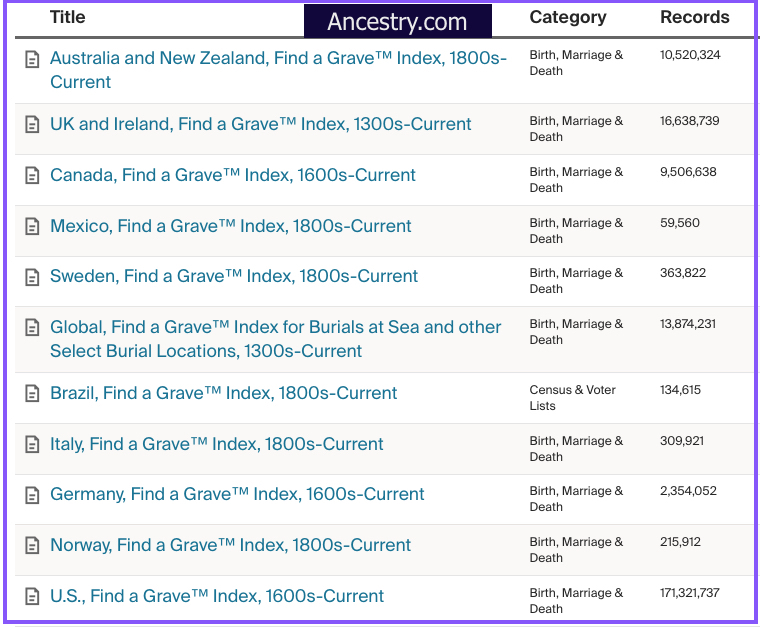
Now back to LOCKSS. At top is a screen shot of the Ancestry catalog entry for Find a Grave. This, this, is a big reason why I invest so much time in Find a Grave. 

See how many millions upon millions of Find a Grave memorials are indexed and searchable on Ancestry?

Anyone researching an ancestor of mine via Ancestry is highly likely to see a link to the Find a Grave memorial page. They'll fill out their tree, and may even connect with me to share info (remember my Find a Grave profile shows surnames researched). My ancestors on multiple Ancestry trees--LOCKSS.

FamilySearch also makes the Find a Grave index available on its free website. Millions of people use FamilySearch--meaning any of them could potentially notice the Find a Grave memorial I created OR a link to a relative on Find a Grave. Quite a powerful incentive to add my ancestors to Find a Grave and improve existing memorial pages!

Is Find a Grave perfect? Of course not, and there are any number of legitimate concerns. But the many pluses make it an important part of my plan for LOCKSS, which is why I'm an active member.

"Membership" is Amy Johnson Crow's genealogy prompt for week 12 of #52Ancestors. 

Thursday, March 16, 2023

Book Review: Essential Guide to Researching Your Kentucky Family History


If you're researching ancestors in the Bluegrass State, you'll find lots of practical information in the brand-new book Essential Guide to Researching Your Kentucky Family History. 

Published by the Kentucky Genealogical Society, available on Amazon here, this 144-page book is filled with expert research advice, useful historical maps, insider's tips, and much more. Disclaimer: I'm a member of the KGS and received a free copy to review, but the opinions expressed here are entirely my own.

Organization of chapters

Not for beginners only, the Essential Guide is divided into six sections, leading readers through the background of the state, genealogical methodology, and specific resources and techniques for genealogy research in Kentucky:
  • Understanding Kentucky History (forming counties, pioneer family paths, Jackson Purchase, common causes of death in 19th century)
  • Basics of Family Research (getting started, pedigree charts, tips for research, remotely researching in Kentucky, strategies for working with clues)
  • Finding Genealogical Sources (Census, tax lists, land grants, obits, military records)
  • Genealogy Techniques and Tricks (maps, vital records, female ancestors, marriages for formerly enslaved persons, timelines, courthouse disaster plan, published ancestor research)
  • Sharing Your Research (catch relatives' attention, tips and suggestions for family storytellers)
  • Reference (county formation dates/county seats, cousin formula)
Insider's knowledge

The book spotlights resources and approaches not necessarily familiar to researchers outside of the state--but known to the insiders at the Kentucky Genealogy Society. 

For instance, the chapter titled "Is Your Kentucky Ancestor in the Log Cabin?" explains how to access and search, for free, issues of a weekly newspaper published in the Harrison County area from 1896 to 1960. Often ancestors' activities were mentioned in the paper--a terrific place to check if your family's roots extended to that region of Kentucky.

I'm partial to maps, so I particularly like the chapter about the use and source of topographical maps, historical county maps, and cadastral maps (which indicate land ownership). 

Another super-valuable chapter digs into techniques for researching Kentucky land grants, following the four-step patent process and specifics of where to locate land documentation.

In short, anyone who has Kentucky ancestors will want to read and refer to this detailed yet succinct guide again and again. 

Tuesday, March 14, 2023

Word Cloud of Hubby's Irish Ancestors


For St. Patrick's Day, I created a lucky four-leaf clover of surnames and places from my husband's Irish ancestry. The free site I used is WordArt.com

As always, I sent "Erin Go Bragh" greeting cards to the grandkids. This year I included a four-question quiz about a few of the Irish ancestors I've been telling them about for years.

  1. Who was the first Brice in our family to be born in America, and where in Ireland did his parents come from?
  2. What happened to our ancestor Robert Larimer after he set sail from Northern Ireland bound for America in the 1740s?
  3. Where in Ireland were Larimer in-laws Thomas McKibbin and Jane Irvine McKibbin born before moving to Turkeytrot, Pennsylvania?
  4. Which Scots-Irish ancestors, born in Donegal, paid for passage to sail to Philadelphia and then walked to Virginia to buy farm land?
Answers:

  1. Brice Smith was the Brice in our family to be born in America, in Pennsylvania in 1756. His parents, William and Jean Smith, were from Limerick. Brice and his wife Eleanor Kenny Smith were hubby's 4th great-grandparents. There is also a Brice in my husband's generation.
  2. Robert Larimer boarded a ship about 1740 to sail across the Atlantic in search of a new life, age 21. Unfortunately, he was shipwrecked and forced to serve as an indentured servant to work off the cost of his rescue. After years of hard work, Robert ran away, married Mary Gallagher, and farmed in Pennsylvania. Later, the couple and their family moved to Rush Creek, Ohio. Robert and Mary were hubby's 5th great-grandparents.
  3. Thomas McKibbin was born in County Down, Ireland, and married his wife Jane Irvine in Ireland before traveling to Pennsylvania about 1812. Later, Thomas and Jane moved west to pioneer in Indiana, where both are buried. Thomas and Jane were in-laws of hubby's Larimer family.
  4. Halbert McClure and his wife, Agnes, were both born in Donegal, although the McClure family is originally from Scotland. Halbert, his wife, their children, and some of Halbert’s brothers sailed to Philadelphia and then walked together to Virginia in the 1700s. Their descendants became farmers in Ohio and then in Indiana. Halbert and Agnes were 5th great-grandparents of my husband.
"Lucky" is the 52 Ancestors theme for this week, from Amy Johnson Crow. 

Saturday, March 11, 2023

Bite-Sized Family History from World War II

It seems my relatives like to learn about family history in small doses. Not for them a big data dump about dozens of ancestors or multiple generations. Keep it focused, keep it simple, they'll pay attention for at least a little while.

This week, I created a bite-sized photo book with snippets of what some ancestors did during World War II--in the military and on the home front. (Photo of photobook will be posted soon!)

Many served in the armed forces. I selected four to profile in some detail: my Dad (US Army), his brother (US Army Air Corps), my aunt (WAC), and my uncle (US Army). Lots of photos and bits of documents brought their stories alive.

I also briefly touched on the military service of Dad's and Mom's first cousins, including one in the US Navy and one in the US Marines Corps. Another of Dad's cousins served in the New York Guard. Nearly every branch of the armed forces was represented in the family tree, and mentioned in the bite-sized book!

Supporting the war on the home front

Beyond the military, our Farkas family had its very own Rosie the Riveter. My great aunt Freda, younger sister of my Grandma Minnie, worked long hours in the Grumman aircraft factory on Long Island. 

Other women in the family tree were supporting the war effort on the home front, as well. My Mom and her twin, plus two cousins, joined the American Woman's Voluntary Services, volunteering for a range of activities including selling war bonds. 

My maternal grandma's Farkas Family Tree association often held war-bond sales during monthly meetings, raising a couple thousand dollars at a clip. Mom was also involved with New York City's civilian Air Warden Service during 1943, checking that curtains were closed for blackouts in case of overnight enemy bombing raids. 

Does your family tree include any Rosie the Riveters? Women's History Month is a great time to show pride in these ancestors by telling their stories in a bite-sized family history project.