Wednesday, November 18, 2026

The Short Family in the News - A Time of Change

In November of 1872, farmer David Oscar Short (1849-1895) married Cornelia Jane Shank (1851-1938). Oscar, as he was usually known, was my husband's 1c3r. He and Cornelia Jane had one daughter, Eleanor Josephine Short (1873-1916).  Unfortunately, that was the end of their line, a real change for a family that had so many children in most lines.

I researched Oscar, Cornelia Jane, and Eleanor Josephine in local newspapers, including the Goshen Times [Goshen, Indiana]. There I learned about Oscar suffering from consumption and his being visited by family in the weeks leading up to his untimely death. The news report of his death on April 10, 1895, the reads: 

David Oscar Short died at 11 o'clock last night of consumption, aged about 46 years. He leaves a family. The funeral will be held at the late residence corner of Logan and New Main streets tomorrow morning at 11 o'clock, Rev. Leas conducting the obsequies. The remains will be buried in the Eldridge cemetery near Middlebury.

Only child Eleanor Josephine sadly became seriously ill with cancer in her early 40s and passed away at the age of 42 in February, 1916. She was also buried in Eldridge Cemetery. (Her mother answered the 1900 US Census question about how many children by saying 1 ever born, 1 still living then.)

So much change for Cornelia Jane Shank Short from the happy time of her marriage in 1872 to the mournful time of her child's death in 1916. When she died at the age of 86 in March of 1938, I'm sorry to say Cornelia Jane's obit in the South Bend Tribune [Indiana] got nearly every important date wrong. 

The obit said she was married on November 21, but the actual certificate says November 19 (see for yourself at top--the cert was returned on November 21). 

Obit said her husband Oscar died in 1896, but it was actually 1895. 

Obit said her only child Josephine died in 1915, when it was actually 1916. 

What the obit got right was her burial to rest alongside her husband and daughter in Eldridge Cemetery in Middlebury, Indiana.

"A time of change" is this week's prompt in Amy Johnson Crow's 52 Ancestors series.

Friday, November 13, 2026

Oldies But Goodies: NARA's Free Genealogy Articles

The US National Archives and Records Administration used to publish a quarterly magazine, Prologue, with articles featuring items of historical interest from NARA vaults across the country. Alas, after nearly 50 years, Prologue ceased publication with its Winter 2017-2018 issue.

Yet NARA has kept on its web site many dozens of Prologue articles that are timeless and relevant, even if written a decade or more in the past. For free! Take a look at the full index shown on this page. 

Happily, NARA has also taken the time to post links to articles of genealogical interest on a separate page--see Genealogical Notes here. These are categorized for convenience, as shown in the excerpt at top. 

Below, a look at the Census category under Genealogical Notes. I browsed this category and found a few nuggets.

For example, I was interested in the piece debunking the myth that the US 1960 Census was lost due to technical computer problems. Not so! Read all about it here, for free. This is reassuring because the release of the 1960 US Census will take place in, um, 2032. It's on my calendar! 

Tuesday, November 10, 2026

Saluting WWII Veteran Ancestors in My Family Tree


Three years ago, I created a 6 inch by 6 inch family history book to showcase the World War II military service of ancestors in my tree. I gave a copy to my Sis and to each member of the younger generation so they can be proud of how these ancestors served our nation and the cause of democracy.

On my Dad's side, these were the World War II veterans:

  • Harold D. Burk (1909-1978), my Dad, whose US Army insignia, buttons/badges, and dog tag are shown in the image (from the book) at top. 
  • Sidney B. Burk (1914-1995), Dad's younger brother, enlisted in the US Army Air Force.
  • Myron "Mike" Volk (1921-1986) served as a chief specialist for the US Navy. He was one of Dad's many first cousins.
  • David "Buddy" Smith (1914-1990) served in the New York Guard, training at the local armory for state emergencies. Another of Dad's first cousins.
  • Jules Smith (1916-1996) enlisted in the US Marine Corps. Another of Dad's first cousins.
  • Harvey Smith (1916-1996) enlisted in the US Army. Yet another of Dad's first cousins, and Jules's twin.
In my mother's line, these ancestors were World War II veterans:

  • Dorothy Schwartz (1919-2001), my mother's twin sister, served in the US Women's Army Corps (WACS). 
  • Fred Shaw (1912-1991), Mom's older brother, served in the US Army.
  • George Farkas (1921-1949) enlisted in the US Army Air Corps. One of Mom's many first cousins.
  • Robert Farkas (1924-2014) enlisted in the US Army Medical Corps. Another of Mom's first cousins.
  • Harry Pitler (1925-2014) enlisted in the US Army and became trained as an X-ray technician. Yet another of Mom's first cousins.
On Veterans Day, I will remember these veterans with pride and gratitude for their service.

Friday, November 6, 2026

Fibber McGee and Molly and My Parents

In my childhood, my parents would occasionally use some catch-phrase that became familiar yet I had no idea where it came from.

As just one example, I remember they laughed about Fibber McGee's closet. Went right over my young head. I was born in the age of television and old radio shows were not on my radar. When I tuned into the radio, I wanted rock 'n roll music, not corny comedy or melodrama.

Tune In Yesterday by John Dunning

A few years ago, I picked up this encyclopedic volume describing the commercial development of radio and the programs that aired. The book was priced at $4 in a used book sale and was it ever a bargain! 

From A (Abbott and Costello) to Z (The Zero Hour), author John Dunning traces the history of hundreds of radio shows. Reportedly he had to edit out some content to keep the book to just 700 pages. 

Fibber and Molly

Dunning explained the background and huge popularity of Fibber McGee and Molly, a radio program that aired nationally from the 1930s until the early 1950s. The McGee hall closet was a long-running gag, accompanied by humorous sound effects as Fibber opened the door and was buried in a noisy avalanche of miscellaneous items. 

Because my family's apartment had way too few closets, some were stuffed full enough to feel like the McGee closet. Mom and Dad knew the reference from listening to the radio in the 1930s and 1940s, and it didn't take too long before I got the gist. This radio catch-phrase echoed in my family history.

1930 US Census asked about radio

The US Census had a question about whether each household had a "radio set." About 40% of the population had a radio at that time. Ownership was higher in Northern states and in urban areas, as shown in the map above (probably due to more extensive electrification in those areas).

My immigrant ancestors all owned radios, according to their 1930 US Census enumerations, so my parents would have been exposed to lots of early radio programming. The Farkas Family Tree meeting minutes mention that some years, the family would gather at one person's home to listen to the election results on the radio. It was most definitely an integral part of their lives, both for news and for entertainment, during World War II.

By 1950, 96% of US households owned a radio, but only 12% owned a TV set, according to the US Census. And in fact, my family tree minutes say some relatives made a point of gathering around one couple's TV for election results in the early 1950s. Think how small that TV screen was! 

Browsing for Early TV Shows

Back to the old-time radio book: The author notes how many of the most popular radio programs tried to make the transition to television in the late 1940s/early 1950s. Those include soap operas and westerns. Some were successful, some lasted only a brief time on the screen. Either way, I enjoy browsing Dunning's book now and then in search of programs and actors I remember from my childhood. 

Maybe early radio references echoed in your family history too? 

Monday, November 2, 2026

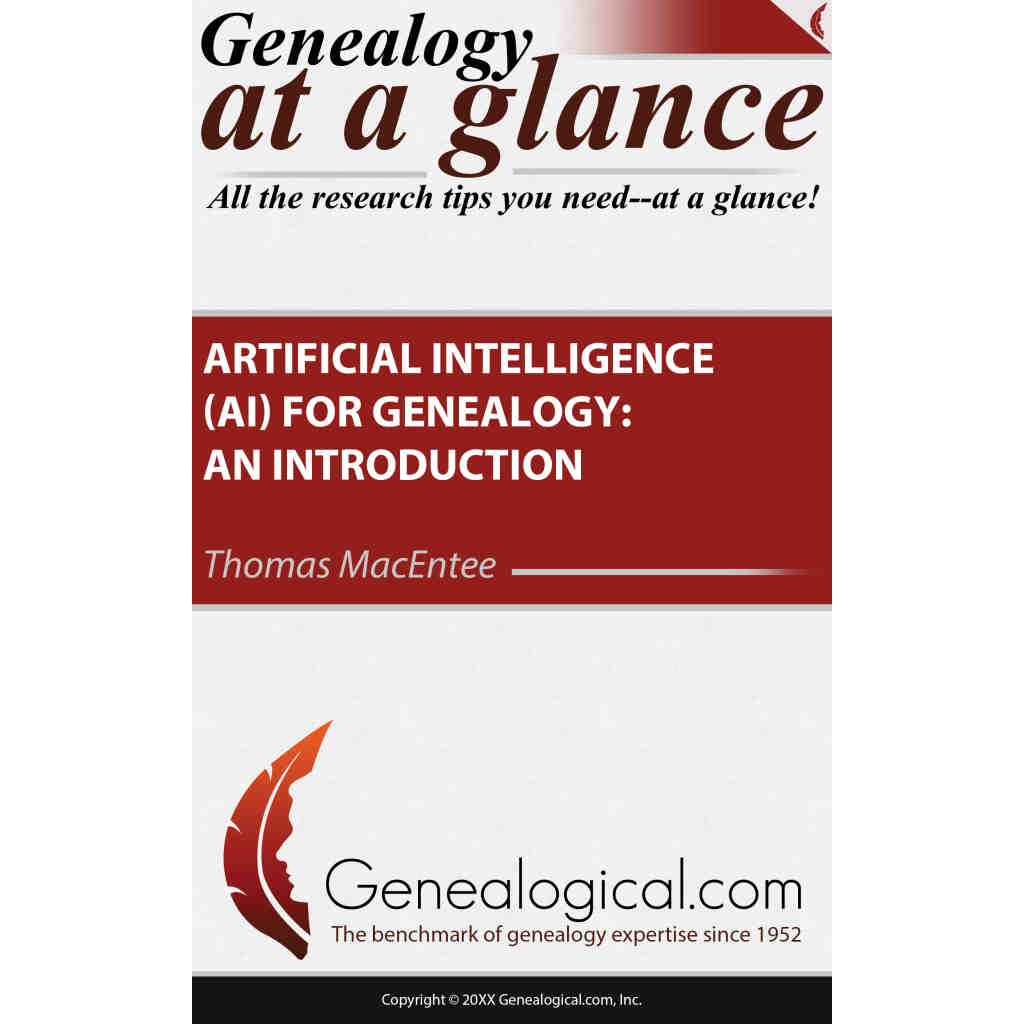
Brief Review: AI for Genealogy, An Introduction


At the end of 2024, Thomas MacEntee published a brief overview of using artificial intelligence (AI) for genealogy. Genealogical.com provided me with a free review copy of this concise digital publication--with no strings attached and no influence over my brief, honest review of this digital-only publication.

Despite the rapid evolution of AI in the past couple of years, MacEntee's "at a glance" brief intro to the technology can be useful, especially to folks like me who have barely dipped a toe in the water of AI for genealogy. The cost is $7.95 for downloading this 13-page overview. 

The author explains what AI is, provides a glossary to define terms, describes several popular AI platforms, and also offers a variety of ways AI can be used to help genealogists, such as for creating images related to ancestors and for filling in the blanks on social history background. Just as important, he lays out the good of AI (such as the ability to analyze large data sets) and the bad of AI (such as potential privacy violations).

I especially appreciated MacEntee's discussion of how and why to cite AI as a source. On p. 11, he provides a specific example of a citation "for content generated by a ChatGPT prompt used to determine the value of an ancestor’s home" (sorry, I can't reproduce his citation). 

Don't expect a lot of deep detail in this very basic but affordable overview. I do wish it came with links for more info, although links can change quickly as this technology continues to progress at break-neck speed. Bottom line: If you are just beginning with AI for genealogy and want a primer, consider this "at a glance" overview to get yourself oriented. 

For more about AI from Thomas MacEntee, see his website here.

Also, let me suggest checking this FamilySearch page with links to recent videos and ideas about using AI for genealogy. No doubt the 2027 RootsTech conference will include even more about AI for genealogy. Stay tuned.