Sunday, April 9, 2023

Happy Easter 1914, from Aunt Nellie and Aunt Ada


In 1914, my husband's 9-year-old uncle, Wallis Wood, received two penny postal greeting cards for Easter. He lived in Cleveland, Ohio, and was the recipient of postcards for every holiday!

Above, a postcard from his father's older sister, Rachel Ellen Wood Kirby, who lived in Chicago. She signed "Aunt Nellie."

Below, a postcard from his mother's older sister, Adelaide Mary Ann Slatter Baker, who lived in Toledo. She signed "Aunt Ada."


Wishing you and your family a lovely Easter holiday!

Saturday, April 8, 2023

Relatives by Heart, Not by Paperwork


Thanks to an exchange of messages with another genealogy researcher, I was reminded that even when relationships are unofficial, they can be super-important to our ancestors.

In this case, the researcher was interested in one of hubby's ancestors (Lynn), who had a foster daughter (no full names, for privacy reasons). 

Lynn's obit mentioned the foster daughter, indicating a close emotional link. In fact, when the foster daughter's husband died, his obit named Lynn as grandmother of his child. 

So far as we know, there was no official government documentation of this foster relationship. They were relatives by heart, not by paperwork.

To honor this special bond, the researcher is connecting all of these folks on his family tree, with an explanation. 

Sources? He cites the obits as his sources. 

A lovely tribute.

Sunday, April 2, 2023

A is for Asenath: Wife, Mother, Pioneer, Baker, Library Founder


This week's #52Ancestors prompt from Amy Johnson Crow is "begins with a vowel." Great--a chance to write about one of the favorite female ancestors in my husband's family tree: Asenath Cornwell Larimer (1808-1897). At top, Asenath's home in Santa Monica, California, where she spent her last years after quite an adventurous life.

Canada to Ohio to Indiana

Asenath and her siblings were born in Canada, according to multiple Census records over multiple years. How she wound up in Ohio, I don't know. But on August 14, 1832, in Fairfield county, Ohio, she married hubby's great-great-great uncle James Larimer (1806-1847). They had 6 children together (sadly, one died in infancy). Within a year, they moved to Elkhart county, Indiana as pioneer farmers, clearing heavily wooded land to raise crops.

After James was accidentally thrown from a horse and died early in 1847, Asenath was left the family farm in Indiana and still had five children under the age of 10 to raise. Her brothers and in-laws helped out, but it was a struggle.

Gold Rush journey

Within a few years, she made a bold but emotionally difficult decision: Sell the farm, leave the children in care of family and friends, and use the money to accompany her brother John Cornwell, a jewelry merchant, on a journey to the Gold Rush in California. Starting in March, 1852, they took two steamboats en route to joining a wagon train at Lexington, Missouri. 

During the long, arduous trip west, Asenath wrote in a journal from March 1852-March 1853 about the daily thoughts and events of that period. Although her oldest son tried to dissuade her from leaving for California, she wrote in her journal about her strong faith: "...looking forward to the dangers and trails of the way, I feel very gloomy, but in the Lord put I my trust." She missed her children very much, yet she was hopeful of establishing herself in a new place where she could earn a living and the family would be reunited in the future.

By mid-May of 1852, her wagon train joined a "constant crowd of wagons" headed west. She wrote: "Colera [sic] and small pox both among these trains. 30 fresh graves have been counted on that road." Several more of her traveling companions sickened, passed away, and were buried, even as babies were born. 

California had been a state for less than two years--and Asenath writes of passing out of the United States, then entering the States again during the journey. By September of 1852, six months after leaving Indiana, she and her brother John reached Volcano (east of Sacramento). They went 8 miles further to Clinton, where they chose a lot and set up a tent. Her brother prospected for gold while Asenath earned a bit of cash washing, patching, and baking. 

After a while, when her brother did not strike gold, she moved to San Francisco and reinvented herself based on her skill in baking. 

John, for his part, traveled back to his family in Athens, Ohio and reopened his jewelry store. He also kept a Gold Rush journal. The store he reopened prospered for more than a century, finally closing its doors in 2019.

Putting down roots in California

Meanwhile, Asenath opened a bakery in San Francisco in the early 1860s. Soon, one of her married sons moved west and she lived with him and his family, continuing her bakery business. 

Later, she moved south to Santa Monica in Los Angeles County, Calif., where she was a force in establishing the first public library. Her granddaughter Elfie Asenath Mosse (1867-1939) was the first librarian in 1890. The quote above talks about Asenath's early involvement in the Santa Monica community and library.

Asenath never remarried. At the age of nearly 89, she passed away in 1897 and was buried in Woodlawn Cemetery in Santa Monica. I'm in the process of putting her bite-sized bio in multiple places, including here, WikiTree, and Find a Grave.

Remembering Asenath

Thanks to her journal and her civic involvement, Asenath has been mentioned in a number of sources that are digitized and searchable online. I hadn't seen her home before, which is in the Santa Monica Image Archives (image is at top of post). But clearly, Asenath is going to be remembered inside and outside the family, because her name and her life are referenced in a variety of places (not just on my blog and family trees).
Friday, March 31, 2023

World Backup Day - Keep Your Genealogy Data Safe!


Today is World Backup Day. So many options...the cloud, one or more external hard drives, flash drives, but please keep a backup off-site just in case. Ideally, use more than one backup method!

Also be sure your surge protector(s) are in good working order. I recently upgraded from a decade-old surge protector to a newer unit that offers better protection and has room for a variety of power adapters and plugs. 

Keep your genealogy research, family photo scans, and other data safe for today, tomorrow, and beyond. 

Monday, March 27, 2023

Adopting Orphan WikiTree Profiles


In the interest of LOCKSS (lots of copies keep stuff safe), I've put family trees on multiple platforms (Ancestry, MyHeritage, FindMyPast). Others are working on family trees on Family Search, so I only touch up profiles there and check that cousins who are very much alive are not yet shown as "deceased." Right now I'm waiting for FamilySearch to change the status of a 99-year-old cousin from "deceased" to "alive." Hey, I spoke with him a week ago and he's definitely alive! UPDATE: Only a few days after requesting this change, my cousin was officially declared "living."

Focusing on WikiTree

Currently, I'm adding and enriching ancestor profiles on WikiTree. Rather than upload a GEDCOM, I'm entering one ancestor profile at a time. The collaborative WikiTree tree is more than just names and dates--sources are required, and often contributors link to actual sources. By creating profiles one by one, I can review the sources I've already gathered and conduct fresh research to fill any gaps and sketch a bite-sized bio for each ancestor. 

Early this year I finally connected hubby's ancestors to people already profiled on WikiTree. Now I'm discovering even more of his McClure ancestors and in-laws on WikiTree. At top, the formerly orphaned WikiTree profile of Louisa Austin McClure (1837-1924), the wife of hubby's great-granduncle Theodore Wilson McClure (1835-1927). 

I immediately adopted her profile and began filling it out. Below, my work in progress, with a bite-sized bio and more sources. I still have more children to add, and more orphaned profiles to adopt...but this is a good start. (You know I married my husband for his ancestors!)


My first ancestral connection to someone profiled on WikiTree was through a cousin-in-law on my Farkas side. That profile had originally been created in 2011, and I adopted it this month. Fewer orphans means more recent research and enriched bite-sized bios. 

Connect-a-Thon Coming 

I'll be participating in WikiTree's Connect-a-Thon during April, concentrating on adding more profiles of my ancestors and their in-laws. See you there?!

Tuesday, March 21, 2023

Small Family History Book Brings Wartime Activities to Life


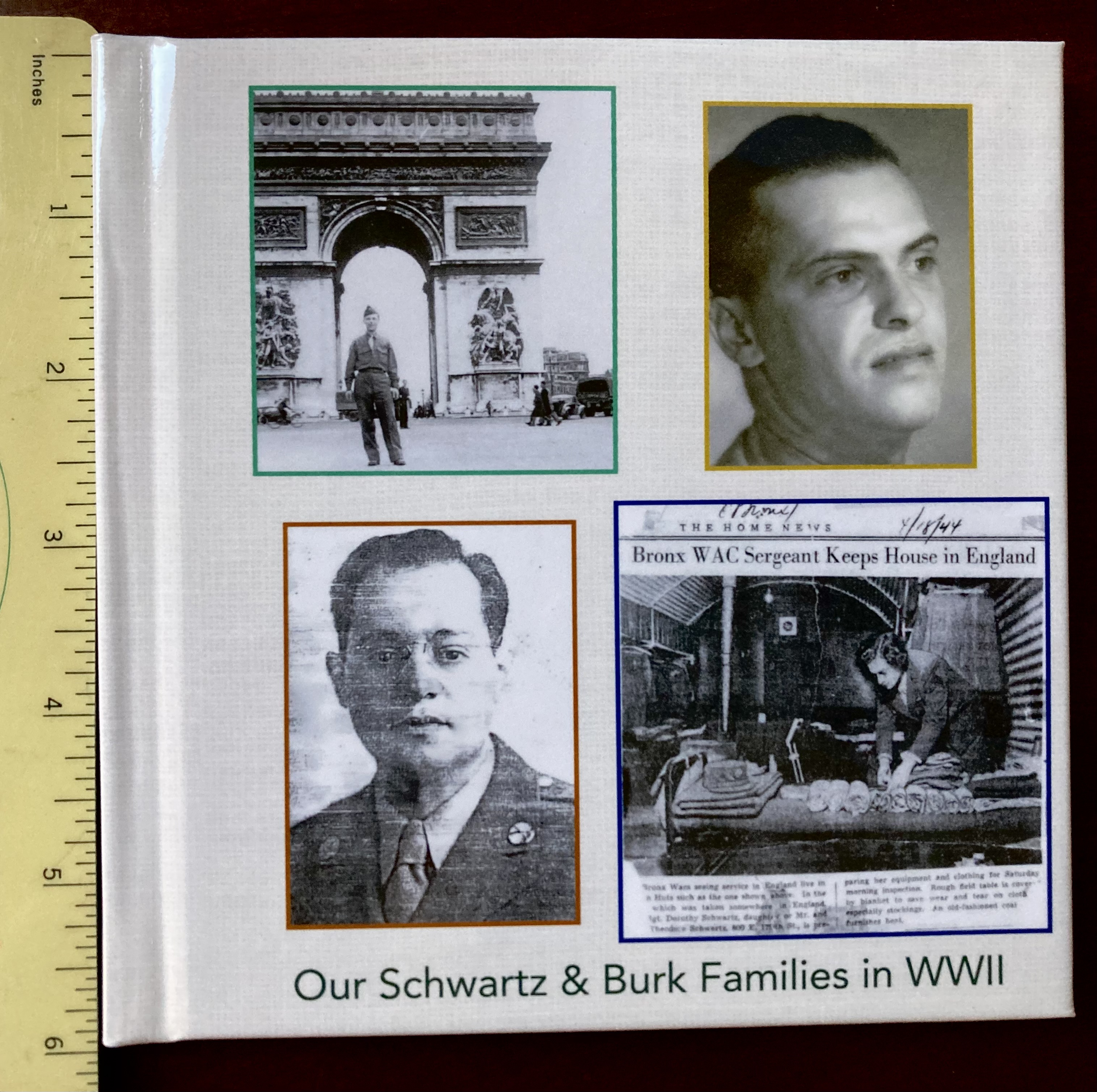
Early this month, a young relative asked about our family in World War II. In response, I created a small (six inch by six inch) photobook focused mainly on the military service of my Dad, my two uncles, and my aunt. Bite-sized family history projects like this don't take a lot of time to prepare and don't overwhelm the audience with details--using images to bring ancestors and stories to life.

The cover (see above) shows the four focus ancestors, with a colorful border around each image. Even a small touch of color is important because the next generation has complained that "black and white is boring." The text is dark green, and the background is light tan, avoiding the dreaded black-and-white that makes eyes roll among my younger audience.


On the back cover, I repeated the two most colorful images from the inside pages. Top left, the unit shoulder patch from Dad's US Army unit. He was in the 3163d US Signal Service Company, and everything on that patch has significance, from the thunderbolts forming a V for victory to the blue star in a white background, which stands for the Army Service Forces, and the broken chains, freeing Europe from the Axis. I explained the significance inside the book.

Lower right on the back cover is the shoulder patch for the 9th US Air Force, to which my aunt's WAC unit was attached. This particular image is from that WAC's unit history, researched and written by my aunt, Sgt. Schwartz.

Inside, I also included a few sentences (with photos) about the military service of Dad and Mom's first cousins, noting that Mom was in the New York City Air Warden Service. 

This attractive bite-sized book has a hard cover and looks professional, with flashes of color throughout. Now the next generation will know that our Schwartz and Burk ancestors were active during World War II in the US Army, US Army Air Force, US Marines, US Navy, US WACs, and on the home front as well.

Sunday, March 19, 2023

LOCKSS via Find a Grave


After I join my ancestors, I don't want my family history to be forgotten or lost. That's why I've been sharing far and wide, knowing that LOCKSS - lots of copies keep stuff safe.

In addition to documenting my family tree and hubby's family tree on multiple websites, I've made Find a Grave a big part of my LOCKSS plan. Membership in Find a Grave is free: register, create a member profile (you can list surnames you're researching, great cousin bait!), and get started. 

Create memorials, link relatives, add bios

I'm steadily going through my trees and checking for Find a Grave memorials. I add a page for ancestors who have none, when I know where those people were buried (or cremated or memorialized on a cenotaph, like hubby's cousin here). Little by little, I'm also adding bite-sized bios, as shown on hubby's cousin's page.

If a memorial already exists, I link the memorial pages of ancestors who were related to each other. That way the memorial will show an ancestor's parents/spouse/children/sibling(s) as family context--and clues for other researchers. This also gives me a push to conduct a bit of research if I'm missing a date or a relationship.

Nearly all the memorial managers I've dealt with have approved my edits quickly and completely. The wonderful manager whose bio I show here holds a few ancestral memorials from my tree. He's posted all suggested edits within a day or two, and also made one transfer at my request. He is the ideal manager IMHO. I've heard so so many complaints about managers who won't transfer memorials, won't make edits, but rarely have I had a bad experience and I'm not easily deterred from my mission of LOCKSS.

Once or twice I had to explain my edits to a memorial manager by showing documentation. For instance, when there was no headstone, I proved someone's name was wrong in the cemetery's index and the manager changed the page. This doesn't happen often, but I can understand a manager striving for accuracy might want to know "how I know."

On the other hand, I disagreed with an edit suggested by a researcher trying to be helpful. The edit suggested adding "Jr" to the ancestor's name because his father was "Sr." Um, the younger guy had a different middle name than his dad AND never in his life did he use the "Jr" suffix (lots of documentation on this guy). We had a polite exchange of messages when I rejected the proposed "Jr" change, explaining my reasoning and thanking the researcher for other edits I did approve.

Find a Grave index is widely available

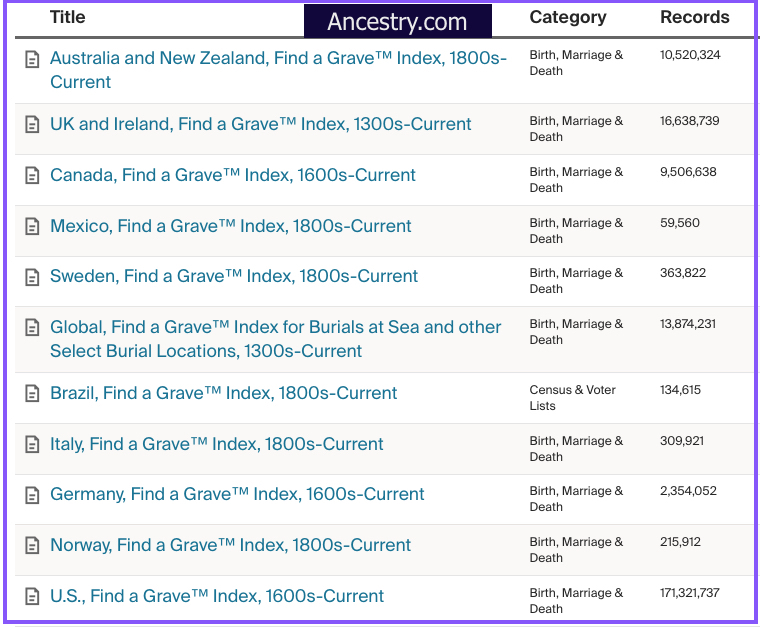
Now back to LOCKSS. At top is a screen shot of the Ancestry catalog entry for Find a Grave. This, this, is a big reason why I invest so much time in Find a Grave. 

See how many millions upon millions of Find a Grave memorials are indexed and searchable on Ancestry?

Anyone researching an ancestor of mine via Ancestry is highly likely to see a link to the Find a Grave memorial page. They'll fill out their tree, and may even connect with me to share info (remember my Find a Grave profile shows surnames researched). My ancestors on multiple Ancestry trees--LOCKSS.

FamilySearch also makes the Find a Grave index available on its free website. Millions of people use FamilySearch--meaning any of them could potentially notice the Find a Grave memorial I created OR a link to a relative on Find a Grave. Quite a powerful incentive to add my ancestors to Find a Grave and improve existing memorial pages!

Is Find a Grave perfect? Of course not, and there are any number of legitimate concerns. But the many pluses make it an important part of my plan for LOCKSS, which is why I'm an active member.

"Membership" is Amy Johnson Crow's genealogy prompt for week 12 of #52Ancestors. 

Thursday, March 16, 2023

Book Review: Essential Guide to Researching Your Kentucky Family History


If you're researching ancestors in the Bluegrass State, you'll find lots of practical information in the brand-new book Essential Guide to Researching Your Kentucky Family History. 

Published by the Kentucky Genealogical Society, available on Amazon here, this 144-page book is filled with expert research advice, useful historical maps, insider's tips, and much more. Disclaimer: I'm a member of the KGS and received a free copy to review, but the opinions expressed here are entirely my own.

Organization of chapters

Not for beginners only, the Essential Guide is divided into six sections, leading readers through the background of the state, genealogical methodology, and specific resources and techniques for genealogy research in Kentucky:
  • Understanding Kentucky History (forming counties, pioneer family paths, Jackson Purchase, common causes of death in 19th century)
  • Basics of Family Research (getting started, pedigree charts, tips for research, remotely researching in Kentucky, strategies for working with clues)
  • Finding Genealogical Sources (Census, tax lists, land grants, obits, military records)
  • Genealogy Techniques and Tricks (maps, vital records, female ancestors, marriages for formerly enslaved persons, timelines, courthouse disaster plan, published ancestor research)
  • Sharing Your Research (catch relatives' attention, tips and suggestions for family storytellers)
  • Reference (county formation dates/county seats, cousin formula)
Insider's knowledge

The book spotlights resources and approaches not necessarily familiar to researchers outside of the state--but known to the insiders at the Kentucky Genealogy Society. 

For instance, the chapter titled "Is Your Kentucky Ancestor in the Log Cabin?" explains how to access and search, for free, issues of a weekly newspaper published in the Harrison County area from 1896 to 1960. Often ancestors' activities were mentioned in the paper--a terrific place to check if your family's roots extended to that region of Kentucky.

I'm partial to maps, so I particularly like the chapter about the use and source of topographical maps, historical county maps, and cadastral maps (which indicate land ownership). 

Another super-valuable chapter digs into techniques for researching Kentucky land grants, following the four-step patent process and specifics of where to locate land documentation.

In short, anyone who has Kentucky ancestors will want to read and refer to this detailed yet succinct guide again and again.