Sunday, March 27, 2022

Seeing Double in Our Family Trees


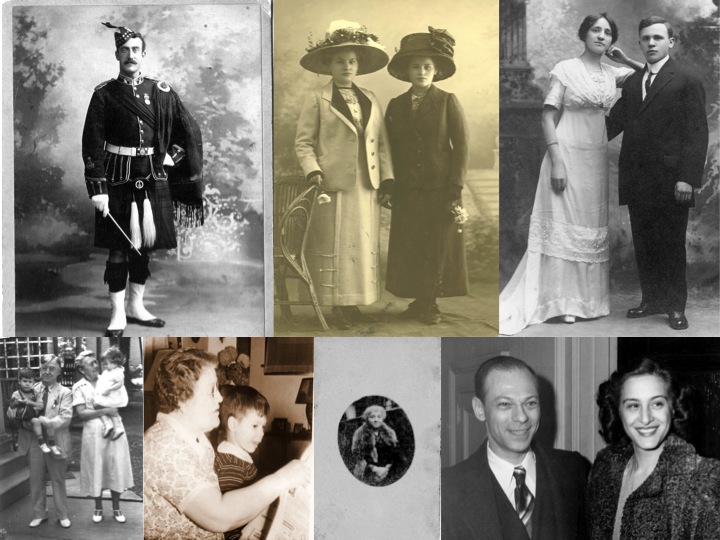
Twins definitely run in my Farkas family tree: I have a twin sister and we're daughters of a twin. Above, my mom and her sis (the Schwartz twins) about 1920ish. In addition, the Farkas family included twin boys, "Woody" and "Sandy," my second cousins.

Twins also appear in my paternal line. Among my Dad's 1st cousins on the Mahler side were Harvey Smith (1916-1996) and his twin brother Jules Smith (1916-1996). They died within five months of each other and are buried near one another in Florida. 

My husband's family tree has twins, as well. Born on the eve of New Year's Eve in 1854, twin sisters Amanda "Callie" McClure (1854-1887) and Anna "Addie" McClure (1854-1928) were great-great aunts of my husband. 

Interestingly, these McClure ladies had cousins who were fraternal twins: Jesse McClure (1875-1952) and Bessie McClure (1875-1959), born on January 31, 1875. This brother and sister were 1c2r of my husband.

"Joined together" -- in this post, about twins together -- is the #52Ancestors prompt for week 12 of Amy Johnson Crow's genealogy challenge.

Friday, March 25, 2022

Did You See These These RootsTech Sessions?

 
Hundreds and hundreds of RootsTech presentations from 2022 and 2021 are still available to view, for free, at RootsTech.org.

There were many excellent sessions, and I still have dozens more to view, waiting on my playlist. 

Here are five sessions that provided food for thought and encouraged me to dig deeper into genealogy and family-history questions. If you haven't seen them, please consider adding them to your playlist!

  • Dealing with ethical dilemmas in an online world. So many ethical questions arise in today's world of genealogy, and this session looks at a few very timely concerns (DNA, grave memorials, and terms of service, to name just three). A conversation worth watching.
  • When Harry met Dotty. A relatively brief but fascinating and informative case study of how Nick David Barratt used DNA to break down a key brick wall. Maps are part of the story too. A good case study like this can be really helpful!
  • Genealogy YouTubers. I've already blogged about this terrific panel discussion. What did I love? The candid conversation about the challenges and opportunities of using YouTube to connect with an audience of family historians. Interesting and fun.
  • What to do when there's nothing to do. Speaker Renate Yarborough Sanders reminds us of the many things we can do when we choose to take a break from intense research and return with fresh eyes. Thoughtful and encouraging!
  • Family Folklore: Fact or Fiction? Anyone who's heard a family legend will get something out of watching Virginia M. Pratt's talk, featuring interesting case studies of trying to find the truth and suggestions for how to discuss family stories with relatives. 

Wednesday, March 23, 2022

1950 US Census Prep: Check for Special EDs on the Maps


If you, like me, suspect some ancestors were in a hospital, hotel, or another facility on April 1, 1950, let me suggest something to try as you prep for the release of that year's Census.** 

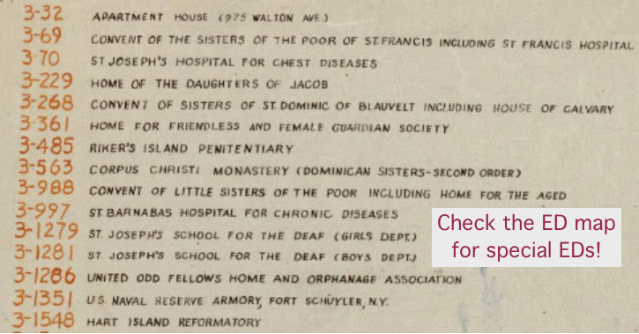
Check the Enumeration District maps for the county, town, or city where that institution was located. You might be lucky and find a listing of special EDs at the top, bottom, or elsewhere on the map where those buildings are shown.

Above, a partial listing of special EDs from an ED map of one section of the Bronx, New York, showing convents, an orphanage, a reformatory, a monastery, hospitals, schools for the deaf, even a large apartment house. This is an unusually long list--but it's not unusual to find special EDs marked on an ED map. Take a look!

Knowing the specific ED for the institution or facility gives you a head start on April 1, when the Census is made public. You'll be able to either browse the handwritten Census sheets for that one ED or use NARA's initial index to search by name and ED. 

I'm not 100% sure where all of my ancestors will be, or which will be away from home. One ancestor lived for years in a residential hotel and that's where I'll look first in the 1950 US Census. Another died weeks after the Census was taken so she might actually be in a nearby hospital, not at home. In each case, having the ED number for the facility can help me find those ancestors more quickly before full indexing.

The big genealogy sites are gearing up to the 1950 US Census fully indexed sooner rather than later. FamilySearch.org has an update page where you can learn more about the release and about indexing. If you want to help FamilySearch index the Census, I recommend watching Devon Lee's Family History Fanatics video about indexing

IMHO, since indexing can't be done until April 1st, there is still time to prep by finding EDs and being ready to look for top priority ancestors when the Census is made public!

**To see how to turn a street address into an Enumeration District, I have a case study here. To see how to use Enumeration maps and descriptions, see my case study here.

For even more posts and links related to the 1950 US Census release, please see my summary page here.

Monday, March 21, 2022

1950 US Census Search: Look for Head of Household


The 1950 US Census will be released on April 1st!

Recently, the US Census Bureau hosted a webinar at which Census and US National Archives experts talked about the background of this Census and what will be available on the day of release. That webinar is posted on YouTube.

Claire Kluskens of NARA discussed the basic name and location index that will accompany the 1950 US Census release. It could very well give us a head start on our searches!

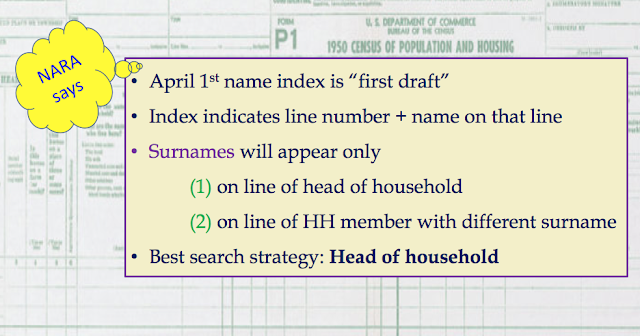
My key takeaways from her comments are shown in the image at top.

  1. Try the search functions but remember the name index is only a first draft and will need to be refined with the assistance of members of the public who submit corrections to NARA.
  2. Indexing was line by line on each sheet of the Census, showing the line number and the name written on that line.
  3. Enumerators were trained to write the surname of the head of household and the given name/initials. Others in the household who shared the same surname will NOT have the surname listed on the line number, only the given name or initials.
  4. If someone in the household has a different surname (such as a married daughter or a lodger), that line will show the surname and given name.
  5. BEST SEARCH STRATEGY, says this expert, is to look for the head of household if known--because that line will have the person's full name.
You can try your search with a combination of the head of household's surname, given name, and location (ED or city/town and county). 

Use all your usual search strategies but be prepared to browse by ED if your search doesn't lead you to your ancestors.

Meanwhile, Ancestry and Family Search and MyHeritage will all be working hard to index the Census. 

For more 1950 US Census tips and info, see my summary page here.

Sunday, March 20, 2022

Honoring the Memory of Ancestors Killed in the Holocaust


Rezi Regina Schwartz Winkler was the oldest sister of my grandpa Theodore Schwartz. Sorry to say, Rezi and too many other family members were killed in the Holocaust. As I learn more, I've been adding their names to my online family trees, to honor their memory and not let them be forgotten in the future. 

Also I'm specifically identifying the cause of death for these ancestors where they appear on my family trees. 

  • MyHeritage adds an automatic designation of the yellow star when the user selects "Holocaust" as the cause of death from the drop-down menu. This is a visual indication of the fate of that ancestor.
  • WikiTree has different Holocaust stickers that can be posted on an ancestor's profile. I can separately identify an ancestor who died, an ancestor who survived, and so on, depending on each person's circumstances.
  • Ancestry allows me to add a custom TreeTag to ancestors. I created one to indicate any ancestor who was a Holocaust victim. If I choose, I can create a custom TreeTag for Holocaust survivors.
  • On FamilySearch, I created a custom fact for the "other information" field to indicate an ancestor who died in the Holocaust.

Prior to World War II, most of my grandfather's family lived in and around Ungvar, which is now Uzhhorod, Ukraine. One way I'm supporting relief efforts in Ukraine is by attending the all-virtual Jewish Roots in Ukraine workshop on April 3d. The four experts will be talking about research strategies, sources of information, and understanding Ukrainian ancestors in context. I'm registered and ready to learn as well as to aid Ukraine.

Friday, March 18, 2022

Save March 26-27 for History for Ukraine


Want to support Ukraine relief efforts AND learn from well-known history and genealogy experts?

Get ready for History for Ukraine, the star-studded live marathon of talks assembled by Nathalie Pithers and a team of volunteers, taking place March 26-27!

Here are some of the speakers already confirmed to participate: 

  • Josh Taylor, President of the New York Genealogy and Biography Society
  • Judy Russell, "The Legal Genealogist"
  • Amy Johnson Crow, Host of Generations Cafe podcast and #52Ancestors originator
  • Earl Charles Spencer, best-selling history author and founder of Althorp Literary Festival
  • Dr Janina Ramirez, BBC documentary maker, author, and President of the Gloucester History Festival
  • Dr Wanda Wyporska, head of the Society of Genealogists
More speakers will be announced shortly. A few days ago, Family Tree Magazine conducted an interview with Nathalie Pithers. In her words, "History for Ukraine is a combination of Live Aid and Red Nose Day, but for history!"

Although this special event is entirely free, donations will be gratefully accepted! (In fact, donations can be made in advance if you wish.)

All proceeds go to DEC Ukrainian Humanitarian Appeal which is administered by the British Red Cross.

Please mark your calendars! See you at History for Ukraine on March 26-27.

Wednesday, March 16, 2022

New, Free New York City Vital Records!

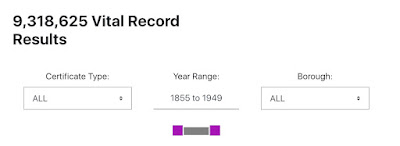
Anyone with ancestors who were born, married, or died in New York City from 1855 through 1949 can now search the New York City Municipal Archives site and view more than 9 million document images, at no charge. This action wasn't directly due to any specific lawsuit by the nonprofit Reclaim the Records, although it has sued the agency four times to get public images made public. This particular release of documents is a project that New York City has been working on for years, and now the results are being made available for free

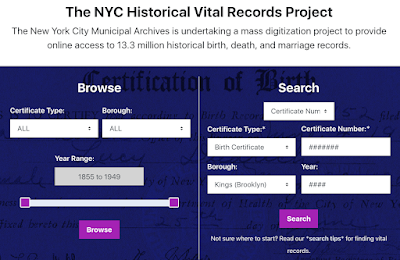
As shown in the image above, note that these images are for vital records only from 1855 through 1949. Also, not all images have yet been scanned, but the majority are available to be found via search or browsing.

Search by cert number

NYC recommends searching by certificate number, borough, and year for the best results. You can find a cert number in a number of ways. There are indexes on Ancestry, Family Search, and other sites, but usually I use the databases at ItalianGen.org - also free, thanks to the efforts of many incredible volunteers. 

As shown above, you can search the ItalianGen databases for birth, marriage, death by surname and given name or initial, specify a range of years, and narrow the search to a specific New York City borough. When I did this for my great aunt Sadie Mahler's marriage, I found two possibilities. I know her spouse (Samuel Smith) but if I didn't, the ability to look at either of these certs FOR FREE is a big, big plus.

Once I plugged in the cert number, borough, and year using the NYC search function, up popped Sadie and Sam's marriage document, both page 1 and page 2 (with their signatures and the witnesses). I don't need a certified copy for my genealogy, but if you do, you can click to buy.

Want to browse?


If you want to browse in search of an ancestor's cert (maybe you can't find the cert number, for instance), you can use the browse interface here. Select type of certificate, borough, and don't forget to use the slider to narrow the range of years.

What a wonderful treat to have, just two weeks before the 1950 US Census is released!

PS: I tried finding Sadie's marriage cert at FamilySearch but "no image" was available, only a transcription. Much better to have the actual image to view!

Saturday, March 12, 2022

1950 US Census Prep: Finding Small Town EDs

The 1950 US Census is almost here! Only 20 more days until this mid-century Census is released to the public by the US National Archives.

Even though there will be a basic index and the ability to search by name and location, nobody expects the initial index to be perfect or complete. Just in case, I've been using 1950ish addresses to locate the Enumeration District for my ancestors so I can browse the ED pages when they're made public. Or, at the very least, be able to search by name and ED, to be more specific about my searches. 

Most of my ancestors were in big cities in 1950. I described how to turn a big-city street address into an ED in an earlier post, using the incredibly powerful (and free!) Unified Census ED Finder on SteveMorse.org. 

Small town ED process

However, there's a slightly different process for finding the EDs of towns with fewer than 5,000 residents, because Steve Morse has no tables for towns that small. (He explains why on this FAQ page.)

Here's the process for finding a small town ED.

As shown in the screen grab at top, I'm using the example of the small town of Woodbury, Connecticut, which had 2,564 residents in 1950

First, I went to the Unified Census ED Finder page, and used the drop-down menus to specify the state of Connecticut and the county of Litchfield, where Woodbury is located.

Although some larger population centers are available in the drop-down menu for town/city, Woodbury is not. So instead, I selected "other" in that drop-down menu area and typed the town name (purple arrow).

ED map or description or both?

There are five possible EDs in this general area, listed in numerical order in the image at top. I don't want to browse all five in search of a Woodbury resident.


To narrow down my options, I checked the ED descriptions (in image at top, see green arrow). 

This took me to a page with written descriptions of the five possible EDs for Woodbury, as shown directly above. However, I don't know Woodbury well enough to determine from these descriptions which ED would be the most likely for my purposes. Anyone who knows the streets might take a solid guess from these descriptions.


Then I clicked to see the ED maps for the entire county (orange arrow). This took me to the list of map links shown above. The first five of the jpegs are what I wanted to view. These were sections of the entire county map, and I wanted to navigate around each map section to look for Woodbury. 


Most of the town is in one ED 

Of course, the fifth map I checked was the one where most of Woodbury is located. As shown directly above, the town is marked on the map and the ED number for the vast majority of that area is noted as 3-121

Combining the maps with the descriptions narrows things down considerably, even allowing for edges of the town that stick out beyond these straight lines.