Saturday, October 8, 2022

Have You Registered for RootsTech?

Yippee! RootsTech returns in 2023 as a vibrant in-person genealogy conference with a robust virtual component for those who prefer to participate from home.

The conference takes place March 2-4 in Salt Lake City. 

As in the past, virtual presentations will be available on demand even after the event is officially over.

The cost for in-person attendance (180+ sessions and a lot more) is $98 US.

The cost for virtual participation is zero, including a virtual expo hall. 

I just registered for the free virtual event, since I can't get away in March.

Here's the link for more information and to register

Looking forward to another lineup of informative virtual sessions presented by experts from around the world.

Thursday, October 6, 2022

Looking Ahead to 1960 US Census Release in 2032


Nine and a half years from now, the 1960 US Census will be released to the public, as the US National Archives kindly pointed out on social media just the other day.

Of course I had to preview the questionnaire (see list of questions here). 

And again, I see that some of the same outdated assumptions from the 1950 US Census were carried over to the 1960 US Census.

Only men in the military?

As shown at top, the 1960 Census questionnaire asks specifically about military service. 

But only men were asked. Just as in the 1950 US Census questionnaire.

Despite the fact that in the Korean War alone, more than 50,000 women served in military roles. 

Despite the fact that in World War II, more than 275,000 women served as WACs, WAVES, and WASPS.

Thousands of women served in military roles during World War I. 

But no women were asked about their military service on the 1950 or 1960 Census form. Sigh.

Never married? Not asked about babies!


In the 1950 Census, only women who reported they were married, widowed, divorced, or separated were asked about how many children they had ever had.

As shown above, the 1960 Census had a question about the number of babies a woman had ever had. 

But women who reported they were never married would not be asked this question

Great genealogical clues

Still, the 1960 US Census will have lots and lots of great genealogical clues. For one thing, more people were asked sample questions in this Census than in the 1950 Census, so there's a better chance one of our ancestors answered in some detail.

As shown in the image above, answers to the question about when the person was married (and, if married more than once, when married for first time) will narrow the window for researching marriage certificates.

As shown at left, we'll get wonderful clues from the question about where each person was born (note that enumerators were told to "use international boundaries as now recognized by the US).

Also an interesting question about what language was spoken in an immigrant's home before arriving in the US.

Really glad to see questions about country of birth for each parent.

And a question about the specific period when a person moved into the house or apartment where he or she is being enumerated.

Lots of clues to follow up on April 1, 2032, when this next Census is released.

Only 3,465 days to go!
Sunday, October 2, 2022

It's October: Have You Found Your 1950 Ancestors?

It's October, Family History Month! And it's been six months since the US National Archives released the mid-century Census taken on April 1, 1950.

If you haven't yet found your ancestors in that Census, this is a good time to try again, because indexing is nearly complete! 

Plus access to the 1950 US Census is free on all the major genealogy sites. 

Below are some links to check out, including search, browsing, and extra info for background.

Tip: If you can't find your ancestor using one site, try a different one. A couple of my ancestors didn't shown up in a search on one site but were indexed and discoverable by a search on another site. 

FamilySearch.org 

www.familysearch.org/1950census/ (current index review status, background on this US Census)

www.familysearch.org/en/wiki/United_States_Census_1950 (release details, links to forms, lots more)

www.familysearch.org/search/collection/4464515 (search or browse the 1950 Census)

Ancestry.com

www.ancestry.com/c/1950-census  (search this US Census, and background on this Census) 

https://support.ancestry.com/s/article/1950-U-S-Federal-Census (includes link to search this Census)

https://support.ancestry.com/s/article/Census-District-Finder?language=en_US (how and why to use district finder feature, useful for browsing in an Enumeration District for FAN club members)

MyHeritage.com 

www.myheritage.com/census/us  (tips and search link for 1950 US Census)

www.myheritage.com/research/collection-11006/1950-united-states-federal-census (index reviewed by people)

www.myheritage.com/research/collection-11011/1950-united-states-federal-census-ai-index (indexed by computer)

www.myheritage.com/research/collection-11009/1950-united-states-federal-census-images (browse 1950 images by state, county, Enumeration District)

This is my entry for the Genealogy Blog Party for October, 2022.

Saturday, October 1, 2022

World Postcard Day: Spring Valley to the Bronx


In April of 1941, my mother's best friend Sara sent this colorful postcard to Mom in the Bronx.

Sara was on a brief getaway to the green, leafy town of Spring Valley, New York. Today, that town is much more populated and easy to reach via the Tappan Zee Bridge. 

But in 1941, there was no bridge, very little traffic...so the area was a quiet, bucolic place to escape the bustle of city life.

In fact, my maternal grandparents sometimes rented a bungalow in Spring Valley to get out of the Bronx during the hottest summer weeks.

This was before America entered WWII, well before Sara's husband began to serve in the Navy, well before Mom's sister, brother and first cousins began to serve in the US military.

Notice the one solitary car at far right of the postcard? Fun.

#WorldPostcardDay 

Friday, September 30, 2022

Don't Be in a Hurry! Check the Actual Vital Record


Over time, I've been researching vital records for my husband's Work, Short, McClure, McKibbin, and related ancestors who spent time in Indiana. 

Although the Hoosier State began requiring registration of births in 1882, not every county or municipality complied. Luckily, nearly all of the births after 1920 were registered with the state health department. This informative page on the Family Search wiki explains the details.

Recently, I heard from a descendant of my husband's McKibbin line, who was kind enough to mention new clues that jumpstarted my research.

When I got to hubby's 4c1r, it would have been easy to quickly read the transcribed info and add to my tree without looking at the digitized image of the record.

BUT if I'd hurried on, I would have missed the extra details that Indiana so thoughtfully requested on its birth certs at that time, and which I didn't know about till I looked at the record itself.

Multiple birth?

Note the questions in the hot pink oval: 

  • Is this birth a twin or triplet or other?
  • Number of order of birth of this child
  • Is this child legitimate?
Although this child was not part of a multiple birth, I would have liked answers to such questions on other vital records for twins elsewhere in the family tree.

Researching decades after a twin or triplet has died, it's often difficult or impossible to learn who was born first and who was born next. Because I'm an older twin, and but my mother was a younger twin, I have a special interest in birth order among multiple births!

Learning about legitimacy is also of interest to my research, a nudge to look for marriage documents (or not). 

How many children in all?


I'm familiar with New York City/state birth certs because that's where many in my family tree were from. As shown above, there's a question on the NY cert asking how many previous children were born to this mother and how many are now living, in all. This child was the second for this mother, and both were living in 1908, the year of this cert.

Similarly, in Indiana, as shown at top, the blue oval highlights those questions:

  • Number of children born to this mother, including present birth?
  • Number of children still living, including present birth?
For the McKibbin ancestor born in Indiana in 1921, this cert revealed he was one of 8 but only 7 living at that point.

Now I had a narrower window for researching the other siblings, including the one who sadly was born and died before 1921. This is especially important for children who were lived their entire lives between Census years.

By taking a few moments to look at the actual vital record, and read the fine print, I saved a lot of research time in the end. Slow and steady wins!

Wednesday, September 28, 2022

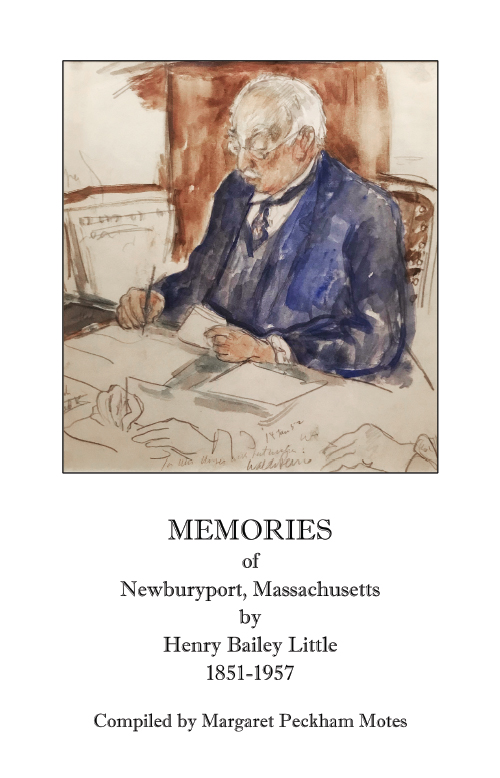
Book Review: "Memories of Newburyport, Massachusetts"


It's too bad my hubby and I have no ancestors who were born, married, died, worked, or sojourned in Newburyport from the 1850s to 1950s. 

Even though we don't know anyone from that place and that period, I really enjoyed reading "Memories of Newburyport, Massachusetts by Henry Bailey Little, 1851-1957," compiled by Margaret Peckham Motes. 

This is a charming recent reprint from Clearfield Company/Genealogical Publishing.

The memories of Henry Bailey Little, originally published in the late 1950s, evoke a fascinating, engaging picture of the changes taking place from the mid-19th century to beyond the turn of the 20th century. 

Little had a front-row seat for changing times in Newburyport, raised on a farm and later serving as president of a major savings bank for more than five decades. 

Of the shipping industry, once a huge economic engine in the area, Little recollects: 

"With the exception of the cotton mills, practically all the business of the town was on the river-bank, the shipyards, and the wharves. The shipyards have disappeared and been forgotten and the wharves are in a state of decay. The last square-rigger was built here in 1884 and while there were a few small vessels built later, after that date shipbuilding was for the most part ended."

The accompanying illustrations shepherd readers through the town's past, including those shipyards, the mills, and even a few gravestones of note. 

Of special interest to anyone with ancestral roots in or near Newburyport: the book has a detailed index of names, places, industries, and businesses. 

In short, check out this book if your ancestors had even a minor connection with the area!

*Note: Genealogical.com sent me this book free, for review purposes. The opinions here are entirely my own!

Monday, September 26, 2022

How a Family Heirloom Lives On

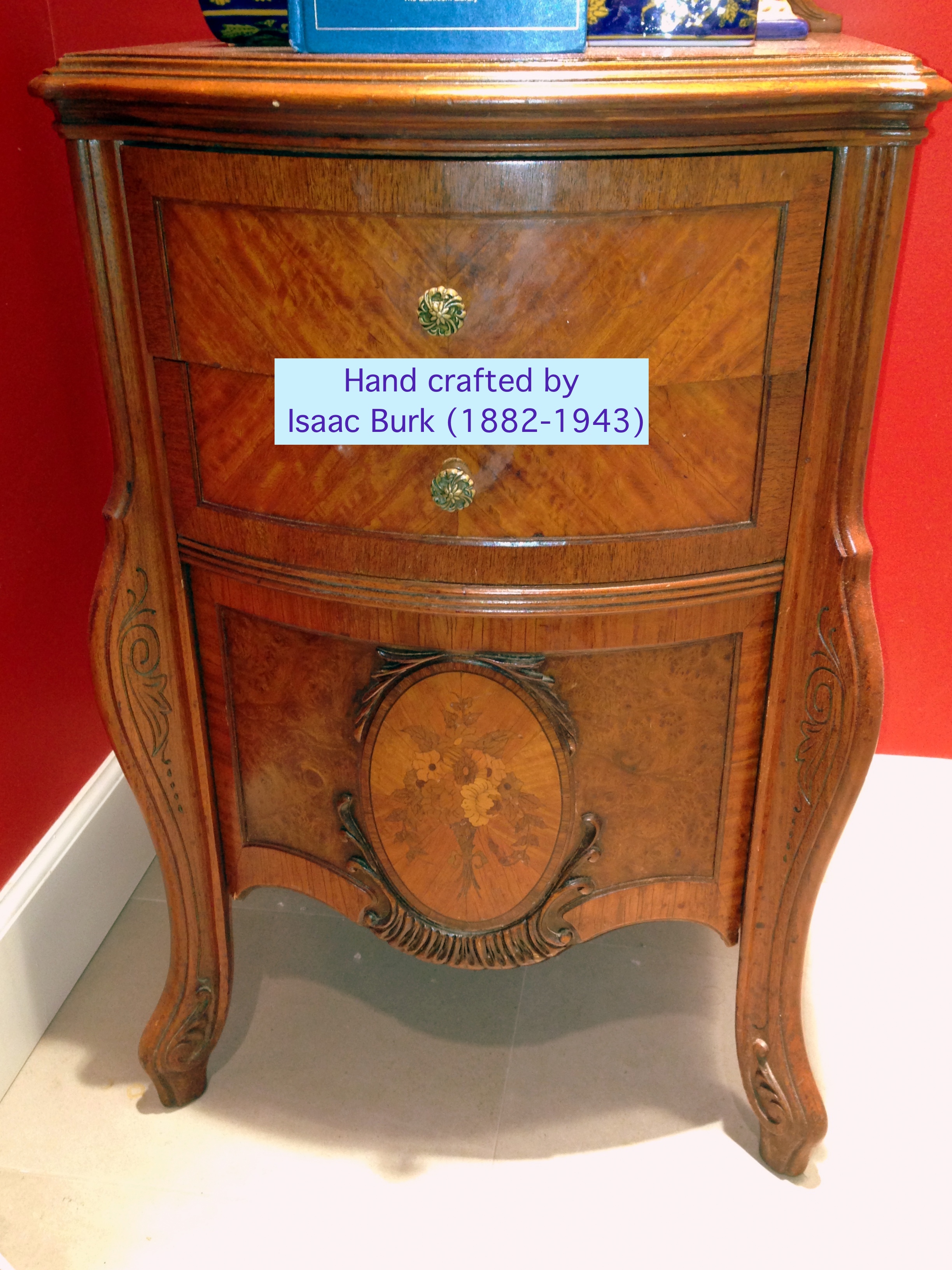
My paternal grandfather, Isaac Burk (1882-1943) and his older brother, Abraham Berk (1877-1962), both trained as cabinetmakers before leaving their hometown of Gargzdai, Lithuania, around the turn of the 20th century. They were seeking more economic opportunity in North America...Isaac ultimately settling in New York City, Abraham settling in Montreal.

That lovely piece of furniture in the photo at top, complete with special touches, was handmade by Isaac many decades in the past.

After Isaac died, the night stand was used daily by his widow, my grandmother Henrietta Mahler Burk (1881-1954), and then inherited by her younger son, my uncle Sidney B. Burk (1914-1995). 

Today, this heirloom has a special place in the home of my first cousin, who regularly talks of Isaac and Henrietta to his children and grandchildren.

Even without the actual heirloom, I do the same--telling descendants of Isaac's woodworking virtuosity and showing off the photo to give the next generation a sense of pride about their ancestor's creation. His name and his skills will live on!