Sunday, January 19, 2020

Saturday Night Genealogy Fun: Where Were Ancestors in 1950 Census?


Randy Seaver and I are on the same wavelength this week, with the Saturday Night Genealogy Fun focusing on the 1950 US Census! I've been digging into the details of the 1950 Census, so I'll be ready to find ancestors by location when the records are released in April, 2022.

Randy's challenge: Who in your ancestral families will be in the 1950 census?  Where will they be residing,  What occupations will they have?  The official "date" was 1 April 1950.

Maternal Ancestors in 1950 Census

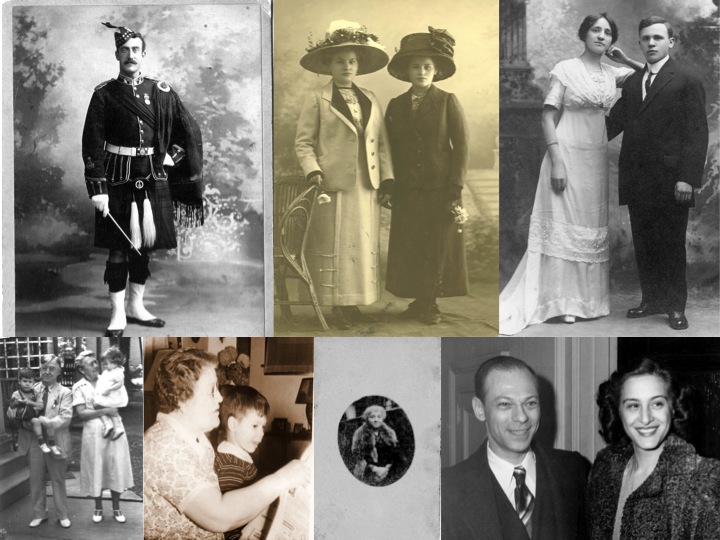
Grandma Hermina Farkas Schwartz and Grandpa Theodore Schwartz will be living on 180th Street in the Bronx, NY, having moved from their long-time apartment on Beck Street soon after World War II ended. He will still be a dairy grocer, but not for long--his retirement came early in the 1950s!

Their twins, Daisy and Dorothy Schwartz, had already left home by this time. Daisy (hi Mom!) married Harold Burk (hi Dad!) and they were living in an apartment building on Carpenter Avenue in the Bronx, NY. The apartment building full of paternal ancestors, as noted below. Daisy was a homemaker and Dad was a travel agent.

Dorothy Schwartz (hi Auntie!) was somewhere in the Bronx, soon to move to Hackensack, NJ, with her partner, Lee Wallace. Dorothy was working for Macy's, I believe, where she met Lee, head of publicity/special events and leader of the Thanksgiving Day Parade for many years.

Daisy and Dorothy's older brother lived in Brooklyn, a high school teacher in 1950. His wife later became head of guidance for all of New York City's public schools. Their two children will both be enumerated in the 1950 Census.

Grandpa's brother, Sam Schwartz, was living in Queens, NY, also a dairy grocer. This is where I'll learn whether he had already married his second wife, Margaret. My guess is yes, they were already married by this time (his first wife, Anna Gelbman, died in 1940).

Grandpa's sister, Mary Schwartz Wirtschafter, was most likely living with her furrier husband, Edward Wirtschafter, in their home in Mount Vernon, NY. There's a small possibility they were elsewhere, since their daughter remembered them taking an apartment in the Bronx at some point.

Many of Grandma's Farkas siblings lived in the New York area and I'll be able to find them easily, thanks to the Farkas Family Tree minutes and letters I've indexed for quick reference.

Paternal Ancestors in 1950 Census

Great-grandma Tillie Jacobs Mahler was living in the Bronx on Marmion Ave., where I believe she stayed until her death in 1952. This is the ancestor who was either 99 or 100 when she died. The Census might give me a solid clue about her age...

Tillie's daughter Dora lived with her at this time. Dora, tall and thin, had been in millinery sales but retired early due to a chronic health condition (heart?). She died just a few months after this Census was taken.

My paternal grandma was Tillie's daughter Henrietta Mahler Burk (hi Gran!). Henrietta's husband Isaac Burk had died years earlier, so I'm going to be interested to see whether Grandma Henrietta was still on Valentine Avenue in the Bronx, where they were living when Isaac died in the 1940s. More likely she will be found in the same apartment Bronx building as her son Harold (hi Dad) and daughter-in-law Daisy (hi Mom) AND her younger son Sidney Burk and older daughter Mildred Burk Lang. Lots of family in one apartment building, the building where I was brought up.

I'll be able to locate all of Tillie's other living children, I think, because I'm in touch with 2d cousins who are their descendants. One daughter married and went to California. A son worked as a handyman in Hollywood and lived in a small apartment in Los Angeles.

One goal is to trace all of Tillie's nieces and nephews, the children of her brother Joseph Jacobs and his wife, Eva Michalovsky Jacobs. Two of Joseph's and Eva's daughter died young. I know where one of the other daughters lived in 1950, and one of the sons. So I'll be looking for the two other children!

Saturday, January 18, 2020

Larimer and McClure Ancestors Worked on the Railroad

Hubby's Great-Great-Grandpa Brice Larimer was a "RR agent" in 1860
As readers know, I married my husband for his ancestors. There is so much to say about them! I wrote last year about my husband's long line of farmers going back many generations, and the year before I wrote about his long line of Wood ancestors stretching back to England in the 1500s (carefully researched by two genealogist cousins).

For 2020, I wanted a fresh take on "long line." As usual, hubby's family tree has a wealth of stories waiting to be told. I remembered that a number of his ancestors worked for railroads over the years. Here I look briefly at four of those ancestors, two in the Larimer family and two in the McClure family.

Larimer on the Railroad

Brice S. Larimer (1819-1906), my husband's 2d great-granddaddy, was a farmer in Elkhart county, Indiana, in 1850. He was appointed an agent for the Lake Shore Railroad in 1859, and reported that as his occupation in the 1860 Census (see excerpt above). He continued working as railroad agent for decades. He faithfully attended Larimer family reunions and was often mentioned in news stories as being the eldest there--by far. His grandson was named Brice in his memory (see below).

Brice's son, William Tyler Bentley Larimer (1849-1921) worked at the railroad depot in 1870, according to that census. After he married Elizabeth Stauffer in 1872, however, he settled down to farming in Millersburg, Elkhart cty, Indiana. William was my husband's 2d great uncle. He was named for William Tyler Bentley, an ancestor who went west during the gold rush era.

McClure on the Railroad

My husband's great-granddaddy William Madison McClure (1849-1887) reported working on the railroad in the 1880 Census, when he was 31 years old. Unfortunately, he fell ill with typhoid fever and died when only 37 years old. Thanks to a news report, I know he had arranged for life insurance, much needed by his widow who had young children to care for.

William's son, Brice Larimer McClure (1878-1970), was a machinist working for the "Big Four" railroads in Wabash, Indiana, when he married Floyda Mabel Steiner in 1903. His skill as a machinist meant he was never out of work, working for railroads and later for war industries during WWII. Brice, named for Brice S. Larimer, was my husband's grandfather. Hubby has fond memories of learning to fish while visiting his cabin in the country during summers off from school.

"Long line" is #52Ancestors prompt #3 for 2020.

Friday, January 17, 2020

Comparing Ancestors with 1950 Census Statistics - for Context

When the 1950 US Census is released in April, 2022, I won't just be looking at who and where--I'll be studying all the answers provided by my ancestors and comparing them to national statistics for the period. This puts my ancestors into context. Income is a good example.

National Statistics: Median US Income in 1949

According to the above map, based on results in the 1950 Census, the median income for 1949 reported by respondents to the Census was $2,619.

The map also shows the handful of states where median income was higher than this national average--and the many states where the median income was lower than this national average.

Many of my ancestors lived in New York in 1950, so I expect that if any were asked the supplemental questions about income, they will answer with above-average earnings. My husband's ancestors were in Ohio, which as a state also shows above-average earnings.

Were My Ancestors Above or Below the Median?

Based on my mother's recollections, my father's earnings in 1949 were well above this national median. If I'm lucky, he will have answered the supplemental questions asked of 20% of the US population in 1950, so I can compare with the median figure.

A self-employed travel agent, my father's business was doing very well during the post-war period. In fact, he could barely keep up with demand for train and plane tickets. Then again, his business was based in a luxury hotel across the street from the world-famous Plaza Hotel in New York City. Well-heeled guests sought out his services to arrange itineraries for trips near and far.

Want to read more about the 1950 Census? See the summary of my series on this page.

Thursday, January 16, 2020

Census Day Bounced Around, and So Did Some Ancestors

From 1950 Census of Population: Vol. 2 (https://www.census.gov/library/publications/1953/dec/population-vol-02.html)

In 2020, Census Day will be April 1st. This is not April Fool!

But Census Day hasn't always been April 1st. I try to keep this in mind when looking for my ancestors in earlier Census years.
  • As shown in the excerpt above, Census Day was originally not a fixed date but taken on the first Monday in August.
  • In the mid-19th century, Census Day was changed to June 1.
  • In 1910, Census Day became April 15.
  • In 1920, Census Day became January 1.
  • Only in 1930 was Census Day fixed as April 1, where it remains.
Because my great-grandpa Meyer Mahler died in January of 1910, my great-grandma Tillie Jacobs Mahler was enumerated as a widow on April 15th--a vital clue I needed to find his death cert. If Census Day had been January 1, however, it would have been more difficult for me to narrow down a possible death date for him.
Focus on 1950 Census

As the excerpt indicates, two-thirds of the US population was counted by mid-April in 1950. By month's end, 90% of the population was counted.

However, "unfavorable weather conditions" in some areas delayed enumeration as late as mid-May. Finally, by the end of June, 99% of the US population was counted. I'll be sure to check the enumeration date on each ancestor's record when the 1950 Census is released in April of 2022.


From a broader perspective, the 1950 Census reflected major post-war trends in population shifts. The map above shows that four states experienced population loss. All others increased population--with the greatest growth on the West Coast, plus Florida, Virginia, and Michigan.

As I chart my ancestors' whereabouts in the 1940s to prep for the 1950 release, I need to consider how many might have moved elsewhere after World War II. There are at least a few who went west to California. Dear ancestors, you can run, but you can't hide. I hope!

For more posts about the 1950 US Census, see my summary page here.

Wednesday, January 15, 2020

Extra Notations and Detailed Answers in 1950 US Census

 Excerpt from 1950
US Census
Enumerators'
Manual
This is my fourth post about understanding the 1950 US Census, to be released in April, 2022. (You can see other posts on my summary page here.)

Whether enumerators for the 1950 US Census actually followed the rules set forth in the instructions, I don't yet know. But if they did, we genealogists will be glad for their extra notations and detailed answers.

Some examples:
  • If the enumerator can't get a specific, accurate age from a household respondent, he or she was instructed to "enter an estimate as the last resort, and footnote it as an estimate." Wonder whether my Great-grandma Tillie Jacobs Mahler told the truth about her age? She tended to fudge a year or two in either direction.
  • If the enumerator thinks an answer is not truthful, he or she should footnote it and indicate what the truthful answer might be. Wouldn't that be interesting to see on a page with my ancestors? Looking at Great-grandma Tillie, would the enumerator believe she was, say, 98? I can't wait to find out.
  • Asking about the respondent's occupation, enumerators are not to accept a general term like "agent" or "clerk" or "engineer" but must ask questions to obtain more specifics, such as "purchasing agent" or "aeronautical engineer." This would help me learn a bit more about ancestors whose work lives I know little about.
  • Enumerators were to be specific about the county in which the respondent lived a year before. This will be really valuable to me, because instructions say not to accept merely "New York City" but ask about the specific borough of the city. If my ancestors moved from, say, Brooklyn to the Bronx in 1949-50, this question may reveal the move. I'm talking about you, Great-aunt Nellie Block! 

Monday, January 13, 2020

What Future Genealogists Will Learn from the 2020 US Census

Page 1 of the 2020 Census questionnaire
Attending a presentation by local representatives of the 2020 US Census, I learned that in the year 2092, when the records are publicly released, future genealogists will be able to see some very valuable pieces of information. (You can browse the entire 2020 questionnaire here.)

Page 2 of 2020 Census

One key piece of info is the month, day, and year of birth for each person in the household, to be entered on page 2 of the Census questionnaire.

Future genealogists will be able to look for a birth cert, compare with age shown on other documents, match someone to a marriage license or other vital record, and so on--with more confidence because they will have the complete birth date, not just "age" or birth month and year.

I was surprised but interested to learn that another question (on page 1) is about whether a person in the household (1) owns the residence clear and free of a mortgage, (2) has a mortgage, or (3) is not paying rent. Clues to seeking deeds, taxes, and other records!

2020 Census questions about usual residence
and relationship to head of household
Happily for future genealogists, the 2020 Census asks specific questions about whether each person usually lives in this residence AND about exactly how each person in the household is related to the head of household (Person 1).

Look at the many answer alternatives shown in the excerpt above! 

These two questions will elicit incredibly valuable information for future genealogists. Question #2 will point toward where the person's usual residence is (such as with another relative or in the military). Question #3 will tell, with great precision, how each person is related to the head of the household--clues to filling in gaps in the family tree!

Future genealogists, there may not be many questions on the 2020 Census form, but there will be several top-quality clues to be followed up. Yes, I'm going to answer the Census as fully and completely as possible. You'll be able to find me and my family in 72 years, I promise.

Saturday, January 11, 2020

1950 US Census: "Think Like an Enumerator"

1950 US Census manual
Although the release of the 1950 US Census is more than two years away, I'm getting ready now.

My prep for this Census release includes understanding what the enumerators were instructed to do (and not do).

I'm browsing through the Urban & Rural Enumerator's Reference Manual so I can . . . "Think Like an Enumerator." (You can read the manual here.)

Enumerators were told, for example, that if no one was home at time of their visit and that household was expected to be away for some time, talk with a neighbor and record as much detail as possible. Then add the notation: "Information given by a neighbor."

Now, 72 years later, we should take such information with a grain of salt because it was not first-hand. How many neighbors can recite the proper age or birth year for anyone or everyone in my household? None. Same holds true for 1950, even though neighbors might have been living near each other for many years. But I'm happy that the Census will contain such notations to alert us to be cautious in accepting the information as factual.

Enumerator instructions on p. 10 of 1950 Census manual
Also I will be checking the pages before and after my ancestor's enumeration for members of the FAN club!

Be aware that 1950 Census enumerators were instructed to visit residences in a particular order and to ask neighbors where houses were located, so they wouldn't miss any. Read more on the U.S. National Archives blog here.

P.S.: I'm putting all of my 1950 Census blog posts into one summary page, with header found at top of my blog. The direct link is here. Thank you for reading!