Tuesday, August 30, 2022

Lots of Space to Color in Ancestor Coloring Book

Late last year, a new twig became part of my family tree!

Now that this young one can almost hold a crayon, I created an updated ancestor and family coloring book especially for him.

In addition to showing his grandparents, great-grands, great-great grands, and great-great-great grands, I included contemporary photos of his parents, aunts, uncles, and cousins.

I've also begun adding a year to the caption when I know the date of an ancestor or family photo, as shown in this sample page.

There's lots of free space on the page and on the photo for the little one to creatively color or scribble.

It's fun and easy to make an ancestor coloring book!

To learn more, watch this brief how-to video I recorded with Jeanette Sheliga for the 4th anniversary of the Virtual Genealogical Association.

"Free space" is this week's genealogy prompt from Amy Johnson Crow's #52Ancestors challenge.

Saturday, August 27, 2022

Cousin Bait: Fish in Many Ponds


Trying to catch the eye of cousins who are searching online for mutual ancestors, I fish in as many ponds as possible. Anything I post as cousin bait works 24/7, waiting to be found when a possible cousin does a surname search or looks on a genealogy-related website for folks in the family tree.

Above, my Find a Grave memorial for Isaac Larimer Work with bite-sized bio (repurposed and posted to multiple sites when I researched hubby's US Civil War ancestors). Although I can't be 100% sure that Isaac is actually in Nashville National Cemetery, he's listed as being buried there in the US Civil War Roll of Honor (see title page here at right).

Isaac was my hubby's 1c4r. The Find a Grave page was cousin bait after being discovered last week by a descendant of this Union soldier's brother. The cousin contacted me via my Find a Grave profile and now we're exchanging family history photos and more. 

Also last week I was contacted by a 2c2r in my Burk/Mahler/Jacobs family tree, who found his grandfather on my Ancestry public tree. He has photos I've never seen, and I have photos he's never seen. We're sharing info and putting our heads together for further research!

To fish in many ponds, I have trees, memorials, photos, and/or bios on all of the following:

  • Find a Grave
  • Ancestry
  • My Heritage
  • WikiTree
  • Find My Past
  • Fold3
  • FamilySearch
  • Ancestor landing pages of this genealogy blog
It was a great week for genealogy last week, and September will be a terrific month for collaborating on research with these newfound cousins.

Thursday, August 25, 2022

Celebrating My 14th Blogiversary


Fourteen years ago, I began this blog to write about my genealogy adventures and document my discoveries, challenges, do-overs, and brick walls. 

A good number of the nearly 1,600 posts have been about my own family history research and some interesting, puzzling, or revealing findings. I'm truly grateful for the reader comments that have offered fresh ideas and even solved a few mysteries!

Many posts focus on methodology, explaining what I've tried and how well it worked (or not), such as my recent series on accessing and interpreting the 1950 US Census. From time to time, I've also written about family-history concerns such as privacy and family secrets. 

Happily, this blog has been excellent for cousin bait. I've been overjoyed to hear from cousins (mine and hubby's) who get in touch via my blog!

Thank you from the bottom of my heart, dear relatives and dear readers, for being along on this journey. 

Tuesday, August 23, 2022

When Rose Gained, Lost, and Regained US Citizenship


Rose Fishman Poticha (1896-1967) married into a distant branch of my father's family. I was researching her because I wondered whether her family lived near my father's ancestors before all came to America early in the 20th century.

Looking at the timeline of her life, I discovered she was caught up in that unfortunate period when women who married non-US citizens lost their own US citizenship.

Background: the Expatriation Act of 1907

On March 2, 1907, Congress passed the Expatriation Act, which stated that "any American woman who marries a foreigner shall take the nationality of her husband." 

This applied only to women...in fact, men didn't lose their US citizenship if they married a woman who was not a US citizen. (For a more detailed explanation, see the pdf here.)

Note that this act didn't cover just US-born women. Also women who were naturalized US citizens automatically became non-citizens when they married a foreigner. And that's where Rose's story comes into play.

Naturalized under her father's naturalization

Rose Fishman was born in Radomyshl, at the time part of Russia (now part of Ukraine). Her parents, Sam and Bertha Fishman, brought the family to America early in the 20th century. 

Sam Fishman quickly initiated the process of becoming a U.S. citizen, and he was naturalized in February of 1914. Under the citizenship rules of that time, his daughter Rose became a U.S. citizen as well.

Rose loses her citizenship by marrying a non-citizen

Two years later, Rose married Russian-born Harry Poticha, on February 6, 1916, in St. Louis, Missouri. Under the Expatriation Act, Rose lost her US citizenship because her husband was not a US citizen. 

Years later, Harry Poticha did become a naturalized US citizen. But meanwhile, Rose's citizenship situation was addressed by yet another act of Congress.

Background: The Cable Act

Women gained the right to vote in America starting in 1920, and perhaps that contributed to the pressure to change the messy citizenship situation created by the Expatriation Act of 1907.

Representative John Cable introduced the Cable Act of 1922, which was also called (appropriately enough) the Married Women's Independent Nationality Act

Under the Cable Act, women retained their US citizenship if they married a foreign-born man who was eligible for US citizenship, even if not yet a citizen and even if he ultimately didn't naturalize. Women's nationality was somewhat, as the act's title indicates, independent of their spouses' nationality. 

I'm oversimplifying the explanation and terms of this act, but you get the idea. IMHO, I doubt every woman affected by the Expatriation Act was aware she'd lost her US citizenship, just as I suspect these women weren't always sure how to regain their US citizenship. 

Rose regains her citizenship

Decades after Rose lost her US citizenship by marrying Harry Poticha, she petitioned to become a US citizen on her own.

As this image shows, she regained US citizenship on November 16, 1942, 26 years after losing it due to her marriage to someone not a US citizen.

Not unique in my family tree

Rose's situation was NOT unique in my family tree. I had a number of US-born female ancestors who lost their US citizenship when they married men who were not US citizens. But Rose is the only one I've noticed who was first naturalized, then lost her US citizenship by marrying a foreign-born man, then applied for naturalization on her own.

"Timeline" is this week's #52Ancestors prompt from Amy Johnson Crow.
Thursday, August 18, 2022

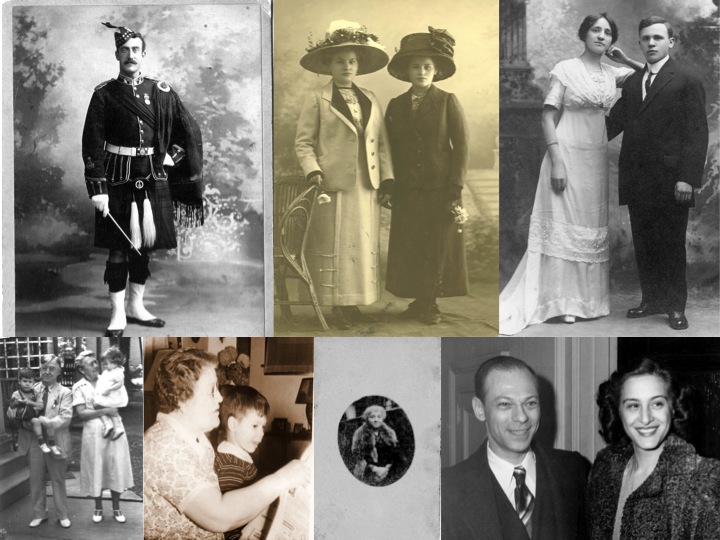
In Memory of Harold D. Burk, World War II Vet and Travel Agent


My Dad, Harold David Burk, was born on September 29, 1909, and died on August 18, 1978, sadly just weeks before his 69th birthday. In loving memory of Dad's life, I'm posting his bite-sized bio here (in addition to posts on Find a Grave, Fold3, Ancestry, and other sites). 

Harry was born in New York City, the second child of Lithuanian-born immigrant Isaac Burk (1882-1943) and Latvian-born immigrant Henrietta
Mahler
Burk (1881-1954) [source: NYC birth cert].

Growing up, his ambition was to be a travel agent. He spent years learning the travel industry from the ground up in Manhattan, waiting for his big break to become a full-fledged agent.

During World War II, Harry interrupted his career to enlist in the U.S. Army on March 7, 1942 and was discharged on October 4, 1945 [source: Dept. of Veterans Affairs BIRLS death file]. His younger brother Sidney B. Burk (1914-1995) also enlisted and served during WWII. In this photo from the war years, Harry is at left and Sidney at right.

Because Harry had good typing skills, he served as a personnel clerk, Technician 5th grade, in the 3163d Signal Service Company of the U.S. Army Signal Corps. His official designation was Administrative NCO 502 [source: DD-214 discharge papers]. His unit served in Central Europe and Rhineland, maintaining communication lines in support of Allied military efforts [source: DD-214]. Toward the end of the war, Harry and his unit were stationed near Paris, in April 1945.

After his honorable discharge, Harry returned home and married Daisy Schwartz (1919-1981) on November 24, 1946, in New York City [source: NYC marriage cert]. They settled in the Bronx, New York, and raised three children. He founded a successful travel agency, Burk Travel Service, working with his brother in their lobby office at the luxurious Manhattan hotel, the Savoy Plaza [source: business documents].

Harry reluctantly retired after the hotel was torn down in 1965 to make way for construction of the General Motors Building. He died of a heart attack on August 18, 1978 in the Bronx, New York, and is buried in Mount Hebron Cemetery in Flushing, NY [source: NYC death cert].

Remembering Dad and missing him today.