Adventures in #Genealogy . . . learning new methodology, finding out about ancestors, documenting #FamilyHistory, and connecting with cousins! Now on BlueSky as @climbingfamilytree.bsky.social
Pages
- Home
- Wm Tyler Bentley story
- Isaac & Henrietta Birk's story
- Abraham & Annie Berk's Story
- Farkas & Kunstler, Hungary
- Mary A. Demarest's story
- Rachel & Jonah Jacobs
- Robt & Mary Larimer's story
- Meyer & Tillie Mahler's story
- McClure, Donegal
- Wood family, Ohio
- McKibbin, Larimer, Work
- Schwartz family, Ungvar
- Steiner & Rinehart
- John & Mary Slatter's story
- MY GENEALOGY PRESENTATIONS
Tuesday, April 1, 2025
Korean War Draft Cards Now on Fold3
Friday, March 28, 2025
Learn for Free: Big Genealogy Sites' Blogs and Videos
Even if you don't subscribe to big-name genealogy sites, you can read their blogs and learn from their YouTube channels for free. Lots of interesting tidbits about historical context, details about info that is and is not in particular data collections, surprising genealogy discoveries, backgrounds of notable historical figures, and many other insights. I especially like browsing blog posts, but informative videos are also readily available without charge.
Here are links to six blogs to browse:
- FindMyPast (blog is here) posts blog entries about history, building a family tree, starting your genealogy journey, customer discoveries, and more. Not just United Kingdom.
- MyHeritage (blog is here) posts blog entries about social history, family history customs, immigration, new collections, DNA discoveries, and more. Posts span the globe.
- FamilySearch (blog is here) posts often about new collections, using the Familysearch site/tree more effectively, involving family in genealogy, RootsTech developments, and much more.
- Ancestry (blog is here) posts about a broad range of genealogy topics and cultures, including strategies for uncovering female ancestry, DNA details, surnames, and more.
- Fold3 (blog is here) posts blog entries about new collections, military history, wartime experiences, and more. Posts pertain mainly to US, but some also cover Australia, New Zealand, and the United Kingdom. Part of Ancestry.
- Forces War Records (blog is here) posts blog entries about military history involving the United Kingdom, World War I and II, women in the military, and more. Part of Ancestry.
- Ancestry YouTube channel
- FamilySearch YouTube channel
- MyHeritage YouTube channel
- FindMyPast YouTube channel
Tuesday, March 25, 2025
Look for Kernels of Truth in Family Stories
Friday, March 21, 2025
Married Twice Because His Mama Wanted a Pastor to Preside
My husband's first cousin once removed, George Ellery Wood (1885-1976) was married for the first time on this date 117 years ago. As shown above, George E. Wood was the groom, Amanda L. Krueger (1890-1947) was the bride. They claimed to live in Detroit, Michigan, where this marriage was recorded, but in reality both lived in Toledo, Ohio.
George was an iron worker, he wrote on this marriage license, and he and his bride both listed their parents and ages correctly. Directly above, the part of the marriage ledger where the officiant is named: a Justice of the Peace.
The family story is that George and Amanda eloped to Detroit on this Saturday in March, returning home the same day. George's mother was not happy. George was her oldest child, and she insisted the couple be married again in Ohio, where they actually lived, and by the clergyman of her choice: Reverend George Candee, an ardent abolitionist.
And so on Tuesday, March 31, 1908, George and Amanda stood in front of Rev. Candee and were again married. Above is the proof. Interestingly, the bride and groom claimed on this marriage license application that neither had been previously married, perhaps because George's mom didn't want anyone to know about the elopement ten days earlier? Also note by the star on the image above, the notation "don't publish please." Hmmm?
This "historic event" of two marriages in 10 days was discussed by descendants for decades. My post is for the #52Ancestors challenge by Amy Johnson Crow.
Wednesday, March 19, 2025
Remembering Maternal Grandma Minnie and Her Age Fibs
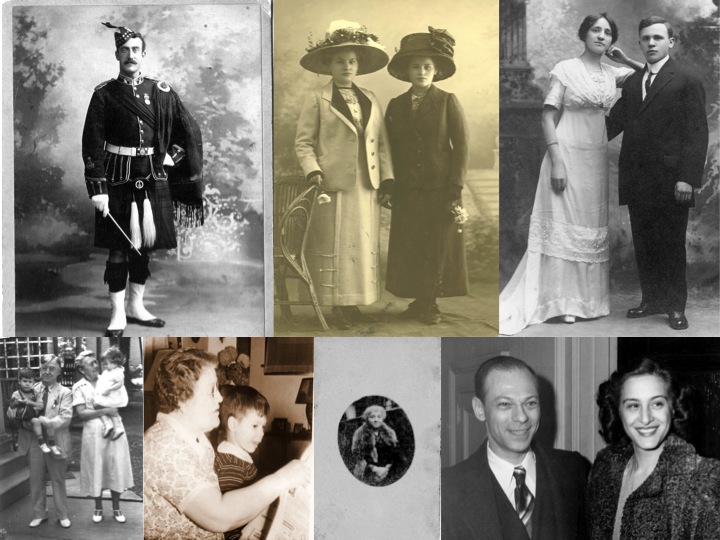
In New York, Minnie worked during the day at a tie factory owned by an in-law and went to school at night to learn English. At the end of every week, Minnie and her siblings handed their unopened pay packets to their mother, who doled out carfare to each adult child and kept the rest for household expenses.
Minnie met her future husband Theodore "Teddy" Schwartz (1887-1965) in a Hungarian deli. Despite resistance from her parents, she married him in October, 1911. From then on, Minnie would not just help Teddy in the store, she would also raise three children AND sew clothing for her siblings, nieces, and nephews AND cook Hungarian specialties for family meals. She worked long and hard for decades.
Only after Minnie and Teddy sold their small dairy store in the 1950s did they have time and money to take a honeymoon! Minnie had happy moments, but as the years passed, she was disillusioned and disappointed because her life did not play out like the rosy future she had dreamed of when she arrived in 1901 as a hopeful immigrant teenager. The more I research her and talk with older relatives who knew her well, the better I understand why she was not "warm and fuzzy" although she was a responsible grandma who pitched in when needed.
Noting Minnie's age changes
On their marriage certificate (shown at top), both Minnie and Teddy are shown as 24 years old. That might be one of the last times Minnie told the truth about her age.
In the 1920 US Census, she was supposedly 30 (actually she was 34). In the 1925 NY Census, she was supposedly 35 (actually 38). In the 1930 US Census, she was supposedly 40 (actually 44). In the 1940 US Census, she was supposedly 52 (actually 53). In the 1950 US Census, she was shown as 63--correct age!
When Grandma Minnie died of heart problems on March 20, 1964, it was the end of an era for the entire Farkas family. Disheartened, and with his health deteriorating, Grandpa sadly passed away 14 months later.
Remembering Grandma Minnie with affection during Women's History Month.
Monday, March 17, 2025
Celebrating Hubby's Irish Ancestors
My husband can wear green with great pride today because it looks like he has a number of Irish ancestors!
Shehen or Shehan
Hubby's great-great grandparents were reportedly born in Ireland, according to the 1841 UK Census.
John Shehen or Shehan (1801?-1875) and wife Mary (1801?-1874) left Ireland and moved to Marylebone by 1834, where their three children was born. John was a laborer and Mary was a laundress. Sadly both husband and wife seem to have died in a poorhouse.
Smith
Hubby's 5th great-grandparents were also born in Ireland. William Smith (1724?-1786) and his wife Jean (1724?-1805) may have been from Limerick. Their children were born in Cumberland County, Pennsylvania.
Jean and William's son Brice Smith got "Ohio Fever" and moved to Fairfield County, Ohio before 1820. The name Brice was passed down in the family tree to this man's grandson and great-great grandson.
Larimer and Gallagher
Robert Larimer (1719?-1803) was born in the North of Ireland, according to the genealogy booklet Our Larimer Family. Sailing to North America to seek his fortune, he was shipwrecked and brought to Pennsylvania, where he was forced to work for years to repay his rescuer.
Robert eventually walked away from his master and married Irish-born Mary Gallagher (or O'Gallagher) (1721?-1803). They, too, got Ohio Fever and brought their family to Fairfield County, Ohio. Mary and Robert were hubby's 5th great-grandparents.
McClure
Actually, the McClure line originated in Scotland but relocated to County Donegal at some point before Halbert McClure's time. Halbert (1684?-1754) married Agnes in County Donegal and they sailed to Philadelphia together with other family members sometime in the 1740s.
They all walked to Virginia, where they bought land and kept buying land as their sons married. Their grandson caught Ohio Fever and his descendants moved further west to Indiana. Agnes and Halbert were hubby's 5th great-grandparents.
Happy St. Patrick's Day!
Wednesday, March 12, 2025
Looking Back Five Years to the Start of the Pandemic
By March 2020, Covid-19 began to spread rapidly and aggressively around the world. In New England, where I live, in-person events evaporated and life ground to a halt in the middle of the month. The next few months were tense and difficult.
An everyday errand like going to the supermarket was suddenly a bit frightening. Not just because being around people might mean exposure to a potentially deadly disease but also because many food and household items were in short supply or completely gone from store shelves. The photo at top shows toilet paper and paper towel shelves partially stocked, months into the pandemic. Eerily empty streets for weeks. No traffic reports on radio or TV because no traffic.
Never had I ever heard about Zoom and yet within weeks of the shutdowns, I was using it to participate in a book club, genealogy meetings, and family conversations. Weeks into the pandemic, the calendar remained empty except for Zoom dates and important medical appointments.
Several times, I threaded my sewing machine and stitched face masks. I learned to cut hair at home. Investigated various streaming services for viewing variety. Hubby and Sis and I walked with friends and neighbors on nice days, observing social distancing guidelines. We also formed pods with folks we knew well, gathering indoors with doors/windows wide open to paint rocks, play games, celebrate holidays and birthdays. For treats, we ordered specialty foods to be delivered from Zabars and other places.
Our community organized outdoor concerts that were well attended and much appreciated. We watched the family commencement ceremonies on YouTube and clapped when our graduates received their diplomas. In short, we found moments of good news and contentment amid all the uncertainty and sadness.
The very instant a vaccine was available, hubby and I and Sis booked appointments and were grateful to do so. We continue to keep our boosters updated. Looking back, I feel saddened that I can never get back the time lost but I also have a very deep appreciation for how fortunate my family and I have been. These days, our pantry is always filled with food and paper products just in case! And thanks to Zoom, family conversations, cultural programs, and genealogy presentations are now only a few clicks away.
How do you remember your pandemic experience in 2020? Please write it down for yourself and for your descendants.
Monday, March 10, 2025
Upcoming Presentation about Fold3 for WAGS
The Whittier Area Genealogical Society is hosting my next live webinar, about how to navigate the Fold3 website.
Come learn about the hundreds of millions of records available on Fold3, see step by step how to search effectively, and find out how to create or enhance free Fold3 memorial pages for ancestors.
Many US public libraries offer free access to Fold3, by the way, so check whether you can access from home with your local library card. I can search Fold3 via the Connecticut State Library, no subscription necessary.
Click here to learn more and to receive the Zoom link. See you on March 15th!
Saturday, March 8, 2025
Female Ancestors in NY Get the Vote in 1917
New York State granted women the right to vote on November 6, 1917. Women were soon allowed to show up in person to add their names to the list of voter registrations all around the state.
Ancestry.com has released a new database of digitized voter registration ledgers from Manhattan. TY to the sharp-eyed folks on the New York City Genealogy FB page for pointing this out!
For International Women's Day and Women's History Month, I prioritized looking for my female ancestors who lived in Manhattan during the period covered by this new database (1915-56).
Women registered in 1918
I was happy to see that some of my female ancestors in New York City showed up to register the first time they were legally permitted to do so.
The image at top shows how many people in all were added to the registration ledger for a particular election district over a two-day period in February 1918, counting my female ancestors too. Yet the ledger was officially known as the 1917 voter registration list. Hold that thought.
Let me say that I'm very proud of the women who registered in February, 1918 so they could vote for the first time in a New York special election held during March, 1918.
Check the source carefully
This is also a reminder to check into each source carefully. As I said, this particular voter registration ledger was titled 1917 and correctly transcribed that way by Ancestry.
However, as shown in the excerpt at the top and on individual pages of the scanned ledgers in database, women (including my female ancestors) who registered in 1918 were added to the 1917 listing.
The lower part of the summary of registered voters notes that as of May 1918, 140 women registered to vote in this specific election district.
So I would indicate 1918 as the date of my female ancestors' voter registrations, despite the official name of the ledger being the 1917 voter registration list.
Tuesday, March 4, 2025
Wood Siblings: Farm "Boarders" and Students
Looking at my husband's Wood family tree: On this day in 1891, Byron Thomas Wood was born, the fourth of five children of Charles Augustus Wood (1862-1895) and Martha Hale Wood (1864-1912). His siblings were Charles Elton Wood, Ethel Carrie Wood, Louisa Lucy Wood (died young), and John F. Wood (died young). The family lived in Toledo, Ohio, where Charles was in a carpentry business with two brothers.
Get out your hanky
Sadly, Charles died of tuberculosis in 1895, only 32 years old. His widow Martha was left with three youngsters under the age of 10.
Also sad: just a year later, Martha entered the Toledo Hospital for the Insane--not necessarily for mental illness, but possibly a chronic illness because she was in that hospital for 14 long years. Martha died there in 1912, only 48 years old, of uterine cancer and loss of blood.
Wood siblings stay with other families
When Martha was hospitalized, the three surviving children were sent to live with other families. The oldest child, Charles, lived with the Bollinger family on their farm in Richland, Ohio, where I found him in the 1900 US Census as a "student." No doubt he also helped out on the Bollinger farm.In 1912 he married one of the Bollinger daughters, Nellie. They had no children. It seems Charles joined the US military as soon as he was eligible, because he told the WWI draft registration board that he served as an electrician in the Navy for nearly 9 years. Remembering Charles Elton Wood, 1886-1974.
Younger brother Byron and younger sister Ethel Carrie lived with the Kiehl family on their farm in Weston, Ohio. In the 1900 US Census, they are marked as "boarders" with the Kiehls and also shown as students. Surely they too helped with farm chores. Even after Mr. Kiehl died, Byron remained with Mrs. Kiel in the 1910 Census as a "tenant." In 1914, Byron married Vesta M. Craft, worked as a farmer, and they had 10 children together. Remembering Byron Thomas Wood, 1891-1968.
Ethel Carrie, enumerated as a student on the Kiehl farm in 1900, got married in 1908 at the age of 20. The groom was an auto mechanic named Clay H. Focht who had been widowed five months earlier. They had two children, divorced in November of 1923, remarried on January 1st, 1924, and had another child together before splitting up again a few years later. Remembering Ethel Carrie Wood Focht, 1888-1969.
How different the lives of these Wood siblings would have been if their father had lived longer and their mother had stayed healthy.
"Siblings" is this week's #52Ancestors challenge from Amy Johnson Crow.