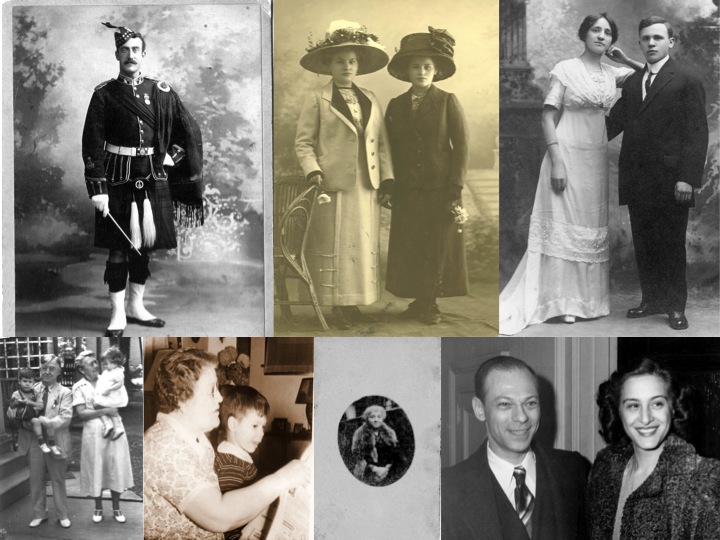
My maternal grandmother's Mahler family was incredibly close-knit. They helped each other out and they lived near each other, often in the same apartment building.
At left, the 1924 New York City Voter's List* showing voters in a now-gone apartment building, 2347 Morris Avenue in the Bronx. Seven of my Mahler family and in-laws were then living in that apartment building.
Joseph A. Markell is on top in this excerpt of the 1924 voter's list, with his wife Mary Mahler Markell shown about halfway down the list. (Mary was the youngest of my Grandma Henrietta's sisters.)
Directly below Joseph's name is Morris Mahler, the brother of Mary and Henrietta. A handful of names below Morris is his brother-in-law, Louis Volk. Louis was married to another Mahler sibling--Ida Mahler Volk, whose name appears on the voters' list a little further down from her husband Louis.
Finally, Dora L. Mahler is at bottom of this excerpt from the list. She's another sister of Morris, Mary, Ida, and Henrietta. Four siblings plus two spouses in one apartment building.
Not shown on this voter list is Tillie Jacobs Mahler, the matriarch of the family, who also lived at 2347 Morris Avenue at the time. Widowed in 1910 when Meyer Elias Mahler died, she stayed with one or more of her children from then on--living with Morris in 1925. But apparently she didn't register to vote, even though women now had the right! (This was a Presidential election year...Calvin Coolidge easily won.)
In the 1925 NY Census, however, the Markell family had moved to a different apartment building. But not very far. The map shows 2347 Morris Ave. at left, and the dotted line shows the quarter-mile walk to 2400 Valentine Ave.
My Grandma Henrietta Mahler Burk lived with her husband and children in an apartment in Jewish Harlem at the time of the 1925 NY Census. A few buildings away lived her sister Sarah Mahler Smith and Sarah's husband, Samuel, and their family. So although these two sisters lived about 8 miles away from the other siblings, they could hop a subway and be together within an hour.
Nowhere in the area: The oldest Mahler sibling, David Mahler, was a bit of a black sheep and had left New York before 1920.
*Thank you to Reclaim the Records for obtaining and posting the 1924 New York Voters' List! UPDATE: The Reclaim folks, on Twitter, reminded me that I can go ahead and request a copy of an original 1924 voter's registration form for anyone on this list. Scroll down on the Reclaim page in this link to find out more about requesting these forms, which will cost about $15 each. If I need to know the year/court of naturalization for any immigrant ancestors who registered to vote in NY, the form will very likely tell me that.
Adventures in #Genealogy . . . learning new methodology, finding out about ancestors, documenting #FamilyHistory, and connecting with cousins! Now on BlueSky as @climbingfamilytree.bsky.social
Pages
- Home
- Wm Tyler Bentley story
- Isaac & Henrietta Birk's story
- Abraham & Annie Berk's Story
- Farkas & Kunstler, Hungary
- Mary A. Demarest's story
- Rachel & Jonah Jacobs
- Robt & Mary Larimer's story
- Meyer & Tillie Mahler's story
- McClure, Donegal
- Wood family, Ohio
- McKibbin, Larimer, Work
- Schwartz family, Ungvar
- Steiner & Rinehart
- John & Mary Slatter's story
- MY GENEALOGY PRESENTATIONS
Thursday, July 26, 2018
Monday, July 23, 2018
Puzzling Out My Family's Colorful Past
Doesn't genealogy feel like a puzzle? With thousands of pieces and no picture on the box as a guide?!
For this week's #52 Ancestors challenge, I was thinking about all the colorful characters who inhabit my family tree and the branches of my husband's family tree.
Then I looked at the puzzle my family is currently assembling, showing colorful doors of Montreal. Doors of all colors, shapes, and sizes. Just like a family tree, with ancestors of all types.
I never know which clue will enable me to complete a door and, if I'm lucky, get a glimpse into an ancestor's hopes and heartaches, dreams and dreads.
Birth-marriage-death dates are a great start, but I really want to get a sense of the things that make someone unique and individual--colorful in his or her own way.
Even someone whose life seems humdrum on the surface has drama waiting to be discovered. Like my immigrant grandma who threw the engagement ring out the window when she rejected an arranged marriage. Like my husband's great-great-grandpa who became a pioneer. They didn't know they were colorful...but we do!
So many ancestors are waiting to get pieced together as I puzzle out the colorful past behind my family tree and my husband's family tree.
For this week's #52 Ancestors challenge, I was thinking about all the colorful characters who inhabit my family tree and the branches of my husband's family tree.
Then I looked at the puzzle my family is currently assembling, showing colorful doors of Montreal. Doors of all colors, shapes, and sizes. Just like a family tree, with ancestors of all types.
Birth-marriage-death dates are a great start, but I really want to get a sense of the things that make someone unique and individual--colorful in his or her own way.
Even someone whose life seems humdrum on the surface has drama waiting to be discovered. Like my immigrant grandma who threw the engagement ring out the window when she rejected an arranged marriage. Like my husband's great-great-grandpa who became a pioneer. They didn't know they were colorful...but we do!
So many ancestors are waiting to get pieced together as I puzzle out the colorful past behind my family tree and my husband's family tree.
Wednesday, July 18, 2018
Earworm Farkas Family Tree Song
| Moritz Farkas, patriarch of Farkas Family Tree, with twin granddaughters, Dorothy and Daisy |
Why use the music from that song? My guess: It was easy for adults of ages to dredge up from memory and easy to teach to the littlest Farkas folks. Like me. It's an earworm to this day.
Here are the first stanza and chorus of the song, written by my great-aunt, Ella Farkas, a daughter of the Farkas patriarch and matriarch:
The Farkas clan has now all gathered
One and all are here
Time for all cares to be scattered
Faces bright and clear,
Jokes and puns and smiles and fun,
Are ready to begin,
The clan has gathered now!
CHORUS:
Farkas, Farkas is the password.As the children of Moritz Farkas and Leni Kunstler Farkas married and had children of their own, Aunt Ella expanded the song. Eventually, she wrote two additional stanzas to include the married surnames of her Farkas sisters and the married surnames of the next generation. The final stanza concludes: A proud family tree . . . as the Farkas Clan grows on!
Sing on high that it can be heard
That we all are here and now cheer:
The Farkas Family Tree!
When a group of Farkas descendants got together a decade ago, we sang the song and recalled the fun of joining in the musical tradition during family tree meetings in our youth.
MUSIC - This week's #52Ancestors prompt from Amy Johnson Crow.
Labels:
#52Ancestors,
family traditions,
Farkas,
Farkas Family Tree
Monday, July 16, 2018
Binge-Watching VGA Genealogy Webinars
During this weekend's heatwave, I binge-watched several webinars hosted by the Virtual Genealogical Association.
And truly, it was like attending a genealogy conference to see expert speakers, but without the costly travel and crowded auditoriums. (Plus I could sip homemade lemonade while I watched.)
There was a lot of wisdom on offer, and the programs were well worth the modest membership fee. Although I only had time to watch 3 of the webinars, I'll return again to view some I missed and more that are scheduled in the coming months.
And truly, it was like attending a genealogy conference to see expert speakers, but without the costly travel and crowded auditoriums. (Plus I could sip homemade lemonade while I watched.)
There was a lot of wisdom on offer, and the programs were well worth the modest membership fee. Although I only had time to watch 3 of the webinars, I'll return again to view some I missed and more that are scheduled in the coming months.
- Thomas MacEntee's "Future Trends" talk provided much food for thought about what's coming in the near and far future. A great way to consider what might be in store for the genealogy community as tech trends evolve (such as: is blockchaining for genealogy on the way?).
- Randy Whited's DNA introduction was illustrated with excellent and informative slides. A thorough and easy-to-digest overview of genetic genealogy, with useful "third-party tools" listed in the handout. Inspired me to check out more of my DNA matches, after a brief summer hiatus.
- Katherine R. Willson's "Voyage to America" talk reinforced my admiration for the hardships faced by my ancestors crossing the Atlantic. It also encouraged me to do a better job of analyzing which ports were used by specific individuals and families--and why they chose these particular ports.
Saturday, July 14, 2018
Ancestral Travels to America
How much distance did my grandparents and great-grands cover in coming to America from their homelands in Eastern Europe? All apparently sailed in steerage, never telling descendants very much about what must have been a difficult and uncomfortable trip. None lived near a port, so their travels also included a journey by foot or wagon or train to the port where they boarded a ship to cross the Atlantic.
- 4430 miles. Above, my maternal grandfather's "as the crow flies" route from Ungvar, Hungary (now Uzhhorod, Ukraine) to New York City in 1902. Grandpa Theodore Schwartz was a teenager and the first in his family to leave for America. With his encouragement (and probably his financial help), an older brother and a younger sister also came to America. Happily, I'm in touch with their grandchildren, my 2d cousins.
- 4460 miles. My maternal great-grandparents, Morris Farkas and Leni Kunstler Farkas, left for America as adults, coming separately from where they had married and lived in the area of modern-day Berehovo, Ukraine. Morris arrived first, with Leni arriving later (and their first 8 children joining them afterward in two groups). Morris missed his homeland and longed to return, but Leni wanted a better life and more opportunity for their growing family.
- 4200 miles. My paternal Grandma Henrietta Mahler arrived from Riga as a preteen. She sailed past the Statue of Liberty in the year it opened (1886). I'm still following up on the possibility that Henrietta was a cousin of some kind to her husband, Isaac Burk, connected through the Shuham part of their family trees.
- 4670 miles. My twenty-something paternal Grandpa Isaac Burk took the journey to North America in two hops. First, he left Gargzdai, Lithuania for Manchester, England. After staying with relatives and learning some English for a year or more, he sailed to Canada but got very seasick. He got off the ship at the first stop in Canada and continued to New York overland. Of all my ancestors, Isaac Burk had the longest journey from his home town to America.
Labels:
#52Ancestors,
Burk,
Ellis Island,
Farkas,
Kunstler,
Mahler,
Shuham
Friday, July 13, 2018
Lessons Learned in My Virtual Research Trip
Today, when I was clicking my merry way through online records pertaining to my husband's Slatter family, I discovered one shortcut and was reminded, yet again, of the value of checking originals.
Above, the shortcut I found to cut through the clutter of hints. My husband's Slatter family tree on Ancestry has more than 9,000 outstanding hints. Most of those are for ancestors too distant to be a priority. So I clicked on "records" to choose only those hints, then brought up the "filter by name" sorting option. (The default is "most recent" which means when Ancestry added that hint.)
By entering "Slatter" in the surname search box, I was able to view only record hints containing that name. Of course, I could have searched by first and last names, but given the creative spelling in so many records, I wanted to click through all Slatter record hints individually. Focusing on one surname enabled me to make progress, rather than being sidetracked by hints unrelated to my current research.
Now for the reminder about original records vs. transcriptions. The three dates on this record of marriage banns from a London church are 1 Dec, 8 Dec, and 15 Dec. The handwriting is very clear. At top of the page, not shown here, is the handwritten year--1907. Yet the transcription of this record says the year is 1908.
By reading the handwritten record, I was able to enter the correct dates for the marriage banns of Thomas Albert Slatter and Jessie Alice Elms. Also, the marriage license original confirmed the actual wedding day as 28 December 1907.
It's never safe to assume a transcription is accurate, let alone complete. It took only a few more clicks to view the originals and extract every possible data point.
My starting point for today's post was Elizabeth O'Neal's Genealogy Blog Party, July edition: Virtual Research Trippin'.
Above, the shortcut I found to cut through the clutter of hints. My husband's Slatter family tree on Ancestry has more than 9,000 outstanding hints. Most of those are for ancestors too distant to be a priority. So I clicked on "records" to choose only those hints, then brought up the "filter by name" sorting option. (The default is "most recent" which means when Ancestry added that hint.)
By entering "Slatter" in the surname search box, I was able to view only record hints containing that name. Of course, I could have searched by first and last names, but given the creative spelling in so many records, I wanted to click through all Slatter record hints individually. Focusing on one surname enabled me to make progress, rather than being sidetracked by hints unrelated to my current research.
Now for the reminder about original records vs. transcriptions. The three dates on this record of marriage banns from a London church are 1 Dec, 8 Dec, and 15 Dec. The handwriting is very clear. At top of the page, not shown here, is the handwritten year--1907. Yet the transcription of this record says the year is 1908.
By reading the handwritten record, I was able to enter the correct dates for the marriage banns of Thomas Albert Slatter and Jessie Alice Elms. Also, the marriage license original confirmed the actual wedding day as 28 December 1907.
It's never safe to assume a transcription is accurate, let alone complete. It took only a few more clicks to view the originals and extract every possible data point.
My starting point for today's post was Elizabeth O'Neal's Genealogy Blog Party, July edition: Virtual Research Trippin'.
Monday, July 9, 2018
Review of "The Mayflower" by Rebecca Fraser
Browsing the new book section in my local library, I found The Mayflower: The Families, the Voyage, and the Founding of America by Rebecca Fraser. My husband has Mayflower ancestors,* so I eagerly dove into this 2017 book.
The book begins with two excellent maps, one of 17th century North America and one of Southern New England circa 1675, before the major war with Native American tribes broke out. These maps remind the reader of when the major settlements were established and which countries were backing those settlements. (I admit, I didn't realize there was a "New Sweden" in 1638 in Delaware.)
One of the strengths of the book is its British perspective on the "Puritan experiment." By beginning with the Winslow family's background in 1590s Droitwich, England and following that family and its relatives/in-laws through to 1704 in England and the colonies, the author shows what the Puritans were leaving, and why--and what they sought to accomplish, and why. This is as much a personal story as a historical account, intensifying the human drama of flight from religious persecution and life-and-death wilderness survival.
Although most U.S. readers already know that the Puritans had commercial backers with financial requirements for the colonies ("plantations"), I was surprised to find out how long the payback was expected to continue. I was also unaware that Plymouth had no royal charter and was therefore often threatened by shifting political winds in the mother country.
My only basic grasp of English political twists and turns meant I didn't immediately understand the author's discussions of governmental turmoil and the effect of the "Civil War" on the colonies. Once I adjusted my thinking to not default to the "War Between the States," I was better able to follow events and implications as they played out on both sides of the Atlantic.
Another strength of the book is how many strong female characters play active roles. From Anne Hutchinson's story of religious belief (and excommunication and exile) to Susanna Winslow's life of balancing between new and old worlds, the book shows how several generations of Puritans fared in a constantly-changing colonial situation.
Finally, I enjoyed the author's insightful narratives of Native American tribes' interactions with the Puritans and other colonists during the decades following the Mayflower's arrival. In particular, I was interested in the "Praying Town" movement, part of the Puritans's efforts to convert Native Americans to Christianity, and in the fact that during the mid-1600s, wampum was demonitised (that's a quote).
You don't need Mayflower ancestors to enjoy Rebecca Fraser's unique take on the founding, growth, and evolution of Plymouth and the personalities who were part of this era.
* Mayflower ancestors are: Isaac Allerton, Mary Norris Allerton, Mary Allerton, and Degory Priest. And Francis Cooke!
The book begins with two excellent maps, one of 17th century North America and one of Southern New England circa 1675, before the major war with Native American tribes broke out. These maps remind the reader of when the major settlements were established and which countries were backing those settlements. (I admit, I didn't realize there was a "New Sweden" in 1638 in Delaware.)
One of the strengths of the book is its British perspective on the "Puritan experiment." By beginning with the Winslow family's background in 1590s Droitwich, England and following that family and its relatives/in-laws through to 1704 in England and the colonies, the author shows what the Puritans were leaving, and why--and what they sought to accomplish, and why. This is as much a personal story as a historical account, intensifying the human drama of flight from religious persecution and life-and-death wilderness survival.
Although most U.S. readers already know that the Puritans had commercial backers with financial requirements for the colonies ("plantations"), I was surprised to find out how long the payback was expected to continue. I was also unaware that Plymouth had no royal charter and was therefore often threatened by shifting political winds in the mother country.
My only basic grasp of English political twists and turns meant I didn't immediately understand the author's discussions of governmental turmoil and the effect of the "Civil War" on the colonies. Once I adjusted my thinking to not default to the "War Between the States," I was better able to follow events and implications as they played out on both sides of the Atlantic.
Another strength of the book is how many strong female characters play active roles. From Anne Hutchinson's story of religious belief (and excommunication and exile) to Susanna Winslow's life of balancing between new and old worlds, the book shows how several generations of Puritans fared in a constantly-changing colonial situation.
Finally, I enjoyed the author's insightful narratives of Native American tribes' interactions with the Puritans and other colonists during the decades following the Mayflower's arrival. In particular, I was interested in the "Praying Town" movement, part of the Puritans's efforts to convert Native Americans to Christianity, and in the fact that during the mid-1600s, wampum was demonitised (that's a quote).
You don't need Mayflower ancestors to enjoy Rebecca Fraser's unique take on the founding, growth, and evolution of Plymouth and the personalities who were part of this era.
* Mayflower ancestors are: Isaac Allerton, Mary Norris Allerton, Mary Allerton, and Degory Priest. And Francis Cooke!
Subscribe to:
Posts (Atom)


