Wednesday, September 13, 2023

Trying Different Archival Photo Albums

This year I've been experimenting with different types of archival photo albums, because I want the next generation to actually browse photos if they get the impulse. Before I join my ancestors, my goal is to caption and store all photos safely and conveniently. 

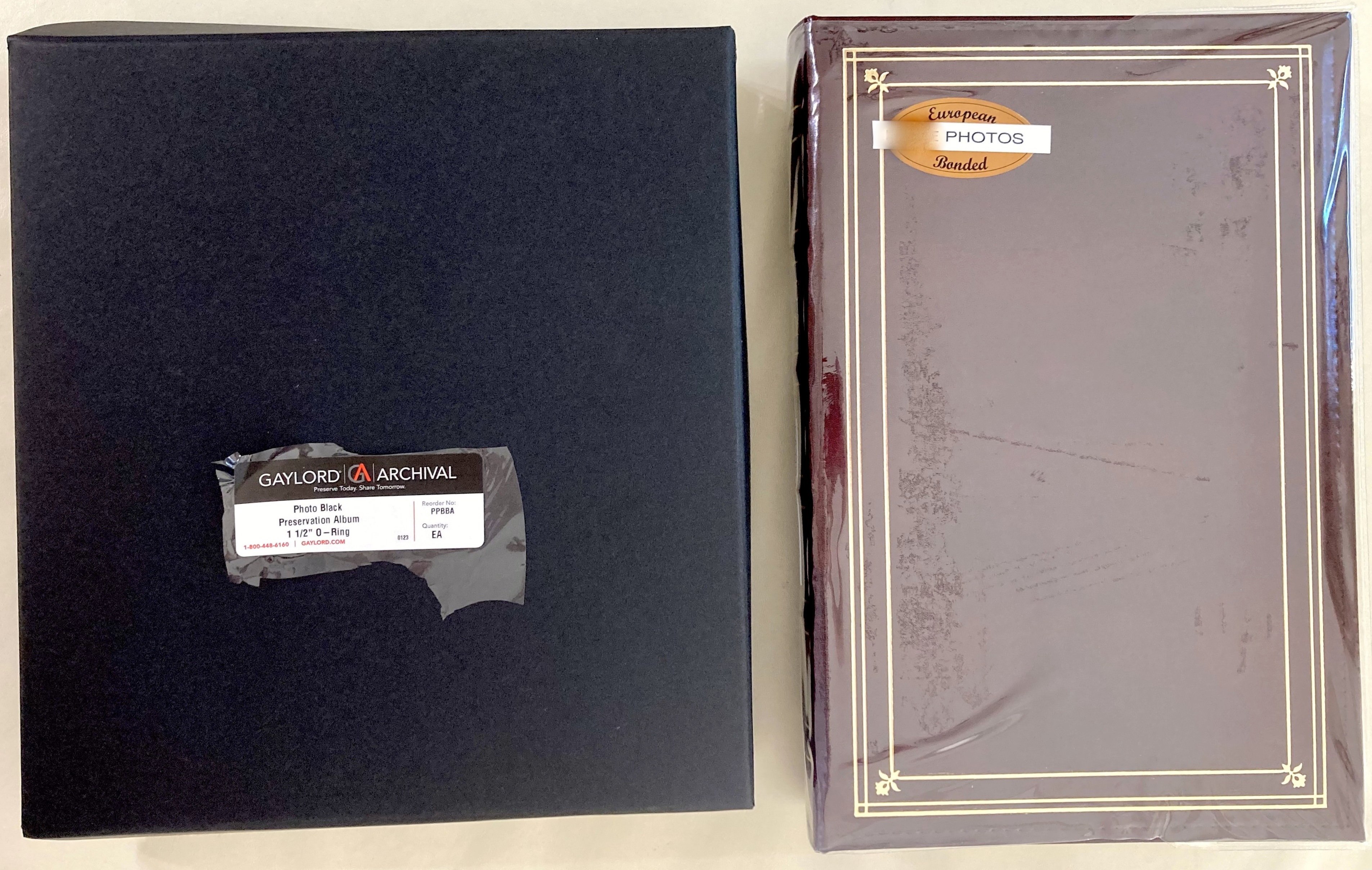
At top, two albums I'm trying out. At left is the Gaylord Archival Photo Preservation Album, which is actually a binder inside an archival box, easily stacked (it has reinforcing metal corners). At right is the sturdy Pioneer Pocket Photo Album, a tall album designed to stand upright or be stacked flat on a shelf.


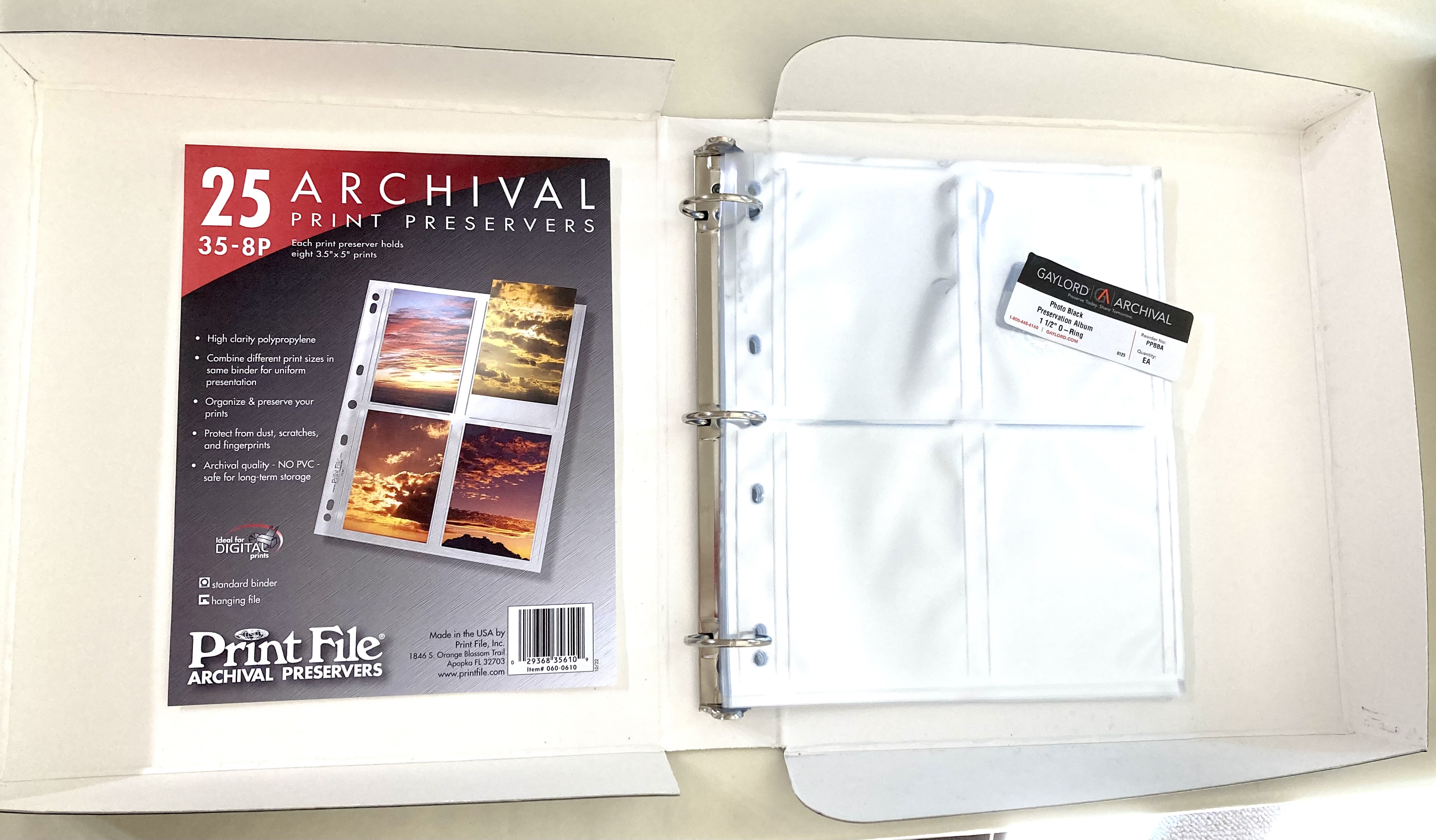
I'm a fan of archival boxes in general, because they look neat and keep the contents flat and in good shape. Above, a peek inside the box, showing the three-ring binder and archival sleeves for 3.5" x 5" photos (or smaller sizes). I have dozens of tiny black-and-white photos taken by my late dad-in-law, which will fit in these sleeves and stay put. For caption purposes, I can include notes inside the box. An advantage is that the box will hold many more sleeves to store many more photos, which are doubly safe: inside sleeves and within the archival box. 

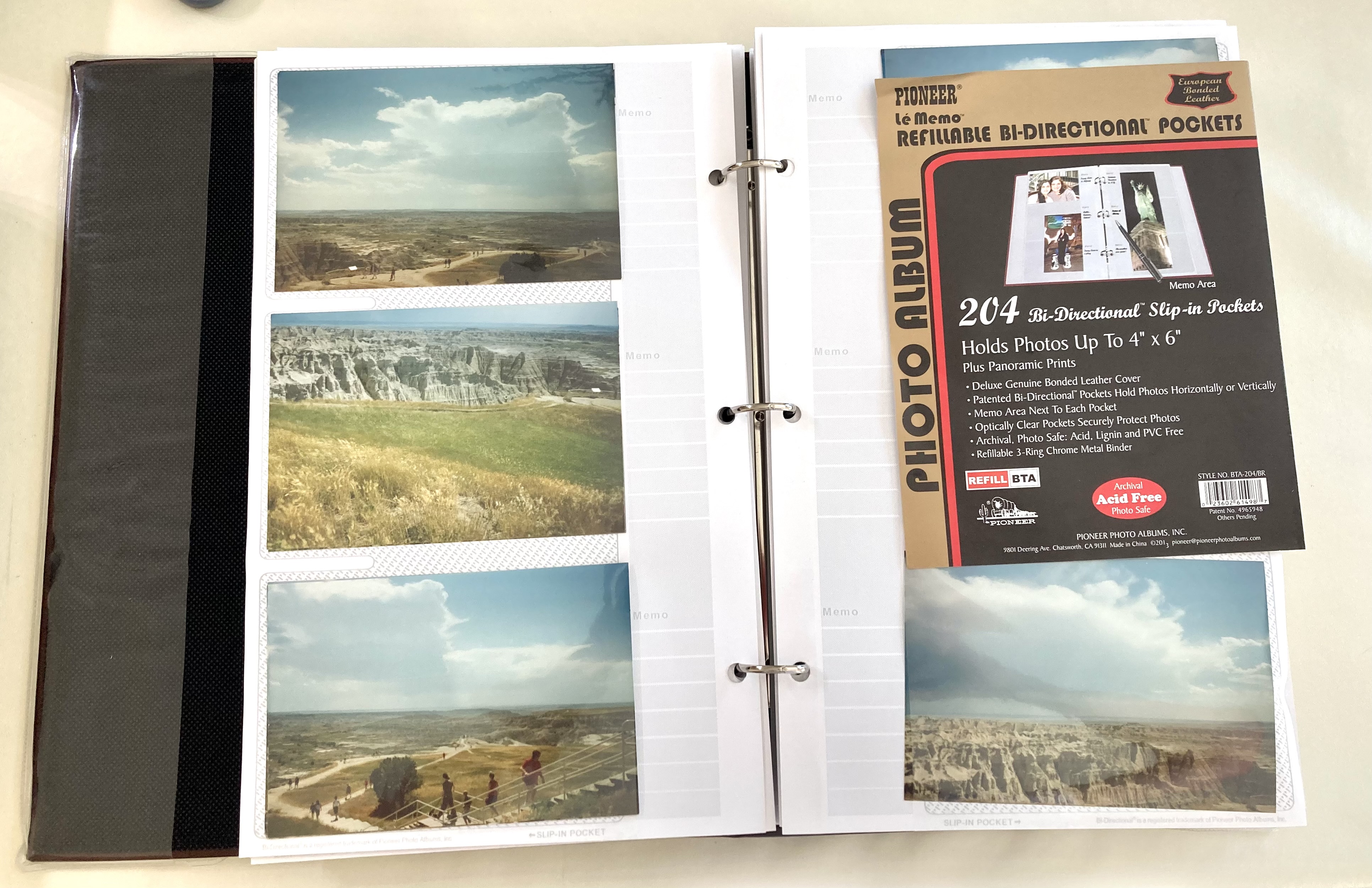
Here's a closeup of the Pioneer album, which holds archival sleeves for 4" x 6" photos (or smaller images sizes). I slipped in a few photos as part of my test. The sleeves have space for written captions next to photos, a real plus because I can jot notes as I go. Although these albums are too tall to stand upright on my bookshelf, they can lay flat or be stacked. In my first try, I crammed too many sleeves into the binder and had to order a second binder to hold the overflow (lesson learned). 

My test is a work in progress, and I don't have a clear preference quite yet. Either album format will keep photos in good shape for the future. No matter how you store your family photos, in albums or boxes or binders, I encourage you to think "archival" so the images and captions will be safe for the sake of many generations to come.

Tuesday, September 12, 2023

Leona Walasyk from Lodz Becomes Lee Wallace in Hackensack


Long, long before I came to know her as "Aunt Lee," Leona Z. Wallace (1903-1989) was working hard to get an education, help bring up her two younger brothers, and create a steady path to prosperity for the entire family. 

As shown in the last line of the above 1950 US Census excerpt, Lee was born in Poland. By the 1930s, possibly earlier, Lee had Americanized her name to Wallace, and until I saw the 1950 Census I wasn't sure what her surname used to be. In 1950, she was enumerated as a "head of household" despite living in the same very nice home in Hackensack, New Jersey with her two brothers, Charles Walasyk and Edward Walasyk, who never changed their names.* Correction: They changed their names later in life.

Charles, also enumerated as a head, was married with two children in the household, working as a salesman. In addition, their brother Edward, a water engineer, was staying with them in Hackensack. He was married and actually lived elsewhere with his family, but was enumerated with his siblings on this Census day in 1950. 

My research shows Edward was not born in Poland but actually in New Jersey, as was Charles, so I'm fairly sure none of the Walasyk/Wallace siblings actually spoke with the enumerator in 1950. Talk about prosperity: The spacious Hackensack home where they all lived in 1950 is now updated and worth a pretty penny

Back in 1950, Lee was doing quite well, which you wouldn't know from simply reading her enumerated occupation: "public relations, department store." 

I've written before that Lee headed up the famous, fabulous Macy's Thanksgiving Day Parade for a number of years, including 1950. Around this time, my mother's twin sister Dorothy went to work for Macy's and met Lee. The two hit it off, personally and professionally.

Not only did they work on the parade together, they were hired to assist with the annual Barnum Festival in Bridgeport, Connecticut in 1953. In March of that year, the Bridgeport Telegram reported that Miss Lee Wallace had "built up the Macy parade to the biggest balloon parade in the country." The final sentence of the news item reads: "Accompanying Miss Wallace was Miss Dorothy H. Schwartz, her associate." 

My aunt Dorothy Schwartz (1919-2001) soon left the world of parades and publicity to become a high school teacher in the Bronx, driving from New Jersey every work day. I later learned that Lee and Dorothy were savvy with their household finances, being able to afford a brand new car every other year as well as annual summer and winter vacations. Aunt Lee had no trace of an accent, and she never spoke of her past to me, a little girl who appreciated her affection and attention.

This week's #52Ancestors prompt from Amy Johnson Crow is "prosperity."
Friday, September 8, 2023

In Beta at Ancestry: Top Hints Feature


 In beta at Ancestry is a feature called Top Hints, which I'm exploring this week.

The leaf symbol captioned "beta" in the image above is where to click for "top hints for 10 people in your tree." Not every Ancestry member may have this new feature, but it is interesting because it calls attention to people from across the tree, people I may have not worked on recently. I know, I know, hints can be misleading or outright ridiculous. But ya just never know, so I do look now and then. This feature is like a variety-pack of hints from across the tree.

Clicking on the beta leaf brought up the list at right in the image. One name is blank here because it's a living relative. To look at the hints in more detail, click on the down arrow at right of each name. In my first list of hints, all were actual records or indexes, like Census documents, marriage/death indexes, or draft registrations, which I can evaluate individually. No ship illustrations or DNA strands, so far. 


Above, how Ancestry explains and introduces "Top Hints."

For me, Top Hints is something to check first thing in the morning before I dive into an ongoing project, or when I have a spare 10-15 minutes at any point. Take a look and see whether you have this beta feature and how well it works for you.

As you can see from the image at top, I'm also having fun with the new fan feature in Ancestry, which I learned about from a blog post by Diane Henriks. I haven't been able to change the number of generations displayed, so as she says, this feature must still be in beta. I like the suggested ancestors shown in green on the fan, hints that I can review and, mostly, reject unless there's solid evidence to investigate. 

IMHO, I'm the quality assurance person on my family trees, deciding whether to accept or reject any hint after looking at the source's credibility and relevance. Most "possible parent" hints get rejected, but occasionally those with real sources lead me in promising new directions. 

Tuesday, September 5, 2023

Honor Roll: Part 5, Korean War Veterans from Bethlehem, Connecticut


This is my final post transcribing names of military veterans from memorial plaques on the historic green of Bethlehem, Connecticut. The first post in this series explains the purpose of the Honor Roll Project, originated by Heather Wilkinson Rojo and hosted here

Roll of Honor

Dedicated to the men and women of the town of Bethlehem who served their country during the Korean War, June 25, 1950-January 9, 1955 - Erected by the Citizens of Bethlehem, May 30, 1982

Glen C. Adams, Sr.
Richard O. Anderson
Curtiss Bate
Hugh L. Bronson
Raymond W. Brown
Frank Bosko
Robert H. Box
Elbert V. Box
Roger Clark
Frank L. Convard
Dolores A. Dauch
Robert J. Dauch
Edward D. Everitt
Gordon J. Fredsall
Kenneth Harlow
Walter L. Hunt
John T. Knudsen
Sally L. Lorensen
Gerald A. Minor
Patsy Narciso
Marvin Parris
Ralph A. Petruzzi
Vincent J. Skelte
Ernest Sommers
Earle R. Thompson
Calvin C. Wiltshire
Alan J. Woodward

Monday, September 4, 2023

A Family of Tradesmen = My Summer Favorite In-Laws


This summer, my favorite in-laws (in my husband's family tree) are the Cornwell family, a multigenerational family of silversmiths/watchmakers/jewelry store proprietors. 

Asenath Cornwell (1808-1897) married James Larimer (1806-1847), my hubby's 3d great-grand uncle. As I posted a few months ago, Asenath was widowed early and made the bold decision to go to the Gold Rush with her brother, John Cornwell, in 1852. Brother and sister wrote journals of their journey and experiences. The journals are fascinating first-person accounts of that time and place. 

John Cornwell (1812-1883) was a lifelong jeweler, watchmaker, and silversmith. He understood the value of gold and was sorely disappointed not to find very much during his Gold Rush years. No doubt his family was disappointed as well, since his wife and children remained in Athens, Ohio, when he was panning for gold in California. Occasionally John put gold dust into a letter for his wife Ann, but he never struck it rich. 

Returning to Athens in 1856, John opened the jewelry store that successive generations of Cornwell descendants operated until 2019. As shown in the Census lines at top, John's occupation in 1860 was watchmaker, in 1870 it was silver smith, and in 1880 it was jewelry (creatively spelled).

John's son David Coleman Cornwell (1844-1938) served in Company B of the 141st Regt of the Ohio Volunteer Infantry during the US Civil War. After the war, he followed the family trade, becoming a silversmith and jeweler. Retiring in his 60s, David was already twice widowed. 

Still, he couldn't stop thinking about a young lady he used to know from Athens, Ellen Jane Sams (1855-1938). Somehow David tracked her down in Illinois, according to a news report in May of 1909, discovered she too had been widowed, and quickly proposed. They were happily married for 29 years until Ellen's death in 1938. David died just a few months later. 

With colorful stories like these, you can see why the Cornwell in-laws are my summer favorites.

"Tradesman" is Amy Johnson Crow's genealogy prompt for this week in her #52Ancestors series.