Tuesday, March 8, 2022

What Age Was My Longest-Lived Female Ancestor in 1950?

On April 1, I hope to learn more about my oldest female ancestor, great-grandma Tillie Rose Jacobs Mahler (1852ish?-1952), daughter of Rachel Shuham Jacobs and Jonah Jacobs and husband of Meyer Elias Mahler.

At left, a 1900s photo of Tillie beautifully colorized by MyHeritage in Color.

The story passed down is that great-grandma "fooled" the family into giving her a 100th birthday party...and then died at the age of 99. Even today, nobody knows her true birth month, day, or year, only that she outlived everyone else in the family tree (by a lot).

Census records were inconsistent

I consulted US and NY Census records about Tillie's age and found, as the years went on, a number of inconsistencies. How did Tillie age so quickly between 1920 and 1925, for example? Or between 1930 and 1940? 

Likely it was not Tillie talking with the enumerator, IMHO, but someone else in the household (or a neighbor) giving an age guesstimate in later years. Take a look at how her age changes:

  • 1900 US Census: Tillie is enumerated as 39 years old (Census day: June 1)
  • 1905 NY Census: Tillie is enumerated as 45 years old (Census day: June 1)
  • 1910 US Census: Tillie is enumerated as 50 years old (Census day: April 15)
  • 1915 NY Census: Tillie is enumerated as 55 years old (Census day: June 1)
  • 1920 US Census: Tillie is enumerated as 60 years old (Census day: January 1)
  • 1925 NY Census: Tillie is enumerated as 67 years old (Census day: June 1)
  • 1930 US Census: Tillie is enumerated as 73 years old (Census day: April 1)
  • 1940 US Census: Tillie is enumerated as 86 years old (Census day: April 1) - see image excerpt below. (Note: Neither Tillie nor her daughter has a circled X next to the name, which would ordinarily suggest they were not the informants. Since no names on that page have an X, this enumerator didn't indicate which member of any household gave the information.)
  • UPDATE: 1950 US Census, Tillie is enumerated as 100 years old (April 1).


What will 1950 US Census say?

Looking ahead: If Tillie was 99 years old when she passed away in 1952, she would be enumerated as 96 or 97 years old in the 1950 Census. NOPE, she was supposedly 100 yrs old as enumerated in 1950 US Census.

Remembering Great-Grandma Tillie with affection on International Women's Day.

This is my post for the Genealogy Blog Party of March, 2022.

Sunday, March 6, 2022

RootsTech 2022: Don't Forget to Check the Chats! (Limited Time)

My favorite sessions during the kickoff weekend of all-virtual RootsTech 2022 were the live talks and panel discussions. 

Why? Because these encouraged interactivity and offered a sense of connection even though we were home in our bunny slippers rather than being together in person at the Salt Palace.

Above, the four panelists who spoke on Saturday with enthusiasm and candor about their experiences with YouTube. More than 400 people attended the Zoom. The session is on YouTube here. I'm a fan of these folks and I enjoyed hearing them discuss their experiences, successes, frustrations, and ideas for the future. The audience chat was a mix of questions, comments, and "hi from Connecticut" greetings that added to the community feeling.

Another group discussion I really liked was the Ethical Dilemmas panel, on YouTube here.

Check the chats! Available until about March 13

With prerecorded sessions, the chat box was a great way to interact with other audience members and, crucially, with content experts. During the first day's session about the 1950 US Census (featuring Crista Cowan of Ancestry and Stephen Valentine of Family Search), I actually learned key, updated details from the experts in the chat. My least favorite parts of this session were the interviews with people in New York's Time Square--entertaining but not informative. You can watch the entire recorded session here.

As I watched the main sponsors' keynotes, I joined the chat and was pleased to see links to some of the new features being introduced. A running Q&A in chat (still available after the sessions) was of interest, as well. More than 500 people commented in the MyHeritage keynote chat...more than 230 in the Ancestry keynote chat...more than 550 in the FamilyTreeDNA keynote chat. Not all chat comments were of broad interest, but there were many good suggestions and links.

As of today, "join the chat" is still available for all sessions on my playlist. BUT chats will be unavailable after another week or so (by March 13 approximately). Do take a moment to check the chat for any session on your RootsTech playlist. 

Mark your calendar: The next RootsTech will begin March 2-4, 2023, less than a year away ;)

Thursday, March 3, 2022

Important Last-Minute 1950 US Census Info


We have less than a month to wait for the release of 1950 US Census!

The US National Archives (NARA) has begun posting a series of video presentations to help us get ready to find ancestors in this mid-century Census. No preregistration, no fee, just click to watch.

You can see the full schedule and watch individual videos, as they're posted, on this YouTube page. If you watch as each video debuts, you can participate in live Q&A via chat and get answers from experts in the know! If you watch after that time, you can still read the entire Q&A in the chat box, but you can't ask new questions.

Two highlights from talk by Claire Kluskens

The initial presentation in the National Archives series took place yesterday, March 2d. Here are two of many key takeaways from this excellent talk by Claire Kluskens. 

  • Look for Sheet #71. Once you've determined that your ancestor is likely to be in a particular Enumeration District, be sure to browse the final ED pages. You're looking for sheet #71. Why? Because if your ancestor wasn't home when the enumerator came calling the first time, that household would likely have been enumerated out of order. The details would have been written on sheet #71. Remember, even if an ED was tiny and had only 12 pages, there will be a sheet #71 if any household was enumerated out of order for some reason. It's not that sheets were missing between page 12 and page 71.  The Census Bureau deliberately designated Sheet #71 as the page where households enumerated out of order would be recorded in each ED. So always go to the end and look for sheet #71 (sheet numbers are at far right corner of population schedule, see star in image above).
  • Look at notes section. As shown here, the notes section is a blank area midway on the page. Enumerators might write comments or explanations here (such as whether an age is actually an estimate or whether a respondent might not be telling the truth). Also see whether the little box (red arrow) is checked. If your ancestor is enumerated on the final line(s) of that page, the box being checked is an indication to continue onto the next page to see more people in that same household. Do glance at the notes, if any, and look for the check box.
Don't wait--download NARA presentation slides now!

I highly recommend watching Claire's talk and downloading her slides from this pdf. That way, you'll have the slides at hand for reference.

The next two speakers in the NARA series have already posted their slides for download. I can't stress enough how valuable these slides are, jam-packed with information that will help us find ancestors when the Census is released on April 1. 

Right now: 

Download the March 30th pdfs by Michael L. Knight because you will see, for the very first time, what the 1950 US Census website will look like! 

Here is one excerpt from his talk. The "Begin search" button will lead to a search interface. The "How to search" button will explain the different methods of searching (by location or by name). He shows a sample name search and a sample location search. 

These videos and downloaded slides will give you a headstart before the 1950 Census is actually released!

For more about the preparing for the 1950 US Census release, please see my summary page here.


Tuesday, March 1, 2022

The First Female Ph.D. in My Family Tree

My immigrant maternal grandparents (Hermina "Minnie" Farkas Schwartz, 1886-1964 and Theodore "Teddy" Schwartz, 1887-1965) had high expectations for their American-born children. 

They were big believers in education and encouraged their children to reach for the stars. 

Of their three children, one son and one daughter earned a Ph.D. From immigrants to doctorates in one generation!

Uncle Fred, the family's first Ph.D. 

The oldest child, Fred Shaw (1912-1991), earned a bachelor's degree and a master's degree after graduating from James Monroe High School in the Bronx. Just before he married Daisy Katz (1913-1985) on Thanksgiving Day, 1940, he was appointed as an economics teacher at New York City's prestigious Stuyvesant High School.

After a stint as a Captain in the U.S. Army during World War II, he again taught high school economics as he earned a Ph.D. Uncle Fred went on to write the well-regarded book, History of the New York City Legislatureas well as teaching political science at the City University of New York.

Auntie Dorothy, the family's first female Ph.D.

Dorothy Schwartz (1919-2001), my mom's twin sister, interrupted her studies at Hunter College in New York City to enlist as a WAC during World War II. When she returned from overseas in 1945, Sgt. Schwartz initially went to work and then resumed her college career. After graduation, she worked for Macy's, becoming assistant to the wonderful woman who ran the Thanksgiving Day Parade for many years. 

In the 1950s, Dorothy took some education courses and in 1955, she was appointed as a typing and steno teacher at Evander Childs High School in the Bronx, NY. Shortly afterward, she got a job teaching at Christopher Columbus High School, where she spent the rest of her long career. A teacher by day, she was a student by night, earning a master's degree and then a doctorate in education. Auntie Dorothy was my family's first female Ph.D.

My Mom Daisy, behind the scenes support

My Mom, Daisy Schwartz Burk (1919-1981), graduated from high school into the depths of the Great Depression. There wasn't enough money for her and her two siblings to continue to college. Although they would be attending free city universities, money was needed to pay for books, carfare, lunches, and so on. Instead of going to college, Daisy took secretarial jobs to help support her older brother and her twin sister as they studied for their degrees. 

Once she settled down with Dad (Harold Burk, 1909-1978), the focus was on educating the next generation. In later years, Daisy took college courses at night, for credit, while working during the day. She especially enjoyed her literature and history courses, even though she never earned a degree. Her strong belief in education was passed along to her daughters, who all earned masters' degrees. 

You can see how proud I am of my Mom's behind-the-scenes support. I'm proud of my uncle, the family's first Ph.D., and  my aunt, the first female Ph.D. in the entire family tree. This is my week 9 post about "females" for Amy Johnson Crow's series of prompts, #52Ancestors. (Just in time for Women's History Month).

Saturday, February 26, 2022

Bite-Sized Ancestor Bios on Find a Grave--Sometime Soon?


One of my passions is to keep family history alive for the sake of future generations and for future researchers. After years of research, I'm sharing what I know now by posting bite-sized ancestor biographies on multiple websites. 

This is part of the PASS process described in my updated book, Planning a Future for Your Family's Past (available on Amazon, in the book store at American Ancestors.org, and in the book store at the Newberry Library).

Lots of copies keep stuff safe

At top, the bite-sized bio I wrote about my husband's maternal grandfather, Brice Larimer McClure (1878-1970). After sharing within the family, I've posted this on Family Search, My Heritage, and WikiTree. The idea is to share this ancestor's story widely, in public, so those who come after can learn more about his life. 

I'm applying the LOCKSS principle--the concept that "lots of copies keep stuff safe." With lots of copies, it's less likely that genealogical and biographical information will be forgotten or lost or otherwise become inaccessible as time goes on.

Not yet on Find a Grave 

For the past year, I've been trying--unsuccessfully--to have this ancestor's bio posted to the memorial page on Find a Grave. 

Find a Grave is free, it's worldwide in scope, and it's another suitable place to share info about ancestors.

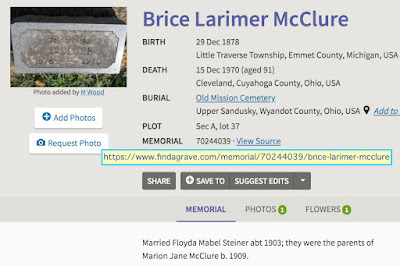
Image at right shows how the memorial page currently looks. Notice that I took the photo of Brice's grave and posted it years ago. 

The brief bio currently on the page was not written by me. It's not just incomplete, it's inaccurate.

I've posted other ancestral bios on Find a Grave, both on memorial pages that I manage and through the courtesy of non-relatives who manage my ancestors' pages. However, I haven't yet been able to get Brice's posted. 

Following Find a Grave's policies

Beginning in January of 2021, I submitted edits multiple times to the current manager of this memorial. Repeatedly. To date, I've had no response. I see the current manager has more than 440,000 memorials, and that person's profile mentions how much time it takes to plow through edits and requests for transfer.

Still, 13 months seems way too long to wait for edits to be posted or a transfer to be completed (with a click). I've even explained to the current manager, at least once, that Brice and Floyda are my husband's maternal grandparents. 

According to Find a Grave's policies, someone who manages a memorial page that is NOT of their ancestor is supposed to transfer to a relative, upon request. You can read those policies here

Now I'm giving Find a Grave an opportunity to stop the 13-month logjam and expedite the transfer of Brice's and Floyda's pages to me. I wrote the support folks, as Find a Grave says to do, and briefly explained why I want to manage those memorial pages and how I've attempted to have accurate bios posted for months, to no avail. 

(March 8 update: No response yet) (March 21 update: Find a Grave said, in a tweet: "We are processing a large backlog at this time. We apologize in advance for a delay in response; we are responding as soon as we can. Thank you for your patience while we process the mail we have received. Please know we are giving each request our full attention."

March 29 update: Partial success!! Find a Grave made me the manager of my Dad's memorial. Now I'm hoping they'll transfer hubby's grandparents in just as timely a manner. TY to Find a Grave.

My goal is to keep alive the memory of these ancestors, not just for descendants but also for other genealogical researchers. And I don't give up easily! Readers, I'll keep you posted about what happens.