Monday, January 24, 2022

Just Curious: Did My Immigrant Ancestors Know English?

As I write bite-sized bios of my great-grandparents, who died long before I was born, I find I'm curious about their daily lives. 

For instance: Did great-grandma Leni Kunstler Farkas (1865-1938) and great-grandpa Moritz Farkas (1857-1936) become fluent enough to speak, read, and write in English? 

Both were born in Hungary (in an area now in Ukraine). Both were, I'm confident without any real proof, able to read and write in their native Hungarian language. Why? Because Leni was the daughter of a family that owned property and operated an inn...Moritz supervised his in-laws' vineyard and leased lands to farm. They interacted with officials, not just family members, and would have needed some level of proficiency in Hungarian.

Comparing family stories and research 

Research and family stories agree on many aspects of these immigrant ancestors' lives. Moritz arrived in New York City in August, 1899, Leni arrived in November, 1900, and their Hungarian-born children followed in two waves. Moritz worked as a presser and cloak maker within the New York City garment industry. Leni was in charge of their children and ruled the household. 

The youngest kids went to city public schools and picked up English quickly and naturally. The older children (mid-to-late teens) worked during the day and went to night school to learn English. At the end of the work week, they handed their pay packets to Leni. She doled out carfare and lunch money for the next week, and kept the rest for rent, food, and other expenses (including an occasional summer getaway of her own, according to family lore). 

Both Leni and Moritz lived in New York City for three decades. Moritz worked outside the family, while Leni may have had dealings with landlords, shopkeepers, school officials, and others in the neighborhood.

But how well could they speak, read, and/or write English? My oldest cousins, who were toddlers when these ancestors died, have distant memories that could only be based on actual conversations, in English, with Leni and Moritz. What other clues can I gather?

Start with the US Census

My first step was to return to the US Census, which often asked about proficiency in English. Interestingly inconsistent answers!

  • 1900 Census: Moritz lived as a boarder in someone else's Lower East Side tenement apartment. For the question "speak English?" the enumerator had originally written YES but overwrote it and the answer is illegible.
  • 1910 Census: YES, Moritz can speak English, according to this record, but NO, Leni's answer is "Magyar."  
  • 1920 Census: NO, neither Moritz nor Leni is recorded as being able to speak English. Their native tongue is "Jewish," according to this Census.
  • 1930 Census: YES, both Moritz and Leni are recorded as being able to speak English. The language spoken at home before coming to America is listed as "Magyar."
Next stop: naturalization documentation

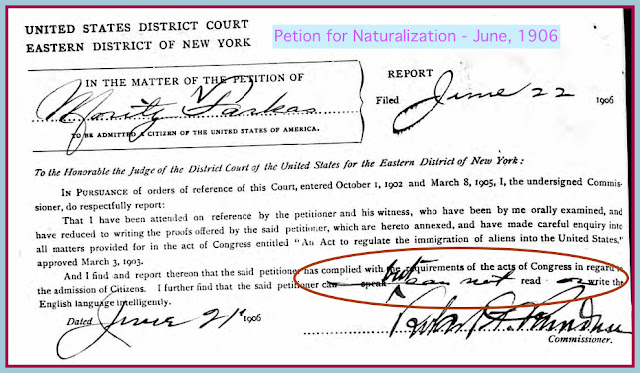
Next, I looked at Moritz's Petition for Naturalization, dated June of 1906. He had been in America for nearly seven years at that point. 

As shown at top, the commissioner who signed this petition indicated that no, Moritz could NOT "read or write the English language intelligently."

So...yes or no?

My conclusion, based on this research, is that for the first decade in America, neither of these ancestors could do more than understand a bit of basic English and possibly answer with a stock phrase. 

I believe, based on my research and my cousins' dim memories, that eventually, both Leni and Moritz understood spoken English fairly well, and could converse in English with people outside the family, even if their vocabulary was not extensive or sophisticated.

I doubt either ancestor could read or write very much English by the time they passed away. Most likely, they (like so many immigrants) relied on their children all their lives to be interpreters and read/write English when necessary. 

-- This is my post for week 4 of Amy Johnson Crow's #52Ancestors series, with the theme of "curious."

Thursday, January 20, 2022

Seeking City Directories for Your 1950 US Census Prep?

With 71 days until the release of the 1950 US Census, this is the time to find 1950ish home addresses for ancestors who will be in that Census. 

A great tool for finding an ancestor's street address is in a city or phone directory published around the time of the Census (1948-1952, for instance). Expand the search to earlier and later years if needed. 

Not every directory for every year is available online--some may be available for research in local libraries or archives if you can visit in person. 

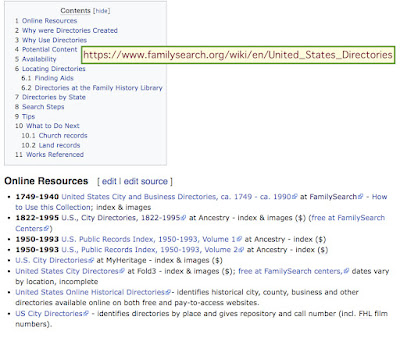
Family Search has links to city directories online, indicating both free and fee-based sources, as shown at top in a page from its invaluable wiki.


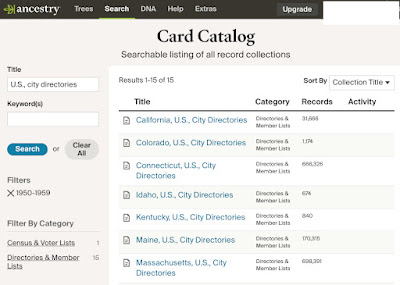
Ancestry.com has lots of city directories. I went to the card catalog and did a search for "U.S., city directories," and 15 state-by-state collections turned up, as shown here. There are other directories in the card catalog, as well--but again, not necessarily in the time period for the 1950 US Census, so check dates carefully.

For more links to US city directories, check The Ancestor Hunt and Cyndi's List, which both have links to directories in various states and for various years.

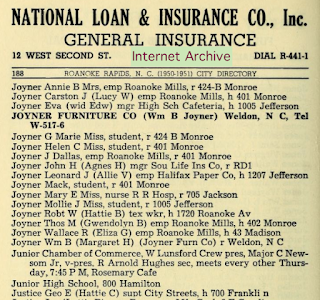
Also check InternetArchive.org, which has lots of directories from all over the country for a wide range of years. At left, a screen shot of part of a page from the 1950 directory for Roanoke Rapids, North Carolina. 

If you take the time now to locate ancestors' addresses, you can turn them into Enumeration Districts using the handy ED Finder by Steve Morse and Joel Weintraub, and be ready to browse the population schedule on April 1. Good luck!

For more about the release of the 1950 US Census, and how to get ready to find ancestors on April 1, see my summary page of posts here


Monday, January 17, 2022

Favorite Photo That Led to a Breakthrough


This photo of a distinguished man in uniform was passed down in my husband's family for a century.

We had no idea who it was until 2011. 

After I posted the photo on my blog, two wonderful readers recognized the uniform, the big breakthrough I needed.

Capt. John Daniel Slatter

This is Captain John Daniel Slatter (1864-1954), in full regalia as Bandmaster of the 48th Highlanders of Toronto.

With a name and dates, I knew just where he should fit in the family tree.

Capt. Slatter is an older brother of hubby's grandma, Mary Slatter Wood (1869-1925). Now I had a new research angle to explore!

Over the next few months, I corresponded with the 48th Highlanders' museum in Toronto. Later, hubby and I drove up for a visit. We learned a great deal about Capt. Slatter's military career from the curators. In turn, we left them a family tree and biographical information to supplement the military artifacts and records in the museum's possession.

Bite-Sized Bio

More recently, I wrote a bite-sized bio to memorialize this legendary bandmaster, posting it on Family Search, Find a Grave, and other sites. It wasn't easy to squeeze his personal life and professional accomplishments into four paragraphs (with sources summarized at the end--see below). 

Thanks to eagle-eyed readers getting me started with the initial identification, I've now traced the Slatter family further back in time and can memorialize more ancestors with bite-sized bios on multiple genealogy websites. 

* This is my week 3 post for Amy Johnson Crow's #52Ancestors challenge, with the theme of "favorite photo."


Thursday, January 13, 2022

"Of the Time" 1950 US Census Ads and Training


While impatiently waiting for the release of the 1950 US Census on April 1, I've been learning a little more about what went on behind the scenes in the buildup to the actual count.


1950 ads for the Census

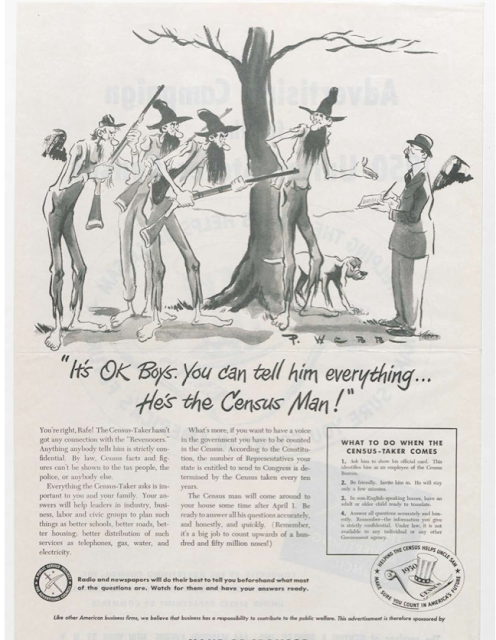
The U.S. government worked with Madison Avenue on a massive advertising campaign to get businesses to support and promote the 1950 US Census. 

The Ad Council made available a number of preformatted print ads for local businesses to run in local publications in advance of Census Day.

The ad shown here addresses concerns about confidentiality. "It's OK, boys: You can tell him everything...He's the Census Man!" [Note: Many enumerators were female, of course, but remember, these ads were very much of the time.]

The ad tells readers the Census has no connection with those dreaded "revenooors." It's fun to look back at those ads, which show the Census Bureau was well aware that people worried about answering personal questions asked by enumerators. 

1950 enumerator training 

In the middle of the last century, schools and businesses often used film strips for training purposes. A trainer or teacher would watch the images projected on the screen and try to synchronize the separate recorded narration on a record or cassette.

Training for the 1950 US Census involved a number of film strips. Read more here, in the fascinating History Hub post by Claire Kluskens. 

See some of these "of the time" film strips on Dr. Joel Weintraub's YouTube Channel here.

To read the script for the training film strip titled "Income--What It Is and How to Report It!" click here

Despite the coffee stain on page 8, and tape fixing page 9, the typed script is quite readable. It offers insight into how the Census Bureau instructed enumerators about collecting income info from the public, again very "of the time."

Getting in the mood for the 1950 US Census? We have only 78 days to wait for the release!

For links to more information about the 1950 US Census release, see my summary page here. 

Tuesday, January 11, 2022

Memorializing Little Ones Who Died Young


I admit it--I get a bit teary-eyed thinking of the babes in my family tree who died too young. I want their names to live on, by putting them on public family trees and making sure their burial places are recorded.

How Miriam wound up in hubby's family tree

Today I'm focusing on Miriam Louise Wise (1925-1926). This little girl's father was Clifford "Buck" Wise (1895-1963) and her mother was Edith Macklin Wise (1897-1947). After Miriam's early death, Clifford and Edith were happy to welcome a second daughter, Janice (1927-1988), bringing light back into their lives, as I know from family letters. 

Clifford was widowed in 1947 and the following year, he married my father-in-law's first cousin, Edith Eleanor Baker (1901-1989), who became a devoted and loving stepmom to Janice. This connection with the Wise family is how little Miriam Louise Wise wound up in my hubby's family tree.

Making sure Miriam is remembered


Miriam's parents (both on my family tree already) are buried in Acacia Masonic Memorial Park Cemetery in Mayfield Hts, Ohio, and memorialized on Find a Grave. But until now, I hadn't looked carefully for Miriam's final resting place.

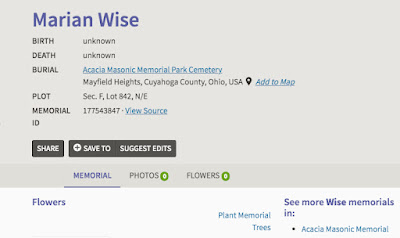
By searching for "more Wise Memorials" in the same cemetery, I came upon a memorial page for "Marian Wise," birth/death unknown (see image above). The plot is exactly where Miriam's parents are buried. 

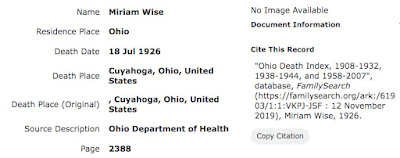
My conclusion: Marian is surely Miriam. Interestingly, the obit in the Fremont Daily Messenger (which I've ordered*) calls her Mariam Louise Wise, but the Ohio death index lists her as Miriam. Family letters also call her Miriam. 

Her now revised memorial page is on Find a Grave


This reflects edits I submitted to the memorial page's manager, correcting Miriam's name and including her dates. I also posted an image of Miriam's name in the death index. And I posted Miriam's sweet baby photo, as shown.

Miriam is already on the tree at FamilySearch and on two Ancestry public trees, courtesy of relatives in the Wise family. I'm adding her to all my Wood family trees over time. 

It's comforting that Miriam will not be forgotten, because her name and dates are documented in more than one place by more than one person. Rest in peace, little Miriam.

Turns out, the obit does name this baby correctly as Miriam Louise Wise. She died of "telescoping of the bowels" (causing dangerous blockage). Doctors operated, unsuccessfully, sad to say. 

This post is my "May Day" for The Genealogy Blog Party, 2022.