Saturday, January 8, 2022

Bite-Sized Bios for Earlier vs Recent Ancestors


When I write a bite-sized bio for ancestor who was known to me or my relatives, I frequently have so much material that I have to pick and choose to make the bio both brief and informative. 

There are so many recent genealogical sources available, as well as family letters, diaries, and family photo albums, that I have a rich cache of content. Plus, older cousins who remember these people can share stories that make the bios more vivid and add personality well beyond the basic facts.

What can I learn about earlier ancestors?

However, writing a bio for an ancestor who died before the 20th century can be more of a challenge because nobody alive today knew that person and rarely do I have personalized sources. 

Still, my bio for someone who died more than a century ago usually includes: birth, marriage(s), and death dates and places (where known); parents' names; spouse(s) name(s); occupations; residence(s) and land ownership; military service (if applicable); children's names; geographical movements; and some social/historical context.

Sources for writing bios of earlier ancestors

I get these details from sources such as (but not limited to) multiple Census records, vital records, military records, naturalization records, city directories, newspapers, obits, and county histories. I use Wikipedia, history books, and other sources to add a bit of background, such as about immigration trends or frontier life, when I weave the basics into an interesting story told in my own words. 

Sometimes there are scant sources for a much earlier ancestor. Then I write what I can, emphasizing details that I do know--such as where that ancestor is in the birth order of siblings, how many of that ancestor's siblings survived to adulthood, what that ancestor did for a living, whether that ancestor married, and so on. These bios are not as long or rich as bios for more recent ancestors, but I do try to make them interesting and bring out the human angle.

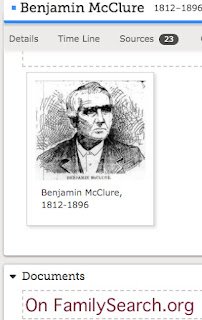
Other times, I can dig up a considerable amount of content for an ancestor who died more than a century in the past. When my husband and I were in Indiana a few years ago, we cranked a local library's microfilm reader to research ancestors in 19th century newspapers. There we found a wonderfully detailed obituary for hubby's 2d great-grandfather, Benjamin McClure (1812-1896)--a truly great source for an ancestor bio!

The woodcut portrait of Benjamin McClure, shown at top, is also from a 19th century newspaper accessed via microfilm at that same local library.* I've posted the woodcut on FamilySearch and other sites where I post bios and images, to bring this ancestor to life.

*About copyright: The Legal Genealogist, Judy Russell, writes about copyright and newspapers from time to time--including this old but still informative post. Also see this brief Library of Congress post about newspaper databases. Note that I'm not an expert on the legalities of newspapers/books and copyright, so please do your own homework before using any published content, either words or images, from the past!

Wednesday, January 5, 2022

Take Your Genealogy to the Next Level via RootsTech 2022

Ready to take your genealogy to the next level? 

Register for RootsTech here.

It's free, it's entirely virtual, and it's worldwide

Although the official kickoff is on March 3rd, presentations will remain available for months afterward.

Learn from experts in their fields and check out the virtual exhibits featuring new products and new technology. 

Watch presentations at your own pace, whenever you wish. This is an opportunity to get tips from the best in the world and expand your knowledge of genealogy!

Best of all, did I mention this incredible conference is free? 

PS: For more, see the RootsTech blog on FamilySearch.org, here.

Monday, January 3, 2022

Caption Crazy: Foundation for Future Genealogy


This is my year to go caption crazy. Before I dive into the latest batch of ancestral photos that await scanning, captioning, and storage, I'm completing a photo book featuring highlights of 2021. Even in a pandemic year, my husband Wally and I had some adventures and family gatherings that didn't involve teleconferencing ;)

I began this photo book tradition at the end of 2008, with a slender softcover book featuring favorite photos of family and vacation fun of that year, complete with brief captions.

Since then, I've created at least one photo book per year and sometimes more than one. At right, a selection of these photo books, filled with colorful images plus captions that remind us of what we did each year, the ups and downs of our lives.

For the next few days, I'll be finishing up the full-year photo book for 2021 and pressing the button to print. 

The memories are precious to my husband and me--and the captions naming names and places will be a great foundation for future generations interested in our family's history.

A bonus: Photo books are professional, look polished, and are more likely to be kept by future genealogists because they are full of family history being made year by year!

- "Foundation" is the first prompt in Amy Johnson Crow's #52Ancestors challenge for 2022. 

Saturday, January 1, 2022

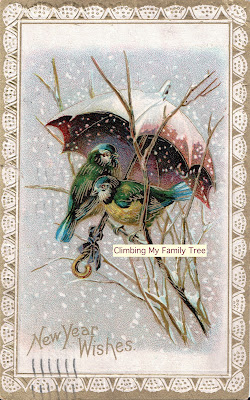
A Colorful Postcard to Kick Off 2022


This colorful postcard was sent from a young Wood cousin living in Toledo, Ohio to his first cousin living in Cleveland, Ohio. It's postmarked at the very end of 1909. 

From my home to yours, sending warm "New Year Wishes" on this first day of the new year.

And if you're stateside, don't forget to watch the new season of Finding Your Roots on PBS starting the first week of 2022. 

Friday, December 31, 2021

Penny Postal Greeting New Year's


When my husband's uncle Wallis Wood was just 5 years old, he received this fanciful New Year's postcard from his Wood relatives at the end of 1910.

It was very early in the air age. The two kiddies in in this air ship are having a steampunk holiday, from the looks of this colorful illustration. 

But in reality, an airship named America did set out to cross the Atlantic Ocean in October of 1910, lifting off from New Jersey to land somewhere in Europe (no fixed destination). Before experiencing difficulty and abandoning the attempt, the crew set a new record for flight time (71.5 hours) and distance flown (1,008 miles). 

Dear readers, wishing you a brighter and better new year in 2022!