
Happy birthday to us! Today is another twin birthday. 🎂🎂
Maybe my beloved Sis and I will celebrate with lollipops and pinwheels?!
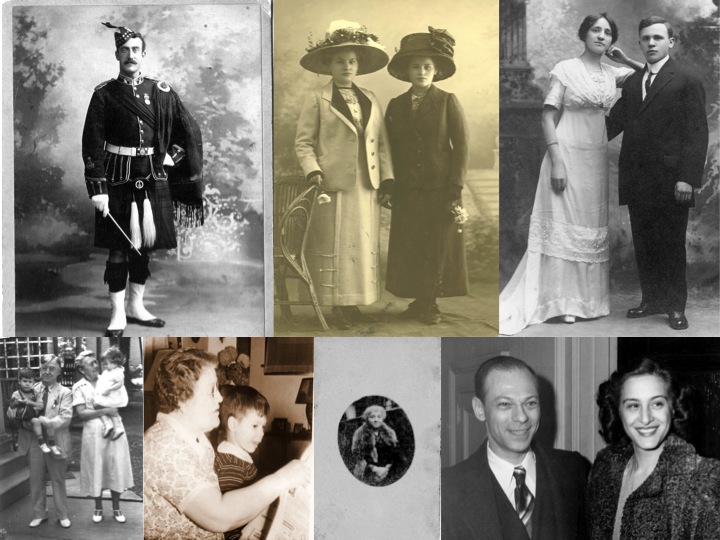
Maybe my beloved Sis and I will celebrate with lollipops and pinwheels?!

As I get ready to find them in the 1950 US Census when the records are released in April, I'm finding I have to dig even deeper to determine the specific Enumeration District for a few of these Big Apple residents. This holds true for other big cities, by the way, as I've discovered searching for Cleveland ancestors.
Details matter
Here's a mini case study featuring ED maps and ED descriptions. My cousins lived at 3706 72d Street in Queens, New York. But studying the map, I see that the borough of Queens also has 72d Avenue, 72d Avenue Ext, 72d Crescent, 72d Drive, 72d Lane, 72d Place, and 72d Road.
So my first step was to be sure I entered the correct street name when using the nifty Unified Census ED Finder by Steve Morse and Joel Weintraub.
With only the street name/number, there were too many potential Enumeration Districts for me to browse. As the site directs, I next looked at the Google map and entered a cross street (Broadway) and a back street (37th Avenue) for the block where these cousins lived.
These two additional details narrowed the number of EDs to three. I couldn't enter a fourth cross or back street, because my cousins lived on a triangular city block.
Go to the NARA map
My next step was to look at the National Archives map for the three EDs that were around the address. The Steve Morse site has an easy one-step process to go to the maps. Be sure you set the year to 1950.
Once I located the map for this section of Queens, I enlarged it to read the street names. I found my cousins' address was at a location numbered as block 12 on the NARA ED map (at top).
The little white star on image above is where my cousins lived in 1950. But the orange lines delineating the districts didn't show me precisely which ED my cousin lived in. What now?
Read the NARA map description


I looked more closely at the specific blocks included within each ED. Remember, the NARA map at top shows that the address is on block 12.
Block 12 is described as being within ED 41-608. So on April 1st, I'll be looking for my cousins in this single ED!
For more about the 1950 US Census release, see my summary page here. To learn more about the US National Archives ED maps and other maps of interest to genealogists, see here.
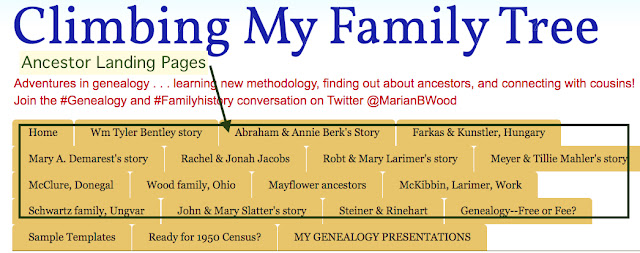
It's been nine years since I first created ancestor landing pages along the top of my genealogy blog, an idea I got from Caroline M. Pointer.
I use these landing pages to summarize what I've learned about each ancestor or ancestral family, including images plus links to specific blog posts I've written about that ancestor or family. As I discover more details and write new posts, I add the links to the corresponding ancestor landing pages.
Just as important, ancestor landing pages are incredible cousin bait! When relatives search online for one of their ancestors, they often see my ancestor landing pages in their search results. With a click, they land on the landing page, read about the ancestor(s), and can connect with me via my blog's "contact me" widget.
Thanks to landing pages, I've heard from dozens of farflung cousins who have landed on my landing pages. What a joy to get acquainted or reacquanted and exchange stories and photos!
By far the most popular ancestor landing page is the one devoted to my husband's McClure ancestors from Donegal. Even when most readers don't turn out to be related to this branch of the McClure family tree, they can get fresh ideas for researching their McClure ancestors by checking the resource links on this landing page or getting in touch with me.
Other genealogy bloggers have created different formats for their ancestor landing pages. For instance, Randy Seaver calls his "Randy's Genealogy," with links to his family trees plus more. Gail Dever calls hers "My Ancestors' Stories," linking to stories she has written about particular ancestors. Sandra Sue Pittman McPeak labels each landing page by surname.
Different formats, same goal: to tell the ancestors' stories AND to serve as cousin bait!
"Landed" is the week 7 genealogy prompt in Amy Johnson Crow's 2022 edition of #52 Ancestors.

Although some of the 2020 names are familiar from my family tree, I expect to find many more of the names popular in the 1940s and 1950s as I search for ancestors in the U.S. Census for 1950, being released on April 1.
According to the Social Security database, the top 10 given names for girls in the 1950s were:
Interestingly, top given names from the 1940s were not very different. I will definitely find most of these names as I search for ancestors in the 1950 US Census.
According to Social Security, the top 10 given names for girls in the 1940s were:
The top 10 given names for boys in the 1940s were:
After April 1, when the US Census is made public, we can not only search for ancestors, but look at who lived nearby. Whether we find each ancestor using the basic surname search or do homework to browse (as in this example) the proper Enumeration District, we can then click through each page in the ED to spot familiar names, addresses, ages, birthplace details, and much more.
Hello neighbor
This is a more deliberate effort to actively search out FAN club members. I usually look at the page before and after where my ancestor is in the ED, hoping to find other relatives or familiar names. But Paul's idea is to proactively search out FAN club names we already know as well as investigating the entire ED where an ancestor lives, looking for FAN club members we might not know or expect to find there.
Because my parents lived in a large apartment building in the Bronx, New York, I'll be browsing that ED to look at their neighbors. This 1950 US Census will also tell me more about my father's family, because his widowed mother, unmarried brother, and married sister lived in the same apartment building.
Seeing who else was in each apartment, and reading about their background will help me understand family dynamics at that time. There may even be people who were temporarily visiting on Census Day--if I'm lucky, possibly a cousin or an aunt or someone's mother-in-law. Plus I'll be browsing for names of people on the block or around the corner that I remember my parents mentioning in conversation.
Friend, neighbor, in-law?
I'm lucky to have my mother's 1953ish address book with names, street addresses, and phone numbers of family and neighbors. I don't recognize every name, but some might be distant relatives and some might be in-laws. I'll be watching for them in the Census to clarify potential family connections.
Similarly, the 1950 Census will enable me to learn more about the names in my late father-in-law's diaries. He mentioned people who I suspect were friends and neighbors in Cleveland Heights. I'll search for them, see where they lived, how close their residence was to the Wood residence, and whether there are any fresh clues to relationships (business or personal).
Paul will be searching for the surnames of kids he remembers from his early childhood. The outcome will be a map of his neighborhood, with relatives and FAN club members marked by location.
Will you be working on a 1950 US Census FAN club project?

Why a map when there will be a surname index?
A rudimentary surname index will be available when NARA releases the 1950 US Census digitally on April 1st. Family Search and Ancestry and others are working to index the records, as well.
However, these initial indexes are unlikely to be complete or accurate, despite all the technology and attention they will represent.
So I'll want to identify the Enumeration District in which each ancestor lived. That will enable me to browse the ED records to locate my ancestors if they don't pop up in surname search results.
Great Aunt Jennie, the dressmaker
Today I'm mapping great aunt Jennie Katz Farkas (1886-1974), the husband of my maternal great uncle Alex Farkas (1885-1948)--he was my maternal grandma's older brother.
With Alex's death cert in hand, I know exactly where in New York City they were living in 1948. But as a widow, would Jennie be living in the same place?
I searched the 1949 directory for Manhattan, hoping to find Jennie on her own. There she was at the same address as in 1948 (see image at top). I was surprised but not flabbergasted to see her listed as Farkas, Jennie Mme.
All of my Farkas cousins know the story that Jennie was a peerless professional dressmaker with an expert eye for detail. She could study a high-fashion photo in Vogue and then recreate the dress on her own. She was renowned within the family for making beautiful gowns for her sisters-in-law when they married (and for bridesmaids and matrons of honor, as well).
I was aware she had a thriving business in dressmaking, but I didn't realize she called herself "Mademoiselle Jennie Farkas" for professional reasons. Um, she was born in Hungary! Still, she appears as Mme Jennie Farkas in Manhattan city directories throughout the 1940s. What an interesting detail to add to her story.
Mapping Jennie's Enumeration District
To map Jennie's ED, I went to the Unified 1950 Census ED Finder developed by Steve Morse and Joel Weintraub. If you haven't already bookmarked their page, add it to your list of key sites as you prep for the 1950 Census release!

I used the easy drop-down menus to enter Jennie's 1949 address (a proxy for her 1950 address), as shown on the image directly above. This was a busy, crowded Manhattan area, and I was careful to choose 80th Street West. (FYI: An address on the East would be in a different ED. This east/west situation is a factor in many cities and towns, as is north/south, so pay close attention to these details in your own searches.)
With only the street address entered, there would too many EDs to browse--see the listing at bottom of the above image. I needed to further narrow the number of EDs by selecting cross streets and back streets. On the ED Finder page, "See Google Map" is the place to click to see the map.

I clicked to view the map and found her address indicated by the red marker. It was easy to spot the three cross/back streets (I circled them above).
One by one, I entered the cross/back streets into the ED Finder with the convenient drop-down menus to guide me.
As the image below indicates, checking the map and having the four street boundaries surrounding Jennie's address allowed me to narrow down the number of EDs to only one: 31-803. That's the ED I'll browse on April 1st if Jennie doesn't show up using the surname index for the 1950 US Census.


"Maps" is this week's genealogy prompt in Amy Johnson Crow's yearlong #52Ancestors challenge.
Lisa Gorrell kindly sent a link to the NARA map for Jennie's ED, which is one of many hundreds of EDs in Manhattan. Jennie's ED is way at top left of the image at left.
Thanks, Lisa!
For more about the 1950 US Census and prepping for its release, please see my summary page here.

I have discovered a number of people recently that were married and never had children, when writing a narrative how do you approach the subject with compassion, sensitivity and no way of knowing why?
Paul is known for going beyond names, dates, and places in his genealogy. He tries to flesh out his ancestors with more detail and background on their stories, which is why he raised this question.
In the end, he tweeted that he would follow the suggestion of Derek and use this wording in his family history:
No children were found during this research - Simple, factual, sensitive, to the point and leaves the door open if needed.
How can we know why?
As a result of Paul's conversation on Twitter, I thought back to the couples in my family tree who had no children that I know of. Also I thought about the unmarried aunts and uncles and cousins in my tree--unmarried, so far as I know.
If we never knew these ancestors personally and no relatives living today knew them personally, is it possible to answer "why" in an intelligent way?
Or would we be speculating, with the benefit of hindsight and through the lens of today's perspective in the absence of any documentation?
Is an explanation even needed?
Well, being a family historian, I guess I'm nosy. I always try to consider "why" an ancestor did something--left the old country, got married at an unexpected place or time, left a spouse, left a child, and so on.
Family dynamics are affected by decisions like these, and I wish I could know "why." That's what I believe Paul was getting at with his question about married couples who have no children that he could find through research.
Will anyone care in the future?
The family historian for my Mom's side has spoken with me privately about sensitive "family stories" not able to be confirmed by a paper trail. I'm not telling any of the stories here, but one is exactly what Paul would want to know about couples on his family tree ;)
I talked with my sister about how to approach these topics. Here's what she said:
Is it anybody else's business why some ancestor had no children or never married or got divorced? Would telling the reason (if passed down as a "family story") add anything important to the understanding of those ancestors today? Will anyone today or in the future actually care? And since none of this is provable, why bring it up?
She and I don't have the same answers to her questions. However, we definitely agree that writing the stories down and putting them in my genealogy files is a good way to ensure that they aren't entirely lost...and will be available to my heirs in the future.
I'll seal them in an envelope and mark them "sensitive family stories" and indicate the origin of each story, emphasizing that there is no way to know the truth today.
Perhaps my nosiness about family stories might be of interest to a future generation?! I won't be here to tell the story, but my notes will reveal what I was told, clearly marked as a "story" and not as fact.
