Tuesday, December 28, 2021

A Look Back at My Genealogy Projects in 2021


Staying close to home in 2021, as I did in 2020, it was a year chock-full of genealogy projects. 

Although I've been doing some research, I was particularly focused on documenting family history for descendants and to share more widely online. Genealogy is never complete...but anything I share is more than the family (and future researchers) had before. Why wait? I'm sharing now.

Also, I blogged, wrote, and gave talks about preserving family history, prepping for the 1950 US Census, perpetuating family history, and many other topics.

Highlights:

  • I published a new edition of my best-selling book, Planning a Future for Your Family's Past, receiving highly favorable reviews from the Atlanta Journal-Constitution, Family Tree Magazine (UK), as well as from genealogy societies and genealogy bloggers.
  • It was a real honor to be a featured guest during the WikiTree Challenge. The remarkable WikiTree super-sleuths smashed several brick walls (Burk, Farkas, and Kunstler) and provided concrete clues to help me continue the research!  
  • I made nearly two dozen live webinar presentations to US genealogy societies from coast to coast, plus one talk in person. In addition, I recorded talks for the New England Regional Genealogical Conference, THE Genealogy Show UK (summer and winter), and the Virtual Genealogy Association Conference. Wonderful audiences! 
  • It was fun being a #GenChat guest expert, sparking discussion about finding ancestors when the 1950 US Census is released in April. Also I participated in lots of #GenChat and #AncestryHour chats, occasionally chiming in on #ANZAncestryTime chats.
  • I wrote an article, "Finding Heirs for Your Family History," published in the December, 2021 issue of Internet Genealogy magazine.
  • I wrote an article, "Free and Almost Free Genealogy," published in the winter 2021 issue of Avotaynu, the International Review of Jewish Genealogy.
  • I found new homes (museums, libraries, historical societies) for artifacts such as theater programs collected by my late father-in-law from the 1920s to the 1980s. Family is so happy about donating these items. More to go!
  • Consulting with relatives, I wrote and posted (on Find a Grave, Family Search, MyHeritage, WikiTree, and elsewhere) dozens of bite-sized ancestor bios from my tree and hubby's tree. Good progress, with more in the works.
  • My late father-in-law left hundreds of photos and negatives, which I'm slowly scanning, captioning, and sharing with relatives. To be continued in 2022, along with scanning my childhood photos. Scanning is easy, captioning is key.
  • I helped my hubby record several family-history videos and prepare a number of written reminiscences, complete with photos. Lesson learned: For our family audience, videos are watched once, but printed materials live on.
  • I expanded my virtual cemeteries on Find a Grave to share with relatives and keep burial places from being forgotten in the future. More to go!
  • I expanded my knowledge base by watching talks all year, not just those fantastic RootsTech talks but also programs hosted by national, regional, and local genealogical societies. In my bunny slippers and headset! (PS: I'm excited to be a RootsTech Influencer--aka Ambassador--for 2022.)
My next post will be a look ahead to 2022, when I will celebrate 14 years of genealogy blogging.

Saturday, December 25, 2021

Penny Postcard Christmas Greetings


More than 100 years in the past, this colorful penny postal greeting was sent by a loving aunt and uncle in the Wood family to a young nephew living in Cleveland, Ohio. 

This and other postcards are still in family hands today, much treasured and well preserved.

Dear readers, may you have a joyful Christmas!

Wednesday, December 22, 2021

1950 US Census: Look Out Below!


When you find your ancestors in the 1950 US Census (to be released on April 1, 2022), read across the line for every response given by your ancestor. Note every question and answer carefully.

And, of course, download the page so you can review at any time, check again for nearby FAN club members, and cite your source.

But wait, there may be more.

Was your ancestor among those sampled?

Whenever you find an ancestor in this Census, always--always!--look at the bottom of the page. 

If you're lucky, your ancestors might have been among the millions selected to answer additional "sample questions" about their 1949 residence, 1949 income, birthplace of parents, military service (males only), and much more. Six folks were designated on every page to answer sample questions.

The excerpt above shows just some of the questions that run along the lower edge of the population schedule.

Click here to see the main questions in the 1950 US Census as well as the detailed sample questions.

Six sampled per page

Unlike previous Census forms, where the number of the line sampled was the same on every page, the 1950 Census planners took care to avoid that situation. As a result, you can't predict which six will be sampled on the page where your ancestor is enumerated. 

Given the dozens of ancestors I'll be looking for in this mid-century census, there is a good possibility that a few (or more than a few) will be among those chosen to answer the sample questions.  

So look out below whenever you locate an ancestor in this census. If your ancestor wasn't sampled, perhaps a neighbor or friend was sampled--which may give you some clues as well.

For all my posts about the 1950 US Census, please see my summary page.

Sunday, December 19, 2021

Three Brick Walls Smashed by Remarkable WikiTreers


This past Wednesday, the remarkable WikiTree volunteers who worked tirelessly on improving my family tree were able to break three challenging brick walls. 

Overall, they improved many branches of my tree, adding people, lots of background, detailed sources, and dozens of clues for me to investigate! 

If you want to see the reveal as it unfolded during the WikiTree broadcast, take a look here

And here's a link to learn more about WikiTree's collaborative family tree. WikiTree is free, the emphasis is on connections, and it's a very friendly place!

Breakthrough on my Burk line

The WikiTree broadcast led with the news of an important breakthrough on my Burk line. 

When I first ventured into genealogy, my goal was to discover the where, when, and how my paternal grandfather Isaac Burk (1882-1943) died. In the process, I learned about my paternal great-grandfather, Solomon Elias Burk--but that was as far back as I could go.

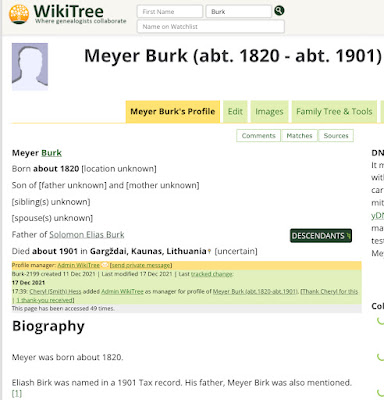
Until now. The WikiTree team was able to discover the name of my great-great-grandfather, Meyer Burk, in Gargzdai, Lithuania, the place where my grandpa Isaac and his siblings were born (see WikiTree image at top). An exciting breakthrough! Because the name Meyer has been carried down in the Burk line through multiple generations, he is a most welcome addition--among the earliest of my ancestors on the family tree.

Breakthrough on my Farkas line

Yet another brick wall was busted when the WikiTree team uncovered a brother for my great-grandfather, Moritz Farkas (1857-1936). 

Digging really deep, the WikiTreers found evidence of Simon Farkas (b. about 1852), who is almost certainly Moritz's older brother. The names fit, the dates and places fit--Botpalad, Hungary was where a number of Farkas ancestors were born. 

This is an intriguing breakthrough because Simon's father was Ferencz, as was Moritz's father, according to the official birth records. Now I hope to learn more by tracing Simon's line, starting with the research notes provided by WikiTreers.

Breakthrough on my Kunstler line

One more breakthrough was the discovery of a possible brother for Samuel (Shmuel) Zanvil Kunstler, my great-great-grandfather. A little background (corrected): More than 20 years ago, a cousin visited this ancestor's grave and saw that the stone lists Josef Moshe as the father of Samuel.

This week, the WikiTreers found records pointing to innkeeper Herman (Hersko) Kunstler, in NagyBereg, as a possible brother to Samuel. The Kunstlers did, in fact, operate an inn, which confirms some kind of connection! 

Updated: Herman's father is Josef M., according to the records uncovered by the WikiTreers. Samuel's father, according to his gravestone, was Josef Moshe, whose father was Hillel. I'm going to take a closer look, but this is extremely promising.

Clearly, more research is in my future, a happy prospect for 2022. 

It was truly an honor to be a featured guest during the WikiTree Challenge.

I want to thank the many WikiTreers who worked so hard and dug so deep to improve my family tree.


This is my week #50 post for Amy Johnson Crow's #52Ancestors challenge. 

I've already signed up for the 2022 edition of #52 Ancestors! Follow this link if you want to sign up, too.

Friday, December 17, 2021

Latest News: 1950 US Census Release


This week, the US National Archives announced that when it releases the 1950 US Census records on April 1, 2022, a basic surname search function will be available!

The key is the use of artificial intelligence and OCR (optical character recognition) technologies to decipher handwritten names on the population schedules. You can read the details here

Also, on a recent Extreme Genes podcast, Scott Fisher asked Jim Ericson of FamilySearch.org about the timeline for indexing the 1950 US Census. The response: Family Search hopes to have the 1950 Census indexed by the fall of 2022, thanks to new technology and more volunteers. Plus the effort will capture even more of the details beyond name! You can read the transcript of the podcast here.

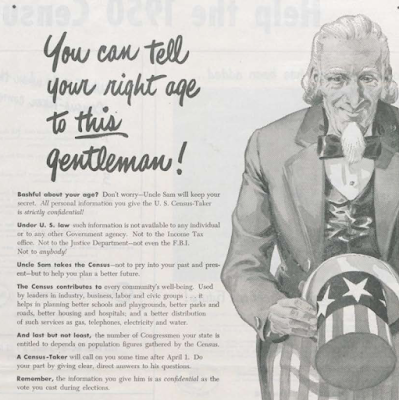
For a bit of mid-century Census advertising, take a look at good ole Uncle Sam, above. He was the star of one of the print ads created to promote participation in the count. See this NARA page for a full selection of ads leading up to April 1, 1950.

Are you getting ready for this exciting Census release? Please check my page of tips and analysis here. I also give a webinar about the unique genealogical info in this Census, and how to find ancestors before indexing is complete. Here's a link to my presentation schedule. Happy ancestor hunting!

Monday, December 13, 2021

For the Holidays, a Bite-Sized Family History Project


With Christmas fast approaching, I asked my wonderful hubby to please write a few lines about his childhood memories of Christmas Eve and Christmas Day. He thought for a few minutes about what stood out, both the good and the not-so-good, and he wrote half a page. As we talked, more details started flooding back. Pretty soon he had a full page of memories, ranging from putting up the tree to singing carols as his father played the piano.

Illustrating written memories

Next, my hubby browsed old 35mm slides from his childhood and chose seven to go along with his written memories. He found slides of his siblings next to the tree, one of himself in pjs and robe on Christmas Day, one of his father (Edgar James Wood) testing a Christmas toy, one of his mother (Marian McClure Wood) in holiday finery, and one of his grandfather (Brice Larimer McClure) chatting with a grandchild on Christmas. 

As a holiday surprise, we're sending family members these images along with the page of memories. Even in a busy season, we found a couple of hours to assemble the project--and I'm sure recipients will find a few minutes to read the story and smile at the photos from decades in the past.

Of course we've been sharing these and other memories around the dinner table during this year's holiday celebrations. And making new memories for the future.

Bonus: "spot the heirloom"

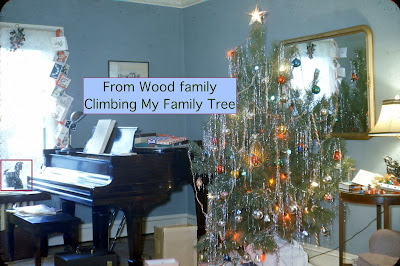
Among the images scanned from old slides, my eye was drawn to the one at top. It shows the living room in hubby's childhood home in Cleveland, Ohio, festively decorated for Christmas exactly as he saw in his mind's eye. 

Next to the piano keyboard, on the left edge of the image, the camera captured a special heirloom that has been passed down in the family: his mother's handmade ceramic sculpture of a zebra. I marked it with a red box in the image above. 

My heart was touched by seeing my late mom-in-law's favorite little zebra on display in her living room. Some distant day, this little zebra and her other ceramics will be inherited by descendants, along with the stories and photos.

- This is my Genealogy Blog Party post for December 2021.

Saturday, December 11, 2021

Preserving Our Family's Legacy of Needlework

Last year, I wrote about my husband's grandma Floyda Mabel Steiner McClure's needlework legacy. A love of sewing and crocheting has continued in that family to the present day. I've wrapped each item in archival tissue to keep it safe for the future when it will be inherited by the next generation.

In my family, we have a number of hand-made needlework items we treasure for their beauty and for the long tradition they represent. 

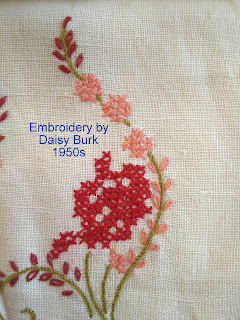
At left, a detail from an embroidered set of linens by my mother, Daisy Schwartz Burk (1919-1981). The set is in great condition, washed and ironed and stored in an archival box for preservation. I put a label on the box to indicate who made the needlework and who inherits it.

Mom learned to embroider and to crochet from her mother, Hermina Farkas Schwartz (1886-1964), who also used her treadle machine to sew clothes. I imagine Hermina learned needlework from her mother, Lena Kunstler Farkas, and so on.

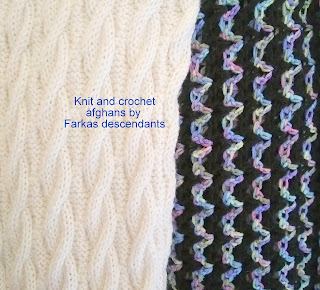
Love of needlework has been passed down from generation to generation in my Farkas family. Here are two afghans, one knit by a special cousin and one crocheted by a special niece. Each time I cuddle up in one of these, I think of the person who painstakingly made it, one stitch at a time. 

My hope is that by documenting these homemade heirlooms, and keeping them safe, future generations will be know they come from a very long line of talented needlework enthusiasts. 

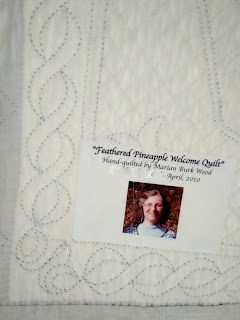
None of my ancestors were quilters, but I got interested and over the years, I've made a number of wall quilts, bed quilts, and baby quilts. Each one has a label attached to the back, showing my name as the quilter, the date, and a photo...sometimes the photo is me, sometimes of the recipient if the quilt was a gift.

Now another of my nieces has taken up quilting and enjoys stitching quilts for her young ones and for friends. I'm so happy the tradition of homemade needlework is continuing in our family!

This is my week 49 post in Amy Johnson Crow's #52Ancestors series of genealogy prompts.

Thursday, December 9, 2021

My 1921 English Census Research

The 1921 Census for England and Wales will be released on January 6,  through FindMyPast.com, with a fee charged for accessing records. 

However, there will be several designated places (such as the Manchester Central Library) where the public can view and save 1921 Census records for free

My Manchester cousins are planning to look for our mutual immigrant ancestors in the 1921 Census. They have also offered to help me by looking for several ancestors in my husband's family, including descendants of his great-grandfather. I'm making a list and checking it twice! 

John Slatter Sr. and his children

My husband's great-grandfather John Slatter Sr. (1837-1901) was born in Oxfordshire, England and died in Cleveland, Ohio at the home of his youngest daughter, my hubby's grandma. John and his wife, Mary Shehen Slatter (1837-1889) had six children together: Thomas, Albert, John, Henry, Adelaide, and Mary. 

Five of the six children left England. Two settled in Ohio, three settled in Canada.  But one of the children doesn't seem to have left England, so far as I can determine.

John's probate as a clue

At top is a probate listing for John Slatter Sr, filed in Ohio in 1902, months after his death. Notice that five children are listed as heirs. Those are the five children I can account for. 

Thomas, however, is not listed. Very likely this is because Thomas had passed away before his father, but I don't know for sure. 

I do know Thomas John Slatter was taken in by his father's mother, Sarah Harris Slatter Shuttleworth, by the time of the 1871 UK Census. This saved Thomas John from going into the poorhouse along with his siblings and his mother.

Unfortunately, his grandma Sarah died in 1872 and at this point, I haven't definitively located Thomas John Slatter. I do have some leads to check out, including a possible stint in the military, but more research is needed to connect the dots.

Slatter ancestors on my 1921 list

In addition to searching the 1921 Census for a possible clue to Thomas John Slatter, I'll be looking for his cousins in the Slatter family: Thomas Albert Slatter (who I found in the 1939 register), Fanny Slatter Gardner (who died in 1931), and John Shuttleworth Slatter (a WWI veteran who died in 1927), among others.

So early 2022 is shaping up to be a period of intense Census searches for my hubby's family and, in April, for my family!