Tuesday, June 15, 2021

Quirks of Old City Directories


My husband's great-grandparents, Thomas Haskell Wood (1809-1890) and Mary Amanda Demarest Wood (1831-1897) settled in Toledo, Ohio early in the 1860s. I have had fun tracking these ancestors through city directories, great sources of family-history clues between Census years.

Along the way, I've noticed a few quirks of these early directories. (For more about the history of city directories, see this excellent post from the NY Public Library.)

Previously, I wrote about not relying on the cover date of a city directory. Today I'm looking at two more quirks: how alphabetical order was a bit elastic, and how different publishers included different details.

Not strictly alphabetical

Directories were being revised up until the moment of printing. As a result, names didn't always appear in strict alphabetical order. In the 1868 directory for Toledo, Ohio, the publisher acknowledged wanting to include as many entries as possible, even if the final arrangement was less than perfect.

As you can see in the excerpt at top, the entry for "Wood, Thos. H., carpenter" appears after the entry for "Wood, William, carpenter." 

Also, Mrs. K.L. Wood appears after "Woodard, Samuel E" and before "Woodbury, Geo." 

In other words, it pays to look at entries before and after where the ancestor would be expected to appear.

Also look at the very last-minute name/address additions in any directory, which are on a separate page, usually near the front of the alpha listings.

Clues beyond name, occupation, residence

In the 1868 Toledo directory, I was surprised and pleased to see the notation "fmly 10" at the end of the entry for Thomas H. Wood. The abbreviations page confirms that this refers to "family." A real find, the first time I've ever seen a notation like this. 

Of course, I wouldn't necessarily assume the directory's family count was accurate. Still...it could be a clue.

I compared my husband's family tree to the directory's notation of 10 people in the Thomas H. Wood family that year. Counting the 2 parents and 8 living children, my tally agreed with the directory. If my tally had not agreed, I would follow up by looking for a child I might have missed or some other change in the household. 

Fast-forward to the Toledo directory for 1890. It listed the exact death date of Thomas H. Wood, confirming what was already on the family tree. The directory got it right!

One more quirk: The 1864 Toledo directory has a listing for "Wood _______, carp, h East Toledo." A blank wasn't really that unusual. Every page in that directory had an entry missing a given name. Looking at multiple years in the same decade helped me feel confident that, based on the occupation and home location, this entry is indeed that of my hubby's ancestor.

Monday, June 14, 2021

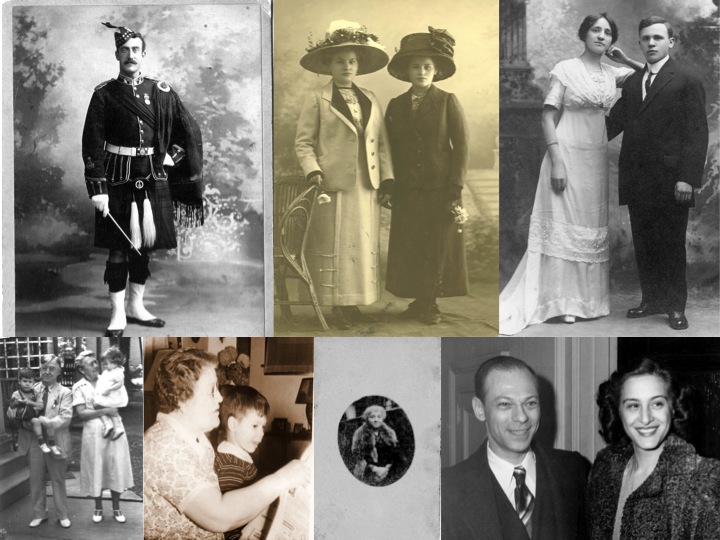
Honoring Grandpa Isaac, My Genealogy Inspiration

For Father's Day 2021, it is my pleasure to pay tribute to immigrant Grandpa Isaac Burk (1882-1943), who lived and died before my time.

How I wish I could tell him that he's the reason I became addicted to genealogy in the first place.

Isaac Burk, my inspiration

In 1998, the genealogist of my mother's side of the family asked me about my father and his parents, Isaac and Henrietta. She taught me, by example, how important it is to include in-laws on the family tree.

Sadly, I knew almost nothing about Isaac, nor had I even seen a photo of him. I knew precious little about his wife, Grandma Henrietta Mahler Burk (1881-1954), although I did recognize her in a couple of old family photos. 

Isaac's story proved elusive. It took five years of spare-time research to discover where, when, and why he died. The seemingly endless search became my inspiration for filling out branches on my family tree and that of my husband.

Hint, hint

After years of library research and by-mail requests for fruitless searches of New York City and state death records, I actually picked up the phone to call a Big Apple office. I knew where Isaac was buried by then, but not where he died and what caused his death. I threw myself on the mercy of the kindly clerk who answered the phone.

The clerk, in low tones, offered a completely unofficial, totally off-the-record hint to look beyond New York. The hush-hush suggestion was to, um, maybe consider, possibly, say, a place sorta like Washington, D. C. What?!

As a result of this hint, I was able to obtain Isaac's death cert. It turned out Isaac had died in Washington and his body was transported to New York for the funeral, generating paperwork that the clerk could view (but I couldn't see). Another lesson learned: sometimes it's a good idea to call and politely ask for help.

The hunt for Grandpa Isaac's history opened the door to decades of genealogy fun, finding many more ancestors and connecting with wonderful cousins along the way.

Thank you, Grandpa Isaac, for inspiring me. You are remembered with affection on Father's Day, 2021. My Sis and I have also paid to add you and Grandma Henrietta to the Ellis Island Immigrant Wall of Honor, as shown above, to keep your names alive for many generations to come.

--

Father's Day is the week 24 prompt for Amy Johnson Crow's #52Ancestors challenge.

Thursday, June 10, 2021

Family Search Remote Access Services Solves a Mystery


More than a few of my ancestors didn't know their actual birth dates. Sound familiar?

This week, I was able to solve the mystery of an uncle's birth date in New York City, thanks to the new Family Search Remote Services team.

When no image available or document is not viewable from home, this new team accesses the image or document (if available) via the Family History Library and sends it to the requester, for free.  

For more about this service, see the announcement here.

Pandemic PLAs 

During the pandemic, I would have posted an image request on the New York City Genealogy Facebook page.

Wonderful volunteers known as "parking lot angels" (PLAs) would go outside a Family History Center, tap its Wi-Fi, and look up images for folks like me. 

For the next 90 days, however, no images are available--except by request to the Family Search Remote Access Services team.

One uncle, two birth dates

I knew my uncle, Charles Lang (1906-1968), was born in New York City. On his World War II draft registration card, he said his birth date was September 10, 1906. On a document from his teenage years, the birth date was March 15, 1906.

What I needed was his actual birth certificate. The transcribed birth document is on Family Search, showing his parents and a birth date of March 2, 1906. But to be absolutely sure there were no transcription errors, I wanted to view the actual certificate with my own eyes. 

So late last week, I submitted a request to the Family Search Remote Access Services team, providing all the details requested on the form. 

Four days later, the terrific Remote Access Services team sent along the image of my uncle's birth certificate. And now the mystery is solved: his correct birth date is March 2, 1906, shown clearly. Because this document was filed only days after my uncle was born, I am very confident in its accuracy.

Thank you to the Remote Access Services team!

Tuesday, June 8, 2021

Looking Back at the 1950 Census in the News

Prepping for the public release of the 1950 U.S. Census in April, 2022, I'm searching newspapers that cover the areas where my ancestors lived during the spring of 1950. 

Not only am I researching my ancestors, I'm putting the Census into context and learning more about how people thought about the Census back then.

Names and Faces in the News

First, I do a name search (creative spelling of surname, nicknames, maiden names, and so on). Maybe one of my ancestors or a FAN club person was mentioned as a Census taker? 

Here's another angle to consider: Was an ancestor quoted in a story about the Census, perhaps talking about being enumerated or expressing an opinion about the process? 

On March 26, 1950, The Brooklyn Eagle (New York City) interviewed eight local residents who were outraged at the personal questions about income. The article included photos, names, and addresses of those interviewed! 

Other news items (including a January, 1950 story from the Los Angeles Times) also quoted people who were unhappy about the income question. None were my ancestors, but you might be luckier.

Fido in the News (in the Census?)

According to multiple newspaper articles (Brooklyn Eagle, L.A. Times, and others), enumerators were requested by some households to list dogs as family members. 

In fact, household heads could be rather insistent on the matter! "Rather than argue, the census taker wrote down the dog's name, age and residence," one news item reported.

I don't know whether those names were left as is or deleted during later steps of review and coding. But be aware, as you browse the 1950 U.S. Census after its public release next April, you may just see Fido, Spot, Mittens, or other dogs listed as a member of a household.

Sunday, June 6, 2021

Instructions for 1950 US Census Enumerators: Who to Count


In my series on preparing for the release of the 1950 U.S. Census on April 1, 2022, I've been examining the instructions to enumerators who knocked on every door and interviewed the head of every household.

By understanding the nuances of these instructions, I'll be better able to interpret what I see when the scans of the population schedules are made public next year.

Don't count certain people

As shown at top, the enumerators were trained to enumerate only certain people and omit enumeration of other people. This excerpt is from the informative publication The 1950 Census: Procedural Studies, available to view and download from the U.S. Census Bureau site here.

Enumerators were not to count members of the military who were temporarily away from home serving in the Coast Guard or a U.S. Navy vessel, for instance. The reason: These vessels were provided with Census forms to be completed separately.

Similarly, armed-forces personnel who lived in a military facility in the enumerator's assigned district were not to be counted. Again, other plans were in place to enumerate people living on military bases, in a separate count from the residential and institutional buildings in those enumeration districts.

In April of 1950, I had one ancestor in the military. These instructions are a reminder that I won't find him at home, but should look for him on the military base where he was stationed at that time.

How many apartments to count


Another interesting quirk of the 1950 Census was the way the Census Bureau prepared to enumerate residents of apartment buildings in large cities.

The various district offices in major cities (with 100,000+ population) prepared a preliminary list of large apartment complexes. Then these offices wrote to the owner or manager of each building to find out how many apartments were there, how the apartments were numbered, and so forth. As a result, enumerators who were assigned to count residents of those buildings would have advance information about how many apartments they could expect to visit. 

Because the majority of my New York City ancestors lived in big apartment buildings, these instructions would have affected how they were enumerated. I will be very interested to see whether the population schedules indicate the apartment numbers for my parents and for his mother, who had apartments on the same floor in the same big building in the Bronx, New York.

-

For more posts about prepping for the release of the 1950 Census, please see my special page here.

Friday, June 4, 2021

Instructions for 1950 US Census Enumerators: The Fine Print


In previous posts, I've highlighted elements of the Enumerator's Reference Manual that was the training guide for how the 1950 U.S. Census was conducted. You can read or download the main manual here.

Supplemental Manual

Today, I'm looking at the supplement to the main manual. You can read and download it here.

This supplemental manual includes detailed instructions for how enumerators should list people in five specific areas, as shown in the excerpt here. 

If you suspect you have ancestors who might be enumerated in one of these five types of areas, it's worth checking the instructions in this brief, 16-page supplement.

Reading the Fine Print

The fine print explains who should be enumerated as living at one of these areas, versus who should be enumerated at their regular residence. For instance, staff members who have living quarters at a hospital, mental institution, or prison would be enumerated there. Staff members who don't regularly live on-site would be enumerated at their usual residence, according to the fine print.

Knowing that enumeration of large institutions might require many hours, enumerators were instructed to determine which inmates might be leaving on April 1, and count them before they depart. Also, when new inmates entered an institution on April 1, enumerators had to determine whether they were enumerated at a different residence--and if not, count them as living at the institution. My guess is that there will be some overlap or omissions or both.

Patient, orphan, prisoner?

The supplemental manual tells enumerators what to label each person who lives in an institution, as shown here. The idea is to show the relationship of each person to the institution.

"Inmate" is only to be used if the other descriptions aren't descriptive enough.

Glance at the supplement if you think an ancestor might be enumerated in one of the five special areas, because the instructions will help you interpret what you see in the 1950 Census.

PS: For more about preparing for the 1950 US Census release in 2022, please see my special page here.


Tuesday, June 1, 2021

Alas, Google Won't Send My Posts Beginning in July

Dear regular readers,

Alas! If you've been subscribing to my blog and regularly receive my latest post by email, I'm sorry to say that Google is dumping this function at the end of June. 

Here is the notice I received about Google's FeedBurner, the subscription widget that sends my blog posts to your email after you've signed up. It's been a great way to stay in touch for all these years! 

I'm still investigating alternatives to try to have blog posts delivered to your email automatically, but in the meantime...

If you follow a number of blogs, you may already be using a blog reader like Feedly.com, which I use. It's free when reading up to 100 blogs, and there's an app as well as a web-based version. 

Please be sure to add my blog (https://ClimbingMyFamilyTree.blogspot.com) to the list of blogs you follow.

I'll update this situation toward the end of June...meanwhile, thank you so much for reading my blog! UPDATE on June 10: I now use follow.it but not sure this is my "final answer" because emails are delivered with ads along the bottom, which I don't like. Still a work in progress! UPDATE on July 18: After more than two months of using follow.it, I've gained new followers and been pleased by the consistent way the service delivers my latest blog posts via email to my subscribers--every time. 

Monday, May 31, 2021

Memorial Day 2021: Hubby's Ancestors Who Served


Sadly, a few members of my husband's family tree died during their wartime military service. I've been memorialized them on my trees and on other genealogy sites. Now, for Memorial Day, let me pay honor to those who died by listing them individually:

  • Isaac Larimer Work (hubby's 1c4r) - died in U.S. Civil War, served in 74th Indiana Volunteer Infantry 
  • John Wright Work (hubby's 1c3r) - died in U.S. Civil War, served in74th Indiana Volunteer Infantry 
  • Arthur Henry Slatter (hubby's 1c2r) - died in WWI, served in Middlesex Regiment and Labour Corps 
  • Arthur Albert Slatter (hubby's 1c1r) - died in WWI, served in Royal Fusiliers, 20th Battalion 

I also want to remember the service of hubby's ancestors who were in the military and then returned to civilian life, with respect and appreciation:

War of 1812, American side

  • Daniel Denning (hubby's 3d great-uncle) - Mounted Infantry, Ohio Militia
  • Isaac M. Larimer (hubby's 4th g-grandfather) - Capt. George Saunderson's Company
  • John Larimer (hubby's 3d great-grandfather) - 90 days service, No. Ohio
  • Robert Larimer (hubby's 4th great-uncle) - Hull's Division
  • Elihu Wood Jr. (hubby's 3d great-uncle) - Sgt. F. Pope's Guard, Mass. Volunteer Militia
Union side, U.S. Civil War

Confederate side, U.S. Civil War
World War I
World War II

It is a privilege to honor these ancestors on Memorial Day weekend, 2021.

--

This week's #52Ancestors prompt is "military."