Sunday, November 28, 2021

Remembering WWI Vet Frank M. Jacobs


My 1c2r, Frank M. Jacobs (1896-1974) enlisted in the US Marines on April 18, 1917, when he was 20 years old. While he was fighting in World War I, he left behind his mother (Eva Michalovsky Jacobs), his father (Joseph Jacobs), and his siblings in Brooklyn, New York. 

Fighting in France

After a brief period of training, Frank was sent to France on June 27, 1917, where he fought in the Toulon Sector, Aisne Defensive, Chateau-Thierry Sector, and Soissons (the Aisne-Marne Offensive). All this detail is on his New York "Abstracts of World War I Military Service" record, shown below. By June of 1918, he had been promoted to Corporal.


Sadly, Frank lost a leg on July 19, 1918 during fierce fighting at the Battle at Soissons. He received medical attention in France and was returned to the States for further treatment. Meanwhile, more tragedy in the family: His father Joseph, a chronic invalid, died in November of 1918, before Frank was formally discharged.

So far as I can determine, Frank never married or had children. He pursued a long career in advertising. On his WWII draft registration card, Frank showed his employer as the big Madison Avenue firm Young & Rubicam.

In Frank's own words

Frank wrote home quite regularly throughout his service in WWI. His family shared some of those letters with local newspapers, a common practice at the time. Thanks to the wonderful (and completely free!) newspaper site Fulton Search, I read a number of letter excerpts and interviews with Frank, supplementing the official records with my ancestor's own words.

Only a week before being wounded, he wrote to his family that "I am glad to be one of the lucky ones to come through without a scratch. Our regiment has been cited five times for conspicuous bravery." On July 19, the newspaper reported that letter along with the news of Frank's injury.

In an interview with the Daily Standard Union newspaper in Brooklyn, New York, Frank described what happened in the Battle of Soissons. He told the reporter that "a high explosive shell broke right beside me. A pebble hit me in the head and I put my hand there. It was then that I noticed that my leg was gone. I didn't lose consciousness then or afterward."

I'm currently writing Frank's bite-sized bio and posting on genealogy websites to keep his memory alive and share his war experiences in his own words.

Plus I'm pleased to post this on the Genealogy Blog Party for November of 2021!

Thursday, November 25, 2021

Penny Postcard Thanksgiving Greetings


More than a century ago, this colorful penny postal greeting was sent to my husband's uncle in Cleveland, Ohio. 

Wishing you and your loved ones a very happy and very healthy Thanksgiving! 

Tuesday, November 23, 2021

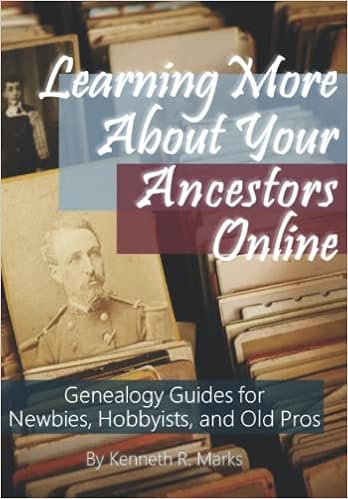
Book Review: Learning More About Your Ancestors Online

I've been a big fan of Kenneth R. Marks's website The Ancestor Hunt since I came upon it a few years ago. 

In one easy-to-navigate site, he's assembled 160,000+ links to free genealogy resources in North America, arranged geographically and by type of resource.

Kenneth also offers a series of free, downloadable Quick Reference Guides with useful tips for family-history researchers at all skill levels.

Now I'm a big fan of his new, very affordable reference book, Learning More About Your Ancestors Online: Genealogy Guides for Newbies, Hobbyists, and Old Pros, available in paperback and digitally on Amazon.

A baker's dozen of chapters

In 13 chapters, Kenneth organizes his advice and links according to topic: 

  • Chapter 1: Introduction
  • Chapter 2: Birth and marriage 
  • Chapter 3: Death records and information 
  • Chapter 4: General advice about genealogy research
  • Chapter 5: Immigration, naturalization, travel
  • Chapter 6: Military 
  • Chapter 7: Miscellaneous records (such as secret societies, old-time illnesses)
  • Chapter 8: Newspaper research
  • Chapter 9: Occupations
  • Chapter 10: Photos and physical description
  • Chapter 11: Residences and other locations
  • Chapter 12: Schools and yearbooks
  • Chapter 13: Resources

Every chapter has a ton of useful ideas and time-tested suggestions. The final chapter, not to be missed, is a roundup of links to other websites with additional information about search techniques and genealogical records.

I highly recommend Kenneth's book, which I purchased in paperback as soon as it was published. It's a handy reference book for everyone interested in genealogy research, from beginners to experienced professionals. Happy to have it on my genealogy bookshelf!

Saturday, November 20, 2021

The Penny Postcard Craze and Family History

Early in the 20th century, my husband's Wood family stayed in touch frequently via colorful penny postal greetings. 

Any holiday or celebration was a great reason to write to a young relative.

Not just on birthdays but also for Abraham Lincoln's birthday and July 4th and everything in between!

Penny postcard craze

The Wood family was completely caught up in the postcard craze of that era. 

It really took off when the price of mailing a postcard was lowered from two cents to one cent. 

At the time, the highest quality postcards were printed in Germany and shipped across the Atlantic. Most of the postcards sent by Wood ancestors in Ohio and beyond were, in fact, made in Germany. 

Postcards as family history clues 

Wallis Wood (1905-1957), my hubby's uncle living in Cleveland, received dozens of birthday postcards during his preteen years. Happily, the family held onto these postcards over the years.

Thanks to the addresses and postmarks, I was able to track this Cleveland branch of the Wood family as they moved to different houses nearly every year from 1905 to 1917. 

Why? Because Wallis Wood's papa (James Edgar Wood, 1871-1939) was a home builder. 

James constructed a new house roughly every year, moved his family in as he finished the interior, and sold that home. Then he moved the family to another home being completed by his crew. 

James, his wife (Mary Slatter Wood, 1869-1925), and their four sons had lots of different addresses over the years. In between Census years and in between directory listings, the postcards showed me where they were living.

These are just three of the fun birthday postcards sent to Wallis before 1915.

This is my post for week #46 of Amy Johnson Crow's #52 Ancestors challenge.

Thursday, November 18, 2021

1950 US Census: Putting Reported Income In Context


When the 1950 US Census is released in April, it will have detailed information on a surprisingly large sample of the population.

One in five sampled

If I'm lucky, my ancestors will be among the 20% of people sampled, which meant they answered additional questions about 1949 full-year income and more.

My deep dive into the reported statistics about each state will give me good context for interpreting my ancestors' answers. (You can see each state's reported statistics in the publications at HathiTrust. There are so many fascinating tables of statistics, income and much more, on a state-by-state basis.) 

Apples-to-apples comparison 

As shown in the excerpt above, the median income for urban areas of New York state was $3,123*, higher than the median for the state overall. I would expect my Big Apple ancestors and other city-dwellers to report higher incomes than any who lived in rural areas. Common sense, but seeing the statistics in the official reports gives me a sense of how much people might have earned at that time, so I can compare with my father's income. 

In later life, when my mother occasionally talked about those post-war years, she said my father's travel agency was doing well. I won't know how well unless they were among the 20% of the population who answered those sample questions in the 1950 Census. 

Yes, I already have their Enumeration District listed so I can browse for them as soon as the Census is released in April.

*The 2021 equivalent of $3,123 in income would be more than $33,000. 

Tuesday, November 16, 2021

1950 US Census: "Separated" Added as Marital Status


To be ready when the 1950 Census is released on April 1, 2022 (woo hoo!), I'm reading background information and thinking about what ancestors' responses could reveal about family history. 

If you have ancestors enumerated in the 1950 Census, do check out the summary report(s) for the state(s) where they lived in 1950. The reports are digitized and available at HathiTrust. The excerpt above is from the introduction to the results summary for New York State, where so many of my ancestors lived at the time. 

Separated, divorced, widowed?

"Separated" was a new category for marital status in the 1950 US Census. That's a plus for genealogical researchers, if our ancestors answered truthfully. 

In earlier years, a few of my ancestors said they were "widowed" rather than admit to being separated or divorced. Maybe in 1950, they answered "separated" because it was a little less of a stigma than "divorced" was at the time? 

As shown in the excerpt at top, the Census Bureau noted that this new "separated" category may have lowered the number of people recorded as "divorced." 

But read further, and see how the Census Bureau dealt with situations in which no marital status was recorded by the enumerator.

"Estimated" marital status

The Census Bureau "estimated" marital status in situations where the enumerator, for whatever reason, didn't record an individual's marital status.

The "estimate" was made on the basis of age and presence of spouse or children in the household.

So some individuals who were recorded as "single" under 1940 US Census rules might be recorded in 1950 as "married, spouse absent" or "widowed." Interesting clues.

Who's telling the truth?

What about my great aunt Nellie Block, who previously told enumerators she was single? In the US and NY Census documents I've checked, Nellie lived alone or was a boarder in someone else's apartment. She never had any spouse or children in the household with her, so far as I could see. She consistently said she was single. 

Yet when Nellie died late in 1950, she was supposedly widowed, according to her brother, the informant for her death cert. Who was telling the truth, Nellie or her brother? Looking forward to seeing how her marital status was recorded in the 1950 Census.

Monday, November 15, 2021

1950 US Census: "Errors in Age Statistics"


Before the 1950 US Census is released on April 1, 2022, I'm doing background reading to understand what the population schedule will tell me about my ancestors.

I recommend looking at the state-by-state results published by the US Census Bureau in 1954 and available for free at HathiTrust. Browse the list until you see the state(s) where your ancestors lived. Many of my ancestors lived in New York, so I've been clicking my way through that statewide report of 1950 Census results.

No matter which state report you read, you'll see the same introductory information that will add context to the 1950 Census results. 

Look at reported age, for instance, which we know isn't always accurate on Census forms. Women, in particular, might fudge age downward. In fact, both my grandmas were sensitive about being a year older than their husbands, and lied to enumerators in more than one Census. But there were other reasons for age errors, as well.

The Census Bureau knew about age errors 

As shown in the introduction excerpt above, the Census Bureau was well aware of "errors in age statistics." Young children tended to be undercounted, a situation that was partially fixed by the use of Infant Cards written out by enumerators for kids born in Jan-Feb-March of 1950. Sadly, these info-rich cards were not retained and we won't have access to that valuable data.

In addition, errors were noted among older age groups. The Census Bureau said there were fewer than expected people enumerated in the 55-64 age group, but more than expected enumerated in the 65+ age group. 

Suddenly so many seniors?

Coincidence? Maybe, but my guess is this had to do with post-war retirements and people wanting to collect Social Security at age 65. With an eye toward eligibility, I suspect lots of folks were suddenly willing to admit to a government agency that they were 65 or older. 

This was an actual problem for my hubby's maternal grandpa, Brice Larimer McClure (1878-1970) He told employers he was younger than he really was so he could work all during World War II. 

Once the war was over, however, Brice was already over 65. At that point, he had difficulty straightening out his age documentation so he could collect Social Security payments. He eventually did manage to collect, and I'm looking forward to seeing what he said about his age on the 1950 US Census!

For more background about preparing for the release of the 1950 US Census, please see my summary page here.