Wednesday, August 25, 2021

Celebrating My 13th Blogiversary


Today is the 13th anniversary of ClimbingMyFamilyTree.blogspot.com!

On August 25, 2008, I wrote my first genealogy blog post, about searching for my great-grandpa's death date and place. 

Now, 13 years later, I'm still discovering new things about the life and times of great-grandpa Mayer Elias Mahler (1855?-1910), with even more research in my future. Between my ancestors and those of my husband, plus new techniques and experiments, I never run out of genealogical activities to blog about.

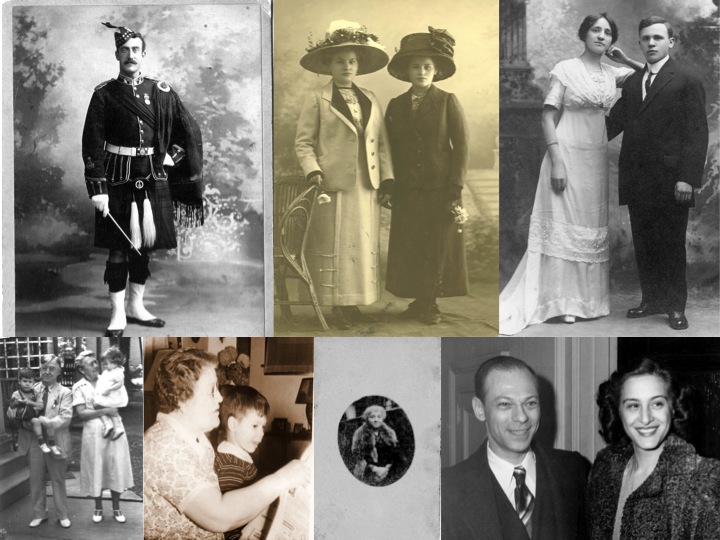
There are still plenty of family history projects in my future as I work to keep ancestors' names, faces, and stories alive for the next generation. These days, many projects (such as 10-minute videos) are bite-sized, but I do have other ongoing projects, such as photo and slide digitization, preservation, and storage.

The ancestor landing pages across the top of my blog summarize what I know about the main surname groups...and serve as cousin bait for distant relatives who "land" on my blog after doing an online search for someone in their family tree. 

A heartfelt thank you to the many cousins worldwide who have been part of this ongoing journey and generously share what they know about our family tree.

Also, special thanks to my genealogy buddies all over the planet, who continue to inspire me. It has been fun to participate in #AncestryHour, #GenChat, #OurAncestors, and GeneaBloggers Tribe, plus be a member of (and sometimes a speaker at) virtual and in-person genealogy groups and conferences.

Tuesday, August 24, 2021

Emotion and Family History

The latest in a series of bite-sized family history videos are in progress. As I wrote recently, we're using old photos and headlines as visual cues in a slide show while my husband or another family member narrates the story for a brief video. 

The stories are family history for the younger generation, but we, the narrators, actually lived through these experiences. Then and now, the experiences evoked emotions that we want to share.

The first story my Sis and I are going to video is about going to dancing school and performing in recitals. The story was inspired by one of our favorite family photos--this adorable little dancing tomato girl.

Narrating the video combines facts and memories, sometimes with a bit of research to support (or disprove) parts of the story. I was able to research the location of the dancing school, among other facts. I also remembered how my parents complained about the extra cost for costumes, at a time when the household budget was increasingly stretched.

Adding emotion to family history

Emotion plays a role in our choice of topics for these videos, and in our enthusiasm for telling the stories we want future generations to hear. Enhanced by our positive or negative feelings, if the overall story can touch the heart in some way, it will be remembered. 

If we merely recited names, dates, places, and relationships as old photos appear on the screen, our audience members would probably not respond as strongly. Not every story will be "fun" but we hope that the next generation will remember at least one or two points from each video.

Family history foundation beyond emotion

There has to be a solid family history foundation to any story, beyond nostalgia or reminiscences. For instance, the "history" part of the dancing school story is that it was a tradition in my mother's family to send children for lessons, often music or dance (or both). 

Our first cousins all took lessons of some sort, I know from family tree letters and documents (and from personal memories of the past). The athletic cousins took up sports. Some cousins had piano teachers come to the house or went to photography camp, etc. 

Other "history" elements in the dancing school story: how our parents managed to pay for these lessons...and their pride in our performances and sharing our (fairly slow) progress with the wider family. 

We didn't grow up to be dancers or musicians, but our parents gave us an opportunity to widen our horizons. And we have photos that remind us of that history and of how we felt about it, photos that help tell a family history story for future generations.

Thursday, August 19, 2021

Experiment: Bite-Sized Family History Video


This week, my hubby and I experimented with videoing a bite-sized family history story from his childhood. Every Sunday, his Dad would take the kids (pre-school age) to church while Mom stayed home and cooked a big dinner. 

After church, it was still too early to bring the kids home. Mom needed another 30 or 60 minutes to finish cooking and set the table. So Dad took the kids to a nearby railroad yard, where they all watched trains being made up. When they returned home, Sunday dinner was on the table. 

Here's the three-step process we followed to get from "story" to "bite-sized video."

Step 1: Find visuals

Visuals are, of course, a big part of any video. We had a couple of good photos of the kids at the rail yard and in the car.

To add more to the story, I found (via Pixabay.com) free, somewhat generic photos of a railroad yard and a church. These would be good enough to convey the sense of childhood Sundays.

Step 2: Create a slide show

Next, I created a slide show (I use PowerPoint) with a simple colored background, making the photos the center of attention. 

I added headlines at the top of each slide, partly to guide the narration and partly for viewers to read. I used present tense for these headlines, to make the story feel "in the moment" rather than "in the past." Example: "After church, Dad drives to..."

Not visible in this illustration are the names superimposed on one of the photos, to clearly caption who's who even though one of the children is narrating the story. Also, I included an approximate date on one of the slides.

Step 3: Record the videoconference

Once my husband was happy with the four slides and had thought about what he would say as a voice-over, we began a videoconference (in this case, Zoom). He shared his screen with the slide show, and then I began the recording. He narrated the four slides in about eight minutes. I stopped recording, waited for it to be converted to mp4 video, and then we played the video. 

Our first try was pretty good. We did a second take, and that one was better, with my husband adding a few specific details he had not mentioned the first time. 

More ideas to try

Because the video was short, we were able to email it to recipients. (A longer video, too large for email, would have to be sent a different way.) Although we're still waiting for reaction, hubby and I enjoyed the process so much that we're already thinking about our next bite-sized video of family history.

Next time, we'll figure out how to have the narrator (my husband) visible on screen as he tells the story and advances the slides. Or we might include a recent photo of him next to a photo of him at the time of the family-history story he's telling.

Another plan is to have a sibling reminisce with him, via videoconference, with slides on the screen. The headlines could be a starting point for discussion as the photos stimulate memories from the past.

Also, I need to add my husband's name and the date of recording to one of these slides, so future viewers know who is narrating and when.

Have you tried videoing a family history story? How did it work? What did your family think?

--Post is part of the August Genealogy Blog Party  https://www.thefamilyheart.com/
Tuesday, August 17, 2021

No Captions - A Loss for Future Generations


Now that I'm scanning, inverting, and enhancing negatives from the collection left by my late father-in-law, James Edgar Wood (1903-1986), I'm finding clues to family history--and so many mysteries.

A few (but not many) of the negatives had dates scratched into the edges, sometimes very specific dates. Most of the negatives were in small paper folders with titles such as "Summer, 1919" or "1917-1918-1919."

Help from genealogy folks on social media

With a bit of help from the wonderful genealogy folks on social media, I'm getting ideas about where some of these photos were taken, the groups, the clothing, etc. 

Genealogical folks identified the uniform worn by a young man in several 1919 photos as Royal Air Force. I know from previous research that one of my husband's ancestors from Canada served in the RAF during WWI. Very quickly, I found a US/Canadian border crossing card for him during the same month as that 1919 photo. As a result, I've been able to caption a series of photos with names and dates. Thank you, genie friends!

More research is in my future

The group parading in the image at top holds a banner indicating it's a lodge from London, Canada. Thanks to a Canadian genealogy social media group, I now have some leads to follow up.


Also, I'm interested in the group shown in this parade (date uncertain, sometime between 1917 and 1919). This is not necessarily from the same parade as the previous photo, not from the same batch.

Most of the men are holding what looks like a ceremonial staff, perhaps from a lodge? More research is in my future.

Not having captions for my father-in-law's photos would be a real loss--a family history tragedy for future generations. 

--"Tragedy" is the theme for week 33 of Amy Johnson Crow's #52Ancestors challenge.

Friday, August 13, 2021

Decoding Why Ancestors Died


Thanks to the Summer 2021 issue of American Ancestors from the New England Historic Genealogical Society, I have a new tool for analyzing death certificates  filed in the 20th century.

Genealogist Hallie Borstel wrote about the International Classification of Diseases code, either three or four numbers added to a death cert to categorize the cause of death.

Look at the Wood ancestor's death cert above. See the three digit code 131 in the red circle? That's the ICD.

I looked up 131 in the 1929 ICD listing for causes of death, and see the classification is chronic nephritis.

The doctor's written cause of death on this particular cert is: "cardio-vascular renal disease."

Not exactly the same as code 131, but very closely related. If the doctor's handwriting had been illegible, the ICD code would have given me insight into cause of death.

To use the ICD, look for the most recent version adopted before the ancestor's death. In this example, the ancestor died in 1936, so I used the 1929 version (excerpt shown above). If she had died in 1939, I would have used the 1938 version. 

Another tool in my genealogical tool kit! 

Wednesday, August 11, 2021

"Big City" Cleveland Ancestors in 1950


As I continue to prep for finding ancestors when the 1950 U.S. Census is released in April, I'm using my RootsMagic7 genealogy software's reporting functions.

When Census documents are initially made public on April 1, the only way to find ancestors will be to browse the proper Enumeration District. If I wait a few months, the Census will be indexed and I can search by name. But I really want to learn more about my ancestors sooner than that, which means preparing to browse by finding specific addresses and turning those into individual Enumeration Districts.

Who was there?

Above, an excerpt from one of the "Who Was There" lists I created with RootsMagic 7. This list covers ancestors who were in Cleveland in 1950. The report lists ancestors by surname in alphabetical order, shows birth and death dates, age in 1950, and a chronological listing of places for each ancestor (based on my research). As the image shows, the listing includes street addresses from my sources.

Interestingly, the software allows me to indicate an average life span to be considered when compiling the report. Sometimes I don't yet know an ancestor's death date, so this parameter helps me cast a wider net and include people who might be still alive and in that area, based on their last-known address in my database. I like this flexibility.

Edgar James Wood, my father-in-law, was one of many ancestors in my husband's tree who lived in metro Cleveland in 1950. By grouping these ancestors according to where they lived, it's more efficient for me to look up and browse their 1950 Enumeration Districts (see step-by-step process here). 

Context: Cleveland vs the Bronx

In 1950, Cleveland had 914,800 residents. It was truly a major city, the seventh largest in the United States, thanks to the influx of industrial workers during and after World War II. That year was a population peak for Cleveland, which had only 318,000 residents in 2019. 

My husband, a Cleveland native, often says he was born in an "Eastern" city. Because I'm a Bronx native, I respectfully refer to his home town as being solidly in the Midwest!

In 1950, the Bronx had 1.45 million residents. This will be the first Census where my parents are enumerated as a married couple, living in the Bronx, New York. If counted as a standalone city instead of a Big Apple borough, the Bronx would have been the sixth largest U.S. city in 1950. In other words, well ahead of Cleveland, where hubby's parents were living in 1950.

Just mentioning this factoid to put the 1950 Census in context for both sides of my family. Ahem.

-- "In the city" is Amy Johnson Crow's #52Ancestors prompt for week 32.

Monday, August 9, 2021

Researching Ancestors in Photos from 1918


My late dad-in-law (Edgar James Wood, 1903-1986) took thousands of photos in his life, beginning in 1917. 

We've inherited many of the negatives, which I'm steadily scanning, inverting, and enhancing, one batch at a time.

Family and more from 1918

I just finished working on 20 negatives in a batch titled "Negatives, 1918...prints in album." Although the album itself doesn't seem to have survived, I can identify some of the people now that I've turned the negatives into positives.

From earlier negatives and photos, I recognize members of my dad-in-law's immediate family. Here is one of Edgar's younger brothers, in an outdoorsy outfit (note buttons on belt). Also in this batch were negatives showing other brothers and, of course, Edgar's beloved mom, Mary Slatter Wood (1869-1925).

Mystery photos

At right, a nurse whose portrait appears in two negatives. Who is she? 

Other "unknowns" are two brothers, who appear to be about 6 and 12, and a 20ish guy in a uniform (no military insignia visible).

There are no place clues visible in the photos, and no inscriptions other than dates scratched into the negatives by my dad-in-law. But the Wood family tended to motor around the countryside in their 1917 Ford and visit relatives, so more than likely, these mystery people are folks on the family tree whose faces I don't recognize (yet).

So many ancestors to research

James Edgar Wood (1871-1939), Edgar's dad, came from a large family. To try to identify mystery people in these photos, I'm looking closely at children of his six siblings who were still alive in 1918. The younger generation would be around the age of the folks in these negatives.

It's possible some of the mystery people might be from the family of Edgar's Mom, Mary, of course. Most of her nieces and nephews lived in Canada. I have to consider that possibility, as well.

Without a doubt, more research is in my future. If I can connect with descendants and get identifications, I'll gladly share photos privately with them and, I hope, swap family history stories.