Tuesday, September 1, 2020

Free! RootsTechConnect, Feb 25-27, 2021

RootsTechConnect registration confirmation--I'm attending!
Family Search announced today that its 2021 RootsTechConnect conference will be all-virtual and entirely free! Mark your calendar for February 25-27, 2021.

The world's largest and most exciting genealogy conference will have something for everyone, everywhere.

Don't miss this opportunity to see some of the genealogy world's brightest stars, and learn new tricks and techniques while sitting at home in your bunny slippers.

Registration is entirely free. Just click here to go to the website for more info and to register. See you there!

Sunday, August 30, 2020

Pandemic Pastime: Painted Rocks

Painted rocks - my pandemic pastime!

This week, Randy Seaver issued a "Saturday Night Genealogy Fun" to describe hobbies or pastimes, other than genealogy, that we're currently enjoying or have enjoyed in the past. Randy, I accept your challenge!

During the pandemic, I've been trying my hand at rock painting. The bottom rock is an early try, using a stencil and a specialty brush. Then I began browsing Pinterest for more elaborate designs and found lots of inspiration.

The top two rocks are critters I painted more recently, based on designs pinned to Pinterest.

None of these rocks is larger than 4 inches long. It doesn't take long to paint one, and with a top-coat for protection, they look great as decoration or ornaments in house plants.

Yes, I actually had to buy smooth rocks suitable for painting, but this is not an expensive hobby. And yes, some painted rocks (or painted coal lumps) may find their way into Christmas stockings this December ;)

Saturday, August 29, 2020

Unforgettable Stories of Civil War Ancestors

From Library of Congress, sketch showing aspects of region surrounding Gallatin, TN
I am almost finished with my family history booklet about the 18 ancestors in my husband's family tree who served in the Civil War. Of the 18, 15 were fighting for the Union and 3 were fighting for the Confederacy. (Thanks to hubby's wonderful cousin L, who originally researched those 3 Confederates.)

Each of their life stories is unique and many are unforgettable. Let me share the story of two brothers who didn't survive the war.

Students Against Slavery

Isaac Larimer Work and John Wright Work were born in Ohio but moved with their pioneering family to Indiana when very young. The brothers were starting their first year of college prep at Hillsdale College in Michigan when the Civil War broke out. Hillsdale College was then quite well-known for its anti-slavery position, and students resolved to do their part in the fight against slavery.

In the spring of 1862, hundreds of students left campus and returned home to enlist for the Union--including Isaac and John, who both joined Company I of the 74th Indiana Infantry. The unit quickly moved into position for the Union, pursuing Confederate General Bragg and his forces through Kentucky. It fought in the Battle of Perryville, which the Union won but which caused heavy losses on both sides. Toward the end of 1862, the 74th Indiana Infantry marched to Gallatin and Castillian, Kentucky, to regroup and care for sick and wounded soldiers.

Dying of Disease, Not Wounds

Alas, Isaac and John both succumbed to chronic diarrhea at Gallatin not long afterward. Isaac was only 24, and his brother John only 22. The brothers had been in the Union Army for less than six months. They were my husband's first cousins, 4 times removed.

Their infantry unit actually lost many more men to disease than to battle: 91 officers and soldiers were killed or fatally wounded during fighting, while 2 officers and 181 soldiers died from illnesses like diarrhea. The prevalence of death by disease was the reality for both North and South throughout the War.

Knowing that these idealistic young men died only weeks apart, not from wounds but from disease that is today very treatable, made their story unforgettable for me.

RIP, Isaac Larimer Work (1838-1862) and Jacob Wright Work (1841-1863).

The #52Ancestors prompt for this week is "Unforgettable."

Tuesday, August 25, 2020

Happy 12th Blogiversary

My genealogy blog is entering its 13th year and I'm still climbing my family tree.

In nearly 1,300 posts over 144 months, I've examined methodology, brick walls, breakthroughs, and intriguing family stories.

Lots of ancestors found, lots of cousins connected, and looking ahead, more genealogy adventures are in my future.

Thank you to my incredible family, my dear readers, and the wonderful genealogy community for your support and interest!

Sunday, August 23, 2020

Who Tells Your Story? Choosing to Be Family Historian

With a nod to the now-iconic musical Hamilton, I've been thinking a lot lately about the question: "Who lives, who dies, who tells your story?"

Long after my grandparents and parents were gone, I chose to be the family historian. I was curious about all those stories I didn't hear (or didn't pay attention to) when I was growing up. And I was especially motivated to dig out the stories NOT told, about my family and my husband's family. Remember, I married him for his ancestors ;)

By the time I chose our families as my focus, there were faces I could not recognize in old photos. There were important family stories and cousin connections that had somehow been forgotten.

I chose myself to tell the stories of who lived and who died--and that's how I came to understand that their stories are our stories, too.

Honoring the memory of ancestors, finding "new" cousins

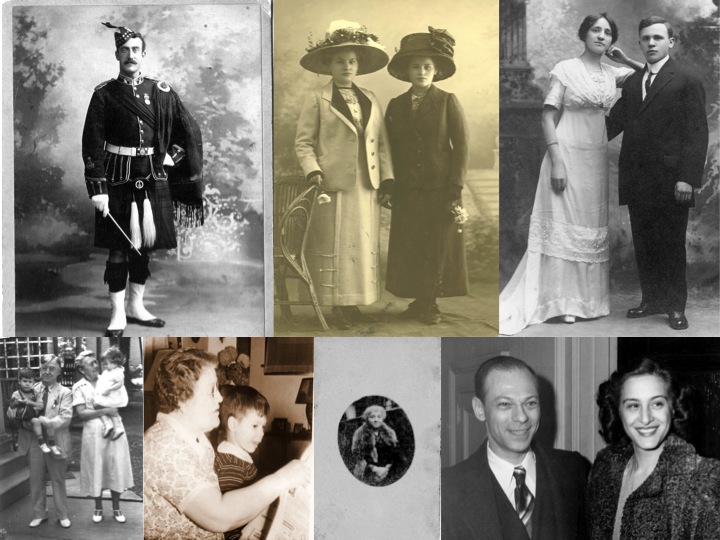
My paternal grandfather Isaad Burk died years before I was born. Only after years of research did I come face to face with his face, on his naturalization papers. That clue helped me identify him in other family photos.

I really don't want to be the last person on Earth to recognize grandpa. In addition to captioning, I wrote a brief booklet about Isaac and his wife, my grandma Henrietta Mahler Burk, whose face I did recognize. This honors their lives and preserves their stories for future generations.

Happily, my family history activities put me in touch with delightful cousins from the Burk and Mahler families. The same happened when I investigated my Schwartz and Farkas family tree--I forged new and treasured connections with cousins near and far.

Forgotten heritage, now preserved

Hard as it was for me to believe, my husband's Wood family somehow didn't inherit the knowledge of their Mayflower ancestry. Only thanks to my hubby's 2c1r did we find out about 5 Mayflower ancestors in his Wood family tree: Degory Priest, Isaac Allerton, Mary Norris Allerton, Mary Allerton, and Francis Cooke. Needless to say, I'm not letting family forget this story, especially during this year of Mayflower 400 remembrances.

My research also led to uncovering the tragic story of many Schwartz family members killed in the Holocaust. I watched my mother's first cousin tell that story on video for the USC Shoah Foundation project. Her courage and survival against all odds gives me hope.

It's up to me, as guardian of family history for both sides of the family tree, to document who lived, who died, and to tell their stories.

--

"Chosen family" is Amy Johnson Crow's prompt for week 34 of #52Ancestors.

Wednesday, August 19, 2020

The Women Married to Civil War Ancestors

Excerpt from Wood Civil War Ancestors booklet
In researching and writing about my husband's Civil War ancestors (both blue and grey), I'm making sure to document the lives of the women they married.

Some wives outlived their Civil War veteran husbands, by a few years or decades; some wives died while their husbands were away at war; some wives died soon after the vets returned home. Each has a story and I want to be sure their lives are remembered, along with their husbands.

Here's my plan for writing "cradle to grave" about each veteran and his wife or wives:
  • Head the first page with veteran's full name and dates. 
  • Explain the veteran's relationship to readers in the next generation.
  • List the full name of his wife (or wives) and her dates. 
  • List the units in which the veteran served (blue indicates Union, red indicates Confederate).
  • First paragraphs summarize the man's family background (parents, siblings, birthplace, movements, occupation). This is the "cradle" part of "cradle to grave" in a nutshell.
  • Emphasize "story" part of family history by adding a dramatic hook early in the veteran's life narrative. Here, I say that this man and two brothers were all in the Union Army, but their lives diverged after the war was over.
  • Include at least one illustration, such as a newspaper obit or a Civil War Pension card. 
  • Say when and where the man got married, and any special circumstances. In the excerpt above, John N. McClure married Rebecca Jane Coble only 3 days after he enlisted in the Union Army, just before he shipped out with his unit. Quite a start to their married life.
  • Describe the wife's life as well as the veteran's life to add context to the family tree overall. 
  • Say when and where (and why) the veteran and his wife died and were buried, the "grave" part of this "cradle to grave" profile.
What's in This Family History Booklet?

My booklet will have a table of contents, a listing of Civil War military units in which the men served, and possibly the key battles or actions in which they participated. 

This is a work in progress, having grown from the quickie booklet I originally envisioned, so I may decide to add an index. After all, I'm profiling 19 men and their wives/families. That's a lot of names. I want to make it easy for descendants to look up any particular ancestor by checking the table of contents and/or the index.

Highlight the Drama: Spoiler Alerts Wanted!

I'm going to write a page highlighting "not to be missed" dramatic or interesting details about some key ancestors. Spoiler alerts will actually whet my readers' appetite for more. 

For instance, Robert Crooke Wood was the next generation's 4c5r and a senior U.S. Army surgeon. He married Ann Mackall Taylor, the oldest daughter of Major General Zachary Taylor--yes, the U.S. Army veteran who later became the 12th U.S. president. Zachary Taylor's daughter Sarah married Jefferson Davis. Yes, that Jefferson Davis. So Robert Crooke Wood's father-in-law was a future U.S. president, and his brother-in-law was a future Confederate president.

The Civil War intensified the family drama: Two of Robert Crooke Wood's sons fought for the Confederacy, while their father remained on active duty in the Union Army. (Many thanks to my hubby's wonderful cousin L for sharing his knowledge of this distant part of the Wood family tree.)

Don't you think such spoiler alerts will get my readers' attention?

Friday, August 14, 2020

Trouble Finds Lemuel C. Wood Senior and Junior

Neither Lemuel C. Wood Senior (let's call him "Capt. Wood") nor his son, Lemuel C. Wood Junior (let's call him "Junior"), actually made trouble for anyone, except for the Confederacy during the Civil War. Unfortunately, trouble came looking for them.

Capt. Lemuel Wood, Sr. (1792-1870) Hubby's 3d great uncle

Capt. Wood was a successful mariner based in Fairhaven, Massachusetts, at the major whaling port of New Bedford. He also owned 13 acres of farmland and livestock worth about $9,000 in 1860 (nearly $280,000 in today's dollars), according to that year's Census.

Sadly, the captain's first wife, Mercy Bowditch Taber, died of consumption in 1856. A year later, in 1857, he married Rosetta Howland Ellis, who died of either consumption or palsy in 1859 (records are inconsistent). One year after that, he married Julia Lambert Sampson--and she survived him by 21 years. In order to collect his Civil War pension, she had to prove that her first husband died (at sea during a whaling trip) and that Capt. Wood's previous two wives had died. Quite a fat file of paperwork and a lot of trouble, but she won her case.

Capt. Wood answered the call for Union service during the Civil War. According to some war records, he was commander of the USS Daylight. (Other pension records call him the "acting master" of the Daylight.) He was already in his 60s, with decades of experience on the water.

The USS Daylight sailed along the coast of Virginia and North Carolina, part of the Union blockade against the Confederacy. After the ship was damaged by Confederate gunfire, she was repaired and reassigned to the James River from October, 1864 to May, 1865, after the war ended.

Doctor's note attesting to Sarah H. Wood's deadly illness
Capt. Wood returned home at war's end. In 1870, a few months before he died at the age of 78, he told the Census his occupation was "mariner." He left his widow Julia an estate of $13,450--worth more than $270,000 today.

Lemuel C. Wood, Jr. (1828-1898) Hubby's 1c3r

The Captain's son and namesake, “Lemuel Junior,” first went into business as a merchant. At the age of 28, he married Sarah Howland Wood, on June 26, 1856. By the time their first child was born in 1857, the birth record recorded Junior’s occupation as “gentleman.” He and Sarah had four five children in all, but only two survived to adulthood. Two died within weeks of each other, one of "brain fever" and one of consumption. So tragic.

At the start of the Civil War, Junior became an acting paymaster for the Union Navy. He resigned that post in June of 1862. On September 22, 1862, he enlisted as a private in Company I, 3d Massachusetts Infantry, and was mustered in the next day. At the time of this enlistment, he said his occupation was “farmer.” On December 3, 1862, Junior was working as a hospital steward at Plymouth, North Carolina, according to his Civil War records.

Trouble hit Junior's family while he was at war in North Carolina. His wife Sarah was fatally ill with consumption. Letters written to her husband’s commanding officers requested that Junior be given a month of furlough to be at her side.

After weeks of letters back and forth, Junior was granted a month's furlough on April 5, 1863. It was just in time: His wife Sarah died on April 14th.

Junior returned to North Carolina after his furlough. His nine-month service with the 3d Massachusetts Infantry ended when he was mustered out on June 26, 1863. Then he joined the 23d Unattached Company Massachusetts Infantry as a sergeant for 100 days. According to the 1890 Veteran’s Schedule, he had dysentery and was “brought home sick.” From April to September of 1865, Junior was an acting assistant paymaster for the Union Navy, stationed aboard the USS Nantucket.

When he first left the service, Junior took a job as a grocery clerk and hired a housekeeper to care for his children. Eventually, he remarried in 1894, to Emma Louise Small Sherman, listing his own occupation as nursing (remember, he was a hospital attendant during the Civil War). Junior died four years later, at the age of 70, in Fairhaven, his birthplace.
--
You know I married my husband for his fascinating ancestors! This week's #52Ancestors blogging prompt is "troublemaker."