Wednesday, January 8, 2020

Two Bracelets, Two Family Heirlooms

Daisy and Dorothy Schwartz, mid-1920s
Shown here in one of my favorite photos is Mom (Daisy Schwartz Burk, 1919-1981) and her twin sister (Dorothy Schwartz, 1919-2001), with matching Buster Brown haircuts and lacy dropped-waist dresses.

Look very carefully at the arm of the smiling twin on the right, and you can see a dainty pearl bracelet dangling from her wrist. No doubt both girls had identical bracelets, but only Mom's survives.

It's a tiny heirloom (see the ruler to see how tiny) that will be shared with Mom's descendants, along with the treasured studio photo of the twins.

Worn by Daisy Schwartz Burk

The second bracelet heirloom is this one from the late 1950s, a piece of Mom's costume jewelry with photos on both sides--photos of her twin daughters (Sis and me).

As with the pearl bracelet, this charm bracelet will be shared with Mom's descendants, along with memories of her and her twin sister, my Auntie Dorothy.

One of my 2020 goals is to finish a booklet about Daisy and Dorothy, with lots of photos to bring them alive for future generations who never had the opportunity to know them.

"Favorite photo" is this week's #52Ancestors prompt.

Thursday, January 2, 2020

Who We Are and How We're Related

List of Larimer ancestors written by Brice Larimer McClure
"I am Brice McClure, a son of Margaret Larimer McClure and Wm. McClure," begins the scrap of family history above. It was written by my husband's maternal grandfather (Brice Larimer McClure, 1878-1970) in the first half of the twentieth century.

The family treasures this scrap of paper in Brice's handwriting, listing what he was told about his Larimer family's history. It also demonstrates Brice's pride in his family's background and his hope that these ancestors would be remembered for generations to come.

Brice set a wonderful example: He told descendants (1) exactly who he was and (2) exactly how he was related to his ancestors.

I've been putting my name and the date on every family history booklet I write. Now I realize that's not enough information about me.

When I wrote my most recent booklet about my late father-in-law's musical life, I added a longer note to the title page:
"Written by Marian Burk Wood, daughter-in-law of Edgar James Wood, in December, 2019."
In a decade or two, when some descendant pulls this dusty booklet off the shelf, he or she will see both my name and my relationship to this ancestor.

Although I could add even more info to explain how I fit into the family, I want to keep things simple and leave the spotlight on the featured ancestor in my booklet.

Now future generations will at least know my name, my relationship to the ancestor I'm writing about, and when I prepared the booklet.

Wednesday, January 1, 2020

Fresh Start: New York's Cafe Monopol


The entrepreneurial Roth family, cousins to my Hungarian-born great-grandpa Moritz Farkas, sought a fresh start after leaving Hungary for opportunities in New York City at the turn of the 20th century.

Cafe Monopol on Second Avenue in NYC

Peter Roth (1872-1956) and his brother-in-law Peter Stern, with two other partners, owned and operated the Viennese-style restaurant Cafe Monopol at 145 Second Avenue in Manhattan.
They paid $5 to organize as a corporation in 1913 (shown at left).

Peter and his wife had put in $10,000 in funding during the previous year, according to incorporation documents. The incorporation process probably formalized family shares in the restaurant corporation.

Peter had headed the Cafe Monopol since at least 1910. That's the year he told the US Census he was the "keeper" of this restaurant, which was also listed in the 1910 New York city directory. He learned the business from the ground up, listing "waiter" as his occupation in the 1900 Census (when he lived only a few blocks from his future business).

I just found an ad for Cafe Monopol on November 21, 1908, saying "Hungarian music, Vienna Restaurant" at the 2d Avenue address. And other early ads in New York Evening Telegram for the Cafe Monopol said it featured "a concert every evening." The place must have been hopping at dinnertime!

A Cafe Monopol in Berlin and Another in New York

Reading the 2018 book, A Rich Brew: How Cafes Created Modern Jewish Culture by Shachar M. Pinsker, I was pleased to find the Roths' Cafe Monopol in New York briefly mentioned (p. 228). Much more space was devoted to the far better-known Cafe Monopol in Berlin, then a gathering place for Zionists (see pages 167+ of the book). Surely my Roth ancestors from Hungary would have been aware of the Berlin cafe's fame when naming their New York cafe.

In New York City, the entire Second Avenue neighborhood around Cafe Monopol was home to a rich brew of Jewish culture, including the Yiddish Art Theatre and the National Theatre. In the 1940s, a cousin of my Roth and Farkas ancestors acted in New York's Yiddish theater for a time!

A Star's Fresh Start at the Cafe Monopol

I just found out that a really big star got her fresh start at the Cafe Monopol more than a century ago.

Sonya Kalish, the star's original name, was a baby when her family settled in Hartford, CT after leaving Tulchin, Ukraine. She married Louis Tuck and was known as Sophie Tuck.

But Sophie was eager to sing, and so she took herself off to New York City to break into show business. Her money was running out when she approached the proprietor of Cafe Monopol and offered to (literally) sing for her supper.

When he asked her name, she made up a variation of her married name on the spot: Sophie Tucker. 

That's how Sonya Kalish became Sophie Tucker ("The last of the red-hot mamas"), and got a fresh start at the Cafe Monopol on Second Avenue in New York City!

(My sources: Sophie's biography, "Some of These Days," and the Museum of the City of New York.)

--

Many thanks to Amy Johnson Crow for this first #52Ancestors prompt of 2020.

Tuesday, December 31, 2019

Happy Family History New Year 2020


This pretty postal card was sent to my husband's uncle more than a century ago.

Let me wish you and your loved ones a very happy and healthy new year! It's a perfect time of year to share your own memories of holiday traditions as part of family history. (Actually, it's always the right time to share family history.)

I've reached a new blogging milestone: Never have I posted more entries than in 2019. Looking forward to more blogging in 2020, including Amy Johnson Crow's new #52Ancestors prompts.

Thursday, December 26, 2019

Thank YOU to My Ancestors and Cousins

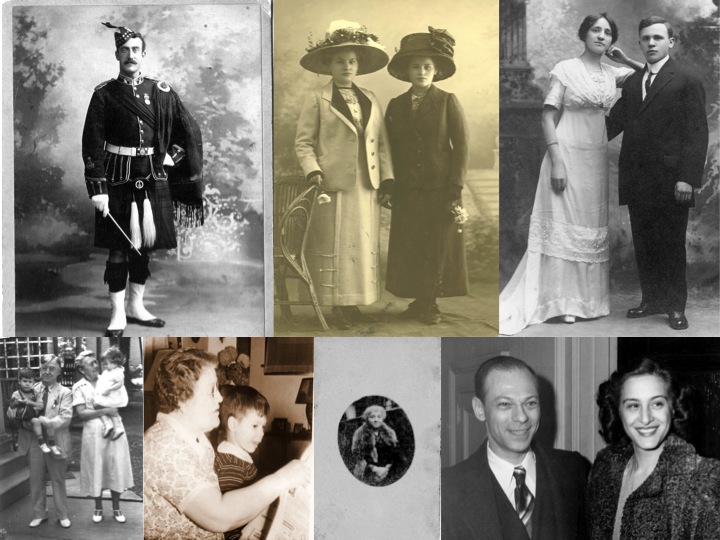
Ancestor collage - his & her family tree
In this last #52Ancestors post of 2019, I want to say a big thank YOU to my ancestors and their descendants.

Dear ancestors, if not for your courage, sacrifices, hopes, and dreams, I would not be here. I would not be discovering and saving your stories for future generations to know.

I've come to deeply appreciate the heritage you bequeathed to me, not to mention the strength and determination you showed in the lives you led.

It is my privilege and pleasure to get to know more about you, dear ancestors, through ongoing genealogical research. And to share your history with descendants near and far!

Dear cousins, my life has been truly enriched by being in touch with each and every one of you. Thank you so much!

To all of YOU, ancestors and descendants, I dedicate this post with sincere and heartfelt gratitude.

--

Amy Johnson Crow, thank you for another fun and rewarding year of #52Ancestors prompts. She just announced the entire year of 2020 prompts!

Wednesday, December 25, 2019

Holiday Wishes from Last Century


One hundred years ago, my husband's uncles in Cleveland, Ohio received these delightful Christmas postal cards from relatives.

Wishing you and yours a very happy holiday season!

Monday, December 23, 2019

What Did Ancestors Say in 1950 US Census?

Question #33 on 1950 Census
I vividly remember the morning of April 2, 2012, when the 1940 US Census was released to the public. Although volunteers were racing to index the names as quickly as possible, no name search was available for several weeks.

To start, the only way to find ancestors in 1940 records was by address. Specifically, by scrolling through page by page of Census records in various Enumeration Districts (EDs). It was slow but also exciting when I finally found the handwritten entries for ancestors in my tree and my husband's tree!

The 1950 Census has lots of questions that will fill in gaps in genealogy for us all. No wonder I can hardly wait for the release of these records in April of 2022. Here are a few specifics I'm really curious about.

What About Women in the Military?

Excerpt from 1950 Enumerator Instructions
I'll be interested to see how the enumerator handled my aunt's WWII military service (she was a WAC). As shown at top, question #33 indicates that males over age 14 are to be asked about their military service. At left, instructions to enumerators reiterates that "each male 14 years old and over" be asked about military service.

I guess the Census officials never heard of WACs, WAVES, or WASPs. Not to mention SPARs, women Marines, female military nurses, and . . . and . . . more than 300,000 women who were actively serving in WWII.

Will there be an answer shown on my aunt's line in the Census? Knowing her pride in having served, she would certainly want to answer. She would even insist on answering! But will the enumerator have put a check mark in one of the boxes for her line? That's a mystery until April of 2022.


How Much Money Did They Make?
Question #31 on 1950 Census

My mother used to say that 1950 was a peak year for my father's income as a self-employed travel agent. She named a dollar figure too.

Well, the 1950 Census asks how much money each person earned in 1949. See the excerpt from the Census questionnaire here.

I can't wait to see what the enumerator was told about how much Dad earned "in his own business," as the question is phrased. BTW, enumerators were instructed to write $10,000+ if the income was above 10 grand per year. That was a good deal of money back in the day!

And I'll see how much money other relatives made during 1949, a year that was, I now understand, not a time of growth but actually a recessionary period. (Genealogy has made me intensely interested in the historical context of my ancestors!)

Prepping for 1950: Addresses and Priorities

Steve Morse and Joel Weintraub have written a primer on prepping for the 1950 Census release, following the same general guidelines as for the 1940 Census. Also watch their video here.

If you are lucky enough to know the exact street address of an ancestor in 1950, you can easily find the Enumeration District via Morse's One-Step Page. If you don't know the address, Morse recommends checking old city directories, family address books, and other sources. Then use his one-step links to get the ED.

Until the 1950 Census is indexed (I bet it will be done faster than in 2012), my plan is to prioritize who to find first. I'll create a simple list of people and the address where I think or know each is likely to be found.

And of course, I'll use the Census to examine or update the FAN club--friends, associates, neighbors--of my ancestors. This is a great opportunity to look more closely at "family friends" who may turn out to be cousins or closer, in reality.

Back to the future in 2022!

P.S.: I'm gathering all my 1950 US Census posts into one summary page, shown at top of this blog header. Here's a direct link.