For this week's "Independent" prompt from Amy Johnson Crow's #52Ancestors series, I wanted to look at the long tradition of independent family farming in my husband's Larimer and McClure families.
Larimer Family Farmers
Several Larimer ancestors fought in the War of 1812 and received land grants in later years, based on their military service. One was hubby's 4th great-granddaddy, Isaac M. Larimer (1771-1823), who was born on the family farm in Cumberland County, Pennsylvania and died on his farm in Fairfield county, Ohio.
Isaac was the son of immigrant ancestor Robert Larimer (1719?-1803), the 5th great-granddaddy who came from Northern Ireland in the 1740s who began the family's farming tradition in America. Isaac's mother was Mary O'Gallagher (or Gallagher, 1721-1803).
Isaac and Mary's son Robert Larimer (my hubby's 4th great uncle) also fought in 1812 and earned the land grant shown in the document at top.
Isaac and his wife Elizabeth Wood Larimer's son John (1794-1843) was my hubby's 3rd great-granddaddy and a 90-day enlistee in the War of 1812. Like so many others in the Larimer family, John Larimer eventually moved from Ohio to Elkhart county, Indiana, to obtain more land for farming.
My husband's 2d great-granddaddy, Brice S. Larimer (1819-1906) continued the tradition of family farming in Elkhart county, Indiana. By 1853, he had been appointed postmaster. Brice later served as a railroad agent, and his son William Tyler Bentley Larimer (1849-1921) also worked at the railroad depot. Later in life, William T.B. Larimer returned to farming, but none of his children or grandchildren were family farmers.
McClure Family Farmers
The McClure family tradition of farming in America began with my husband's earliest McClure immigrant ancestors. Hubby's 5th great-granddaddy Halbert McClure (1684-1754) and his wife Agnes (?-1750) led a large group of McClure family members from County Donegal across the Atlantic to Philadelphia, where they walked all the way to Virginia to buy farmland.
Halbert's son Alexander McClure (1717-1790) bought land in Mill Creek, Augusta, Virginia in 1751. Alexander was hubby's 4th great-granddaddy. His son John McClure (1781?-1834), hubby's 3d great-granddaddy, was most likely a farmer after moving to Adams county, Ohio.
John and his wife, Ann McFall (1780-1823) had one son, Benjamin McClure (1812-1896) who most definitely a farmer in Noble township, Elkhart, Indiana. Benjamin was my husband's 2d great-granddaddy.
In the generation after Benjamin McClure, not everyone was a full-time farmer. Oldest son Theodore Wilson McClure told the Census in 1880 that his occupation was "farming and storekeeping." Second son John McClure was a farmer, first in Indiana and then as a tenant farmer in Little Traverse, Michigan. Third son Train Caldwell McClure operated an oil mill in Wabash county, Indiana.
Benjamin McClure's youngest son was William Madison McClure (1849-1887), my husband's great-granddaddy. He grew up on the family farm in Indiana but after marrying Margaret Jane Larimer (1859-1913), William worked on the railroad. That was the end of family farming in this line of the McClure family: None of Margaret and William's three children married a farmer or worked in farming.
Adventures in #Genealogy . . . learning new methodology, finding out about ancestors, documenting #FamilyHistory, and connecting with cousins! Now on BlueSky as @climbingfamilytree.bsky.social
Pages
- Home
- Wm Tyler Bentley story
- Isaac & Henrietta Birk's story
- Abraham & Annie Berk's Story
- Farkas & Kunstler, Hungary
- Mary A. Demarest's story
- Rachel & Jonah Jacobs
- Robt & Mary Larimer's story
- Meyer & Tillie Mahler's story
- McClure, Donegal
- Wood family, Ohio
- McKibbin, Larimer, Work
- Schwartz family, Ungvar
- Steiner & Rinehart
- John & Mary Slatter's story
- MY GENEALOGY PRESENTATIONS
Friday, July 5, 2019
Thursday, July 4, 2019
Family Tree Fourth of July
HAPPY FOURTH OF JULY!
This vintage Independence Day greeting card was sent to my husband's uncle Wallis Walter Wood in Cleveland more than a century ago. The Fourth of July has significance for our family trees in two instances.
Larimer Elopement

George Ainsworth Larimer (1873-1922), hubby's 1st cousin 2x removed, married Cora Lutz (1875-1945) in a Gretna Green elopement on July 4, 1899. They didn't announce the marriage until November, as shown in this news snippet.
Over the years, St. Joseph was a Gretna Green for several of my husband's family members who eloped. On that particular July 4th in 1899, St. Joseph recorded 21 marriages, including that of George and Cora!
George retired early from a career in civil engineering and bridge construction, due to a heart condition. His death cert mentions the contributing factor of "dropsy" (related to his heart problem). He died in Memphis, TN, on Halloween of 1922 at the age of only 49.
Schwartz Birth
My great uncle Samuel Schwartz (1883-1954) was born on July 4, 1883, in Ungvar, Hungary. He was an older brother of my immigrant grandfather Theodore "Teddy" Schwartz.
Teddy came to America in 1902, followed by brother Sam two years later. According to the 1904 passenger manifest, his given name was Simon but somehow once he arrived in America, he became Samuel. Sam and Teddy teamed up to pool their hard-earned money and bring their younger sister Mary to America in 1906.
Like his brother Teddy, Sam married only days after he attained U.S. citizenship. Sam settled down and raised a family in New York City, where--like his brother Teddy--he ran a small dairy store. Sam died on a hot June afternoon, just weeks before his 71st birthday.
Labels:
Cleveland,
fourth of July,
Gretna Green,
immigration,
July 4th,
Larimer,
Lutz,
Schwartz,
Wood
Tuesday, July 2, 2019
Keep Redoing Searches--New Ancestors May Pop Up!
![]() |
| Transcribed death record for Sundel Mahler |
Finding New Members of the Mahler Family
Last year I was redoing searches for my great-grandma Tillie Jacobs Mahler and great-grandpa Meyer Elias Mahler, and their children. That led me to find on FamilySearch.org a death record for their three-year-old son, Wolf, who died of "acute Bright's disease" (liver problems). Neither I nor any of my Mahler cousins had ever heard of Wolf. But the death cert (visible only at a Family History Center) was quite clear and proved that Wolf was, indeed, a son of my great-grandparents.
Today, I redid that search for Tillie and Meyer--and found yet another death record for a previously-unknown son who died at an even younger age. The transcription is shown above. I have to get to the FHC to view the death cert in person, but based on the transcribed info, not just names but also the street address, little baby Sundel* Mahler would have been my great uncle if he had grown up.
Sadly, the baby died within weeks of his birth. He's buried in Mount Zion Cemetery, with a burial date of April 7, 1901, in the Sons of Telsh plot. That's where my great-grandparents were laid to rest. Another strong piece of evidence in favor of Sundel being part of my Mahler family.
Baby Is Buried in Telsh Plot--Somewhere
![]() |
| Search of Mahler interments in Sons of Telsh plot, Mt. Zion Cemetery, NY |
As shown above in the interment search results, he is in the plot but he is not in a designated grave. Sometimes infants were buried with either a tiny marker or in a part of the plot where other babies are buried. This is very likely what happened in the case of Sundel Mahler.
More Evidence: Census Data
In the 1900 U.S. Census, Meyer and Tillie said they had 9 children in all, but only 7 were living at the time of that Census. Wolf was one of the two who died. The other child who died may have been born in the old country, during the multi-year gap I noticed between the births of early children and the time the family arrived in America. That's my working hypothesis.
In the 1910 U.S. Census, Meyer Mahler had died a few days before the enumerator came around. Widow Tillie told the Census that she had 10 children in all, but only 7 were living at the time of the Census. Now I can account for that one more child--baby Sundel Mahler, born and died after the 1900 Census but before the 1910 Census.
Never Give Up!
Keep redoing searches--new ancestors can and do pop up as more records are added to online collections, transcribed, and indexed! That's how I found baby Sundel and baby Wolf. More ancestors are certainly waiting to be found if I continue to redo my searches. Never give up.
* I'm told "Zundel" in Yiddish means "small boy" but it's also a name.
Monday, July 1, 2019
Remembering Great Uncles on Canada Day
Happy Canada Day!
Both my husband and I have immigrant ancestors who settled in Canada . . . and by coincidence, these men were our great uncles.
About Great Uncle Abraham Berk (Burk/Burke)
Abraham and Isaac left Lithuania in 1900 or 1901 and stopped in Manchester, England, presumably to learn the language and make some money. I found the Burk/Berk brothers in the 1901 UK Census in Manchester with "Uncle" Isaac Chazan (1863-1921) and his wife, Anna Hinda Hannah Mitav Chazan (1865-1940). After consulting with my Chazan cousins, we've come to the conclusion that Anna (not Isaac) was actually the relative.
Abraham got married in Manchester in 1903 and in 1904, he continued on to Montreal, Canada, his final destination, establishing his business in cabinetmaking. Wife Annie followed in 1905, bringing their baby Rose.
According to the Canadian Census, Abraham was originally naturalized in 1910. Still, he and Annie went through another naturalization process during 1944, results published in 1945, in accordance with the Canadian "Naturalization Act." When my father and mother married, his uncle Abraham served as patriarch of the Burk family and had pride of place in the wedding photos.
About the Slatter Brothers, Hubby's Great Uncles
Three of the four sons of John Slatter and Mary Shehen Slatter grew up and left London, where they were born and raised, to become well-known military bandmasters in Canada. They were the brothers of my husband's maternal grandma, Mary Slatter Wood.
Albert William Slatter (1862-1935) was the older of the three sons who came to Canada. After a career in the Army, he married, came to Canada, and became part of the Ontario Band in 1906. By 1911, he was living in London, Ontario, with his family and listed his occupation as "bandmaster." By 1921, he was the bandmaster of the Western Ontario Regiment. After a long career in music, Albert retired in 1932 and passed away in November, 1935. Researching Albert again today, I found that he was a member of the United Grand Lodge of England Freemason from 1905 to 1907. Also found a document saying he was with the Shropshire Light Infantry, serving as "Color Sergt & Acting Sergt Major of Volrs" in 1906.
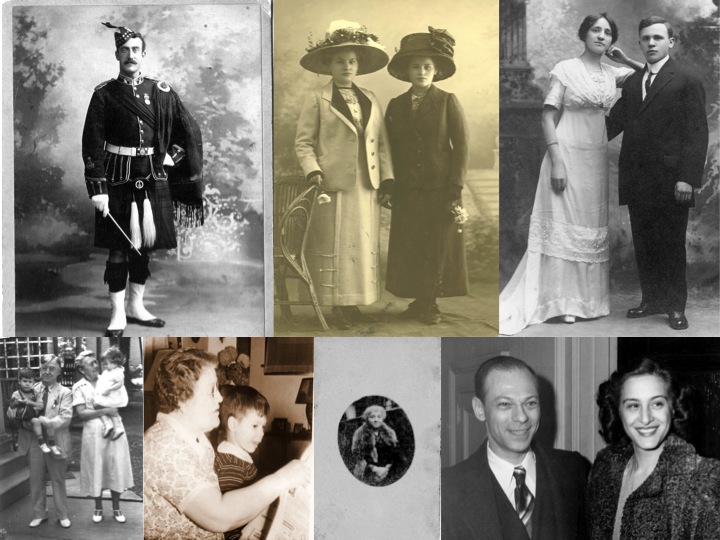
John Daniel Slatter (1864-1954) - at left - was the most famous of the Slatter brothers. At the age of 11, he served as "band sergeant" of the Boy's Band on the Training Ship Goliath, anchored in the Thames River in London. John left London for Toronto in 1884, married in 1887, and was appointed as the first-ever bandmaster of the 48th Highlanders of Toronto in 1896. Captain Slatter toured North America early in the 20th century with his renowned "Kiltie Band" and trained 1,000 buglers for WWI while at Camp Borden in Ontario. Capt. Slatter died in December, 1954.
Henry Arthur Slatter (1866-1942) enlisted at age 11
as a musician in the British Army! At top, a copy of his attestation, joining the Army in Dublin in 1877. He lied and said he was 14 years, 2 months." Later, he became part of the Grenadier Guards. By 1912, he had gone to Canada to become bandmaster of the 72d Highlanders of Vancouver. After his wife died, he remarried, and then went back to Vancouver as reappointed bandmaster of the reorganized 72nd Highlanders in 1920. Henry died in Vancouver on July 15, 1942. I'm still searching for "Jackie Slatter," born in England about 1915 to Henry and his second wife, Kathleen. Come out, come out, wherever you are, Jackie!
Sunday, June 30, 2019
Who Was Bela Roth Working For? Part 2
In my most recent post, I wrote about receiving the 1924 New York City voter registration ledger for my maternal grandma's uncle and aunt, Bela Roth and Batia Bertha Weiss Roth.
Bela said his "business connection" was "Hisckowitz," at 350 E. 67 St. in Manhattan. Bearing in mind that this was NOT Bela's handwriting on the ledger, I was prepared for some other creative spelling as I searched the 1925 New York City directory.
First Stop, HeritageQuest Online
I used my library card to access the free HeritageQuest Online genealogy databases, including the 1925 New York City directory.
I entered "Bela Roth" and "Bertha Roth" as my initial search.
Surprisingly, Bela was not listed at all (not even under his sometimes Americanized name of "Bernard").
Bertha was there, at the same address as on the 1924 voter registration--328 E. 19th Street in Manhattan.
That is a bit odd, since both Bela and Bertha are at that address in the 1925 New York state census.
Creative Spelling: Haiskowit
Next, I searched the same directory for the business connection listed by Bela Roth. I entered "Hisckowitz" but when there was none, I browsed the H section.
And as shown at top of this post, I found his employer under a creative spelling: Haiskowit.
Specifically, the listing was for Haiskowit, Myer, slsman, h. 350 e. 67th St., Apt 10. That is the exact address listed as Bela Roth's "business connection."
What kind of business? Well, in the 1925 New York Census, Bela Roth listed his occupation as "salesman," without naming any industry. He had the same occupation in the 1930 U.S. Census. And Myer "Haiskowit" says he's also a salesman. So far, no idea what kind of business they were in.
I've found several families in New York City headed by Meir or Myer Hiskowitz/Haskowitz/Huskowitz. I can't tell which might be Bela's employer, at least not yet. I'm going to try a few more research angles, including New York newspapers.
This process showed me how voter registration records can add more to the bare bones of my ancestors' lives. Thanks again to Reclaim the Records for pushing to have these documents be made more accessible.
Friday, June 28, 2019
A Bonus from the NYC Voter Registration List
![]() |
| 1924 NYC Voter Registration List - Bela & Bertha Roth |
Bela Rebuilds His Life
Bela soon remarried to a much-younger woman--Batia "Bertha" Weiss (1885-1967). Bela and Batia had three children together in Hungary. They initially arrived in New York City in 1907, returned to Hungary, and then came back to New York City permanently in 1914, bringing the entire family with them.
Bela and Zoli's only daughter, Margaret, was photographed at the "cousins table" at my parents' wedding in 1946. Bela was known affectionately in my grandma Minnie's Farkas family as Bela Bacsi--meaning "Uncle Bela." He was, in fact, my grandma Minnie's uncle because he had originally been married to Zoli, Minnie's aunt.
When I found Bela's name on the 1924 NYC Voter Registration List, first published online by the fabulous folks at Reclaim the Records, I decided to send for all the details. And I'm glad I did!
Requesting Big Apple Voter Registration
The process is simple and straightforward as long as all the required details are at hand. Read more on the Reclaim the Records site, here.
Be aware that this request process is especially smooth if the person was registered to vote in Manhattan, Staten Island, or Queens. However, if the person registered to vote in the Bronx or Brooklyn, the process is more complicated. Luckily for me, Bela and his second wife lived in Manhattan.
To prepare a request, I had to find Bela in the registration list, jot down the borough and also the Assembly District, Election District, and street address. This meant scrolling around in the list, but it only took a few minutes.
I typed a snail-mail letter to the NYC Municipal Archives at 31 Chambers Street, Rm 103, NYC, 10007. I included all the above info plus of course Bela's name, exactly as he appeared in the registration. Then I mailed the letter, with my check for $15 and a self-addressed, stamped envelope for the reply.
Two for the Price of One (Signatures Too)
Today my SASE landed in my mailbox. Happily for me, it included a bonus: Bertha was registered to vote on the line just beneath her husband Bela, living at the same address at that year. So I received two voter registration records for the price of one!
Here's what was on the ledger page:
- Date of registration (for Bela and Bertha, it was Oct 8)
- Party of affiliation (Democrat for both Bela and Bertha)
- Age of voter (Bela was 60, Bertha was 40)
- Marital status (married)
- Number of years in state and in US (11 years for both)
- Number of years in this Election District (11 years for both)
- Country of nativity (Hungary for both)
- Naturalization if not native born (Aug 9, 1921 for Bela -- "HP" meaning "husband's papers" for Bertha) and court where naturalized ("Sup, NY")
- Business connection of voter ("Hisckowitz" for Bela, "Housewife" for Bertha--I'm going to look this company up in the NYC City Directory at the stated address of 350 E. 67th St)
- Two signatures! See excerpt above.
This was admittedly an experiment and I'm pleased with the results. Not every ancestor is worthy of the $15 investment, but I was curious about Bela and got Bertha as a bonus!
Tuesday, June 25, 2019
The Stanbury Bros, Savile Row Legends (and Farkas Cousins)
![]() |
| Botpalad, at the far northeast corner of Hungary |
Thanks to my uncle's letters, my family knows about a "distant cousin" connection with Fred & Louis Stanbury, Savile Row legends who created impeccably-tailored bespoke suits for celebrities and royalty.
Just be aware: There are two family members named Fred in this post--very possibly my Uncle Fred Schwartz was named after the same Farkas ancestor as our much more famous cousin, Fred Stanbury.
Born as Steinberger in Botpalad, Hungary
Frederick Stanbury was born in 1893 in Botpalad, Hungary, as Frederick Steinberger, the oldest son of Josephine "Pepi" Farkas* and Noe Steinberger. His younger brother Louis (Lajos) Steinberger was born early in the new century.
Botpalad was, then and now, a small town...the same town where my great-grandpa Moritz Farkas was born in 1857.
Renamed Stanbury in London
Brothers Fred and Louis Steinberger were trained in fine tailoring and soon left Hungary for London. Anglicizing their surname to "Stanbury," the two worked their way up at the posh bespoke suit firm Kilgour on Savile Row.
By 1937, the firm had been renamed Kilgour, French & Stanbury to reflect the brothers' central importance to expanding the business. The firm became known all over the world for serving elite clients such as Fred Astaire, Cary Grant, Rex Harrison, and many other big names.
Uncle Fred's 1937 Visit
My Uncle Fred, planning a trip to London and the Continent, was urged by Fred Stanbury's brother-in-law (Deszo Klein, married to Sarika Steinberger) to write ahead and ask to visit in the summer of 1937. That weekend visit went well enough that the following year, my Uncle Fred again wrote and asked to arrange another meeting.
An interesting note: In 1971, Louis Stanbury told the New York Times that he had served in the French Resistance, won the Croix de Guerre, and was a member of the Legion of Honor.
My Uncle Fred's handwritten letter of 1937 mentions visiting with Louis in Paris. He had no way of knowing that within a few years, Louis would become a legend for his wartime activities as well as famous for his achievements on Savile Row.
As always, thank you to Amy Johnson Crow for this week's #52Ancestors prompt of "Legend."
*I'm very sad to say that Pepi was killed in the Holocaust, along with at least one of her children, Zoltan. Her husband Noe had died in 1939, prior to the Shoah.
Labels:
#52Ancestors,
Farkas,
Kilgour,
Savile Row,
Schwartz,
Stanbury,
Steinberger
Subscribe to:
Comments (Atom)


