Sunday, May 12, 2019

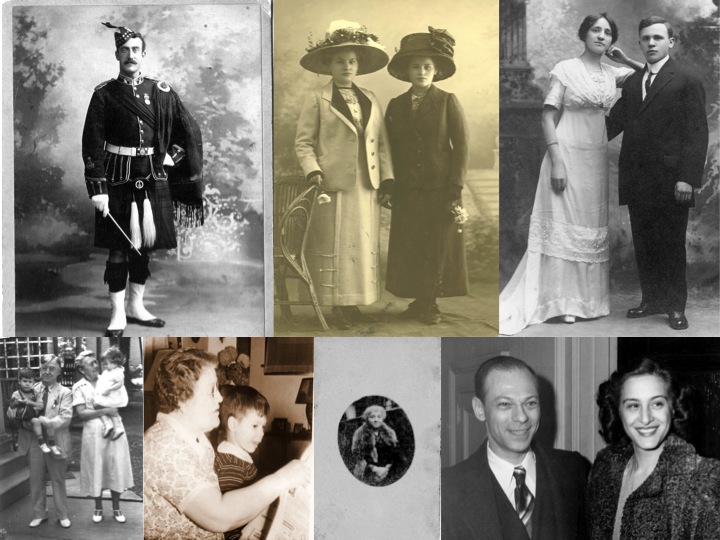
Remembering Moms on Mother's Day

Daisy Ruth Schwartz
It's been a very long time since I was able to say "Happy Mother's Day" to my mother, Daisy Ruth Schwartz Burk (1919-1981). She is still much beloved and much missed, not just on Mother's Day. Above, a formal portrait of Mom as a young lady.
Marian Jane McClure
Alas, I never had the opportunity to meet my husband's mother, Marian Jane McClure Wood (1909-1983). An only child lavished with love by doting parents, she's shown above in her 20s. How I wish I could have gotten to know her. She's remembered with great affection on this Mother's Day.

Friday, May 10, 2019

"Very Pretty Home Wedding" Starts off Sam and Anna's Life

Nearly 110 years ago, my great-uncle Samuel Schwartz (1883-1954) married Anna Gelbman (1886-1940). Sam was the older brother of my Grandpa Tivador "Teddy" Schwartz. Interestingly, although Sam was the older brother, he wasn't the first of the Schwartz family to leave their native Hungary and cross the ocean to New York City.

Teddy, three years younger than Sam, came to New York City in 1902. Two years later, Sam joined his brother in New York. Together, they sent money to bring their younger sister, Mary, to New York in 1906.

Sam & Anna's Wedding in Bridgeport

Sam met his future bride, Anna, in Bridgeport, CT, where he was working as a printer. Sam became a naturalized U.S. citizen on October 19, 1909. Days later, he married Anna in a "very pretty home wedding" according to the Bridgeport Evening Farmer newspaper (see above).

Younger sister Mary Schwartz was the maid of honor for her sister-in-law, and Anna's younger brother George Gelbman was the best man.

Two December Marriages for Mary

Fast-forward to late December, 1913, when Samuel Schwartz was a family witness signing the marriage certificate for his younger sister Mary as she married Edward (Avram) Wirtschafter in a religious ceremony.

This was actually Mary and Edward's second marriage within a few days--their first was a civil ceremony at City Hall, where they eloped on Christmas Eve.

Mary and Edward were very happily married for more than four decades, raising a son and a daughter.

Alas, Anna died of breast cancer at the age of 54, leaving behind a bereft husband and two grown sons.

Anna, Sister-in-Law and "Second Mom"

Anna served as a nurturing "second Mom" to her sister-in-law Mary, whose own mother never left Hungary. For a while, Anna and Mary lived in the same Bronx apartment building, and Mary turned to Anna for advice and assistance when she had children.

Not surprisingly, Mary's children became very close to Anna, a strong, loving bond that continued until Anna's untimely death, I was told by Mary's daughter.

Let me honor the memory of Anna and Mary with affection as Mother's Day approaches.

Thank you to Amy Johnson Crow for the #52Ancestors prompt of "nurture."

Thursday, May 9, 2019

Road Trip: At the London Metro Archives

Checking the catalog at the London Metropolitan Archives
In search of more info about hubby's great-great grandma Mary [maiden name unknown] Shehen (b. abt 1801-d. ?) my husband and I took a road trip to the London Metropolitan Archives two weeks ago.

We preregistered online and when we presented personnel with our two pieces of identification, we were each issued on-site IDs. Then we proceeded to the computers, where we entered requests for relevant materials.

In Search of Physical Documents 

Many of the poorhouse and workhouse books have been digitized and are available on Ancestry, including this ledger of admissions and discharges from the Northumberland Street Workhouse.

"Mary Shehan" is the fourth name down on this page from March, 1871. This is unquestionably the right Mary, because on the facing page is her street address--which exactly matches her residence in previous UK census records. She was in the medical ward, due to chronic rheumatism, where she remained for 30 days.

With limited time for on-site research, we concentrated on printed materials only available in person at the archives. We requested a Visitors Book for the Northumberland Street Workhouse, not sure whether Mary would have have visitors during her monthlong stay. This was a physical book from the period that we would be allowed to page through on our own!

Visitors = Oversight

Well, I have to admit that I didn't understood the terminology. "Visitors" were actually committee people responsible for oversight of these institutions for the poor. They would visit the institutions periodically and look at conditions, also indicating whether the diet was good, etc. They weren't actually individually visiting the poor people, only writing reports about the care being provided.

But the good news is that the Visitors Book listed every person kept in the insane asylum areas during each visit. Most pages showed 8-20 inmates, although there were sometimes no inmates present during a visit.

Mary Shehen was not listed in the book, most likely because she was in the medical ward, not in the asylum itself.

Still, we found it a bit amazing to hold in our hands a workhouse ledger from way back in the 1870s. It made a big impression on both of us.

Records of the T.S. Goliath

Having struck out on Mary, we next huddled with the research staff about records of the Training Ship Goliath, where three of hubby's teenaged great uncles, born poor in London, learned maritime skills and were taught to play musical instruments during the 1870s. These three boys, sons of hubby's great-grandpa John Slatter and great-grandma Mary Shehen Slatter, grew up to be well-known military bandmasters in Canada.

We were given a microfilm showing the names of recruits on the Goliath, arranged by date (not indexed). Cranking through, we found some promising leads on one of the Slatter boys to follow up later, but ran out of time to do more in-person research. Guess that means another visit?!
--
Thanks, as always, to Amy Johnson Crow for the #52Ancestors prompts. This is my post for "Road Trip."

Tuesday, May 7, 2019

Honor Roll Project: Manchester, England War Memorial

Walking through Manchester, England a couple of weeks ago, I passed this war memorial with newly-laid poppy wreaths, across from Manchester City Hall.
Although the memorial is primarily for WWI, other military service was recognized. The above plaque reads: "To the honour and memory of Mancunians who have given their lives in other conflicts since 1945." (Mancunians are people from Manchester.)
Here, the wreath is inscribed: "To our fallen comrades...British Legion, Manchester."

Only a few individual names of World War I veterans were visible, which I'm transcribing for Heather Rojo's Honor Roll Project.

They are:

Lt. Graham Lyall, Central Ontario Regiment, Canadian Expeditionary Force. 27th September and 1st October 1918. (Being honored for valor.)

Lance Corporal John Thomas, Prince of Wales's North Staffordshire Regiment, 30th November 1917. (Being honored for valor.)

Private John Readitt, South Lancashire Regiment, 25th February 1917. (Being honored for valor.)

2d Lt. Henry Kelly, Duke of Wellington's (West Riding Regiment), 4th October 1916. (Being honored for valor.)
Private Albert Hill, Royal Welsh Fusiliers, 20th July 1916. (Being honored for valor.)

Private George Stringer, Manchester Regiment, 8th March 1916. (Being honored for valor.)

Thank you to these brave military men for their service more than 100 years ago.

Friday, May 3, 2019

More Resources at HeritageQuest

From Library of Congress collection, accessed via HeritageQuest

Photos in the public domain! HeritageQuest, which many U.S. residents can access from home, absolutely free, with a local library card, has so many wonderful databases for genealogy. It's my go-to for city directories and other databases.

I also like its photo and map databases. They are conveniently searched right from the easy-to-use search box, and it's easy to change parameters to expand or restrict my searches.

Locating Photos for a Wood Family History Booklet

In preparation for a family history booklet about my husband's Cleveland parents and grandparents, I wanted to photos of the time and place, for illustration. Public domain photos would be perfect, the price is right--free!


To find a Library of Congress photo using HeritageQuest, I entered a date (1925) and place (Cleveland, Cuyahoga county, Ohio), plus the name of a well-known building, Terminal Tower, and clicked the search button.

The top results (shown here) are exterior and interior photos of Terminal Tower, taken "about 1933" (close enough to 1925 for my purposes). Good quality photos, with extra information on each page, including a written description of what's in the photo.

If you're looking for photos of a particular city, occupation, etc., or maybe a map of where an ancestor once lived, see whether your library offers access to HeritageQuest from home.

Wednesday, May 1, 2019

Researching at the London Metropolitan Archives


While in London for #FamilyTreeLive, my husband and I went to the London Metropolitan Archives for some genealogy research.

Some UK records can only be accessed in person, and that includes detailed records from London workhouses and poorhouses. We wanted to request documents about two related families in his tree: Shehen and Slatter.

Mary "Unknown Maiden Name" Shehen

Hubby's great-great-grandmother Mary (unknown maiden name) Shehen (1801-??), born somewhere in Ireland, was married to John Shehen (1801-1875).

During the 1871 Census, Mary Unknown was enumerated twice: Once in the medical ward of the Northumberland Workhouse, where she was suffering from chronic rheumatism, and once at home, with her husband, at Gray's Buildings.

We wanted to see any surviving records of Mary's stay in the medical ward and whether she was there before or after for another reason. We hoped to find clues to her death date.

Mary Shehen Slatter & Family

Mary Unknown's daughter, hubby's great-grandma, didn't escape the cycle of poverty, either. She was London-born Mary Shehen Slatter (1837-1889), who had 6 children with her Oxford-born husband, John Slatter (1838-1901).

Mary and the 5 younger children were in and out of poorhouses and workhouses while the children were growing up. The earliest admission I've found for Mary Shehen Slatter is 1873. In mid-1874, she was sent from a workhouse to the first of two insane asylums, diagnosed with melancholia. Sadly, she died in notorious Banstead Asylum at the age of 51. Cause: Phthisis (tuberculosis).

Although my wonderful cousin Anna has visited the London Metropolitan Archives to see many of this Mary's records, we wondered whether there was anything earlier that we can see--and perhaps something that explains why her husband John Slatter took off for America before his wife died.

More soon about the results of our research visit.
--
Any comments won't be posted for a few more days. Thanks for reading!

Sunday, April 28, 2019

Asenath Larimer and Worship on the Wagon Train

Cover of transcribed journal kept by Asenath Cornwell Larimer 
Asenath Cornwell Larimer (1808-1897) was born 211 years ago today.

She was the widow of my husband's 4th great-uncle James Larimer (1806-1847), who sadly died at age 40, thrown from a horse while riding near their farm in Elkhart county, Indiana.

When James died, Asenath was left with five children under the age of 10. Her brothers helped her through this difficult time, but ultimately, Asenath made a bold decision she hoped would secure her children a better life.

Westward Ho

Five years after her husband's untimely death, Asenath sold the farm she had been bequeathed and used the money to join her brother, John Cornwell, in taking two steamboats en route to joining a wagon train at Lexington, Missouri.

Their destination: the Gold Rush country of California.

Asenath wrote in a journal from March 1852-March 1853 about the daily thoughts and events of that time. She notes that her oldest son was against her going west. Despite his opposition, she wrote that "...looking forward to the dangers and trails of the way, I feel very gloomy, but in the Lord put I my trust."

Faith Guides Asenath

Asenath was sustained by her strong Presbyterian faith during the arduous journey west. When possible, she and others on the wagon train would worship together on the Sabbath. In one journal entry, she wrote [sic]:
"...we felt that the Lord was as truly with us here sitting round on the grass, as if we had worshiped in a church, and likely we felt as much love and gratitude even at home." 
Most of the time, however, the wagon train leaders pushed ahead without stopping on the Sabbath, which distressed Asenath, even as she acknowledged the necessity of maintaining a good travel pace.

Asenath recorded not just the details of daily life on the wagon train (births, sickness, deaths, cooking, laundry) but also the natural wonders they viewed, for which she praised the Lord.

Journey's End

After arriving in the mining town of Clinton, California (now a ghost town outside Sacramento), Asenath scraped by on odd jobs such as washing clothes while her brother prospected for gold.

Then she moved to San Francisco, where she launched a bakery and was joined by one of her sons. Later, she moved south to Santa Monica, where she helped found the public library. She died in Santa Monica only a few weeks before her 89th birthday.

Thanks to Amy Johnson Crow for the #52Ancestors prompt of "At Worship."
--
Note: Any comments won't be posted for a few days. Thanks for reading!