Wednesday, October 18, 2023

Occupation as a Theme in Family History

Home built by James E. Wood on Lancelot Ave, Cleveland Hts, Ohio
Home built by James E. Wood on
Lancelot Ave., Cleveland Hts, Ohio

In my husband's family tree, multiple generations of people had the same occupation. Another recurring pattern was younger generations choosing vastly different occupations than the generations who came before. The theme of occupation can be a really good hook for sharing bite-sized family history stories, no matter what your ancestors did for a living.

Slatter: Military men

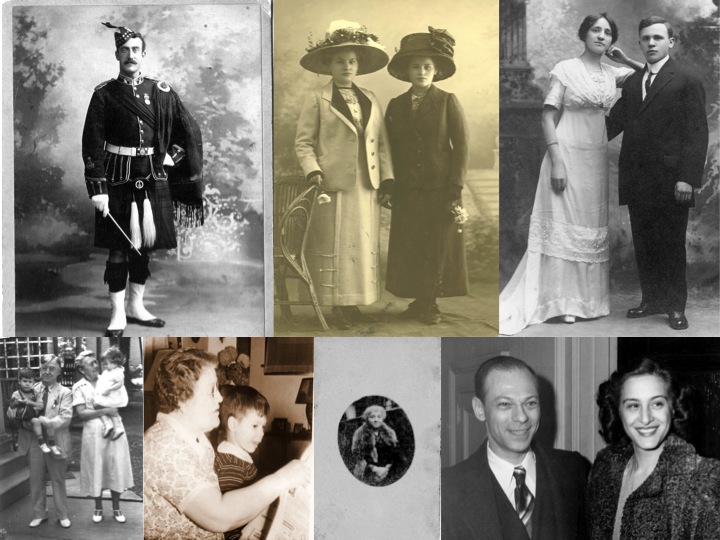
My husband's three great uncles in the Slatter family were military bandmasters, and their sons also joined the military. I've written a few bite-sized family history bios of these men, and found lots of rich research, in particular, about Captain John Daniel Slatter (1864-1954) and Bandmaster Henry Arthur Slatter (1866-1942). But even without the extra details about how Capt. Slatter popularized the kiltie band, I can organize stories around the multiple generations of Slatters who served their country in wartime and in peacetime. 

Younger relatives in our family were quite interested in the dramatic backstory of how the three Slatter brothers got their military training, starting in their preteen years. They were also fascinated by artifacts such as this WWI handkerchief, passed down in the family for more than a century. The theme of military career has been a hook for me to tell quick stories on Memorial Day and Veterans Day, not just in bite-sized bios, photo books, and on websites.

Wood: Carpenters for generations, then none

My husband's grandfather, James Edgar Wood (1871-1939) plus James's brothers and father and earlier generations going back many generations were--as the name Wood implies--carpenters. Earlier Wood ancestors were shipbuilders and general carpenters, later Wood ancestors applied carpentry to build railroad carriages, homes, and other things. 

The family still has several photos of homes built by grandfather Wood in Cleveland and Cleveland Heights, Ohio, during the first three decades of the 1900s. At top, the photo shows a home Wood built on Lancelot Ave, Cleveland Heights, as it looks today--more than a century after it was constructed. The grandchildren were impressed that their ancestor built a home so sturdy that it looks very good even after so many decades.

Then I tell the youngsters that our Wood line no longer has any carpenters. After James, the next generation went into professional careers such as stockbroker, insurance, and company management. That abrupt shift got their attention, sparking conversation about the older careers and the newer careers. 

Lower: Attendance officer and breadwinner

There were women teachers in several branches of my husband's family tree during the first decades of the 1900s, but usually they stopped teaching soon after marriage. Hubby's grand aunt, Lola McClure Lower (1877-1948), wasn't a teacher, though she worked in schools when she became the breadwinner of her family after her husband, a civil engineer, was confined to bed.

Lola built a career as a truant officer in Wabash, Indiana, and became well-respected in the field, giving presentations to regional conferences. How she found time to volunteer for the Red Cross for 25 years, I'll never know. Telling her story is an opportunity to hear what younger relatives think about her choice of occupation! Plus an opportunity to discuss societal and economic changes during the 20th century as more women entered the workforce.

IMHO, any occupation, in any time period, can be an engaging theme for sharing family history stories. Just don't bury the lede

Monday, October 16, 2023

Family History as News: Don't Bury the Lede


When I write family history stories and create family history photo books, I put the important stuff close to the beginning. Why? It's an old but still relevant journalism adage: don't bury the lede.  

In other words, don't wait to reveal key information until later in the story...unless there is a really compelling reason to build up to it slowly.

Will our audience pay attention?

For family historians, simply getting the attention of our audience can be a challenge. Encouraging them to keep reading or listening to a story about ancestors is often a challenge as well. Every family history incident has some drama or mystery or fascinating element--it's up to us to shape the narrative and keep the audience engaged.

If we bury the lede, we make the audience wait for the payoff to the story. Um, maybe they won't stick around until the second paragraph or second page to find out what happened to that ancestor.

But if we give them a strong hint or outright reveal the most exciting or important details near the start, our audience will know right away why this story is worth their time. I hope they'll be intrigued enough to continue to find out who, what, when, where, and why. Especially why! 

It's news to them!

For example, when I blogged about my grandpa Isaac last week, my first paragraph didn't hide what was going to happen--it led with the sad fact of his death while visiting relatives. Then I told the story leading up to his unexpected death. No need for suspense, 80 years after the fact, IMHO. 

Family history isn't exactly news coverage but I feel these stories are, in fact, news to our younger relatives. Maybe they've heard the story before, but not with the new discovery I just made. Or maybe they've never heard about what other people did or said about the story and how it rippled through the family in the past. There's always a way to make genealogy fresh and interesting.

That's why, as the family historian conveying ancestral news to the next generation and beyond, I believe it's up to me to put the lede up front. 

Wednesday, October 11, 2023

How Floyda Won Her Divorce Plus Alimony and Court Costs


In my current family-history photo book, I'm telling the story of my husband's maternal grandparents, Floyda Mabel Steiner McClure (1878-1948) and Brice Larimer McClure (1878-1970). One page is devoted to Floyda's first marriage, to an affluent local farmer in Upper Sandusky, Ohio, in 1898. Three years later, Floyda left him and filed for divorce--very unusual for a woman in her early 20s in small-town Ohio, circa 1901.

Which court house?

A few years ago, I called two county court houses in the area to see which might have the divorce files. Turns out Floyda filed in the closest court to her hometown, much to my surprise. Other ancestors I've researched filed for divorce in a neighboring county or even another state. Not Floyda. I imagine her mother and sisters stood by her as she prepared to confront her husband in the court room. 

It cost me only $3 and postage to obtain photocopies of all the divorce documentation by snail mail. Here's what I learned, all of which I'm sharing in my photo book.

Floyda's side

Floyda alleged that her husband was verbally abusive (calling her a "damn hen" and jeering that she was low-bred, among other taunts and curses I won't repeat here). She said he was also physically abusive (scratching her face, kicking her, threatening to do more). 

Her husband's side

Her husband's attorney responded to the petition with just a few handwritten lines to the court. The lawyer wrote "that the facts stated therein are not sufficient to constitute a course of action." Note that the lawyer didn't dispute Floyda's version, just said the allegations weren't enough to lead to divorce. Hmmmm.

No-show leads to divorce

Floyda's husband failed to respond in person to the court summons and the judge therefore ruled entirely in Floyda's favor, granting the divorce and all she requested in her petition. 

At top is the accounting of how much Floyda won: $215 in alimony and full payment of her divorce costs (in all, worth $8,400 in today's money). 

The court also ruled she could return to her husband's home and retrieve her own belongings. Floyda now legally resumed using her maiden name. I found her mentioned in newspaper social items as "Miss Floyda Steiner" once again. 

Only recently did I figure out how Miss Steiner met Mister McClure. That story is also in the current photo book! 

Sunday, October 8, 2023

The Tragic Last Trip of Grandpa Isaac

Tintype taken around the time of their marriage in 1906

My paternal grandfather Isaac Burk died on this date, 80 years ago. At the time, he and my grandma Henrietta Mahler Burk, who lived in New York City, were on what was probably a rare trip during the war years. They had been married more than 37 years, and had four grown children. This vacation began with laughter and happiness, but ended in tragedy and tears.

Grandpa Isaac got me into genealogy

More than 25 years ago, my maternal cousin was creating a family tree and wanted to know a bit about my father's father. Unfortunately, I knew very little about Grandpa Isaac, who had died many years before my birth. All my cousin asked for was his death date and place. In the days before digital documentation and genealogy websites, it took me (an absolute beginner) a very long time to learn the sad story of Isaac's final days.

For months I researched New York deaths in the Bronx, Manhattan, and Brooklyn within a wide range of dates, with no luck. Eventually, I went to my library and used its New York Times historical database to search for Isaac's name in the death notices, remembering that my city-based family traditionally posted notices to let people know about funerals. I found a terse notice about Isaac Burk's death on Oct. 8, 1943 and his funeral service on Oct. 10, 1943, listing his wife and four children as survivors. No info about cemetery name or location. 

Now I dialed the NYC authorities, asking about a death cert from that period. A kind official put me on hold to look, believe it or not, and then returned to tell me that Isaac Burk had NOT died in New York city or state. What?? I threw myself on his mercy, asking for advice, since I had been searching for nearly two years and had no idea what to do next. He lowered his voice, not to be overhead by others in the office, and casually recommended I look out of state, such as in, say, Washington, D.C., of all places. 

Why were my grandparents in Washington, D.C.?

With this clue, I wrote away to the D.C. authorities and enclosed a check to pay for Isaac's death certificate. The cert arrived a few weeks later, and I was both excited and confused. My grandparents' "usual residence" was in New York City...but Isaac died of a heart attack at a residential address in Washington, D.C., and the informant was his brother-in-law, Louis Volk. I blogged about this mystery, and it caught the eye of a paternal cousin who filled in more details.

Isaac and Henrietta had traveled to Washington to stay with her favorite sister, Ida Mahler Volk, arriving in early October, 1943. World War II was raging, and I doubt my grandparents traveled very far or very often. Their two sons were serving in the US Army overseas. Their two daughters were married and in their own households. This trip must have been much-anticipated.

Isaac and Henrietta got together with other family members while in D.C. and enjoyed walking downtown, as well as sitting and chatting at Ida's home. It was a Friday afternoon, just after lunch in the home of Ida and her husband Louis, when Isaac had a heart attack and died. Grief-stricken, the family scrambled to have Isaac's body sent back to New York City, and his funeral was held that Sunday afternoon. He was buried in New Jersey. Small wonder I had great difficulty researching this ancestor's death in the pre-internet days. 

Years later, another paternal cousin found documentation that filled in the blanks of Isaac's last good day and his burial.

I'm grateful that my dear maternal cousin asked about Isaac, sending me on this genealogical journey and connecting me with dear paternal cousins.

Remembering Grandpa Isaac on this anniversary of his death.

"Travel" is this week's genealogy prompt from Amy Johnson Crow for her #52Ancestors series.

Wednesday, October 4, 2023

Mark Your Calendar for WikiTree 15th Anniversary Events


This is WikiTree's 15th anniversary year and the celebration will take place over three days in early November. 

Fifteen years of building a free, worldwide collaborative family tree, with more than a million genealogy folks adding more than 35 million ancestor profiles.

You're invited to attend any or all of the free genealogy presentations on November 3-4 plus a virtual party on November 5! Door prizes are part of the celebration too.

More than 30 speakers are participating, and the program also includes a panel discussion about artificial intelligence and genealogy.

You don't want to miss this special event! Take a look at the full schedule here.

Please mark your calendar and save the dates...including my presentation, "Keep Your Family's History Safe for the Future," on Friday, Nov. 3, at 5 pm Eastern. Watch my talk on YouTube with this link.