Saturday, October 1, 2022

World Postcard Day: Spring Valley to the Bronx


In April of 1941, my mother's best friend Sara sent this colorful postcard to Mom in the Bronx.

Sara was on a brief getaway to the green, leafy town of Spring Valley, New York. Today, that town is much more populated and easy to reach via the Tappan Zee Bridge. 

But in 1941, there was no bridge, very little traffic...so the area was a quiet, bucolic place to escape the bustle of city life.

In fact, my maternal grandparents sometimes rented a bungalow in Spring Valley to get out of the Bronx during the hottest summer weeks.

This was before America entered WWII, well before Sara's husband began to serve in the Navy, well before Mom's sister, brother and first cousins began to serve in the US military.

Notice the one solitary car at far right of the postcard? Fun.

#WorldPostcardDay 

Friday, September 30, 2022

Don't Be in a Hurry! Check the Actual Vital Record


Over time, I've been researching vital records for my husband's Work, Short, McClure, McKibbin, and related ancestors who spent time in Indiana. 

Although the Hoosier State began requiring registration of births in 1882, not every county or municipality complied. Luckily, nearly all of the births after 1920 were registered with the state health department. This informative page on the Family Search wiki explains the details.

Recently, I heard from a descendant of my husband's McKibbin line, who was kind enough to mention new clues that jumpstarted my research.

When I got to hubby's 4c1r, it would have been easy to quickly read the transcribed info and add to my tree without looking at the digitized image of the record.

BUT if I'd hurried on, I would have missed the extra details that Indiana so thoughtfully requested on its birth certs at that time, and which I didn't know about till I looked at the record itself.

Multiple birth?

Note the questions in the hot pink oval: 

  • Is this birth a twin or triplet or other?
  • Number of order of birth of this child
  • Is this child legitimate?
Although this child was not part of a multiple birth, I would have liked answers to such questions on other vital records for twins elsewhere in the family tree.

Researching decades after a twin or triplet has died, it's often difficult or impossible to learn who was born first and who was born next. Because I'm an older twin, and but my mother was a younger twin, I have a special interest in birth order among multiple births!

Learning about legitimacy is also of interest to my research, a nudge to look for marriage documents (or not). 

How many children in all?


I'm familiar with New York City/state birth certs because that's where many in my family tree were from. As shown above, there's a question on the NY cert asking how many previous children were born to this mother and how many are now living, in all. This child was the second for this mother, and both were living in 1908, the year of this cert.

Similarly, in Indiana, as shown at top, the blue oval highlights those questions:

  • Number of children born to this mother, including present birth?
  • Number of children still living, including present birth?
For the McKibbin ancestor born in Indiana in 1921, this cert revealed he was one of 8 but only 7 living at that point.

Now I had a narrower window for researching the other siblings, including the one who sadly was born and died before 1921. This is especially important for children who were lived their entire lives between Census years.

By taking a few moments to look at the actual vital record, and read the fine print, I saved a lot of research time in the end. Slow and steady wins!

Wednesday, September 28, 2022

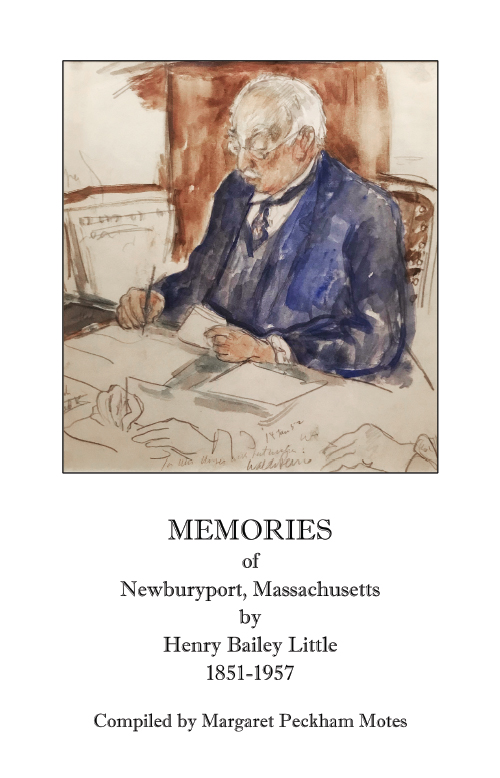
Book Review: "Memories of Newburyport, Massachusetts"


It's too bad my hubby and I have no ancestors who were born, married, died, worked, or sojourned in Newburyport from the 1850s to 1950s. 

Even though we don't know anyone from that place and that period, I really enjoyed reading "Memories of Newburyport, Massachusetts by Henry Bailey Little, 1851-1957," compiled by Margaret Peckham Motes. 

This is a charming recent reprint from Clearfield Company/Genealogical Publishing.

The memories of Henry Bailey Little, originally published in the late 1950s, evoke a fascinating, engaging picture of the changes taking place from the mid-19th century to beyond the turn of the 20th century. 

Little had a front-row seat for changing times in Newburyport, raised on a farm and later serving as president of a major savings bank for more than five decades. 

Of the shipping industry, once a huge economic engine in the area, Little recollects: 

"With the exception of the cotton mills, practically all the business of the town was on the river-bank, the shipyards, and the wharves. The shipyards have disappeared and been forgotten and the wharves are in a state of decay. The last square-rigger was built here in 1884 and while there were a few small vessels built later, after that date shipbuilding was for the most part ended."

The accompanying illustrations shepherd readers through the town's past, including those shipyards, the mills, and even a few gravestones of note. 

Of special interest to anyone with ancestral roots in or near Newburyport: the book has a detailed index of names, places, industries, and businesses. 

In short, check out this book if your ancestors had even a minor connection with the area!

*Note: Genealogical.com sent me this book free, for review purposes. The opinions here are entirely my own!

Monday, September 26, 2022

How a Family Heirloom Lives On

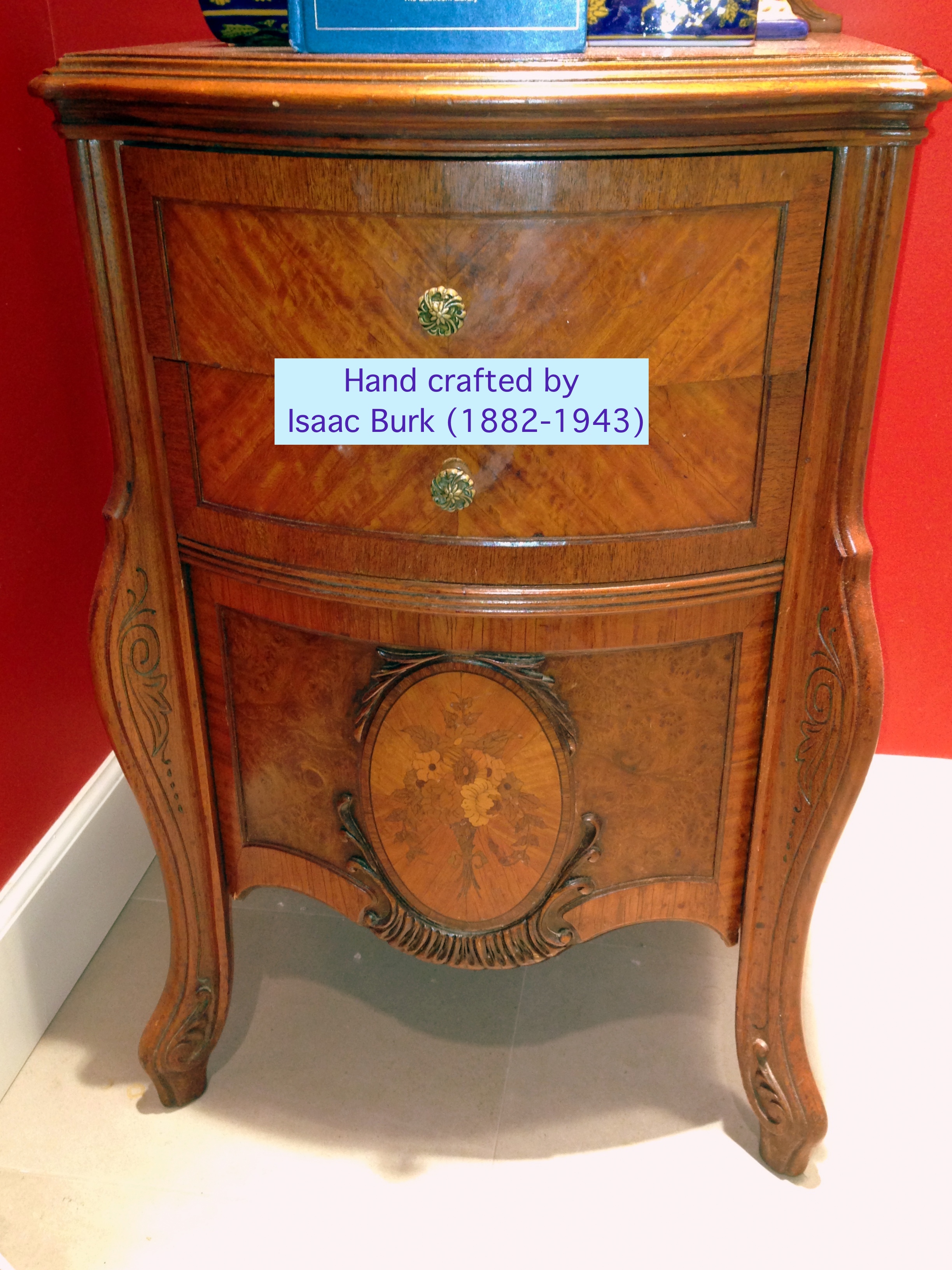
My paternal grandfather, Isaac Burk (1882-1943) and his older brother, Abraham Berk (1877-1962), both trained as cabinetmakers before leaving their hometown of Gargzdai, Lithuania, around the turn of the 20th century. They were seeking more economic opportunity in North America...Isaac ultimately settling in New York City, Abraham settling in Montreal.

That lovely piece of furniture in the photo at top, complete with special touches, was handmade by Isaac many decades in the past.

After Isaac died, the night stand was used daily by his widow, my grandmother Henrietta Mahler Burk (1881-1954), and then inherited by her younger son, my uncle Sidney B. Burk (1914-1995). 

Today, this heirloom has a special place in the home of my first cousin, who regularly talks of Isaac and Henrietta to his children and grandchildren.

Even without the actual heirloom, I do the same--telling descendants of Isaac's woodworking virtuosity and showing off the photo to give the next generation a sense of pride about their ancestor's creation. His name and his skills will live on!

Thursday, September 22, 2022

From Training Ship to Bandmaster: Goliath Boys


My husband's Slatter ancestors, who lived in the impoverished London neighborhood of Whitechapel, have quite a back story. I've previously researched and written about the difficult life and sad fate of his great-great grandmother Mary Shehen Slatter (1837-1889), who ended her days in an insane asylum. Her husband, John Slatter (1838-1901) left his family behind even before Mary died, making his way to Ohio to start over. 

The impressive--and inspiring--part of this family's history, however, is that as adults, the Slatter children broke the cycle of poverty. Both of the daughters (Ada and Mary) followed their father to Ohio, married hard-working men, and raised children in the Buckeye State. 

Amazingly, three Slatter sons--Albert William (1862-1935), Henry Arthur (1866-1942), and John Daniel (1864-1954)--began the journey toward a better future when they were placed on a training ship anchored in the Thames. They became "Goliath boys."

On the Training Ship Goliath

The Slatter children had been sent to Forest Gate School for education while their father was absent and their mother was in an asylum. From 1870 on, this school operated a training ship positioned near Grays, called the Goliath. The goal was to teach young pauper boys necessary skills that would prepare them for military or civilian occupations (and keep them out of poorhouses).

From knots to notes, plus swimming and reading, thousands of boys gained skills especially valuable for the Royal Navy or for serving on merchant vessels. Instructors hoped their students would "follow the sea" after leaving the Goliath, and many did just that.

The training situation was highly disciplined, and conditions often were harsh...but the three Slatter boys apparently had musical talent that was shaped and sharpened by their time on the Goliath. In fact, John was Band Sergeant and solo cornet of the Goliath's Boy's Band at the age of 11, in 1875, according to one of his obituaries.

Tragedy on the Goliath

Teenaged Albert William Slatter left the Goliath in November of 1875, enlisting in the Shropshire Light Infantry--not the Royal Navy

But the other two Slatter boys--not yet teens--were among the hundreds of students remaining on the Goliath when fire broke out on December 22, 1875.

Despite efforts to extinguish the flames, the ship was consumed by fire and the boys were urged to save themselves by diving into the water. John Daniel Slatter and Henry Arthur Slatter survived by jumping into the Thames, but some students and at least one adult died, sad to say.

This horrific fire was covered by newspapers far and wide, I was a bit surprised to learn when I did an online search. In addition to British press, I found coverage stretching into 1876 in the New York Times and even in a New Zealand paper, and the Goliath has multiple online references (not just a brief, sketchy Wikipedia page).

From Goliath to the Exmouth

The Exmouth, another training ship in the Thames, was the next stop for many of the students who escaped the Goliath fire. 

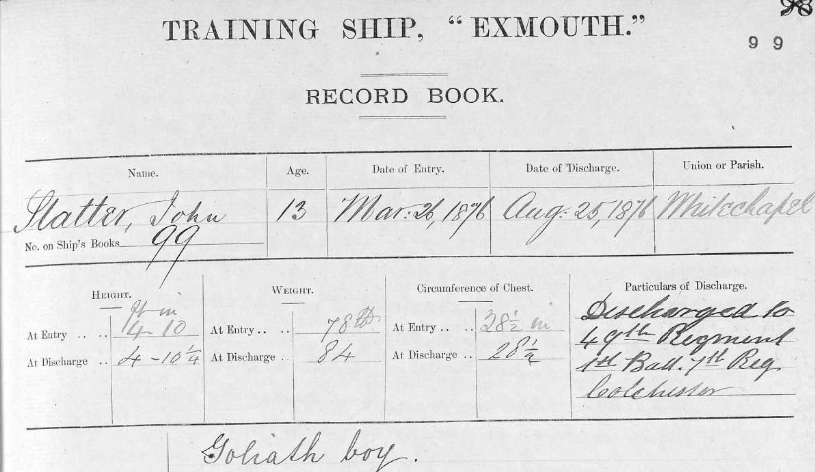
At top is an excerpt from a record book for the Exmouth, showing that John Slatter was a "Goliath boy" moved to the Exmouth from March to August of 1876. The notation states he was discharged to an Army regiment in Colchester--not the Royal Navy!

Above, the record book page for Henry Arthur Slatter, also listed as a "Goliath Boy," living on the Exmouth until September of 1877. Subsequently, Henry joined the Army--not the Royal Navy

Building Better Lives 

In time, all three of these Slatter brothers used their musical skills to advance through the ranks and become highly respected military bandmasters in Canada, as well as devoted family men.

John Daniel Slatter was bandmaster of the 48th Highlanders of Toronto, which popularized the "kiltie band" fad at the turn of the 20th century.

Henry Arthur Slatter was bandmaster of the 72d Seaforth Highlanders of Vancouver.

Albert William Slatter was bandmaster of the 7th London Fusiliers of Ontario.