Tuesday, March 29, 2022

1950 US Census "Sample of Sample" Questions


Just days until the 1950 US Census is released and I'm more than ready to dive in and find my ancestors on April 1st. 

It would be a stroke of luck to have an ancestor selected as part of the "sample" to answer additional, detailed questions about 1949 residence, 1949 income, parents' birthplaces, school attendance, and military service.

Six out of 30 answered sample questions

This sample consisted of 6 people out of the 30 enumerated on every page of the Census. Truly a treasure trove of family history if one of my ancestors is included.

From those who answered the sample questions, one was asked a few "sample of sample" questions. As shown above in an excerpt from the US National Archives page listing all the Census questions for 1950, these questions were for people aged 14 and up.

More details about marriage and children

If one of my ancestors is listed on a line selected for the "sample of sample" questions, the answers will illuminate his or her marital history. Was the person married more than once? How many years since marital status changed? Wonderful genealogical clues for me to follow up and search for marriage or divorce documents!

If I'm really lucky, that person will be one of my women ancestors. Why? Because the final question asks how many children this woman has ever borne.** This will give me hints about whether I've missed an infant death, for instance, and improve my family tree's accuracy for the sake of future generations and future researchers.

1910 vs 1950 question about children

The last time this kind of question was asked was in the 1910 US Census (and before that, the 1900 Census). In 1910, the enumerator first asked how many children the woman ever had borne, and then asked how many were still alive. That's how I knew to look for children who died young or in between Census years. 

Did my paternal grandma Henrietta Mahler Burk (1881-1954) have any children who died young? In 1910, she told the Census she had 2 children and both were alive. Now when the 1950 Census is released, if this ancestor was asked the "sample of sample" questions, I hope to learn whether there were other children I never knew about. 

My great-grandma Tillie Jacobs Mahler (185?-1952), reported 9 children in all and 7 alive in 1900, then 10 children in all and 7 alive in 1910. What about in the 1950 Census? 

My maternal grandma Henrietta Farkas Schwartz (1886-1964) got married and had her children between 1910 and 1920 and never answered this question before the 1950 Census. I don't expect any surprises, but who knows--let's see if she was asked the "sample of sample" questions.

**Note the assumption built into this final "sample of sample" question: If a woman said she was never married when answering question #12 on the Population Schedule, she would not be asked question #38. On the other hand, if she answered that she was married, separated, divorced, or widowed, she would be asked this question if she was recorded on the line chosen for "sample of sample" questions. This assumption didn't apply to the 1910 or 1900 question, apparently.

To see all of my 1950 US Census posts, please go to my summary page here.

Sunday, March 27, 2022

Seeing Double in Our Family Trees


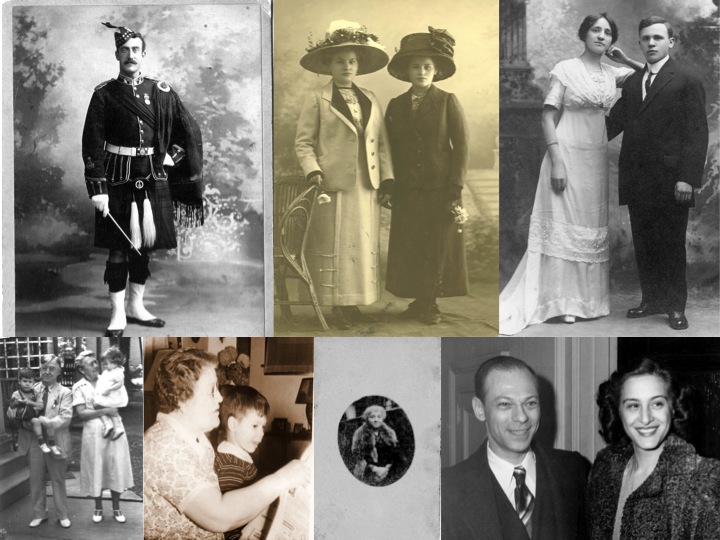
Twins definitely run in my Farkas family tree: I have a twin sister and we're daughters of a twin. Above, my mom and her sis (the Schwartz twins) about 1920ish. In addition, the Farkas family included twin boys, "Woody" and "Sandy," my second cousins.

Twins also appear in my paternal line. Among my Dad's 1st cousins on the Mahler side were Harvey Smith (1916-1996) and his twin brother Jules Smith (1916-1996). They died within five months of each other and are buried near one another in Florida. 

My husband's family tree has twins, as well. Born on the eve of New Year's Eve in 1854, twin sisters Amanda "Callie" McClure (1854-1887) and Anna "Addie" McClure (1854-1928) were great-great aunts of my husband. 

Interestingly, these McClure ladies had cousins who were fraternal twins: Jesse McClure (1875-1952) and Bessie McClure (1875-1959), born on January 31, 1875. This brother and sister were 1c2r of my husband.

"Joined together" -- in this post, about twins together -- is the #52Ancestors prompt for week 12 of Amy Johnson Crow's genealogy challenge.

Friday, March 25, 2022

Did You See These These RootsTech Sessions?

 
Hundreds and hundreds of RootsTech presentations from 2022 and 2021 are still available to view, for free, at RootsTech.org.

There were many excellent sessions, and I still have dozens more to view, waiting on my playlist. 

Here are five sessions that provided food for thought and encouraged me to dig deeper into genealogy and family-history questions. If you haven't seen them, please consider adding them to your playlist!

  • Dealing with ethical dilemmas in an online world. So many ethical questions arise in today's world of genealogy, and this session looks at a few very timely concerns (DNA, grave memorials, and terms of service, to name just three). A conversation worth watching.
  • When Harry met Dotty. A relatively brief but fascinating and informative case study of how Nick David Barratt used DNA to break down a key brick wall. Maps are part of the story too. A good case study like this can be really helpful!
  • Genealogy YouTubers. I've already blogged about this terrific panel discussion. What did I love? The candid conversation about the challenges and opportunities of using YouTube to connect with an audience of family historians. Interesting and fun.
  • What to do when there's nothing to do. Speaker Renate Yarborough Sanders reminds us of the many things we can do when we choose to take a break from intense research and return with fresh eyes. Thoughtful and encouraging!
  • Family Folklore: Fact or Fiction? Anyone who's heard a family legend will get something out of watching Virginia M. Pratt's talk, featuring interesting case studies of trying to find the truth and suggestions for how to discuss family stories with relatives. 

Wednesday, March 23, 2022

1950 US Census Prep: Check for Special EDs on the Maps


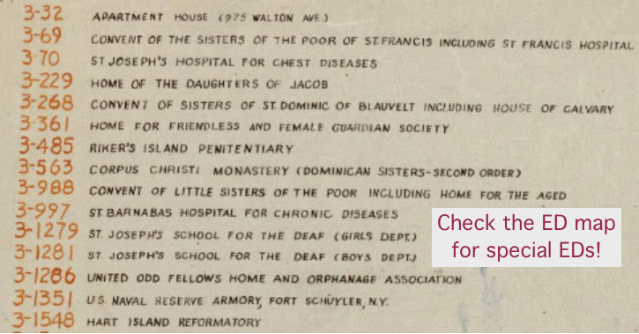
If you, like me, suspect some ancestors were in a hospital, hotel, or another facility on April 1, 1950, let me suggest something to try as you prep for the release of that year's Census.** 

Check the Enumeration District maps for the county, town, or city where that institution was located. You might be lucky and find a listing of special EDs at the top, bottom, or elsewhere on the map where those buildings are shown.

Above, a partial listing of special EDs from an ED map of one section of the Bronx, New York, showing convents, an orphanage, a reformatory, a monastery, hospitals, schools for the deaf, even a large apartment house. This is an unusually long list--but it's not unusual to find special EDs marked on an ED map. Take a look!

Knowing the specific ED for the institution or facility gives you a head start on April 1, when the Census is made public. You'll be able to either browse the handwritten Census sheets for that one ED or use NARA's initial index to search by name and ED. 

I'm not 100% sure where all of my ancestors will be, or which will be away from home. One ancestor lived for years in a residential hotel and that's where I'll look first in the 1950 US Census. Another died weeks after the Census was taken so she might actually be in a nearby hospital, not at home. In each case, having the ED number for the facility can help me find those ancestors more quickly before full indexing.

The big genealogy sites are gearing up to the 1950 US Census fully indexed sooner rather than later. FamilySearch.org has an update page where you can learn more about the release and about indexing. If you want to help FamilySearch index the Census, I recommend watching Devon Lee's Family History Fanatics video about indexing

IMHO, since indexing can't be done until April 1st, there is still time to prep by finding EDs and being ready to look for top priority ancestors when the Census is made public!

**To see how to turn a street address into an Enumeration District, I have a case study here. To see how to use Enumeration maps and descriptions, see my case study here.

For even more posts and links related to the 1950 US Census release, please see my summary page here.

Monday, March 21, 2022

1950 US Census Search: Look for Head of Household


The 1950 US Census will be released on April 1st!

Recently, the US Census Bureau hosted a webinar at which Census and US National Archives experts talked about the background of this Census and what will be available on the day of release. That webinar is posted on YouTube.

Claire Kluskens of NARA discussed the basic name and location index that will accompany the 1950 US Census release. It could very well give us a head start on our searches!

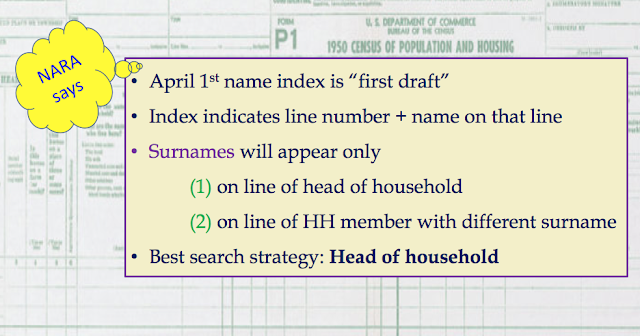
My key takeaways from her comments are shown in the image at top.

  1. Try the search functions but remember the name index is only a first draft and will need to be refined with the assistance of members of the public who submit corrections to NARA.
  2. Indexing was line by line on each sheet of the Census, showing the line number and the name written on that line.
  3. Enumerators were trained to write the surname of the head of household and the given name/initials. Others in the household who shared the same surname will NOT have the surname listed on the line number, only the given name or initials.
  4. If someone in the household has a different surname (such as a married daughter or a lodger), that line will show the surname and given name.
  5. BEST SEARCH STRATEGY, says this expert, is to look for the head of household if known--because that line will have the person's full name.
You can try your search with a combination of the head of household's surname, given name, and location (ED or city/town and county). 

Use all your usual search strategies but be prepared to browse by ED if your search doesn't lead you to your ancestors.

Meanwhile, Ancestry and Family Search and MyHeritage will all be working hard to index the Census. 

For more 1950 US Census tips and info, see my summary page here.