Friday, February 4, 2022

Branching Out to Look Up and Link Ancestors

Part of my genealogical routine is after I look up ancestors on Ancestry, Family Search, and other sites, I link them to siblings, spouses, and children on Find a Grave. 

The process of looking up ancestors and branching out to their extended families has led me to new information and even new-to-me sources.

New to me: Canadian Headstones

Yesterday when I looked up one of my husband's Canadian ancestors on Ancestry, I noticed a different database show up with clues to burial place/dates.

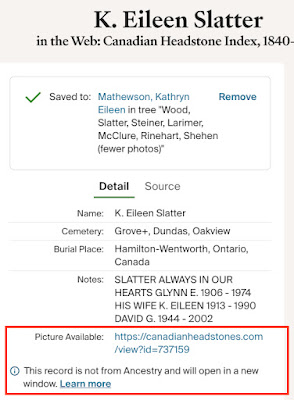
Shown here is the results page from Ancestry informing me that this Slatter gravestone can be viewed on CanadianHeadstones. I clicked to view the picture and the transcription, and I compared the details with what I know about that family. Eureka--a good match from a resource I'd never before used. Of course I'm going to be plugging in other ancestor names to search for more headstones in Canada. But first...

Search and link

After saving this result to all three of the Slatter ancestors mentioned in the gravestone transcription, I looked for these ancestors in my virtual cemeteries on Find a Grave. I expected to find Glynn Edward Slatter (1906-1974), my hubby's cousin through his maternal grandmother, Mary Slatter Wood (1869-1925). 

Glynn wasn't in my virtual cemetery of Wood and Slatter ancestors, because his memorial page on Find a Grave was added only last month. I quickly added him.

Next, I searched out the memorial for Glynn's wife, Kathryn Eileen Matthewson Slatter (also created only last month!) and submitted an edit to link the two as spouses.

My search of the same cemetery on Find a Grave turned up no memorial for Glynn and Kathryn's son David. He was, however, clearly listed on the photo of their gravestone on CanadianHeadstones. 

Based on that info, I created a page for David and then linked him to his parents. All are in my virtual cemetery. And all are now available to the world on Find a Grave, linked by relationship.

"Branching out" is this week's #Genealogy #52Ancestors prompt from Amy Johnson Crow. 


Wednesday, February 2, 2022

Fleshing Out Ancestors Based on Military Records


Reading through the detailed British and Canadian military records available for my hubby's great uncle, Henry Arthur Slatter (1866-1942), I found lots of non-military details that helped build a picture of the boy, the man, and his family. Physical descriptions, health and dental details, but also clues to major turning points in his life.

Born in the gritty Whitechapel section of London, Henry and two of his older brothers were preteens when they were put into a training program designed to give pauper boys the skills to serve in the military or at least have a trade. All three flourished in the program, becoming accomplished musicians well suited to the military life. After they grew up and continued their military careers, they all left England to become well-known bandmasters in Canada.

From poverty to bandmaster

Reading the records, it was clear Henry lied about his age to join the military. Both the official birth index and his baptism record show a birth year of 1866. Yet somehow Henry was recorded as being 17 (instead of 15) years old in the 1881 UK Census, where he was a private in the 7th Fusiliers. 

In 1884, he added two years to his actual age and enlisted as a 20-year-old when he joined the Grenadier Guards. Those records were lengthy!

One son died young

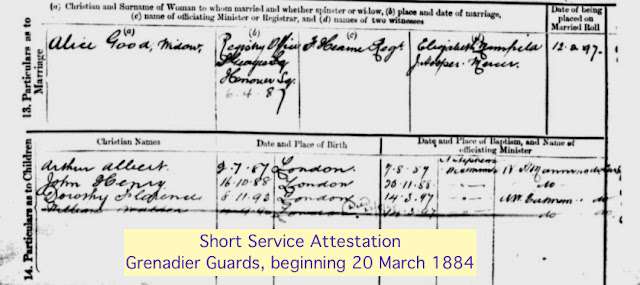
As shown at top in an excerpt from the pension pages in the file, Henry and his wife, Alice Winter Good (1864-1914), had four children...but unfortunately, one child is crossed out in the listing, with a notation about his early death.

I had previously found little William Matthew Slatter's birth, but not his death. Now Henry's military record gave me a death date for this young son, as well. 

After serving in the Grenadier Guards and earning a pension, Henry moved his family to Vancouver. In 1912 Henry was serving as bandmaster for the 72nd Seaforth Highlanders. Then World War I began and more tragedy struck Henry's family.

On Christmas Day of 1914, Henry's wife Alice died. Their son Arthur Albert Slatter (1887-1917) was killed in action with the London Regiment of the 20th Battalion of the Royal Fusiliers, during fierce fighting in Europe (his name is now on the Arras Memorial in France). 

Second marriage details


The military files note that Henry enlisted in the WWI Canadian Expeditionary Forces, serving in England with the 1st Canadian Reserve Battalion.

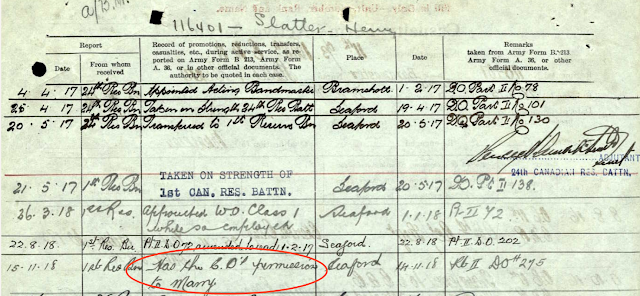
Shown above is part of a page from his thick WWI CEF file. On November 14, 1918, the CO granted permission for Henry to remarry. He was 52 at the time.

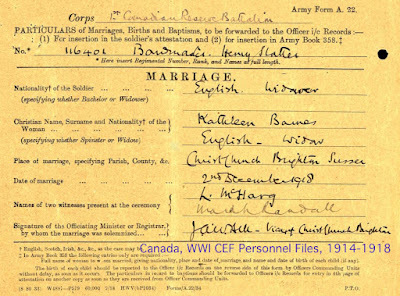
Also in the file is a detailed card showing the bride as Kathleen Barnes, an "English widow" and the groom as an "English widower." They were married on December 2, 1918, in Christ Church, Brighton, Sussex, and the card even includes witness names. 


Wonderful genealogical details but also good for me to see that he was not alone. According to the military examiners, Henry Arthur Slatter was generally healthy, did not have any medical complaints (although he did have poor eyesight), and didn't look his age. Reading their comments gave me more of a sense of the human being, not just the military man.

No wonder I scour every page of every military record in search of details that add to my knowledge of an ancestor's life beyond the service.

Friday, January 28, 2022

Pop Quiz, Part 3: 1950 US Census Vocabulary


This is the answer sheet for the vocabulary terms in Part 2 of my quiz series. 

5. Naturalized? AP

In answering the question about naturalization, enumerators would write "American Parents" when an individual was born to US citizens in another country or at sea. For more, see the full Urban & Rural Enumerator's Reference Manual on Google books here.

6. Sample Person - How would a person be designated as a sample?

On every page of the population schedule, enumerators were instructed to ask additional "sample" questions of people who they listed on certain line numbers. The line numbers varied by page, to add a measure of randomness. So on one page, a separate sample person would be designated on each of lines 1, 6, 11, 16, 21, and 26. On the next page, the sample person would be designated on each of lines 2, 7, 12, 17, 22, and 27. For more, see the middle of the page on Steve Morse's 1950 discussion here.

7. T-Night - What does the T stand for?

T is for transient. Two nights (April 11 and April 13, 1950) were designated for enumerators to visit hotels, hostels, flop houses, and other places where people lived temporarily. For more, see the History Hub blog post here.

8. $10,000+ - When would this be shown?

If an individual answering the sample question about income earned more than $10,000 in the year 1949, the enumerator would record it as $10,000+ rather than entering a specific higher amount. For more, see here for the History Hub discussion of sample questions and enumerators' instructions for recording answers.

I hope you enjoyed these pop quiz posts as you prep for the 1950 US Census release on April 1. For Part 1 pop quiz, see here.

PS: Want to download an original Form P1? See this page on the US Census Bureau site.

And read more about getting ready for the 1950 US Census release on my summary page here.

Thursday, January 27, 2022

Pop Quiz, Part 2: 1950 US Census Vocabulary


This is Part 2 of the 1950 US Census vocabulary quiz!

First, the answers to questions in Part 1. 


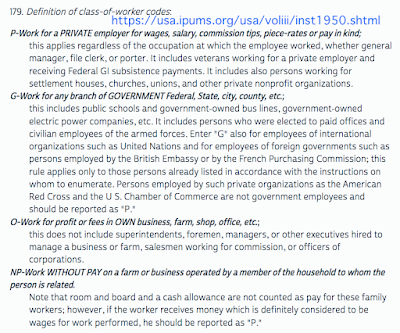
1. Class of worker: P, G, O, NP

P = working for a private employer

G = working for a government agency

O = working in your own business (for pay)

NP = "no pay," as in working without pay on the family farm or in the family business

For more about the 1950 questions, see this page on the iPums site.

2. Enumeration District 

This is defined as the geographic area that one Census enumerator could cover during the Census period. In major metro areas, a single city block filled with apartment buildings might be one entire ED. For more, see Steve Morse's FAQs here.

3. Form P1 

This form is the "Population and Housing Schedule," the main questionnaire completed by enumerators in counting people for the Census. For more, see this History Hub article

4. Inmate - Who would be listed this way in the Census?

Not just inmates in correctional facilities, but also individuals in mental institutions, homes for the aged, and other institutional residences. For a lot more detail, see a pdf government report on the 1950 institutional population here.

---

Now, it's quiz time again. 

Test yourself: Do you know the answers to these four additional vocabulary questions? 

5. Naturalized? AP - What do those two code letters indicate?

6. Sample Person - How would a person be designated as a sample?

7. T-Night - What does the T stand for?

8. $10,000+ - When would this be shown?


. . . Answers soon!

Wednesday, January 26, 2022

Pop Quiz, Part 1: 1950 US Census Vocabulary


How well do you know your 1950 US Census vocabulary? 

Here are four specialized terms or codes you'll encounter when this mid-century Census is released on April 1. 

Test yourself:

1. Class of worker: P, G, O, NP - Decode this alphabet soup!

2. Enumeration District - What does this mean?

3. Form P1 - What's the full name for this form? 

4. Inmate - Who would be listed this way in the Census?


. . . Answers to be revealed soon, along with a quiz about four more vocabulary terms!  Spoiler: answers are HERE!

PS: For more about the 1950 US Census please see my summary page here.